
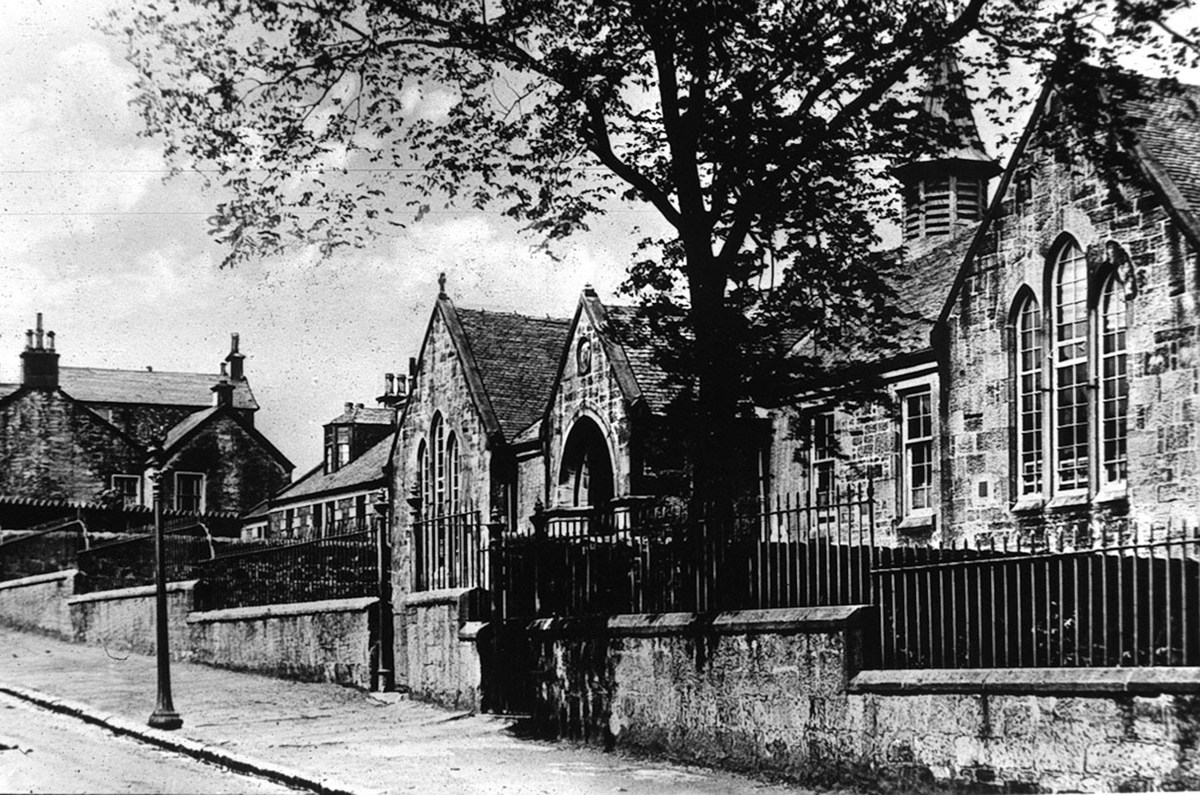
(SMR 1103 / NS 8530 7300)
Upon talking up office in 1873 the members of the Slamannan School Board set about upgrading and replacing the existing portfolio of school properties. It investigated the advantages and disadvantages of extending the buildings that it had inherited from the Parochial School in the Main Street and wisely decided that it would be better to find a new site. Alexander Watt, architect, Glasgow was asked to provide plans for schools at Slamannan and Avonbridge and produced broadly similar designs for the two sites. In November 1874 tenders were invited:
“To Builders, Joiners, & c. Slamannan School Board. Estimates wanted for the MASON, JOINER. PLASTER, SLATER, PLUMBER, and GASFITTER WORKS of Two proposed NEW SCHOOLS and TEACHERS’ HOUSES, viz.,
- Slamannan,
- Limerigg,
Each to accommodate about 300 Children. Plans and Specifications to be seen and Schedules of Measurement obtained (2/6 each) from Mr Alexander Watt, Architect, 67 Renfield Street, Glasgow…” (Falkirk Herald 14 November 1874).
The school opened at the west end of the village on 11 September 1876. It consisted of a principal school room, 64ft long by 26ft broad, which could be converted into two rooms by a folding door. At each end of this room was a class room, 16ft by 18ft, and a retiring room for the teachers, while at the back was an infant class room 24ft square. The whole building, as also schoolmaster’s house, outhouses, walls, and so on, cost around £2,500. As the school was designed to accommodate 350 pupils this represented a rate of £7 7s per scholar. The building was relatively plain, thus keeping costs down, but its substantial character reflected civic pride. The staff at the time of the opening consisted of Mr Horne (head teacher), Miss Hutchison (female teacher), an assistant, and three pupil teachers.
A problem was discovered with the cleaning of the school in that there was no source of hot water. So, in 1877 it was agreed that boilers were to be erected in the sculleries of the adjacent teachers’ houses so that they could be used for this purpose.
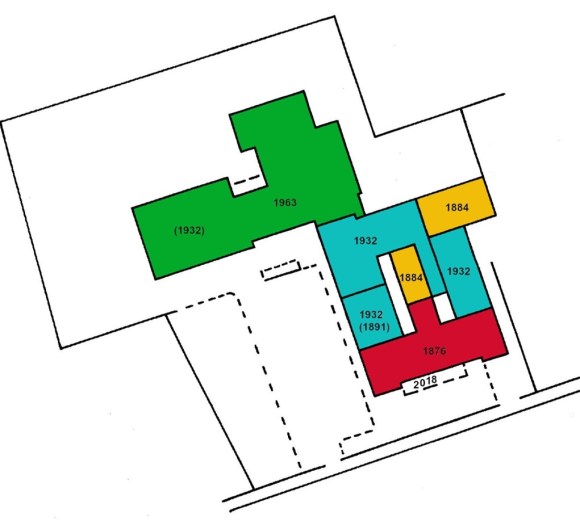
School numbers rose rapidly and in 1880 a small extension was put onto the north end of the infant department, the work being executed by John Main, joiner in Slamannan. The following year the school was designated as the place for higher education within the parish. Further additions were made in 1884. Details are hazy but it appears that a new separate infant block was built to the northeast and the old rooms that it had occupied were converted into primary classrooms.
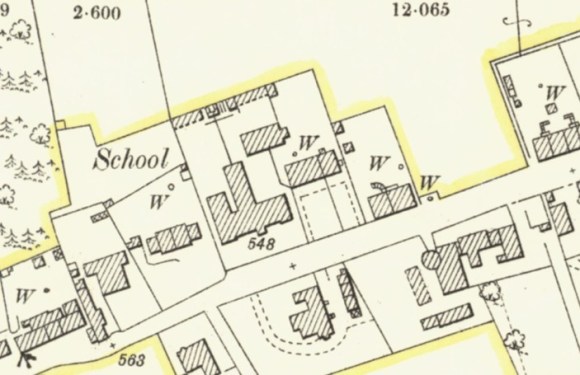
Early on the morning of 23 December 1891 fire broke out in the lately erected addition to the infant department. Before assistance could be procured the building was so enveloped in flames that any attempt to extinguish it was to no avail. Instead, efforts were directed to save the main school buildings and schoolmaster’s houses adjacent. The cause of the fire was attributed to the overheating of the stove. The damage was estimated at £500. It was rebuilt.
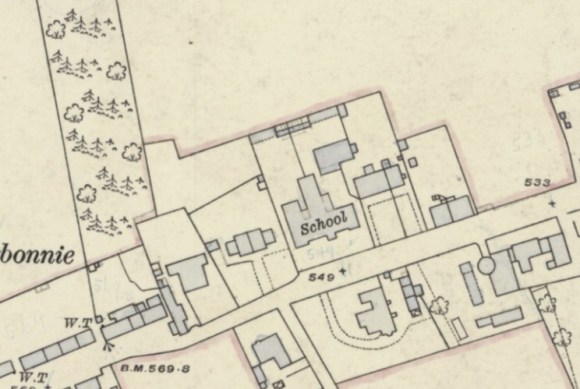
Minor alterations were carried out to Slamannan School in 1901 by the following contractors: mason and joiner works – Mr Forrester; plasterer and slater works – Mr Gillespie; plumber work – Wallace & Connell. James Strang was now the architect employed by the Board.
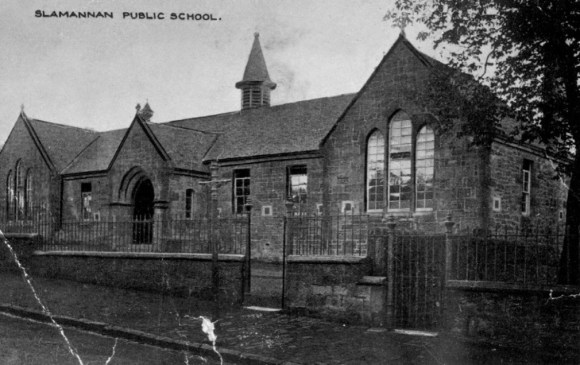
Over the following decades the provision of education in the parish changed. In 1903 supplementary classes were begun and in 1925 Rosemount School closed to infants and the pupils were moved to the Slamannan Public School.
As the school age was increased so to the accommodation at Slamannan had to be increased to provide for a two years’ advanced course.
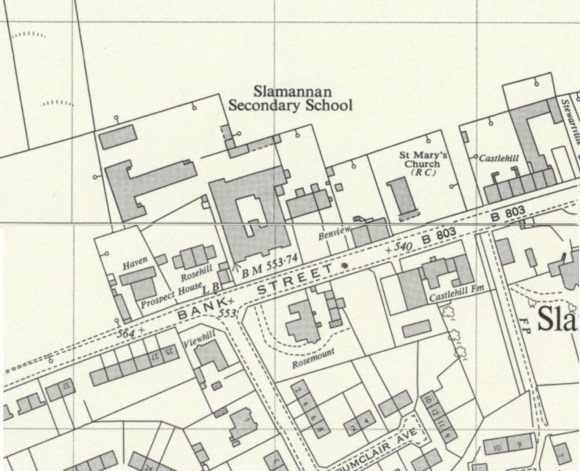
In 1927 A. N. Malcolm, the Stirling County architect, visited Slamannan School and he was asked to prepare additional accommodation so as to give eight classrooms instead of the seven then available, with the necessary staffroom and cloakroom accommodation, and for the erection on adjoining ground to the west of the playground of an addition consisting of two classrooms for 40 pupils each, one science room, one cookery and woodwork room, a hall, and a cloakroom and staffroom. The new building was estimated to cost £4,800 and was to be constructed before the alterations which were to cost £10,000 more. The location of the hall was swapped so that it came under the later scheme. The first phase, the new build in roughcast brick for the advanced division, was completed in March 1931 and shortly thereafter work began on the second phase. The walls of the old school were left as a frame but the interior was gutted and rebuilt for use of primary pupils. The large central porch on the street frontage was removed and the datestone transferred to the west gablet. A new datestone of 1932 was inserted into the east gablet. It was probably at this time that the arched windows were reduced in height and flat lintels inserted. New classrooms were added to the north of the old ones forming a central quadrangle. The reconstruction and addition to Slamannan School formally opened on 13 September 1932. Altogether the school provided accommodation for 600 pupils.
A circulating library for the village had been opened in the school in 1926 but by 1945 it had closed. Attempts to re-open it seem to have been unsuccessful. However, gym equipment, in the form of eight climbing ropes, 24 sets of wall bars, and one set of balance beams, was provided in 1949. The gymnasium was said to be a very good structure. A few years later, in 1953, machine tools were put in place for metalworking classes as part of the boys’ secondary department. That same year, part of the ground reserved for the erection of a school meals kitchen and dining hall was utilised as a school garden for instructional purposes. In 1955 it was decided that the junior secondary department of Slamannan School would be discontinued.
A disastrous fire in the mid-1960s destroyed the new western block. It was replaced by a two-storey steel-framed building which was joined to the north-west corner of the old block. This point of junction is now the main entrance of the school.
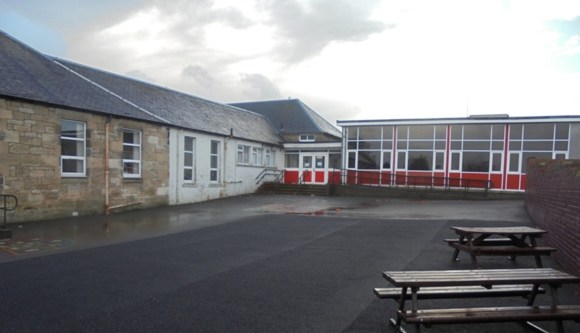
A large assembly hall was erected to the north of the entrance with its east wall composed of large glass panels. The private dwelling to the west of the old block, Rosehill Cottage, was acquired and demolished to make way for a hard-surface playground which subsequently became a car park. These major improvements were ready for the start of the new term in August 1968. The architect was AJ Smith, Malcolm’s successor.
| DATE ARRIVED | HEADTEACHER | DATE LEFT | ROLL |
|---|---|---|---|
| 1873 | Robert Horne | 1903 | 278-409-454 |
| 1922 | Mr A G Abbie | 1932 | |
| 1932 | John Miller | 1936 | |
| 1936 | Thomas McEwan | 1939 | |
| 1939 | George Watt | 1943 | |
| 1943 | John B Thomson | 1952 | |
| 1952 | David Cousin | ||
| Lorna Hart | Present |
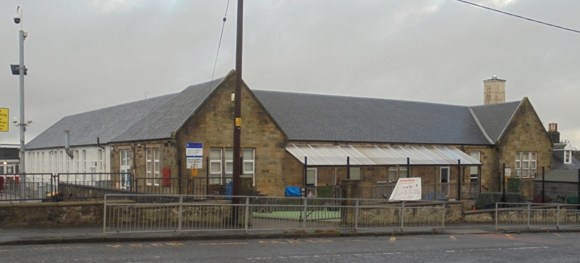
In 2018 Heathrigg Nursery, just three doors down the road, was incorporated into the school. This involved alterations to the internal divisions of the three classrooms in the wing facing the road. Doors were slapped out of the front to give access to a new wooden veranda which acted as a transition to the enclosed playground bestrewn with play features. This work was overseen by the Hadden Group.
Bibliography
| Waugh, J | 1977 | Slamannan Parish through the Changing Years. (Quoted below) |
| Bailey, G.B. et al | 1987 | Slamannan and Limerigg: Times to Remember; p.45. |
“By 1849 it was decided that a new school be built on the lands of Castlehill belonging to Mr. Andrew Rankin. Mr. Rankin was to take over the old school building at valuation. The cost of the new school was not to exceed £260 plus the price of the old building. The site chosen was the one that was later occupied by the Free Schools, later called Rosemount School. At a meeting of the Heritors on 29th September, 1849, it was decided to move to a new site but to keep the existing building as the schoolmaster’s house and as offices, and feu from Mr. Rankin the piece of land immediately to the south of it and erect a school there. Mr. Rankin agreed to a new Feu Disposition to include both the old and the new feus. This was approved by the Heritors who appointed Messrs. George Waddell, Balquhatston, John Waugh, North Arnloss, and William Russell, Easter Greenhill as trustees to see that the work was carried out. The new school was built and the old building renovated. That school building was still in use when the newly appointed Slamannan School Board became responsible for education in the parish in March, 1873, as the result of the Education (Scotland) Act, 1872. The schoolmaster, at the change over from Parish School to Public School under the School Board, was Mr. Robert Horne who continued as schoolmaster till he retired in 1903. List of headmasters… As already mentioned the Education (Scotland) Act was passed in 1872 and by that Act school boards were set up in every parish or burgh. The number varied from 5 to 15. The Slamannan Board was to have seven members. At a meeting held on the 7th March, 1873, the first Slamannan School Board was appointed. Twelve names had been put forward but before the time for voting there were only seven names, the number allowed by this Act. No election was therefore necessary. The seven members of the first Board were… The new School Board was enthusiastic and took its work seriously. Soon after the election it called on Mr. Watt, architect, to submit plans for an extension to the school at a probable cost of £600. At a meeting held on 9th October, 1873 the School board considered the question of whether to go on with the extension to the existing school or to build a new one. After a lengthy discussion it was agreed that they should sell both of the buildings that had belonged to the old Parish School and look for a suitable site for the new school for Slamannan. The site chosen was the one where the present school is situated. “The Slate House”, as it had been called, and the school built in 1849 were advertised in the “Falkirk Herald”, and soon afterwards was sold. “The Slate House”, which was the first school and schoolmaster’s house, was for many years the property of the McAlpines, but it has now been demolished. It was an 18th century building similar to the restored 18th century houses at Culross. The newer part, built in 1849, was bought by the Orangemen for a hall. For many years before it was demolished it was a workshop. The plan for the new school was made by Mr. Watt, architect. It was to have a principal room which could be converted into two rooms by a folding door. At each end of that principal room there was a classroom and a retiring room for the teachers. At the back were the infant rooms. The school, schoolmaster’s house, outhouses, walls etc. were built at a total cost of £2,500. The school was built to accommodate 150 pupils. It was officially opened on Monday, 11th September, 1876. The headmaster was Mr. Robert Horne. His staff at that time was a lady teacher, an assistant and three pupil teachers. The number of pupils on the Roll was 220. By September of the following year two male teachers were added to the staff. In 1880 additions to the infant rooms were made. Repairs and alterations to the school were carried through in 1912 to bring it up to date. Early in 1928 it was proposed to reconstruct the school. On 13th September, 1932, the reconstructed school was opened. The new part of it, erected on the ground adjoining the playground, consisted of 4 classrooms, a cookery room, a technical room, staff rooms and cloak rooms. In the reconstructed building, which took the… By early 1894 the Free Church School came under the control of the Slamannan School Board with the consent of the Scottish Education Department. The school was still to remain in the hands of Mr. Thomson, its head-teacher, and his staff. The school name was changed to Rosemount Public School. One of the reasons for the takeover was because there were a number of children attending the school for which the parish was receiving no benefit in the way of grants. In March, 1901, Mr. Thomson retired after 18 years at Rosemount School and it is a matter of interest to me that my mother, a pupil….. In July, 1910, the School Board decided that Rosemount would be a Supplementary School only. In 1924 Rosemount Supplementary School and Slamannan Public School were united though both buildings continued to be used until the opening of the reconstructed school in 1932. The Old Public School was the Primary Department and Rosemount School was the Advanced Division. The two schools were united under Mr. A.G. Abbie, M.A., Headteacher, and Mr. Leslie, after nearly 25 years at Rosemount, was transferred to Avonbridge.”
 Falkirk Local History Society