
SMR 512 / NS 8565 7308
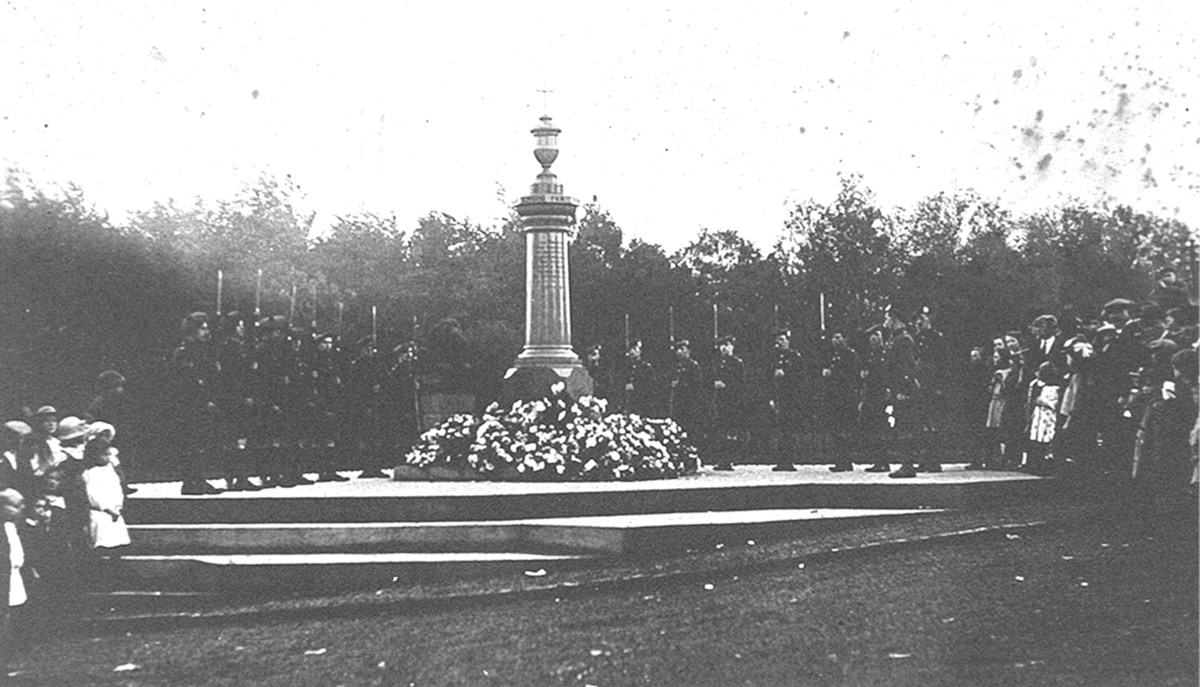
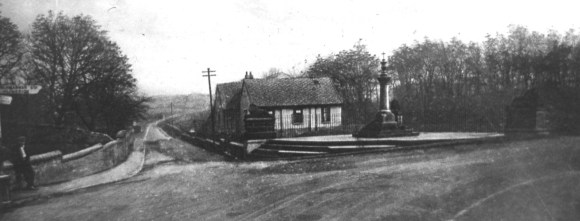
During the Great War many of the young men from Slamannan served abroad with the armed services and a large number did not return. 52 of these are named on the war memorial built on the corner of Station Road and Avonbridge Road and unveiled on 15 October 1921 in the presence of nearly 3,000 people. It was unveiled by Mrs Mitchell on Sunday 9th October 1921 and dedicated by Rev Allan Reid.
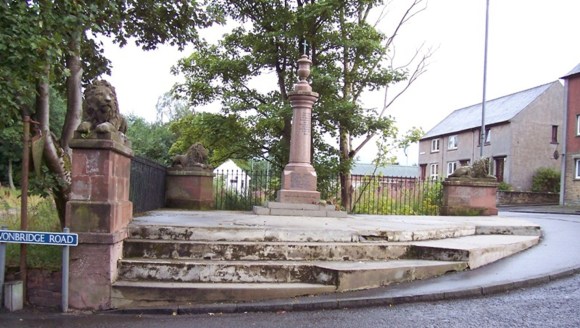
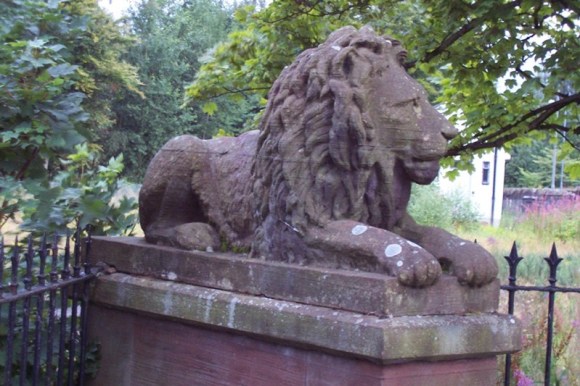
It consists of a platform of concrete rising in four tiers or steps, with a red sandstone pedestal at each corner supporting crouching lions. In the centre is a polished pink granite column with the inscription “This monument was erected by the inhabitants of Slamannan, Limerigg and district in grateful memory of the men who made the supreme sacrifice in the Great War, 1914-1919”. It is placed on a square base bearing the names of the fallen on each side, the whole surmounted by a hexagonal collar and an urn supporting a cross of gilded bronze. The collar carries the words “Their names liveth for ever more”.
The monument was repaired and restored in 1949, and the names of the dead from the Second World War added. The Second World War plaque was unveiled by Major George Wilson on Sunday 9th October 1949, the rededication ceremony performed by Rev Alexander Cameron.
Names of the fallen:
First World War: 52 men.
John Aitken, Martin Aitken, Andrew Allen, Harry Baxter, William Baxter, John Bell,
David Black, Robert Blair, Henry Brodie, John Brown, Robert Buchanan, James Calder, Patrick Cairney, Malcolm J Campbell, Wm Dickson, Robert Dunlop, Abraham Erskine,
Joseph Finlay, John Fyfe, James Gray, Peter Gentleman, John Hamilton, Thomas Hunter, James A Johnston, Charles Laing, George Love, John Lundie, Archibald Mackie,
Charles Mason, John A Meek, William B Nimmo, John Murphy, Thomas McAllister,
George McCracken, Robert McKay, James F McKean, John McKean, Andrew McLaughlin, Norman McLeod, David McMurdo, Alex McComb, David A Purves, Thomas E Richards,
David Rintoul, James Russell, William Y Stevenson, Alex Stevenson, J R Stronach, Wm Smith, James Tripney, Jack Waugh, Wm Wright, Andrew Wyseman.
Second World War: 11 men.
Robert Aitken, William S. Allan,
Edward H Barker, John Black,
James Johnstone, David M. McN. Miller, David Leith, Michael McAndrew,
James Robertson, Archibald G. Stevenson,
James G. S. West.
Gulf War: Garry Lennox
Bibliography
| Geoff Bailey | 1994 | Battle Monuments and War Memorials. Calatria p.56-57 |
| Geoff Bailey | 1987 | Slamannan and Limerigg: Times to Remember, p.56. |
| Jaques, R. | 2001 | Falkirk and District: an illustrated guide “War Memorial, 1921 and 1949 Three noble and bewhiskered sandstone lions guard a quiet corner of High Street containing polished pink marble memorial to First and Second World Wars against leafy background.” [p.110] |
| The Falkirk Herald | 1921 | 15 October (Quoted below) “SLAMANNAN WAR MEMORIAL. UNVEILING OF MONUMENT TO THE FALLEN. |
Falkirk Herald 15 October 1921
“SLAMANNAN WAR MEMORIAL. UNVEILING OF MONUMENT TO THE FALLEN. Memorable and Impressive Ceremonial. Probably no more fitting tribute to the memory of the departed heroes of the Great War exists in any community in Scotland to-day than the memorial which was unveiled by Mrs. T. Mitchell – formerly of Slamannan, and now of Viewbank, Airdrie – at Slamannan last Sunday afternoon. The residents of the village and district were amongst the first to recognise the need for some permanent token of public gratitude to the men who made the supreme sacrifice, and of the fact that their feelings have taken so appropriate an expression they may be justifiably proud.
THE MEMORIAL. Occupying a place of honour at the crossroads of the village, and thrown into fine relief against a background of trees, the memorial is an imposing example of the sculptors’ art. The foundation takes the form of a triangular platform of concrete, which rises in four tiers of steps. At each corner of the triangle is mounted a red sandstone pedestal with a crouching lion, while in the centre of the platform stands a polished red granite monument which is beautiful both in conception and execution. The base is square in shape, and on each of the four sides are inscribed the names of the fallen. The upper part of the monument is column-shaped and supports an urn, which is in turn surmounted by a small cross of gilded bronze. The scene at the unveiling ceremony last Sunday afternoon was indeed a memorable one, the proceedings being witnessed by a gathering of over three thousand people. The weather conditions were altogether favourable to the event, the heat of a strong sun being relieved by an almost summerlike breeze. During the assembling of the audience the band of the 1st Highland Light Infantry, from Redford Barracks, under the conductorship of Bandmaster Maurice W. Geoghegan, rendered music appropriate to the occasion, and a firing party of 7th Argyll and Sutherland Highlanders from Falkirk, under Sergeant Major Cunningham, took up their position with arms reversed, at the rear of the memorial….
A SILENT YET SPEAKING WITNESS. The gathering was thereafter addressed by the Chairman, who stated that they had assembled there that day to do homage to the memory of the men of their own village who fell in the Great War. More than four hundred men belonging to the parish had endured its perils, and a sad proportion – whose names would afterwards be cited- were not fated to return. The proposal to erect some permanent memorial to their own dead heroes was one which won from the first the warmest sympathy and support. There were many, indeed, to whom the achieving of this object had been accepted as a sacred charge. It was still in the early stages of the war, when the dread toll it was to exact of their bravest and best, had been scarcely realised, that one of their number, remarking that the men could not all come back, devoted her gifts to initiating the first contributions to a memorial fund. When a meeting came to be held in May two years ago, and the resolution was made to proceed with the erection of a monument, a considerable part of the necessary means had already been secured. The memorial, therefore, was an offering in the making of which the whole community had borne a willing part, and it was in the fullest sense a public token of their abiding love and gratitude. To all friends who had helped in the completion of their design they desired to express their sincerest obligatures, and he would fail in his duty did he not mention how much indebted they were to the kindness of Mrs. Peddie Waddell for the free grant of the site on which the memorial was raised – a site than which a more suitable could not have been found. However poor and inadequate must be the best tribute they could pay to their gallant brothers, they could not but feel it a real satisfaction to have been granted an opportunity of rearing a symbol so enduring and so impressive of the undying debt they owed to them – of perpetuating the remembrance of their names and their service and their sacrifice. The names of those men could not have been inscribed upon these tablets of stone had not their thankful sense of all that they were and all that they owed to them been still more deeply engraven upon their hearts. God grant that these very stones might speak to the rising manhood of this place and parish to incite it to a similar unselfish devotion and similar noble deeds, and be a silent yet speaking witness – amid all the changes that might await their people – to the great fact that these dear dead comrades of the fight had not died in vain.
THE ROLL OF HONOUR. On the call of the Chairman, the roll of honour – comprising the names of 52 men of the parish who made the supreme sacrifice – was read by Mr. John Doig, hon. secretary of the War Memorial Committee. The names of the fallen are as under: Martin Aitken, John Aitken, Andrew Allen, Harry Baxter, William Baxter, John Bell, David Black, Robert Blair, Henry Brodie, John Brown, Robert Buchanan, James Calder, Patrick Cairney, Malcolm J. Campbell, Wm. Dickson, Robert Dunlop, Abraham Erskine, Joseph Finlay, John Fyfe, James Gray, Peter Gentleman, John Hamilton, Thomas Hunter, James A. Johnston, Charles Laing, George Love, John Lundie, Archibald Mackie, Charles Mason, John A. Meek, William B. Nimmo, John Murphy, Thomas McAllister, George McCracken, Robert McKay, James F. McKean, John McKean, Andrew McLaughlin, Norman McLeod, David McMurdo, Alex. McComb, David A. Purves, Thomas Richards, David Rintoul, James Russell, William Y. Stevenson, Alex. Stevenson, J.R. Stronach, Wm. Smith, James Tripney, Jack Waugh and Wm. Wright.
UNVEILING CEREMONY. Following prayer and the singing by the gathering of the hymn “Now the labourer’s task is o’er.” The Rev. Mr. Reid called upon Mrs. Mitchell to perform the ceremony of unveiling the memorial…. Mrs Mitchell thereafter reverently unveiled the memorial by drawing aside the Union Jack, with which it was draped.
DEDICATION OF THE MEMORIAL. Thereafter the memorial was dedicated by the Chairman, who stated that to the glory of God and the perpetual memory of their brave brothers, who freely gave their lives in their defence, the memorial was dedicated in the name of the Father, and of the Son, and of the Holy Ghost. The party of Argyll and Sutherland Highlanders then fired three volleys over the memorial, the mournful strains of the lament being meantime played on the pipes by L-Cpl W. Walker. During this impressive part of the proceedings the whole of the gathering stood at attention, and heads were reverently bared. The lament was followed by “The Last Post,” sounded on the bugle by Bugler J. Jones… During the singing of the hymn, wreaths were placed at the base of the monument by relatives of the fallen and representatives of various bodies. The first floral tribute was that of the War Memorial Committee, this being followed by other wreaths from Mrs. Peddie-Waddell, the Slamannan churches’ Women’s Guild, the Jawcraig Coal Company, the Comrades of the Great War, the Slamannan school teachers, and the local Co-operative Society. Practically every bereaved household was also represented in the profusion of autumn flowers which surrounded the monument. Despite the solemnity of the occasion, and the poignant chord which the proceedings must have struck in the hearts of many of those present, the spectacle at the cross roads was indeed a beautiful and inspiring one. Strongly silhouetted against a background of charming rural scenery, and towering proudly above the dense throng, the monument, with its gilded cross scintillating in the autumn sun, seemed to possess a real spiritual significance….”
 Falkirk Local History Society