
SMR 1436 / NS 8559 7332
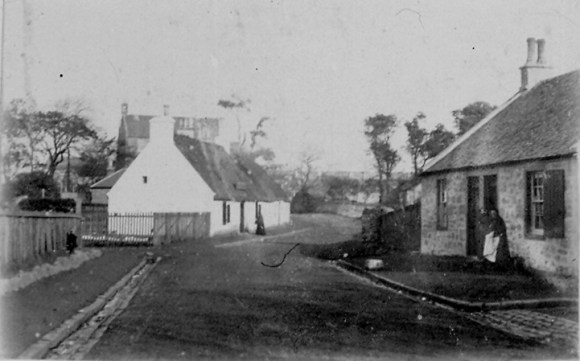
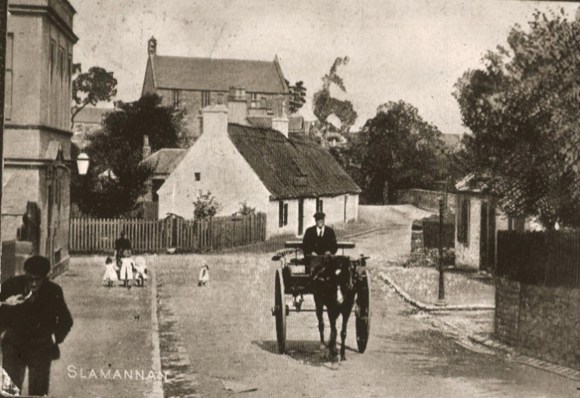
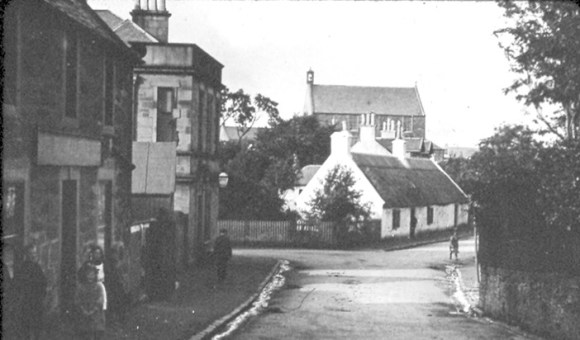
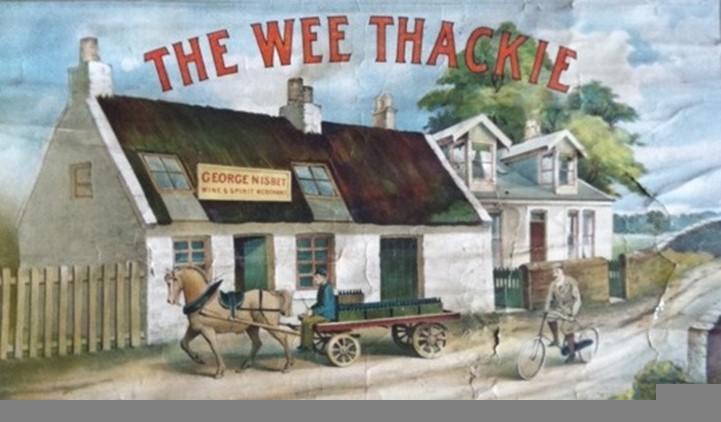
A little to the north of Clerkshall was a long low building with whitewashed stone walls and a thatched roof. For this latter reason it was known locally as the “Thackie.” From a very early date it served as a hostelry – one of only three in the entire parish in 1795. It was just south of the bridge over the Kirk Burn and for that reason the proper name of the building was the “Bridgend Inn.”
There was a prominent chimney on the south gable and the disposition of windows and doors show that this end of the building was the living accommodation and public house. The northern end of the building was almost devoid of windows suggesting that it was used for cattle and subsequently for stores.
It was the last building in the village to retain the thatch but in 1910 the thatch was replaced with corrugated iron. It is said that the roof burnt down when a passing traction engine produced sparks from its funnel.
Christina Fleming or Nisbet was the publican in 1904; and Alexander Fraser in 1910. Shortly thereafter it appears to have been converted into a shop with “with 2 Rooms and Kitchen House Downstairs and 2 Rooms Upstairs” (Falkirk Herald 19 February 1927, 2); and at one time firelighters were made there.
The building was demolished by the Council in May 1966 in preparation for a road widening scheme in connection with the new bridge over the Culloch Burn.
Bibliography
| Waugh, J. | 1977 | Slamannan Parish through the Changing Years. |
| The Old Statistical Account | 1795 | Records – quoted below |
| The Falkirk Herald | Various dates – quoted below |
The Old Statistical Account of 1795 records…
there were three public houses in the parish. The oldest was the Bridgend Inn, popularly called “The Auld Thackie”. Another of those old hostelries was at Dykehead, but the third I have been unable to place. In those days, with no villages in the area, the local tavern would be the likely place for the people to meet each other and to discuss farming prospects and other matters. The position of the “Auld Thackie”, near the church with its few houses, would make it one of some importance. It was so old that it probably had its beginning away back in the Middle Ages when the Castle or Motte was still a centre of activity. It was called “The Thackie” because it had always had a thatched roof until 1910 when part of it was replaced by corrugated iron. By that time no other house in the village was even partially thatched. Very few, if any, remained after Mr. Charles McLean’s thatched house was burned down in July, 1885. “The Auld Thackie” lost its old world atmosphere and quaintness when the corrugated iron partly took the place of thatch. The old inn had gained a certain amount of notoriety at the time of the Fannyside Loch Murder which took place on Saturday, 31st January, 1880. Interest in the case was raised by the question whether it was possible for Tam Anderson to leave his farm at Langdales, Greengairs, at 6.45 p.m., murder Jean Lindsay, put her body in the lint hole near Fannyside Loch, travel by Fannyside Toll and Threaprigg in his pony and trap, reach the old hostelry, “The Thackie”, and be ready to sit down and eat and drink by 7.40 p.m.The jury could not reach a decision, so a verdict of “not proven” was passed. In 1917 the Auld Thackie had lost its licence, and applications to have it renewed failed. I remember about 1921 when our farm house at Arnloss still had a thatched roof, we had an old thatcher called Willie Wilson, nicknamed “Canty Will” from the name of the croft where he lived near Armadale. He was fond of his dram and in the evening when his work was done, he walked the two and a half miles to the village to have his usual at the the “Thackie”, but he did not know it had become a fish and chip shop. He was a bit annoyed at not being told. in June, 1930, the old familiar landmark was destroyed. In March, 1955, it was demolished, and by May, 1961, the last traces of the old tavern had gone. The local poet, James Brown, born at Todsbughts on 5th December, 1861, and who died at Holmbank, Dennyloanhead on 22nd September, 1911, had a book published called “Songs and Poems”. Amongst them there was one called “The Thackie”. from which the following few lines are taken: “There’s an auld fashioned hoose at the fit o’ oor toon, Wi’ riggin o’ thack that is worn an’ broon; And its kent to the droughts for miles a’ aroon, And its kent by the name o’ the Thackie.” He ends his poem with these words: “Whit wid become o’ the Slamannan guid folk, If they shut up the doors o’ the “Thackie””. One wonders what answer he gave to his own question when the doors of the “Thackie” were closed for the last time. [p,18/19]
- Falkirk Herald 25 June 1904, 5:
- Christina Fleming or Nisbet, publican, residing at Bridgend, Slamannan, who holds a certificate for the sale of intoxicating liquors within the public-house known as the “Ween Thackie,” Bridgened, Slamannan, occupied by her, granted in terms of, or under the provisions of the Licensing (Scotland) Act, 1903, was charged with having permitted and suffered drinking therein after 10 o’clock at night…
- Falkirk Herald 17 September 1910, 7:
- THE “WEE THACKIE” VALUATION. Alex. Fraser, publican, Slamannan, appealed against the valuation of the “Wee Thackie” public-house there being fixed at £45. Mr Middleton appeared, and suggested a valuation of £35. The house was a very old one; its licence duty had been increased by £3 0s 2d, and the consumption of spirits had gone down 198 gallons for last year… agreed on £40.
- Falkirk Herald 19 February 1927, 2:
- For sale or to Let, Bridgened House, Slamannan; 5 rooms and kitchen, scullery, Bathroom; Hot and Cold Water throughout. Also SHOP PROPERTY, with 2 Rooms and Kitchen House Downstairs and 2 Rooms Upstairs (Thackie). Entry at Whitsunday, 1927, For further particulars apply to Messrs STEW ART & BENNETT, Solicitors, Dunoon.
- Falkirk Herald 3 February 1934, 8:
- It will also interest you to know the alterations to the old Thackie Brig ’ been completed. The bridge has widened several feet, and new wall, but sturdy, erected. This is surmounted by a railing which…
 Falkirk Local History Society