
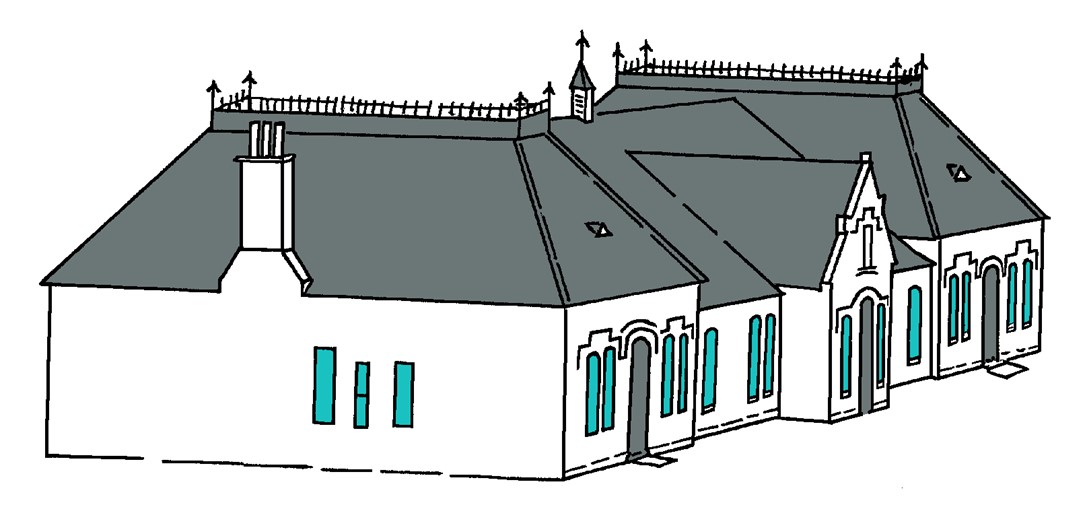
Drill halls in British towns originated as a building type following the formation of the Rifle Volunteer Corps in 1859. Initially the various corps rented accommodation for their meetings, but these were not always available or large enough to meet their requirements. Also known as ‘drill sheds’, the purpose-built halls were dedicated training facilities for the army’s volunteer units allowing drill to be conducted in the dry, lectures to be delivered and prizes to be awarded for marksmanship. They provided a secure store or armoury for the unit’s weapons. Initially they were accompanied by an outdoor rifle range which could be at some distance from the hall, but latterly miniature indoor rifle ranges were incorporated.
It is often said that the force that arose in the early 1860s was the most voluntary of all volunteer armies and each member had to pay for his own equipment. The same was true of the drill halls which were funded by benefactors or by public subscription with the local corps’ commanders taking a leading role. Fundraising events such as fêtes and bazaars were essential. With the 1881 reforms, a capitation payment was received from the government by each volunteer corps and it was specifically stipulated that this should not be spent on the halls – though creative accounting meant that in truth some of the money was diverted. These Cardwell reforms of the Army meant that the Rifle Volunteers were formed into Volunteer Battalions of the county regiments to which they were affiliated which in our area were the Argyll and Sutherland Highlanders and the Royal Scots.
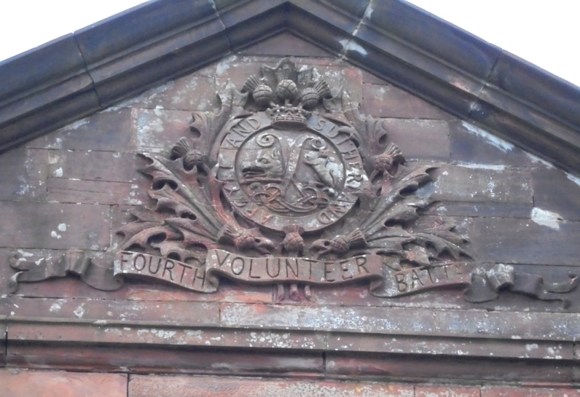
The early drill halls consisted of a large shed or hall with offices and stores at one or both ends, as exemplified at Stenhousemuir and Bo’ness. The frontages were generally low single storey structures of relatively plain design to keep costs down. Later, a common format arose with the administrative block and entrance facing the main road and the hall placed behind it at right angles. The façade was now of two-storeys and often incorporated the regimental device. Falkirk is a good example of this type of layout. This block contained separate offices for the commissioned and non-commissioned officers, the treasurer, a store, lecture room, and conveniences on the ground floor, with accommodation for the drill-sergeant or janitor on the first floor.
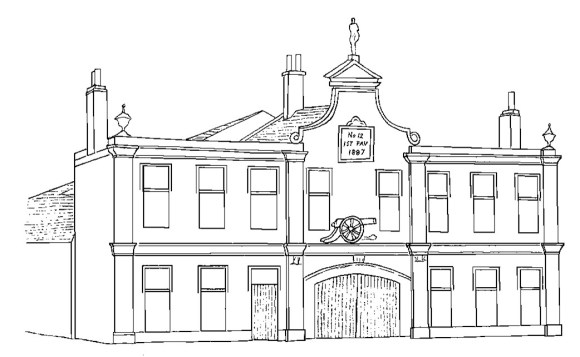
As each drill hall was designed by locally based architects who had to reflect the tastes and pockets of their clients, as well as the restrictions imposed by the sites, the halls are quite individual. At Grangemouth the hall was built for an artillery unit and consequently the main entrance was large enough to allow the gun carriages and wagons to pass through it. That entrance was surmounted by the large stone carved figure of a wheeled cannon in low relief.
In the period from 1890 up to the First World War most of the newly built schools in the Falkirk area included “drill halls” for the children to assemble, undertake fitness exercises and military style drill.
The disbandment of the Volunteers under the Haldane reforms in 1908 led to the formation of the Territorial Force. County Territorial Associations were established to provide the administrative support for the units in their area. That for Stirlingshire was naturally based in Stirling. Most drill halls were transferred to the new organisation, though not a few were in private hands and remained so.
The disbandment of the Volunteers under the Haldane reforms in 1908 led to the formation of the Territorial Force. County Territorial Associations were established to provide the administrative support for the units in their area. That for Stirlingshire was naturally based in Stirling. Most drill halls were transferred to the new organisation, though not a few were in private hands and remained so. Some units were threatened with closure and the Grangemouth Volunteers felt so bitter about the predicted disbandment of their unit that a declaration was placed in the feu contract between the Grangemouth Traders Building Co Ltd and the trustees for behoof of No 12 Battery First Fife Artillery Volunteer Corps whereby, in certain circumstances, the drill hall fell to be conveyed to the Grangemouth Commissioners of Police for the benefit of the public. A review of the properties was conducted by the County Associations and in many cases outlying rural venues were closed. In Stenhousemuir the drill hall which had passed into private hands was bought back. New halls were constructed in some of the growing industrial villages such as Bonnybridge in 1913. The newly built halls were generally stripped down to the bare essentials and so at Bonnybridge it took the form of a corrugated shed.
Change was always viewed with suspicion and the 1908 restructuring was not welcomed on the ground. This report from the Falkirk Herald was typical:
“Amalgamation of Stirlingshire and Clackmannanshire Battalions. The amalgamation is regarded both by the officers and men of the Stirlingshire Battalion with feelings of strong disapproval. It is felt to be a slight to the county that the battalion, which it has for so many years maintained without outside assistance, should now be broken up. If the change is carried out, the associations connected with the county volunteer force, which have produced a valuable esprit de corps, will be destroyed, and so serious will be the check to the patriotic feelings of their young men that it is doubted whether even the greatly diminished number of men required for the half battalion to be furnished by Stirlingshire will be obtained…
The case of Falkirk may be referred to as illustrating the evil of the large reduction of men. At present it has three companies; under the full battalion scheme it would continue to have at least two; but with only half a battalion for the county it could probably only have one. A drill hall was provided some years ago, which easily meets the requirements of the three companies, but the burden of debt secured on it (£700 at 3 ¼ per cent – out of a total cost of £3,000, the balance of which was raised by local effort), together with the cost of upkeep, about £40 in all, would far exceed the sum that could be allowed from the grant of a single company…”
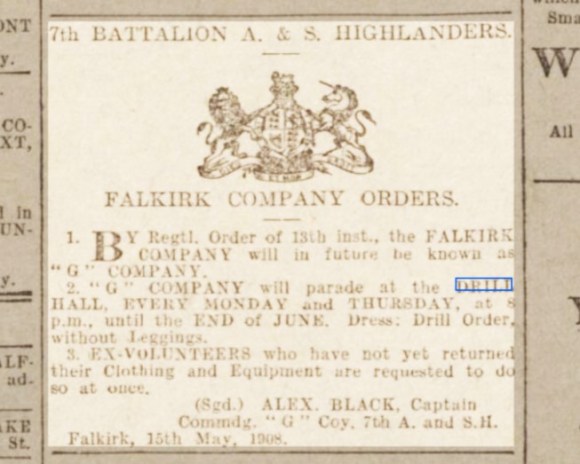
The members of C, D, and F Companies of the former Volunteers paraded in the Falkirk Drill Hall in April to have the conditions of service in the new Territorial Force explained to the men. Only one company in the town was to be attached to the 7th Battalion Argyll and Sutherland Highlanders, and for this only 120 men were required. Despite all the dire warnings, about 200 men intimated their willingness to enlist in the local company.
It took many years but eventually the new Territorial Force gained public acceptance as a more professional army. Although it removed much of the influence of the old noble families, the officers still tended to come from businessmen and landowners.
The First World War was just around the corner and as a consequence the drill halls filled with raw recruits, only to empty once the men were transferred to the Continent. Curiously, it was at this time that something approaching the old volunteers was created once more. County Volunteer Regiments were formed to look after home defence. By the end of 1916 Stirlingshire had 600 such men with units at Falkirk and Grangemouth. These protected the Docks at Grangemouth at a time when the Northern barrage was being laid. Arrangements were made for having the Territorial drill halls and rifle ranges put into a satisfactory condition with a view to their being used by the Volunteer Regiment.
| LOCATION | MILITARY UNIT | DATE OF ERECTION | ROUGH COST | HALL SIZE IN FT | DATE OF RELEASE |
|---|---|---|---|---|---|
| Stenhousemuir – Tryst Rd | 12th Stirlingshire (Carron) Rifle Volunteers | 1868 | £400 | Seat 600 | 1923 |
| Bo’ness – Corbiehall | 2nd Linlithgowshire (Bo’ness) Rifle Volunteer Corps | 1877 | £2,000 | Seat 720 | 1922 |
| Grangemouth – Talbot St | 12th (Grangemouth) Company 1st Fife Royal Garrison Artillery Volunteers | 1889 | £1,300 | 85 x 52 | 1957 |
| Falkirk – High Station Rd | C & D Companies 4th Volunteer Battalion 7th Argyll & Sutherland Highlanders | 1899 | £2,300 | 100 x 60 | c1962 |
| Bonnybridge – the Toll | B Company (Bonnybridge Detachment) 7th Argyll & Sutherland Highlanders (Territorial Force) | 1913 | £700 | 60 x 30 | 1960s? |
| Denny – Kirkslap | G (Denny) Company 4th Stirlingshire Volunteers Argyll and Sutherland Highlanders | 1932 | — | 55 x 23 | 1968 |
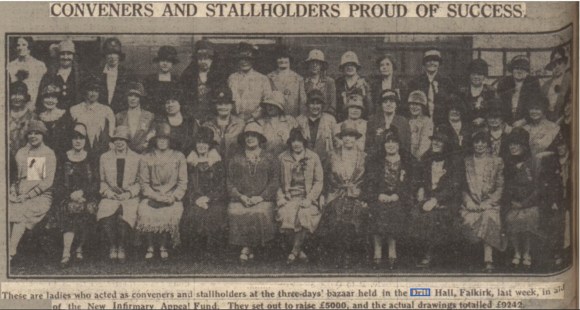
Although primarily a building for military training, the drill hall provided a useful space for other organisations and functions, including fetes and dances, concerts and plays, which provided funds for the upkeep of the hall. They were licensed by the local councils for entertainment. Shows of all kinds were staged in them by local societies – horticultural, agricultural, canine, poultry, art, home, health, cooking, road safety, and the co-co-operative movement to name a few. The halls were ideal for sporting activities such as badminton, gymnastics and boxing – these helped to keep the population fit for military service. The Grange Harriers were based at the Grangemouth Drill Hall and runs usually started in Talbot Street. It was also the “military” training of the youth that led to their use by the Boys’ Brigade, Boy Scouts, Girl Guides, and the Army Cadets. Many of these got to shoot on the miniature rifle ranges and miniature rifle clubs were set up. Exhibitions of military hardware were occasionally staged – with captured German equipment taking pride of place. The Police held annual inspections at Falkirk Drill Hall. The Salvation Army had “permanent” headquarters in the drill halls at Stenhousemuir and Denny. The halls were at the heart of their communities and also held talks, political rallies, elections, and ratepayers’ meetings. Clubs such as the Falkirk Chess Club, and even Falkirk Football Club Supporters Club, met in the Falkirk Drill Hall. Commercial activities were readily accepted as a means of contributing to the upkeep of the premises. These included the sale of second-hand furniture and visits by the early travelling cinematograph companies. Live shows of comedians and singers were common and Harry Lauder even appeared at Stenhousemuir in his early career – apparently performing to an audience of only eleven which included the hall-keeper! The drill hall at Stenhousemuir was ideally situated to take advantage of the Trysts. Temporary banks were installed during these great cattle markets. Many events at the drill halls were one offs, such as the bazaars arranged to raise money for a huge range of good causes including war widows and the Falkirk and District Infirmary. The British Legion had many events in the halls, particularly at Denny where the weekly games of whist became a focal point for the elderly. Many older people have fond memories of social events held in the drill halls of the area. However, poor heating meant that other halls were favoured for smaller events.
| LOCATION | MILITARY UNIT | NOTES |
|---|---|---|
| Alloa | Hall to hold 200 volunteers built 1873. | |
| Bathgate | D (Bathgate Company 10th Battalion Royal Scots (Cyclists) | Opened December 1912 at a cost of £1,700. |
| Broxburn | Built 1911 | |
| Cowie | Territorial Force | Newly built 1910 |
| Cumbernauld | 11th Dumbartonshire Volunteers | Met old parish school until c1875 when a new drill hall erected. |
| Kilsyth | 1st Stirlingshire Rifle Volunteers later 4th VBA and SH | Built c1873 – bought by John Glen c1890. New drill hall erected by Duncan Stewart and Co for the Territorial Association in 1913 for £2,015. Accommodation added 1933. |
| Kirkintilloch | 10th Dumbartonshire Rifle Volunteers | Old church used before 1875. |
| Linlithgow | Built 1910, sold 1922. | |
| West Calder | Built 1911. |
The Territorial Force became the Territorial Army in 1921 and another review of properties took place. It was during this period that the drill hall was built in Kirkslap at Denny. After the Second World War there was a retrenchment and many drill halls were closed and sold off. New central training facilities were provided in Grangemouth and Falkirk to replace the old drill halls and these became known as “T.A. Centres” and are so identified on modern Ordnance Survey maps. The Centre at Central Avenue in Grangemouth opened in 1957 and Falkirk’s centre in the Bog Road in 1961. The Territorial Army in turn was renamed the Army Reserve in 2013.
Inventory of Drill Halls
Sites and Monuments Records
| BO’NESS, Corbiehall | SMR 1484 | NS 9960 8151 |
| BONNYBRIDGE, The Toll | SMR 2317 | NS 8235 8025 |
| DENNY, Kirkslap | SMR 1343 | NS 8146 8274 |
| FALKIRK, High Station Road | SMR 995 | NS 8885 7961 |
| GRANGEMOUTH, Talbot Street | SMR 1627 | NS 9271 8193 |
| STENHOUSEMUIR, Tryst Road | SMR 1694 | NS 8694 8306 |
Bibliography
| Bailey, G.B. | 2008 | Hard as Nails: The Home Guard in Falkirk District. |
| Bailey, G.B. | 2023 | ‘The Grangemouth Volunteers & the Zetland Battery,’ Calatria 37, 151-175. |
| Gillespie, R. | 1868 | Round about Falkirk. |
| Love, J. | 1928 | Highways, Byeways and Biggins of Falkirk. |
| Thomson, J. | 1994 | ‘The Falkirk Volunteers,’ Calatria 6, 77-78. |
| And material from the pages of the Falkirk Herald. |
 Falkirk Local History Society