
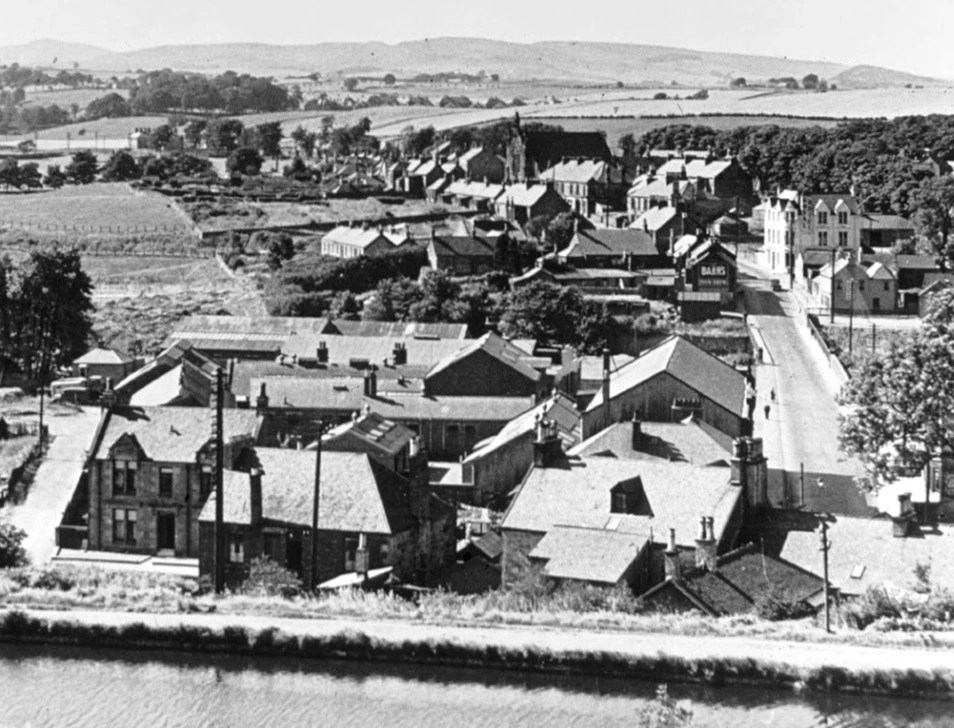
In 1911 the Stirlingshire Territorial Force Association considered a suitable site for a Drill Hall and Armoury for the half-company 7th A & SH (T.F.) at Denny and Bonnybridge with a view to having plans prepared for submission to the War Office. The plans and estimates for a site behind the police station in Bridge Street, Bonnybridge, included an armoury and a sergeant-major’s house and were submitted in March 1912. The site was relatively cheap as it formed part of what was known locally as “the coup.” The estimated cost was £1,270 but this was considered too costly by the War Office. Consequently plans for a brick building was substituted by ones of corrugated iron and that November the War Office gave permission to go ahead with the project. It was September of the following year before the site had been purchased and the architect’s preparations were so far advanced that building work began. The architects were A and W Black of Falkirk. The total cost was only £700. It opened that December and it was perhaps with some sense of irony that the Larbert Territorials noted that “The Territorial Association, who were usually very niggardly, had been very generous this year. They had given them a magnificent new hall at Bonnybridge” (Falkirk Herald 6 December 1913, 6). Despite that the new hall served its function well and outlasted many of the more substantially built ones.
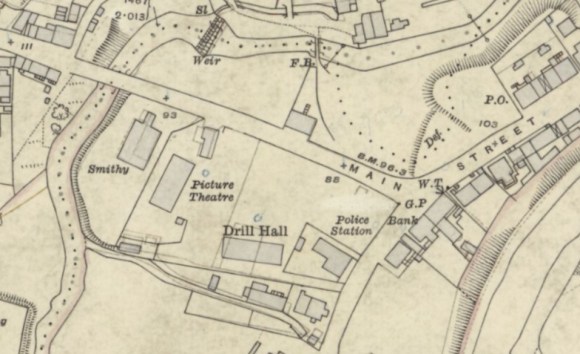
It was a corrugated iron and wood building, 60 feet by 30 feet. Along one side of the hall was to be a miniature rifle range, with a lecture room on the other side. There was also a small armoury and office. The contractors for the work were: foundation and drains – John Gardner, Falkirk; corrugated ironwork –F D Cowieson & Co, Glasgow; plumber work – J T Borland, Falkirk.
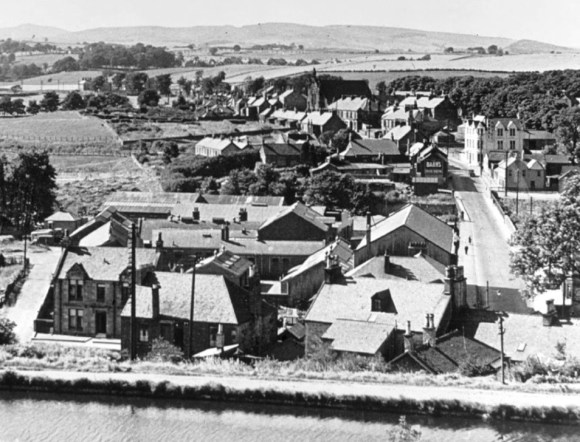
The police station stands in the front left of the photograph with the roof of the drill hall visible above it.
War was just around the corner and in January 1915 the promised miniature rifle range was installed. By that time the Public Hall in the Main Street had been occupied by the Army Service Corps and they were able to benefit from the range and from the use of the drill hall’s recreational facilities. Bonnybridge Drill Hall was also used as a recruiting office during the First World War. It was the home of B Company (Bonnybridge Detachment) of the 7th Argyll and Sutherland Highlanders.
Bonnybridge Drill Hall continued in use between the world wars with the firing range at Greenhill used for rifle shooting. Due to a magnificent response to the recruiting appeal in the spring of 1939, Bonnybridge’s detachment reached a full company’s strength and become “C” Company, 10th Argyll and Sutherland Highlanders. A new drill hall there was authorised to cope with the increased numbers but war intervened before anything was done.
Bonnybridge Drill Hall continued in use between the world wars with the firing range at Greenhill used for rifle shooting. Due to a magnificent response to the recruiting appeal in the spring of 1939, Bonnybridge’s detachment reached a full company’s strength and become “C” Company, 10th Argyll and Sutherland Highlanders. A new drill hall there was authorised to cope with the increased numbers but war intervened before anything was done. During the Second World War it again served to hold soldiers returning from abroad, this time after the debacle at Dunkirk. It acted as a central location providing administration as well as canteen and recreational facilities for men billeted in the area.
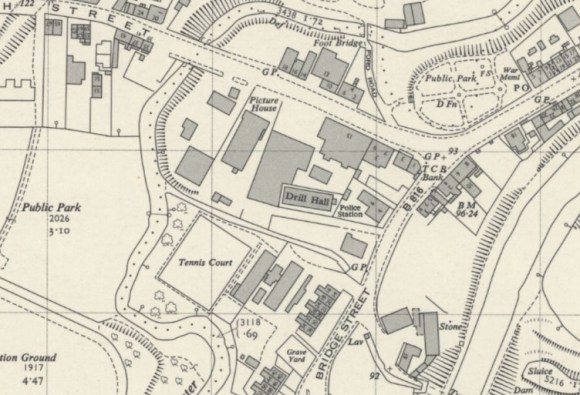
Bonnybridge Drill Hall is still shown on Ordnance Survey maps until 1970 and must have been demolished early that decade. The site is now part of the car park and shop in the small retail park which includes the Tesco Express store.
Sites and Monuments Record
| The Toll | SMR 2317 | NS 8235 8025 |
 Falkirk Local History Society