
In March 1860 the 3rd Company Stirlingshire Rifle Volunteers was formed in Falkirk. A list of the names of the volunteers who were sworn in up to 1870 was published by Love (1928). During suitable weather, drilling took place on the old Glebe to the north of Newmarket Street and in other fields. In inclement weather the Corn Exchange, and later the Town Hall, was pressed into service, but those buildings were not always available and drills had sometimes to be abandoned. Nor were they entirely suitable. Indeed, as time went on the Town Hall became busier and was in constant request for entertainments. In 1896 the auction mart belonging to James Neilson, which stood almost opposite the Town Hall in Newmarket Street, was hired. By then the number of volunteers had grown significantly and with the 1881 reorganisation Falkirk was not only the home for the 3rd Company Stirlingshire Rifle Volunteers, now renamed as C Company Stirlingshire Volunteer Battalion Argyll and Sutherland Highlanders, but also to Companies “D” and “F.” In 1895 C Company was 90 strong and in 1896 101: D company had been 92 and it became 97. This included an ambulance section of 20.
So, in 1896 the Falkirk Volunteers decided that they would raise the money required to erect their own purpose-built drill hall. After discussion it was found that the sum required would be between £1,500 and £2,000 and that the best way to realise this was by holding a grand bazaar over several days. Accordingly that event was arranged for October the following year and canvassing for help and saleable items began. The cause was well supported amongst the local landowners and business community with gifts of valuable furniture and artworks. By the time that the bazaar took place, price inflation had increased the cost of the building to £2,500.
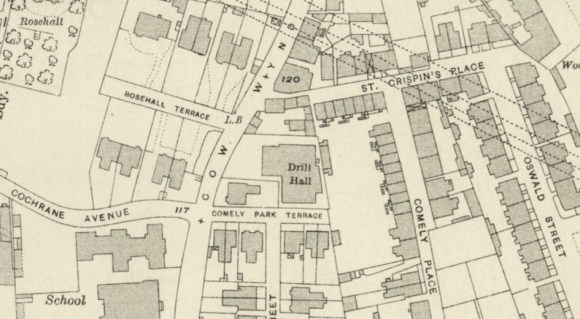
Numerous sites were investigated but it was March 1898 before that in High Station Road came to the fore. Its availability was serendipitous as it had been acquired shortly before by the Linlithgow Free Church Presbytery for building an extension church, but they plumped for a more favourable site in the town for the new church. At that time the High Station Road site was just outside of the urban fringe. A substantial sum (£2,300) having been raised by the bazaar it was possible to purchase the site and in May the following notice appeared in the local newspaper:
“4th V.B. A. & S.H. TO CONTRACTORS. — ESTIMATES WANTED for the MASON. BRICK. JOINER. SLATER, PLUMBER, and PLASTER WORKS of DRILL HALL to be Erected at COMELY PARK, Falkirk. Plans to be seen with, and Schedules of Quantities obtained from, the Subscribers after Wednesday, the 11th curt., and with whom Offers are to be lodged by Wednesday, the 18th curt., at 10am. A. & W. Black, Architects.”
Falkirk Herald 7 May 1898, 1.
The application of the trustees of the Falkirk Volunteer Drill Hall to erect a drill hall, armoury, and sergeant-instructor’s house, fronting High Station Road, was granted planning permission in the first week of July. Building work began almost immediately. The following were the contractors: mason and brick work – John Maxwell; joiner – James Forgie; slater – James Miller; plumber – Wallace & Connell; plasterer – David McNair; glazier – Daniel O’May; painter – Charles Johnston; iron roof work – G.B. Smith & Coy., Glasgow; railing and gates – William Turner & sons, Polmont Station.
Work was proceeding well and rapidly until 1 November. The brick walls of the large hall had reached the wallhead and assembling the roof had commenced. The workmen were engaged erecting the iron roof principals, and had placed seven in position when an accident happened. About a quarter to one o’clock in the afternoon the last principal which had been erected fell forward and, coming in contact with those which had already been placed in position, caused a domino effect with each principal in turn falling against its neighbour. All seven were carried to the ground. In their fall, the ironwork, which had been bolted to the wall head, tore out a considerable quantity of brick work, while the north gable was also damaged. The principals were considerably damaged, being twisted so as to render them practically useless. A number of the workmen who had been engaged on the top of the principals had just reached the ground when the collapse occurred, and several of them had narrow escapes but no serious injuries occurred. The completion of the building was considerably delayed (Falkirk Herald 5 November 1898, 4).
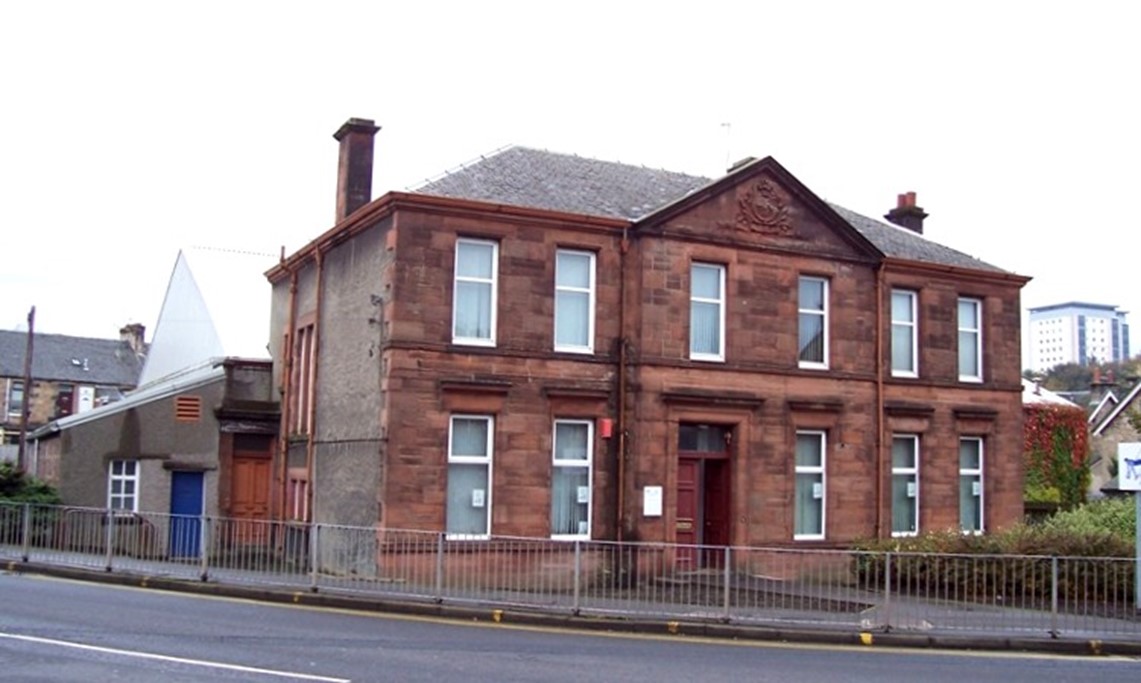
Falkirk Drill Hall was officially opened on 9 December 1899 by Major J King for C and D Companies of the 4th Volunteer Battalion, Argyll and Sutherland Highlanders having cost £2,500. It is L-shaped in plan with a two-storey administration block fronting High Station Road and a large hall placed at right angles behind it. The road frontage is made of red sandstone ashlar in three bays, the central one slightly advanced and furnished with a pediment carved with the regimental crest. This consists of intertwined L’s for Princess Louise, with her coronet over, and a boar’s head and cat to either side. Each bay has two rectangular windows on each floor, except for the central bay where the main entrance takes the place of the northern ground floor void. All the ground floor voids have simple hoods. On the ground flat was the armoury (fitted for 300 rifles and equipment), an officers’ room, a non-commissioned officers’ room, an orderly room, a store, and two lavatories. On the upper flat was a large reading and recreation room, and here also was situated the house of the Sergeant-Instructor. Behind this building was situated the drill hall proper. The hall is 100 feet in length and 60 feet wide, made of brick with rough cast sides facing High Station Road and Comely Park Terrace. The open roof is a composite of iron and wood, and the hall was well lighted by means of eighteen large roof lights. The floor was formed of blocks of pitch pine wood admirably suited for drill purposes. In the rear of the hall was a large store of gymnastic apparatus, etc.
The opening ceremony was performed by Major King. The members of the local companies of volunteers, headed by the Volunteer Pipe Band and the Falkirk Burgh Band, marched to the hall, and were drawn up in line on both sides of the ground in front of the building, where the general public had also assembled in large numbers. Major King was conducted to the front entrance to the hall where William Black, architect, presented him with a silver key on behalf of the contractors and himself. The top of the key was modelled from the Glengarry badge worn by the Argyll and Sutherland Highlanders, and by the local volunteers, which consisted of an ornamental crest surmounted by a wreath of thistles – the ornamental crest being the Princess Louise’s cipher and the Argyll’s badge. On the other side of the key was the following inscription: “Presented to Major King, 4th V.B.A. and S.H., by the contractors and architects, on the occasion of his opening the Drill Hall, Falkirk, 9th Dec, 1899.”
The following January saw the formation of a Gymnastic and Physical Drill Club based at the hall. Then in March there were huge celebrations for the Relief of Ladysmith in South Africa and the Volunteers set off rockets at the drill hall. The Volunteers held their annual prize giving ceremonies and balls at the new facility and before long the hall was being used for entertainments. In 1902 it was visited first by the Royal Italian Circus and then by the Australian Circus and Novelty Hippodrome. Even the reading room was used by local clubs and every Wednesday the Falkirk Chess Club made it its home.
The three local volunteer companies held “assault-at-arms” and boxing displays in the drill hall and in 1903 they were joined by D Squadron, Queen’s Own Royal (Glasgow) Imperial Yeomanry, whose branch headquarters were at 100 High Street, Falkirk.
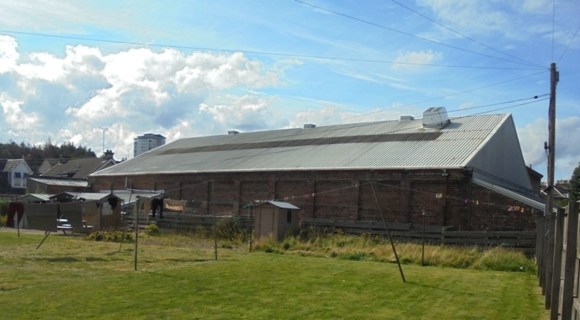
The cavernous nature of the drill hall at Falkirk made it ideal for large exhibitions and concerts. In 1905 the Falkirk and District Fine Art Association converted it into a gallery. The following year, in March 1906, the Falkirk and District Choral Union staged Handel’s Military Oratorio Judas Maccabeus there. It had been composed in 1746 to compliment the victorious Duke of Cumberland upon his return from the Battle of Culloden.
1908 saw a dramatic reduction in the number of men required for the new Territorial Force at Falkirk and it appeared as though the military role of the drill hall would be diminished. The reforms, however, were a bid to increase the professionalism of the remaining participants and in 1912 a new miniature rifle range was installed. At the same time a social club was established and provided with a full-sized billiard table. The 1908 cut in personnel numbers was reversed as a result of the outbreak of the First World War in 1914 and the drill hall once again bustled. By and large social events were excluded for the period, but those related to the war were permitted to take place. In October 1916, for example, a two-day chrysanthemum carnival and autumn market raised £730 to meet with the necessary promptitude cases of hardship among the widows, orphans, and dependents of fallen soldiers and sailors belonging to East Stirlingshire. After the war annual re-unions took place in the drill hall of the Falkirk and district men of the 7th Argyll and Sutherland Highlanders (Territorials). There was a great feeling of comradeship amongst them and not a little difficulty in readjusting to civilian life. Things were not returning to normal and in 1919 there was a great shortage of supplies, exacerbated by a series of strikes, and so Falkirk Drill Hall was commandeered as a storage and distribution depot for food supply.
Slowly things settled down and this was reflected in August 1920 with the return of the annual exhibition of plants, fruits, flowers and vegetables. In April 1922 the Stirlingshire Kennel Club held its first open show since pre-war years and had a record number of entries. The 1920s saw the heydays of fundraising campaigns in the hall. Mrs Robb was the caretaker and ensured that everything ran smoothly. In 1924 the Girl Guides had a successful jumble sale; as did the ladies of the Falkirk District Infirmary Appeal in 1926. Perhaps the greatest of all was the Infirmary Bazaar in 1928 which raised £9,242. By the late 1930s the hall was leased to the Post Office each Christmas to help it to cope with the delivery of festive parcels.
With war on the horizon again in early 1939 the Territorial Army was duplicated and another battalion was formed in the Stirlingshire area. The new battalion, called the 10th Argyll and Sutherland Highlanders, had for its area the following districts – Kilsyth, Lennoxtown, Bonnybridge, Denny, Larbert, Falkirk and Grangemouth, with the battalion headquarters at Falkirk Drill Hall. Once more it was busy with drilling recruits. As these moved to their forward positions, their place was taken by the newly formed Home Guard and it became the headquarters of the 2nd Stirlingshire Home Guard Battalion. This unit covered a wide area as far south as Slamannan and equipment and ammunition were supplied from the drill hall.
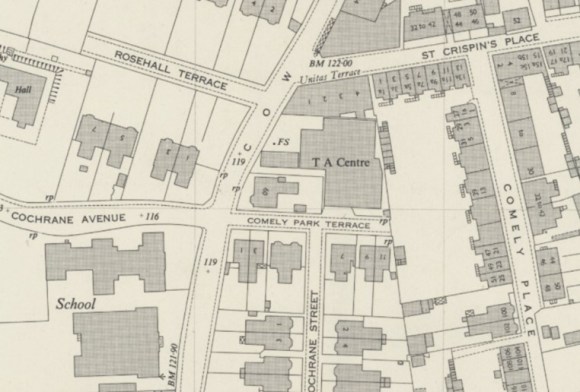
After the war it remained the headquarters for the new Territorial and Auxiliary Forces in the area. To cope with the extra demand a sectional timber-framed hut with weather-boarded walls and felted roof was erected in front of the drill hall in 1947. It had been used in Grangemouth during the war and was transferred on the condition that it would be removed within five years – it is shown on the 1951 map.
By 1951 the Territorial Army was using the northern part of the Bevin Boy Camp at the Bog to the east of the town. This was largely rebuilt and the new centre opened on 20 May 1961 (SMR 2316). The old drill hall was taken over by Falkirk Council and today is used as a gymnastics centre.
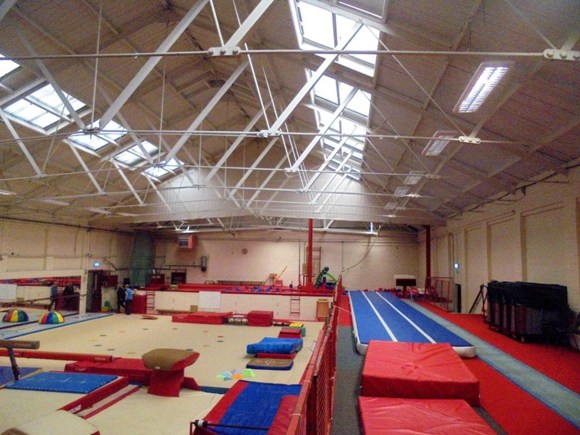
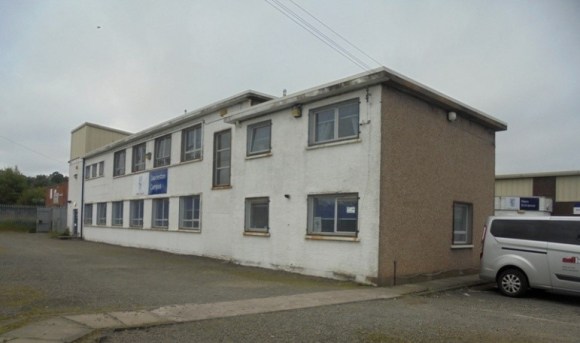
Gymnasts had met in the sports centres at Hallglen and Grangemouth but had to spend the first hour or so setting up their equipment. Robert Callahan, who was looking after the Grangemouth Gymnastics Club, met David Mould, Director of Leisure and Recreation at Falkirk Council and over 1985 a proposal was worked up for a dedicated gymnasium. When the Mariner Centre opened in July that year the old Drill Hall became vacant and the Council agreed that it could be used by three or so clubs. A management committee was set up with Mould as its first chairman, Callahan as the Director of Administration, and representatives from all three clubs. The gymnastics equipment was transferred to the Drill Hall from Grangemouth and Hallglen Sports Centres. The following year a long-term lease was agreed and the Falkirk School of Gymnastics was incorporated as a charity on 18 July 1986 (SC100129).
Grants were then obtained from the Foundation for Sport and the Arts to install foam pits and a new heating system. Much voluntary work was done behind the scenes in order to make the money stretch as far as possible (see Callahan’s forthcoming book). Performing success in competitions followed. In 1993 a Lottery grant allowed the club to completely kit out the Drill Hall with new FIG approved Gymnova equipment. Another grant in 1998 paid for the conversion of the upper flat into residential facilities so that training camps could be held there. Child protection rules and heavy insurance costs eventually stopped these.
Sites and Monuments Record
| High Station Road | SMR 995 | NS 8885 7961 |
 Falkirk Local History Society