
By 1867 the 12th Stirlingshire (Carron) Rifle Volunteers had 88 members. Led by Captain Alex Munro they decided to erect a drill hall of their own and to raise the money by selling shares at 10s each. In August 200 shares were taken and after just two weeks some £200 had been paid up. In November a Grand Concert was held in the Corn Exchange in Newmarket Street, Falkirk, to augment the fund. Despite donations by local landowners, it is unlikely that sufficient was raised to cover the full cost of £400 for the building and in all probability a loan was taken out. A site was procured on Tryst Road just to the north of the Chapel Burn. Construction began before the end of the year and on 16 January 1868 it was reported that the volunteer drill hall was rapidly nearing completion. It was officially opened to the volunteers on 13 March with a grand supper and ball attended by the volunteers with their partners, and by local businessmen and landowners.
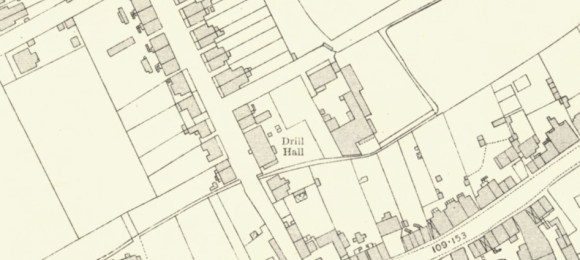
The spacious hall could seat 600 persons and had a stage at the south end for the accommodation of performers at concerts. A large sunlight with numerous gas jets was suspended from the centre of the roof. There was also an armoury, an officer’s room, a reading room, a ladies’ room, and so on. Along the ridge of the roof ran a handsome ornate railing with a crest, which was the gift of George Smith & Co of the Sun Foundry, Glasgow.
The prospect of having a drill hall encouraged 10 more volunteers to come forward before a public opening took place on 29 March 1868 with entertainment by professional performers consisting of musicians, singers, and comedians. The Drill Hall was to be used as a public meeting place which would provide revenue. A committee had been established to oversee the management of the building and an extensive programme of events was soon set up. Local bands appeared frequently. One of the first lectures was about the Universalist Church, which was very strong in the village. The drill hall was ideally placed for activities associated with the Trysts – the great cattle markets. This was immediately capitalised upon and in August the building was let to merchants attending the two markets. In 1886 it was the banks that took a lease of the hall during the Trysts – the charges for stances on the field were even too high for them. The capacious hall also made it ideal for selling second hand furniture and so periodically local auctioneers, such as David Nicol, rented it.
The drill hall was used by the Mutual Improvement Society to give lectures. Lectures of another sort, in the guise of political rallies, also proved popular. In August 1868 Sir William Bruce of Stenhouse introduced the MP for Stirlingshire, Admiral Erskine, there. Amazingly, March 1869 witnessed a lecture on slavery by a coloured freedman from South Carolina called Joke Asania.
The drill hall formed a sort of community hub and over the years following its opening the library was extensively stocked with popular modern works. As Robert Gillespie wrote in 1879 “So much for the pluck, enterprise, and unanimity of the 12th Stirlingshire Rifles… manifested a vitality and harmony which gratified all who had an interest in the security and prosperity of the State.” The hall was also used by various church congregations – either those that had been newly established, and had no home of their own, or temporarily by those whose buildings were being renovated. The hall, and hence the corps, was soon at the heart of the community with annual shows, exhibitions, drills, demonstrations and meetings held there. There was an annual poultry show featuring pigeons and canaries; a horticultural show with chrysanthemums at its core; choral concerts, plays and amateur dramatics, and so on. On a more official level the hall was used for ratepayers meetings, elections for the parish school board, and official announcements. It also provided the headquarters of the local branch of the Salvation Army.
The main function of the hall was, of course, for the rifle volunteers to practise drill. It was here that they held their annual dance and ball, and here that prizes were awarded for drill and shooting. The installation of gymnastic equipment allowed the volunteers to keep fit, but was primarily for the use of a new gymnastics club. However, such military occasions were swamped by the other uses of the hall and so in June 1890 the building was put up for sale by private bargain (Falkirk Herald 21 June 1890, 1). It can only be presumed that the conditions of sale included its perpetual use by the Volunteers. Another factor that led to the sale was the reorganisation of the units within the volunteer force and in 1881 the 12th Stirlingshire (Carron) Rifle Volunteers became “I Company (Carron) 4th Volunteer Battalion Argyll and Sutherland Highlanders.” It held its annual presentation of prizes in the drill hall that December as usual when the hall was decorated with evergreens as was normal. The company had been struggling to get recruits and its numbers had fallen to 77. It blamed the propensity of the young men to favour the game of football over military duty. With the change of name came the free issuing of weapons and with that financial burden removed 18 men were enrolled that year, bringing the unit back up to strength. The functioning of the hall continued as before. A wooden addition was made on the west side of the hall in which refreshments were purveyed, thus leaving the hall free for dancing.
The hall was up for sale again in 1895:
“DRILL HALL, STENHOUSEMUIR. FOR SALE, by Private Bargain, that Substantial Stone Building known as the “DRILL HALL,” consisting Large Hall, Cloak Rooms, and Lavatory, with the Magazine and Vacant Ground therewith connected. Feu-duty, £1 15s 1d. Entry Whitsunday 1896. Offers will be received by Russel & Aitken…”.
(Falkirk Herald 7 September 1895, 8)
Once again the change of ownership appears to have made little practical difference on the ground. Far more significant was the announcement by Major Dobbie in 1900 that he intended to erect a large public meeting hall capable of holding up to 1,000 people on the main road between Stenhousemuir and Larbert. The Dobbie Hall opened in 1901and some of the larger events moved there. Despite that the drill hall continued to be much used.
That changed in 1908 with the formation of the Territorial Force from the old volunteers and the resulting purchase of the drill hall by the Stirlingshire Territorial Association. The Salvation Army was compelled to seek other quarters. It had been there since 1904 and transferred to the Shepherds’ Hall. The intention of the new more professional unit was to have the hall used as a drill hall in the truest sense with, perhaps, the necessary equipment for gymnastic exercises. The use of the hall by the local clubs almost vanished but inevitably over the years it crept back in. One of the first chinks occurred in February 1909 when a meeting of the first Falkirk troop of Baden Powell Boy Scouts was held in the Stenhousemuir Drill Hall. The movement was spreading rapidly in the town and over 50 boys had joined.
During the First World War much help was given to the military authorities by local people and in July 1915 the War Relief Fund Committee moved into the hall. The hall was a centre of activity with young recruits and equipment passing through. Then, with the cessation of hostilities, all went eerily quiet. The army establishment was radically reduced in size and its focus turned elsewhere and the drill hall at Stenhousemuir saw little use. In 1920 the Territorial Association was approached to see if it could be used as a recreation centre. It came as no surprise when, in July 1922, the following advert appeared announcing its sale:
“The Subjects known as STENHOUSEMIIR DRILL HALL, STENHOUSEMUIR. The Subjects consist of Drill Hall and Ante-Room, are in a good state of “repair, and are suitable for being used as a Picture House. Feu-Duty, £1 15s 6d. Immediate entry. Upset price £500. For further particulars apply to T and J Muirhead, solicitors, Stirling, who have the titles and articles of roup.”
(Falkirk Herald 15 July 1922, 2).
In April of the following year it was bought by Mr MacPhail, tentmaker, Greenock. In 1925 he gave permission for the adjacent confectionary business to use the hall to produce its “toothsome delicacies.” The factory of McCowan and Sons was expanded and the hall was incorporated within it. In 1935 it was being used as a store. The hall was therefore not available for use during the Second World War. In April 1939 it was agreed to provide a drill hall for Larbert as part of the strenuous recruitment drive then in process – it was too late. In 1952 the old hall was demolished and replaced by a new works’ canteen.
Sites and Monuments Record
| Tryst Road | SMR 1694 | NS 8694 8306 |
 Falkirk Local History Society