John Hastie and the Conventicles in the Falkirk Area
After the Restoration of the Stuart dynasty, Charles II re-established the Episcopal Church and became very intolerant of everyone else. The Act of Uniformity was passed in 1662, leading to the expulsion of any clergyman who refused to subscribe to everything contained in the Book of Common Prayer and to the doctrine of the King’s religious supremacy, banning such clergymen from exercising religious functions in private houses. This was followed in 1664 by the Conventicle Act which made it illegal to hold any gathering in a private house for religious worship attended by a number exceeding five more than the regular members of the household, under penalty of fine, imprisonment, or transportation. Many nonconformists were arrested. In Scotland, Presbyterianism was suppressed and various Acts were passed by the Privy Council and the Court of High Commission prohibiting conventicles and imposing severe penalties upon participants. Many had already signed bonds or covenants, most notably the National Covenant of 1638 and the Solemn League and Covenant of 1643, to resist the Stuart monarchy’s interference in the Church of Scotland, and are referred to as Covenanters. It was forbidden to supply denounced persons with meat or drink, or give them any aid. Amongst the men commissioned to impose these regulations was the Earl of Callendar.
June 1673: “The missive underwrytten is direct to the Earle of Callandar and Laird of Clakmannan: The Councill, being acquainted that yow have bein very diligent in putting of the acts of Parliament in execution against such as have keiped or bein present at conventicles within the boundes of your jurisdiction, they have commandit me in their name to return yow thanks for the same, and they doe expect that yow will continow the same care and diligence in proceiding against the contraveeners of the foresaids acts in tyme comeing by fyneing them conform to the tenour of the said acts.” (Reg. Privy Council vol. 4, 58-9).
September 1673: “The missive underwrytten is direct to the Earle of Callandar, sherriff principall of Stirlingshyre: My Lord, The Councill, being informed that there hes bein a numerous feild conventicle keiped within the shyre of Stirling upon the last Lordes day, and that there were sundrie persons present thereat in armes, bot, not haveing information of the particulars, they have ordered letters against these present at that conventicle to be sent to your Lordship blank in the persons names, wherein they authorise yow to cause insert such persons names, ministers and others, as after inquyrie yow shall find to have bein present at that conventicle, and lykwayes that yow would condescend upon the witnesses that they also may be sumondit, and the Council does recommend to your Lordship to inform yourself concerning all these particulars of that conventicle and to return ane accompt of your diligence herein against the nixt Councill day.” (Reg. Privy Council vol. 4, 97).
The minister and kirk session at Falkirk cooperated with the new regime. At this time a number of people were “delaired” by the session for breach of discipline. Upon failing to appear before the Session when cited they were referred to as “fugitives.” This term is peculiar to the time and it may be assumed that they were covenanters on the run. The Bishop of Edinburgh wrote to the Presbytery on 4 December 1673 for information “having heard a confused report of several disorderlie and seditious conventicles held in the fields within the bounds of the Presbytery of Linlithgow.” The Presbytery replied that they had knowledge of conventicles having been held in several locations, including Falkirk where there were also house conventicles and irregular baptisms. The Falkirk minister subsequently “made publick intimasne that no persone should vage or goe in companie to the woode or any other place upone the Sabbath day.” (Murray 1887, 221).
Field conventicles were usually held under the cover of night in the open air, more often than not on moors or hills where safety and suitability could be combined. The open moorland and elevated locations made it easy to spot any approaching horsemen and the boggy land was unsuitable for the deployment of such dragoons. These gatherings frequently lasted for hours. At such conventicles, the ordinances of the Presbyterian Church were observed. Baptism was administered, and Communion was dispensed, often to mass groups of people. Latterly worshippers arrived with whatever means of self-defence they could find, such as scythes or cudgels.
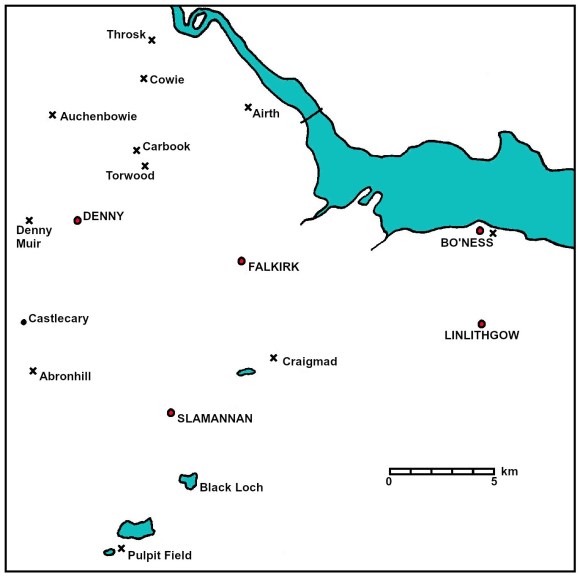
Troops were quartered at Falkirk (Reg. Privy Council vol. 4, 141). Despite the severe repression, conventicles continued. In April to June 1674 they were held to the north of Falkirk at Torwood, Cowie, Airth, Throsk and Carbook (Reg. Privy Council vol. 4, 237, 450; vol. 5, 18, 48); and in August to December at Auchenbowie and Denny. There was then a bit of a gap and in the summer of 1676 it was reported that a conventicle had been held at Bo’ness. Bo’ness, with its links to northern Europe, was a staunchly Protestant settlement. There had been an incident at Kinneil Church back in 1661 when the Episcopalian minister was attacked by local women and furniture in the building was broken up (Bailey 2018). Now in the summer of 1676
“Lykas the tymes forsaids they have invaded and intruded themselves in the pulpitts of the paroches of Borrowstouness, — whereby they have presumed to preach and exerce the uther ministeriall functions, wherby the said persons have directly contraveened the said lawes and acts of Parliament” (Reg. Privy Council vol. 5, 24, 487).
The following year “scandalous abuses” were committed at Bo’ness and Torphichen.
“Dechmont to cause whip soundly the boyes guilty of the abuse committed at Borrowstounes, and, if he can apprehend any of the men or women actours thereof, that he cause scourge tuo of the most guilty and putt the rest in the jogges.” (Reg. Privy Council vol. 5, 267, 272).
In October 1678 conventicles were back at Denny and Auchenbowie (Reg. Privy Council vol. 6, 33).
Illus: Map showing the locations of Conventicles in the area.
In November 1678 James Wilson, gunsmith in Falkirk, was said to have attended field conventicles, one of which was at Bo’ness. He admitted this and was accused of “makeing of pickforks and a new inventione of armes for the use of these who frequent disorderly meetings”. He was ordered by the Lords to be deported to the Indies. From his prison in the Canongate Tolbooth he appealed for a pardon and :
“purged himself upon oath; and confessing that he attended conventicles, but refusing to depone thereanent, he is sentenced to transportation to the plantations. He is a poor man, having a poor wife and family, and nothing to maintain them with but his dayly handy labour, and he resolves to attend no more conventicles but to live orderly and worship in his own parish kirk; so he craves liberty. The Lords ordain the magistrates of Edinburgh to set him free, on his giving bond to abstain from conventicles and frequent the parish kirk, and finding caution in 500 merks to compear befor the Council when called.” (Reg. Privy Council vol. 6, p.69).
Two other Falkirk men were not so fortunate. John Jervy, smith and wright there, and John Rae, tailor there, were both deported (Reg. Privy Council vol. 6, p.52-3; p.76).
Bo’ness was a hotbed of covenanters. The old minster of Kinneil, William Wishart, was removed from his charge and subsequently took part in many field conventicles, and on 6 August 1675 was intercommuned by the Privy Council for taking part in these. He was caught and imprisoned and finally on 5 February 1685 ordered to be sent to His Majesty’s plantations for refusing the abjuration or test. He was only liberated from prison on the 24th of the same month owing to the death of King Charles II.
Rev. John Blackadder also became noted for his preaching at many of the conventicles, travelling widely and visiting towns, including Bo’ness. On one occasion the meeting there was dispersed by soldiers from Blackness Castle. Blackadder had just baptised 26 children and was forced to flee, climbing over dykes and hedges from one yard to another in the dark, and then ascending the hill to the south where he found refuge in a barn. His son, Andrew Blackadder, was left behind in the confusion, and was arrested and placed in the dungeon at Blackness Castle. The route of escape suggests that the conventicle was being held on the Links.
Another famous conventicle preacher in the area was Rev. Donald Cargill. He too was ruthlessly hunted. On 3 June 1680 he was walking between Bo’ness and South Queensferry when the ministers of Carriden and Bo’ness recognised him. They sent word to the governor of Blackness Castle who found Cargill in the company of Henry Hall in a hostelry in Queensferry. During the attempted arrest Hall drew his sword and in the confusion Cargill made off on the governor’s horse. Such was the strength of feeling in the area that the minister of Carriden had to seek protection against possible acts of vengeance – Kinneil had seen precedence for such acts.
Royalist soldiers, aided by spies and informers, often infiltrated the conventicle meetings and broke them up. One of these attacks led to the Battle of Drumclog on 11 June 1679, which resulted in the only military victory gained by the covenanters and the only defeat sustained by Claverhouse who was known as “Bonnie Dundee” (for whom see An Incident Concerning Bonnie Dundee at Falkirk: 1679). Shortly afterwards, on 22 June 1679, Claverhouse had his revenge at the Battle of Bothwell Bridge, which put an end to the armed rebellion. During the years of persecution culminating in the “Killing Times” it is estimated that some 18,000 people suffered in some way for attending these conventicles (for a general background see Wikipedia).
When the oppressive penalties failed to stop the conventicles, the next step invoked was capital punishment. Military leaders and even common soldiers were given authority to immediately execute dissidents without the formality of a legal trial.
Bo’ness remained radical. In October 1680 seven prisoners were taken at Linlithgow Bridge returning from a conventicle. William Duncan in Maddiston, was released (Reg. Privy Council vol. 6, 553). That November:
“Robert Hamiltoun, sone to the chamberlane in Borrowstounes, being delated to have been at conventicles at Torwood, Largo Law, etc., and examined thereupon and severall other interrogatours, made answer as is in his examination.”
Largo Law is a prominent hill in East Fife and shows how far these worshippers were prepared to travel. Other prisoners, including James Skeen, Archibald Stewart, John Sprewll, indwellers in Bo’ness, and a woman by the name of Marion Harvie, were to be examined concerning the harbouring of Donald Cargill (Reg. Privy Council vol. 6, 574). A reward of 3,000 merks was offered for his apprehension, dead or alive.
Cargill made quite a stir when, in September 1680, he excommunicated Charles II and James, Duke of York, and their top officials, at Torwood. A flavour of his pronouncement can be got from this extract:
“I, being a minister of Jesus Christ, and having authority and power from Him, do, in His name and by His spirit (…) excommunicate and cast out of the true Church, and deliver up to Satan, James, Duke of Monmouth, for coming into Scotland at his father’s unjust command and leading armies against the Lord’s people, who were constrained to rise, being killed in and for the worshipping of the true God, and for refusing, that morning, a cessation of arms at Bothwell Bridge, for hearing and redressing their injuries, wrongs and oppressions.”
The Privy Council increased the reward to 5,000 merks. Its propaganda made the covenanters out to be dangerous criminals and the Torwood conventicle was put into this context:
“by their unexampled and sacrilegious excommunication of us, our dearest brother, and our chieffe ministers and officers by the said Mr Donald Cargill at a numerous field conventicle at the Torwood in Stirlingshire in the moneth of October, which impious mock sentence… they endeavour to justifie the lawfullness of killing us and our faithfull ministers and subjects… Moreover, the truth and reality of this cruell, bloody, treasonable and horrid plot and conspiracy is further evident by the declaration and free confession of James Skeen, brother to the late Laird of Skeen, Archibald Stewart in Borrowstowness … and who seemed to have mett together in our city of Edinburgh on Thursday, the elevent of this instant November, to consult with Mr Donald Cargill the best methods for putting the said abominable and hellish plot in execution“. (Reg. Privy Council vol. 6, 584-5)
Sweeping powers were given to those acting for the king, particularly the use of torture. Skene and Hamilton were to be hanged. Robert Hamilton admitted being at the Torwood conventicle for the excommunication, but disowned it and the documents found on Henry Hall and called the New Covenant, and the Declaration of Sanquhair. In April 1681 he was released on caution of 1,000 merks (Reg. Privy Council vol. 7, 95)
After numerous narrow escapes Cargill was arrested in Lanarkshire on 12 July 1681 by a party of dragoons and then tried for treason before the High Court of Justiciary. Unsurprisingly, he was found guilty, and executed on 27 July 1681. Near an oak tree on the Glenbervie estate, which the locals identified as Wallace’s Oak, was an old thorn tree called “Cargill’s Thorn,” where he is said to have stood under its branching head when he excommunicated Charles II (Transactions1881). The ditched enclosure opposite the foot of the Toll Brae in which it stood was called Squaire Field. It was a focal point for sermons over the following centuries, but the thorn blew down around 1895 (Gibson 1908, 74) and the locality returned to its former obscurity.
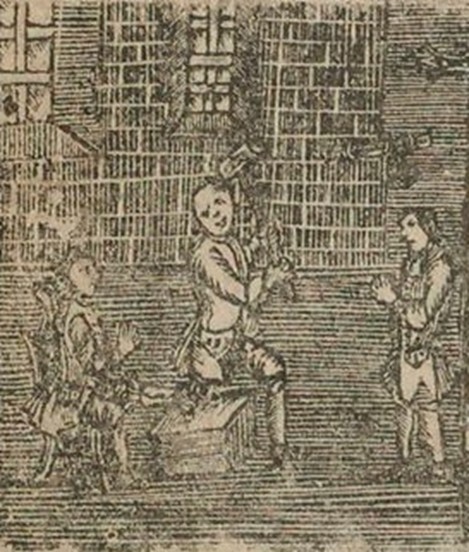
Illus: “Some tortured by boots & thumbkins” (Cloud of Witnesses 1755 – National Library of Scotland).
The four Borrowstounness victims of the persecution who suffered the ultimate penalty were Archibald Stewart, who suffered death at the Cross of Edinburgh on 1 December 1680; Marion Harvie, executed in the Grassmarket of Edinburgh on 26 January 1681; William Gougar, executed at Edinburgh, 11 March 1681; and William Cuthill, seaman, also executed there on 27 July 1681 (Cloud of Witnesses).
Archibald Stewart lived in Bo’ness and travelled to Holland. He was examined by torture on 15 November 1680, at the same time as the Duke of Hamilton’s chamberlain at Kinneil.
Stewart confessed to being at Airsmoss, Ayrshire, where a skirmish had taken place in July 1680 resulting in the death of the leader of the Cameronians, Richard Cameron, whose head and hands were cut off for display in Edinburgh. In addition, Stewart is said to have described to them a number of Cargill’s haunts and places of hiding. Stewart was executed along with James Skene, and John Potter, a farmer at Uphall. Upon the scaffold he sang the 2nd Psalm, and read the 3rd chapter of Malachi. While attempting to pray his voice was purposely drowned by the beating of drums, and while at his devotions he was launched into eternity (Salmon 1913, 138).
Marion Harvie was born in Borrowstounness about 1660, and followed the occupation of a servant maid there. She was fifteen before she had attended a sermon by Richard Cameron who appears to have been among the field preachers who visited this district. She then embraced every opportunity of hearing the persecuted preachers. She speaks in her dying testimony of having attended the preachings of Donald Cargill, John Welch, Archibald Riddell, and Richard Cameron, and of being particularly refreshed with the hearing of the latter at a communion in Carrick, to which she had gone. Marion was taken prisoner in 1680 along with Archibald Stewart, between Edinburgh and Queensferry, after having been to the city to see Cargill. They were betrayed by James Henderson of North Queensferry. She was brought before the Justiciary Court on 6 December that year, and threatened with the boot – a cruel form of torture. However, she readily stated that she approved of Cargill excommunicating the King. She was found guilty on 17 January 1681.
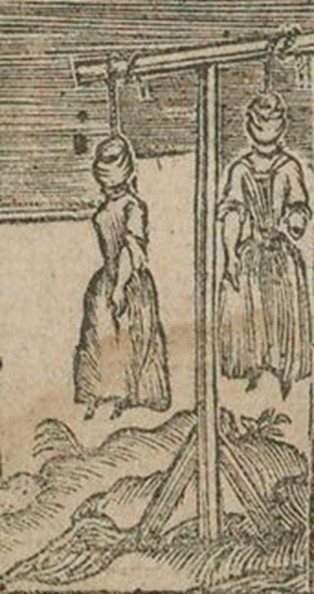
Illus: “Women Hanged” (from Cloud of Witnesses 1755 – National Library of Scotland).
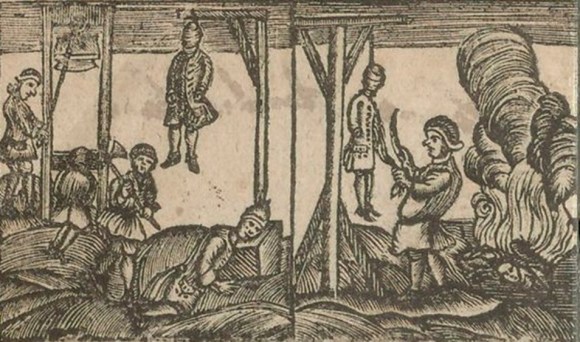
Illus: “Some had their hands cut off & hanged; others beheaded & quartered” (from Cloud of Witnesses – National Library of Scotland).
On the 11 March 1681 William Gouger of Bo’ness was executed in Edinburgh, along with Robert Sangster and Christopher Miller, two Stirlingshire men. Gouger had been present at the battle of Bothwell Bridge, and to the last he resolutely avowed the principles of the covenanters. On the 27 July the same year William Cuthill, a sailor belonging to the port, suffered along with Rev Donald Cargill, Walter Smith, student of divinity, and William Thomson, a Fife man, in the Grassmarket of the capital, for non-conformity and rebellion.
The hangman “hacked and nagged off all their heads with an axe.” Cargill’s and Smith’s heads were fixed upon the Netherbow Port; William Cuthill’s and William Thomson’s upon the West Port.
Conventicles evidently continued in the Falkirk area and in March 1682 the Earl of Linlithgow was given a warrant to suppress them in the regalities of Ogilface and Falkirk and the lordship of Linlithgow (Reg. Privy Council vol. 7, 373).
John Menzies of Dalquhairn, Avonbridge, became embroiled in covenanting affairs and was arrested. Lord Fountainhall records under 19 February 1683:
“At Criminall Court, one Meinzies is pannelled for conversing with rebells, and it being proven against him, (by the mismanadgment of Sir D. Thoirs, his advocat, as was reported,) that he had collected contribution money for these rebells in the West, and distributed it; and that he had receaved letters from Balfour of Kinloch, one of the Archbischop of St. Andrews’s murderers: The Justices condemned him to be hanged: but it afterwards appearing thir witnesses ware infamous, and that they had sworne largely, and was delated by one who was owing him money; the Privy Counsell repreived him.” (Lauder, Historical Notices, I, 420 & 423).
The system was open to abuse and its use by people wreaking revenge on their neighbours was well known.
On 8th June General Dalyell was informed of a “formidable conventicle” at the Black Loch and so he dispatched 20 of a company & 20 dragoons under Lt-Col Winrhame. They found the stoups of the tents, the raised wooden huts from which the preachers delivered their sermons.
June 1684: “The Lords of the Comittie of his Majesties Privie Councill for Publict Affairs haveing receaved no satisfactorie accompt anent those armed rebells who lately mett in order to a conventicle at Blackloch upon the confynes of the shyres of Lanerk and Stirling, notwithstanding the Comittie are informed that ther wer at least one hundred men weill armed, many of them with blunderbushes, and all of them with guns, pistolls and swords, and that they marched off in a full bodie and keeped togither Sunday and Munday in rank and fyle, doe hereby give order…” (Reg. Privy Council, vol. 9, p.2-5).
They pursued part of the unruly host but lost track of them after crossing the Clyde near Hamilton and sent back word to Dalyell. Dalyell forwarded word of the events to William Ross, one of Claverhouse’s officers, who was in attendance at his commander’s wedding. Upon hearing of the nature of the disturbance, Claverhouse saddled up and rode out with his men to pursue the fugitives, returning to Paisley two days later, with no success to report.
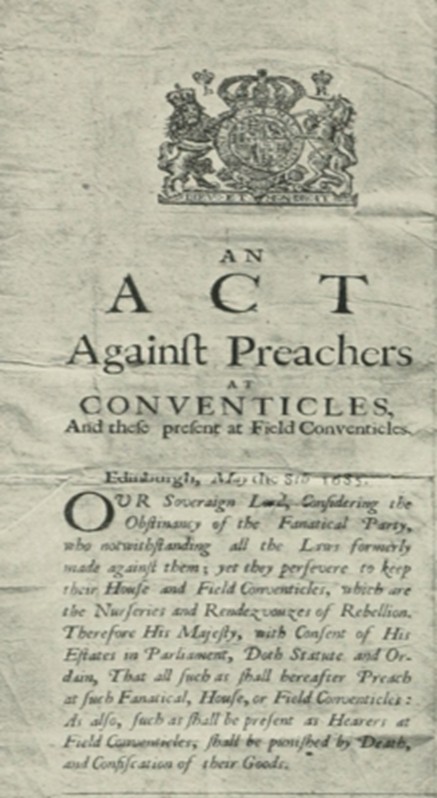
On 8 March 1685 the Scottish Parliament passed an Act Against Preachers at Conventicles, and those present at Field Conventicles:
“Our Soveraign Lord, considering the obstinacy of the fanatical party who, notwithstanding all the laws formerly made against them, still keep their house and field conventicles, which are the nurseries and rendezvouses of rebellion; therefore His Majesty, with consent of Parliament, ordains that all such persons who shall hereafter preach at such house or field conventicles, also those who shall be present as hearers, shall be punished by death and confiscation of their goods.”
As well as Torwood, the other famous site for field conventicles in the Falkirk district was at Craigmad.
This site lay on the eastern edge of Gardrum Moss (at NS 902 752), between Loch Elrigg and Blackbraes, 1.75 miles NNW from Bogohaugh where John Hastie lived (see below).
At that time it formed part of the common muir of Muiravonside. It was close to the boundaries of the parishes of Falkirk, Slamannan and Muiravonside and to some extent this caused the authorities difficulties as they grappled with the questions of jurisdictions. The distribution of isolated family tombs in the south of the Falkirk district (see Family tombs & graveyards, pest graves and miscellaneous burials in the Falkirk district) is a reflection of the non-conformist nature of the population there in the following century.
Craigmad was already a holy place for covenanters because of a vision. It was said that Alexander Stirling, who lived in Redding, had visited the place with some others at the start of the troubles. They
“was in that desert place, and saw that brae-side close covered with the appearance of men and women, singing the 121st psalm, with a milk-white horse, and a blood red-saddle on his back, standing beside the people; which made that serious, discerning, observing Christian conclude that the Gospel would be sent to that the place, and the white horse was the Gospel and the red saddle persecution.” (quoted in Murray 1887, 223).
There are a number of other sites in and around the Falkirk district associated in tradition with covenanters and field conventicles. According to Salmon (1913, 133) there were caves in the rock face on the south side of Kinningars Park (NT 015 811) which they used to hide in, though these are now obscured by later landscaping. Kilsyth has the “Covenanters Cave,” depicted on the early Ordnance Survey maps on the east side of the Garrel Burn. Carved into the cliff face is the date 1669. Another carved stone with a covenanter tradition called the “Hewen Stone” used to stand near Walton to the south of Castlecary (approx. NS 79 77), but disappeared in the 1990s. Well to the south of Slamannan, near Caldercruix, a field adjacent to the Ardenrigg Pit was called the Pulpit Field due to its use at conventicles (NS 826 656). To the west, near Cumbernauld, is Abronhill. This is said to have been named “Abraham the Hebrew’s Hill” and the name gradually changed to Abram’s Hill and then to Abronhill. The hilltop location was typical of those chosen for conventicles. Locally, covenanters were also reported to have met at Herd’s Hill on Fannyside. Then, of course, there is Blackness Castle which was infamously used as a prison for covenanters (Bailey forthcoming).
John Hastie
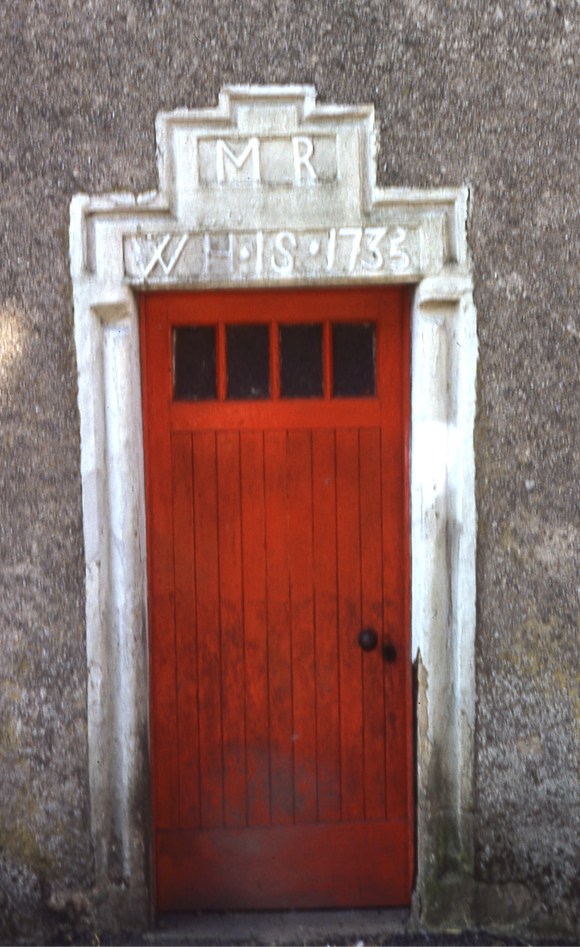
Illus: The doorway at Pirnie Lodge, Slamannan, where William Hastie lived. “MR/ WH.IS.1735” for Minister William Hastie and his wife Isabella Shaw.
In 1728 Rev William Hastie, the minister of Slamannan Parish Church, wrote a history of his family, with particular reference to his father, John Hastie. Much of this was done from personal memory of the people and times of which he was an eye witness. It is this which makes the account vivid and the fact that it is almost contemporary provides an unfiltered family view. The document is now in the National Library of Scotland (Acc. 10886). A large extract was published locally (Murray 1887, 223-226), but this is not readily available and the section relating to the “Killing Times” is given here in greater extent.
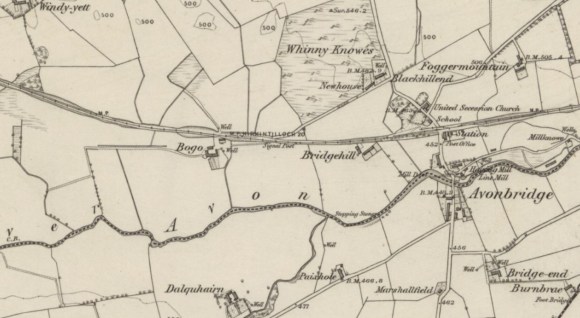
John Hastie was brought up on the family farm at Bogohaugh, on the north side of the River Avon outside Avonbridge in the parish of Muiravonside. This was part of the Lands of Bogo which belonged to the Calder family, and lay between it and the river. This low-lying flattish haugh ground was relatively fertile, especially when compared with much of the surrounding moorland. Immediately to the south of the dwelling at Bogohaugh was the upper mill dam or pond for Haining Mill
(see The Baronial Water Mills of the Falkirk District) and beyond that the River Avon. On the other side of the river was Dalquhairn, mentioned above. A short distance to the north of Bogo was the common muir of Muiravonside where the family had a right to pasture their animals as well as to extract peat.
John Hastie was, according to his son,
“a man of middle stature, broad and well bowed, of a black complexion and grave countenance and a small head and a straight body and bodily strength… he loved a good horse, and was a very good horseman. And he had an inclination to plant and nourish trees. And this was a work that did prosper with him, for when he and my mother were married there was not one tree about the Bogoshaugh save one. And after that time he nourished a very bonny planting which came to great perfection. Many of which he cut down in his own time, and left at his death a good date of goodly trees, both young and old. And by his planting he was delighted and it was his recreation” (Hastie 1728).
He was married in 1664 and died on 27 October 1720 so that they lived together 56 years.
Illus: 1860/65 Ordnance Survey Map showing the location of Bogo (National Library of Scotland).
“…And when the ministers who preached in the fields came to the country side, they were ordinarily in his house, and lodged in it. And I remember that the last preaching that was in the fields in our Countryside was held at Craig-mad and preached by Mr William Boyd, and he was quartered in our house…
“Now after that this blast was over, I do not find but that my father lived with his family in some measure of peace and quietness until anno 1678 in which year the King by an act of the convention of his Estates at Edinburgh, did impose upon the subjects a cess to be payed by the subjects, in which act it was expressly said, that the reason for which that cess was imposed was to suppress field Conventicles, called in the act Radivoze of Rebellion. This cess then, being thus to be improven, became very grieveling to the Presbyterians, and a great many of them suffered trouble because they would not pay it, and my father being one of those who adhered to the Presbyterian ministers that did preach at these Conventicles and did frequently harbour them in his house, came under trouble because he would not pay this cess, and I remember, tho’ I was then but 6 years of age, that I saw a party of soldiers, which quartered in his house for some time upon that occasion. And when they went off they did take several of his kine with them which they sold both for payment of that cess, and for their own wages, which they exacted besides the free quarters which they took. And the same cess still continuing to be paid became very troublesome to him. Again in some time after came on the Rising at Bothwell Bridge which was in the month of June anno 1679, and I think I was then 7 years old. This rising was occasioned by the great oppression and persecution which the Presbyterians were brought under by the Government. And I remember I saw my father give to a young man that lived under him in a little house, a firelock and a sword, which he received and went to that party which were then in arms. This man’s name was William Rankine, and my father took his horse and went also; but it so happened that a day or two before the battle one James Shaw in Greenhill had borrowed my father’s horse and he with some others went out to fight in the fields and before they were aware they were surprised by one Laird of Lachope who was an enemy, and a party with him. So that James Shaw and his party for their escape was obliged to part with their horses, and to fly to a moss and so escaped. My father having thus lost his horse, he came off and did not tarry till the day of Battle. And I do very well remember I saw him come to my mother, at his own house at night, and it was that Sabbath night upon which Sabbath the battle had been. And he had only a horse whip in his hand, and he told her how he came off and that the battle was over, and a great many of the country people were slain, and others made prisoners. Which, when she heard, she wept sore, but he immediately left her and went off. And so from that time till anno 1688 which was the year in which that glorious Revolution was brought about by King William who was an instrument raised up of God for the good of mankind and the protestant interest, my father had a continued time of trouble of losses, of persecution, of wandering from place to place, hiding himself for fear of his life, but yet he never wanted much inward peace and serenity of mind, and that was a sweet feast to him. And when he and others of his acquaintances met together they would have been very cheerful and hearty together. And very Christian in their discourse, and much of the life of religion and the power of godliness was to be seen with them. I remember there was a remnant of very godly men and good Christians in the bounds, with them they did meet and converse and they met together ordinarily in the night time. Their names were John Steel, John Clerkston, John Auld, John Shaw and some others. And when they met they spent the time in prayer, in reading Gods holy Word, and singing of Psalms…
“I shall now proceed and give an account of what I saw and knew that my father met with from the time of Bothwell Bridge to the year 1688. And I shall begin and speak of his losses. It is very true that my father never had much of the world, but what he had he cheerfully parted with if for the cause of Christ which he owned, and besides his being obliged to leave his family and his ordinary employment for the most part, which was to him a considerable loss. I remember that one morning in the time of seed-time, he had come home and had borrowed two horses to harrow part of his seed sown, but a party surprised him, and he himself escaping, they did take away both the horses, the price of which he did pay to the owners. I saw also one morning four of his kine taken away by Halyards, a gentleman from London, who had a commission to persecute such as conformed not to the laws of iniquity which were then made. I saw also a party of soldiers under the command of Duncan Grant, come and quarter several days in his house. And they thrashed and sold all his crops, and took away his kine, & left nothing in the house which they could dispose of, but here I can indeed say that I do not know how often his house was plundered and nothing left in it that was of any use to his enemies, for they were very cruel, and they came frequently that they might apprehend him. And still they carried away whatever they found that pleased them. I remember I have stood by my mother’s hand and seen them gathering together all the cloth and clothes in the house and binding them up for carriage. One time when they came, I myself was lying in a bed sick of a fever, and, as they were taking away a piece of linen, my mother desired that they would allow her as much of it as would serve to be a winding sheet to her sick child for she was expecting his death and she had no more linen but what they had taken, but her petition was refused.
“I now proceed to give an account of the particular hardships which he endured in his own person during these years in which he did travel from place to place, and none dirst harbour him or give him food or quarters without danger of being exposed to the fury of these times, and therefore many times he and many others in his circumstances were obliged to live in the open fields all night, and when he came to visit his family, if he went not presently off again, then he set a watch upon some public place to observe if any of his enemies did appear. I myself have been set to watch upon the know benorth his house, and my commission was that so soon as I saw any persons with hats or old clothes I should come and show it. And there was need for watching for now he was proclaimed a Rebel to the government, and sentenced to death. And by the law then established his enemies were empowered to kill him wherever they found him. And so many came to be killed in the open fields by the common soldiers. But yet though his circumstances were thus sad he did not want some friends to harbour him, and give him quarters. One great friend was an honest farmer man called James Easton, who lived in Summerhouse, with whose children in an out chamber he lodged many a night. This man’s son was afterwards married to my father’s eldest daughter and he and she are living together at this day 1726. And as my father thus wandered in his hiding he met with many remarkable providences and deliverances. If he himself were now to give an account of them, they would be many. I shall only give an account of those which I remember and was a witness of and so I begin to speak of his falling into the hands of his enemies, and his escaping again, And here I do remember that one night having come home and venturing to take a bed, before ever day light came, the Laird of Halyeards with a party surrounded the house and so he was taken. And now he being in his enemies hands they did resort to a change house, viz to James Shaws of Bridgehill, they being to traverse and plunder in the countryside for some days. And so they appointed one soldier to wait continually upon my father. But Providence so ordered that one night this soldier fell sick and the rest coming home from their plunder he committed my father to their care and went to bed. And after a little time the rest of the soldiers being fallen into some confusion among themselves with drink, the Landlady of the house, whose name was Janet Walker, gave a sign to my father which he very soon observed. In an instant he did jump out at the door from them, and it being a dark night they could not catch him again, tho’ they did run about and cried fearfully, and thus did he escape.
“…And now he being escaped went wandering, hiding himself, and came but seldom for a considerable time to visit his family. But after some time was passed over and my father began to visit his family again, one morning as he was travelling from his own house as he was upon the water side bewest the Hanen Milll he was met by one Francis Scott, a gentleman of the Kings Life Guards, who passed by without troubling him, but after he had passed by my father began to think with himself that the gentleman would yet turn after him and take him. And therefore my father as soon as he was out of sight went off the road and took into a little house, and as my father apprehended so it fell out, for in a little time he came after in great haste, and not finding him upon the road, he came directly to the little house into which my father was entered. And lighting from his horse and searching he found my father hid in the house upon which he immediately asked him where he lived. And then my father answered him that he lived in Bogohaugh. Then said he, you are my prisoner. And so he carried him to an hostler’s house at the Dykehead and my mother as soon as she heard came to him and besought the gentleman that he would allow her husband to go home with her, but he refused. Now these gentlemen of the Life Guards were not employed much in the persecution for they only came to the country in time of summer for grass to their horses, but seeing he had taken my father I believe it was even dangerous for him to let such a man go. Yet he being drunk when he did take him after some hours when he began to think, he said he would not take the man’s blood upon him. And as my mother insisted in her petition he asked my father if he were acquainted with Thomas Russell of Elrigg, and if Elrigg would be surety to enter him to him when he was pleased to call for him. To all which my father answered affirmatively, and so Elrigg was sent for, who immediately came, and Francis Scott asked him if he would enter this man to him, and for the present he would let him go. To which Elrigg answered that he would. And so he demanded Elrigg’s hand, which Elrigg gave. And John Boyd of Balmitchell being at that time accordingly came into the company. Francis asked him if he would do the same, and immediately John Boyd gave him his hand. And so my father was once more set free, but obliged to enter when Francis called for him, and this only by promise.
“But there was no more of this matter for some considerable time, for Francis Scott had no mind to call for my father and he never did. But there was then some Bailies in the town of Falkirk, who had my father at ill will because of his noncompliance and not answering to their Courts, which when they understood how Elrigg and John Boyd were engaged for my father, they sent for them upon the point and desired that Elrigg and John Boyd should enter my father to them, which both of them undertook to do, and so upon a day these two did meet together, and sent for my father to come and speak with them, but my father having received information of this their paction and that they had sent for him that so they might deliver him up, he resolved not to meet with them at their desire, for he judged that he was only obliged to enter when Francis Scott called for him and that they were not obliged to any other. So when they had sent once and again, and my father obliged not, they began to know his mind, and so they sent no more, but resolved to take another method and make him their prisoner, and then they would deliver him up to the Magistrates in Falkirk. So they resolved to watch for him as he came or went from his own house. And they having gotten notice of him that he was to come home, John Boyd met him be-east of James Shaws of Bridgehill about two o’clock in the afternoon, and so coming up with him asked what was the reason that he did not come when he and Elrigg sent for him. To which my father answered that he was informed that they intended to deliver him to the Bailies of Falkirk to whom neither he nor they were engaged. But said if Francis Scott were calling for me at your hands, tho’ I should die tomorrow, I should enter and free you. To which John Boyd replied that they resolved to be free of any trouble with him, and therefore he must now be his prisoner. And they would deliver him to whom they pleased. My father answered that he would not be his prisoner, and so he proceeded to step aside and go away from him. But at that time my father had not so much as a staff in his hand. So immediately John Boyd did beat him upon the head with a big thorn staff which he had in his hand and did wound him on the head very sore, the marks of which I suppose he carried to his grave with him. And just as they were at this, Elrigg appeared, which when my father saw resisted no more. So they carried him prisoner to James Shaw’s of Bridgehill. And immediately James Roberts, officer to the Court of Falkirk in the Barony of Ballembrick, was sent for. As was also John Waugh, officer to the same court in Slamannan. And these two officers went through their several districts and summoned every man in the King’s name to come and carry John Hastie prisoner to Falkirk. And no man at that time durst sit their summons, so that in a few hours a great many were convened. By this time, it was ten o’clock at night, and my mother having notice of what was done, was come to him, and having brought some linens to him, my father desired he might be allowed to retire into a private room with his wife that he might change his clothes, which being granted, he and she went to an upper room. And when my father was sitting down in order to shift himself, it came into his mind that there was a room below with a window, and perhaps the casement in it might be loose, which if it were he might escape by it. So without speaking one word to my mother concerning what was come into his mind, he rose up and came quietly downstairs, and laying his hand upon the casement it came away very easily, and immediately he jumped out to the fields, and away he went. But in a little time they began to call for him if he was ready to come down. My mother, not knowing anything of his escape, answered that he was not with her but was already come down stairs. So immediately the cry and a great confusion arose. Some that were present cried one thing and some another, and some were glad of his escape. And the night being dark, none of them could see him….
And now being thus escaped he went and wandered, hiding himself where he could, but durst not come to his own house for a long time after this. And after this he was never more among his enemies hands.
“I shall next give an account how narrowly he many times escaped from being apprehended. One time I do remember being in his own house just at the twilight as he was about to go away, the dog did begin to bark very bitterly. Upon which my father went immediately to the door, and just within a little of the door a party of foot soldiers were coming running. So with speed he betook himself to his heels and did run very hard, and they did pursue as hard, but he running to the moss be north his own house one of them that was likely to overtake him fell into a moss waterhole and so this stopped him and all the rest from pursuing farther; and thus he escaped. And the soldier that was so near him came and entered the house and being both wet & dirty, he was still swearing that if he had not fallen into that hole he would have had him, though he should have run the devil, but he fell in a hole, and neither catched my father nor did he at that time run to the devil…
“I remember also at another time a party came and they so ordered their coming that they might [have] the door of his house always in their sight – so that if he fled out at the door they might see him. And he being in his house at that time got a sight of them and so he was obliged to make his escape just in their sight. But at that time Providence so ordered it that the water which is before his door was full to the Bank, by reason of the head dam, and keeped it back, And thus he escaped. Many other times he escaped very narrowly of which I can give no particular account. Sometime he saw them coming, and some times his neighbours that did wish him well sent him notice. It was most evident in all this time, that Providence watched over him… And still when they came they plundered the house, and thus brought his family to straits. But Providence found out one way by which they were much relieved and that was at that time the Muir of Muiravonside was common and not divided and so my father had still to the number of 50 or 60 sheep that did feed upon it, and his enemies never found them out, and these were very useful both for food & for raiment to his family.
“There was also one thing which I shall here mention that in the time of these troubles proved vexing to him, and that was Mr Andrew Ure was the Episcopal incumbent in Muiravonside and was very uneasy to him. And my father being a Presbyterian he thought he could not pay a Stipend to the Curate, for that was to own and uphold Episcopacy, and the Curate’s Stipend being he got the law against him and sent messengers frequently to catch him, but when they found him not, at last they did resolve to carry away my mother. And so they took her several times to the town of Lithgow and threatened to put her in prison. But one day a gentleman coming into the house where the messenger and my mother were, and this gentleman hearing my mother threatened with a prison, he asked what the matter was, and if she had a husband. To which it was answered that she had a husband, and that it was for his debt that she was a prisoner. To which the gentleman replied that the messenger must not imprison the wife for the husband’s debt while the husband is in life, for that was contrary to law. And so they let her go. I doubt not if my father had been well informed and rightly considered he would have paid the Stipend, for the stipend was not his, but due to the incumbent in the place that was set to serve the cure there…
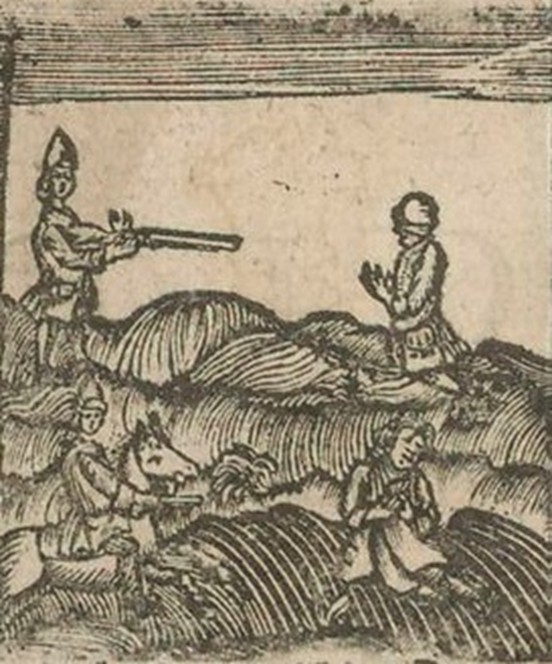
“But at length all these years and troubles came to an end, and the persecution of the Presbyterians did cease… There was in the parish of Muiravonside so far as I remember only three men that were declared rebels, viz Edward Marshall of Caymuir, and Peter Gillies [see note 1], and my father. Edward Marshall was taken, and executed in the Grassmarket of Edinburgh. Peter Gillies was taken and shot in the open fields…
“And now my father, that had been long hunted from place to place, and wandered many a weary foot, and had gotten many a cold bed, and many an untimely diet, had now liberty to dwell with his family and live quietly and serve his God without fear… and now he had his wife & five children,
Illus: “Some instantly shot in the fields” (from Cloud of Witnesses 1755).
two sons and three daughter alive,the youngest of which was now ten years of age. And now my father set about the labouring of his ground and his ordinary employment…and now he could help and lend to his neighbours . My father then, after the years 1688, he with his family continued together for the space of eight or nine years… all the family were abundantly frugal, for before this time they were all taught to read English, and to write tolerably well, for he was very careful to have his children educated according to his capacity… I remember he had one neighbour called John Eaddie of Bogo, who was naturally a man given to strife and contention, as is well known by all who knew him. And my father had a road through this man’s lands to the moor of Muiravonside for leading of his fuel and driving of his beasts to, which he would not allow him to possess. And so my father was obliged to raise a law process against him, first at Falkirk, and then at Edinburgh, which was both troublesome and expensive to him. But he gained his right, and this man having spent all his substance needlessly, was obliged to sell the best part of his land to the Calders from which my brother did buy them.”
Note
1. According to the Cloud of Witnesses Peter Gillies was put to death, along with several others, upon a gibbet, without legal trial or sentence, Claverhouse suffering them neither to have a Bible, nor to pray before they died, at Mauchlein, in 1685.
Sites & Monuments Records relating to the subject
Blackness Castle
SMR 416
NT 0554 8026
used as a state prison
Cargill’s Thorn
SMR 1901
NS 84 84
It lay in the open beside the road from Larbert to Stirling, on the estate of Woodside.
“Covenanter’s” Stone
SMR 1167
NS 79 77
An inscribed slab was found in a dyke near the gamekeeper’s house on Walton Farm in the 1960s. It is said to have borne the name John Smith, a covenanter. Its present location is unknown (2010).
Woodside Mill
SMR 870
NS 9503 7342
Peter Gillies was operating this mill as a fuller in 1685 when he was arrested for his covenanting activities and subsequently executed. At that time the mill was named as “Waukmill of Woodside”.
Lands and Lairds of Larbert and Dunipace Parishes.
Livingstone, E.
1920
The Livingstons of Callendar and their Principal Cadets.
Murray, G.
1887
Records of Falkirk Parish: a review of the Kirk Session Records of Falkirk, from 1617 to 1689.
Reid, J.
2009
The Place Names of Falkirk and East Stirlingshire.
Salmon, T.J.
1913
Borrowstounness and District.
Transactions
1881
Transactions of the Highland and Agricultural Society of Scotland Fourth Series, Vol. XIII.
Waugh, J.
1977
Slamannan Parish through the Changing Years.
1755 6th ed
Cloud of witnesses for the royal prerogatives of Jesus Christ, or, The last speeches and testimonies of those who have suffered for the truth in Scotland, since the year 1680

 Falkirk Local History Society