
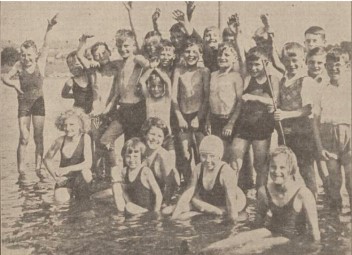
Until the 20th century the settlement of Stenhousemuir was bounded on the south by a small stream known as the Spout Burn, from which many derived their water supply. The field to the south was acquired by Carron Company, which extracted a large quantity of sand for its blast furnaces from the eastern half between c1900 and 1914. A mineral railway went under the Spout Loan (later called Crownest Loan) to Lamond’s Loch, along the south side of the Lade and into the works. The workings were then abandoned and over the following years the holes filled with rain water, causing great concern to parents.
In 1934 Stirlingshire Eastern No 1 District Council secured a 21 year lease of the field from the Carron Company and in 1938 engaged an Edinburgh firm to level the ground, leaving a shallow pond in the centre according to plans drawn up by Leonard Blakey, a Falkirk architect. Initially five local labourers and a foreman were employed but the use of an innovative machine called a bulldozer sped the work up and the levelling was achieved in just three weeks. The huge banks of waste at the east end were dealt with so efficiently that the machine was brought back to grade the access road from the Main Street to James Street and this was appropriately named “Park Drive.” The Council then planted 300-400 trees on the south side; six weeks afterwards there were only four left. Vandalism was to plague the park for years. The paddling pond was ready for the hot dry summer of 1939 and became known as the Lido, a popular name in the 1930s for a public outdoor swimming pool and surrounding facilities (lido is an Italian word for beach).
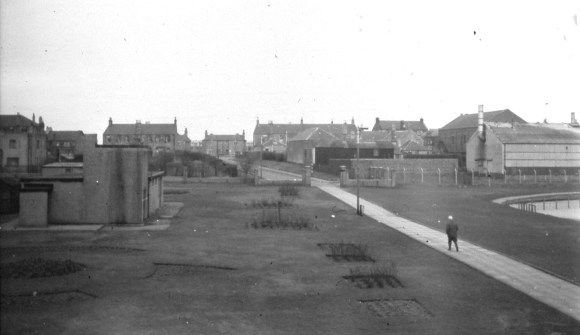
The war put an end to further improvements, but in 1945 Carron Company agreed to a 99 year lease. During the war, allotments had been formed in the SW and NE corners of the area and these remained for some time. A wartime decontamination centre was converted into a sports pavilion and Stenhouse Thistle F.C. became the home team.
A suggestion that the war memorial should be transferred from in front of the Dobbie Hall was assessed but found to be too expensive. Materials were scarce after the war and so the playground equipment took two years to arrive. Two sets of swings, two chutes, a whirling platform, and a joy-wheel were installed in the playground to the north-east of the pond.
“The chute appears to be the most popular of the contraptions and the weans have been patiently queuing for as long as ten minutes to get a five second thrill” (Falkirk Herald 23 April 1949, 4).
Over the following years a playing field with tennis courts and a putting green were laid out. A memorial gateway at the lower end of Park Drive commemorated the reconstruction, which had been part-funded by the National Playing Fields Association and the King George V Trust to the tune of £1,500. The new park was officially opened on 2 June 1953 by Arthur Fair, the convenor of the Council. The all-weather tennis courts had actually already been opened in July 1951 specifically for girls. Constructed to the west of the pavilion by Sportworks Ltd of Glasgow, they had cost £900.
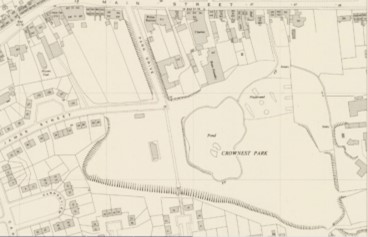
In the late 1940s new housing schemes were commenced on the south side of the park and a paved path was laid across the park to connect them with the town centre. Two concrete pillar standards at The Steps at the south end of the park helped to light the way and in 1953 a ramp was constructed so that prams could avoid the steps. A tree-planting scheme along Park Drive was undertaken conjointly with local children in the hope that it would reduce the level of vandalism seen in earlier years. Likewise a female tennis court attendant was appointed at a wage of £3 3s 8d per week. In the first season the tennis courts were used by 4,955 adults and 684 children. The outdoor draughts board turned out not to be quite so popular, though it was used by the older folk who now had a shelter. In the mid-1950s flower beds enlivening the appearance of the park.
The eastern side of the park remained relatively empty until the mid-1960s, when a north/south path was led across it and a children’s miniature traffic area was constructed to the east. This recreated major and minor roads, a fly-over and a fly-under, traffic lights and road signs – a layout put together by pupils of Larbert High School and the Police.
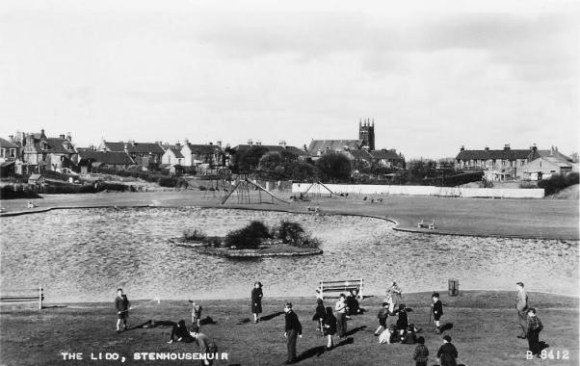
The cost was kept down by doing most of the work in-house. Bicycles and tricycles were available for hire and the layout became a test ground for the National Cycling Proficiency Scheme. It was part-funded by a Physical Training & Education Grant. The official opening was in May 1966 by Chief Constable David Gray. The annual revenue from the tennis courts, putting green, paddle boats and bicycle hire was more than sufficient to hire summer staff for the park.
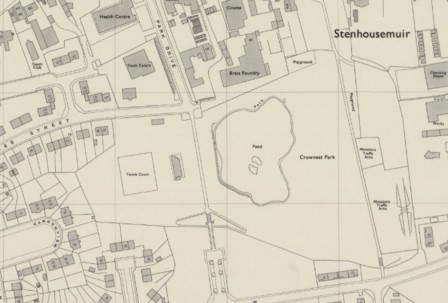
In the late 1980s flooding became problematic. Use of the park declined and so when the Falkirk District Council looked at regenerating the town centre at the beginning of the new millennium, the layout of the park was included. In 2006-10 the main shopping centre at Stenhousemuir was redeveloped and a large section of the park was engulfed by car parking and retail units. The miniature traffic area was removed, the contours remoulded in gentle mounds and reseeded with grass. The dilapidated sports pavilion was demolished and new paths laid out. The pitch, pavilion, and kick-about area were replaced and the pitch is now well used by a number of local teams, including Stenhousemuir under 13s and 14s. It was decided to build an elegant new library building as a gateway into the park and this was opened in 2008. The most dramatic change was to the configuration of the pond, which was reduced in size. A constriction provided an opportunity for a bridge across the narrow neck of land. However, its former parkland setting was subsumed in a semi-urban setting. For a more natural water course walkers can now go along the Lade to Carron Dams.
Sites and Monuments Record
| Crownest Park – Lido | SMR 2115 | NS 868 827 |
| Larbert Library | SMR 1771 | NS 8686 8276 |
 Falkirk Local History Society