
Hill Park at the east end of Broad Street, opposite East Boreland, had been used as the ground of Denny Athletic Football Club since the 1890s and was the venue of many athletic gatherings. The park was about six acres in size and the ground was rather undulating, particularly on the south side facing the main road.
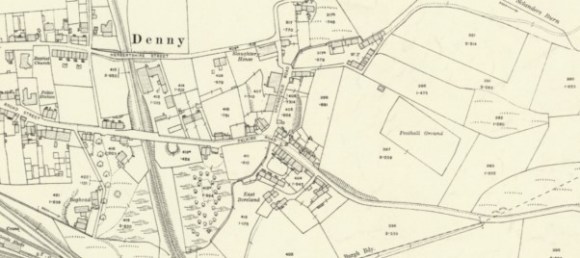
In 1928 the ground was gifted by James Anderson of Myrtle Cottage in Dennyloanhead to Denny Town Council. The Parks Committee set about improving it and Mr Paterson, the cemetery superintendant, drew up suitable plans which were implemented by Mr Cook, the Burgh Surveyor. The twofold division was retained with the football pitch and the flatter area around it being used for sport and the hilly portion facing the roadway as a pleasure ground. This front division was transformed. Mrs Anderson paid for new gateway which consisted of four stone pillars, two on either side, joined by curving roughcast wall. Above the gateway was a wrought iron arch bearing the inscription in gilt letters, “James Anderson Park.” From this central pathway the ground sloped up in semi-circular formations and several gravel pathways led to the top of the hilly ground. The spaces between these were planted with small trees and shrubs. Seats were placed by the Town Council at intervals along the pathways, and one near the entrance has been gifted by Provost Shanks. Part of the necessary funds came from a donation of £100 from the Carrongrove Paper Company which sum formed compensation for land that the company had acquired in the Herbertshire Policies at a time when the Town Council had put in a preference for it. The formal opening ceremony took place on 7 June 1929 in the presence of a large gathering. Mrs Anderson was given a gold key inscribed on one side: “Burgh of Denny and Dunipace. Presented to Mrs Anderson by the Town Council” and on the other side: “James Anderson Public Park. Opened 7th June, 1929.”
In the poor soil not all of the trees survived the first winter’s weather and they were replanted. A flimsy changing room had been erected by the football club and in 1933 it was replaced by a larger structure to the west for use by the YMCA. The first bricks made at the new works at Cannerton were donated for its foundations. Football was a great spectator sport in those days and the matches regularly attracted two to three thousand people. The football pitch was much used by juvenile teams and schools. Initially the local bands gave performances in the park during the summer months and in 1933 circuses put it on their annual circuits. The park was just beyond the urban fringe and new houses were built at the end of Springfield Road – this section becoming known as Anderson Park Road. Owing to the darkness in the vicinity a street lamp was erected there in 1934, illuminating the rear entrance to the park.
In common with most of the parks in the area the swings were chained up at night and a part-time employee was appointed for this task as well as undertaking some maintenance and gardening work. In 1935 the post was made full-time by amalgamating it with three other part-time jobs. It also entailed work at the lavatories at Denny and Dunipace and the swings at the park in Glasgow Road.
The park was mostly used for football matches and sports and so when Denny Amateur Athletic Club requested that the hill to the south of the pitch should be levelled the Town Council agreed on the understanding that the hill would act as a temporary quarry for Messrs Filshie of Headswood. As a consequence of the new Town and Country Planning Act this required planning permission which was granted the following year. Parents were requested to keep their children away from the site and operations continued for a number of years. The name of the park was transferred to a new public open space on the west side of the Glasgow Road. It was late in 1955 before the ground at the south end of the old James Anderson Park had reached a level that enabled the planners to go ahead with the laying of a new football pitch. This was to be encompassed by a running track with six lanes. However, the plans do not appear to have been executed and the Ordnance Survey map of 1961 does not show any football pitch in the field.
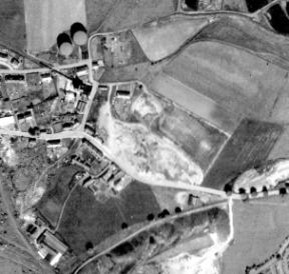
Today the south portion of the field is cut by the re-aligned road to Falkirk as it runs past the new Denny High School.
National Grid Reference
NS 819 827
 Falkirk Local History Society