

(Certified Industrial)
The early nineteenth century saw the formation of a number of so-called “Ragged Schools” in England to take in destitute boys and girls and train them in the ‘habits of industry.’ This was a charitable act spurred on by the nuisance that such street urchins were causing which often led them on a path to crime. By the mid-century the Ragged Schools in Edinburgh were setting the standard for Scotland and inspired by them, early in 1857, Major and Colonel Dundas of Carronhall brought together a committee of influential people to establish a school in Falkirk. The committee was composed of Major Dundas (chairman), Colonel Dundas, Sheriff Robertson, John Gair (secretary and treasurer), Rev McLaren; Rev Wade, Rev Irving; Alexander McFarlane, P Gentleman, R Adam, R Young and Stuart Nicolson. By October they had secured a master – James Brown. By the following October they had premises and a matron and had 24 children under their care. The Ragged School was not viewed as a rival to the Falkirk Charity School because it was the intention to board the pupils when circumstances allowed.
The constitution of the institution laid down the essentials:
“(1) It is the object of this school to reclaim the neglected or profligate children of Falkirk and its vicinity, by affording them the means of a good, common, and Christian education, and by training them to habits of regular industry, so as to enable them to earn an honest livelihood and fit them for the duties of life.
(2) The following classes of children are excluded: First – those regularly attending day schools. Second – those whose parents are earning a regular income and able to procure education for their children; with this declaration, that it shall be in the power of the Acting Committee to deal with special cases, although falling under either of these classes, having regard always to the special objects of the Institution.
(4) All subscribers of 10s and upwards, and all donors of £25 and upwards, shall be members of the Association.
(6) The general plan upon which the School shall be conducted shall be as follows, viz: To give the children an adequate allowance of food for their daily support; to instruct them in reading, writing, and arithmetic; to train them in habits of industry; to teach them the truths of the Gospel, making the Holy Scriptures the ground-work of instruction; on Sunday the children shall receive food as on other days, and such religious instruction as shall be arranged by the Acting Committee.
(7) Children of all denominations shall be equally admitted to the benefit of the school.
Subscribers to the amount of £5 per annum, or donors of £25, shall have right to nominate a child as the particular object of their bounty, subject to the same regulations and conditions regarding admission as in other cases.”
In the early days fundraising occupied much of the time of the worthy committee of management. In October 1857 the Trustees of the late Mr Ferguson offered a grant of £150 to the Falkirk Ragged School, provided that the managers raised an additional £350 for the purpose of acquiring permanent premises. They had already collected £250 and James Walker, engineer, London, subscribed a further £20. Lists of subscribers appeared periodically in the Falkirk Herald. The financial struggle can be seen in the first set of accounts which showed a deficit of expenditure over subscriptions:
| Sums received 1857-58 | |||
|---|---|---|---|
| Annual subscriptions | 79 | 12 | 6 |
| Donations | 346 | 5 | 0 |
| Interest | 4 | 13 | 5 |
| Small sums received by teacher | 1 | 8 | 3 |
| TOTAL: | £431 | 19 | 2 |
| Expenditure 1857-58 (11 months) | |||
|---|---|---|---|
| Food, clothing, fuel, & c | 61 | 11 | 8 ½ |
| Salaries | 62 | 10 | 0 |
| Rent | 10 | 0 | 0 |
| Goods for work | 8 | 11 | 6 ½ |
| Expenses for fitting up school, & c | 28 | 12 | 10 |
| TOTAL: | £171 | 6 | 1 |
These figures were presented at the first annual meeting of the school and it was pointed out that as a result the grant from the Ferguson Trust was at risk. James Russel, solicitor, immediately subscribed £100 at the meeting!
A three year lease of a building at East Burn Bridge was obtained at a moderate rent of £12 annually. It was fitted up with baths, boilers, kitchen apparatus and school furniture sufficient for 40 scholars, and opened on 14 November 1857. Initially only 22 pupils were taken on as an experiment. This broke down to 13 boys and 9 girls, of these 18 did not even know the letters of the alphabet. The teacher, James Brown, was a very kind and patient man and within a year most of the children had been brought up to a standard close to that of other children of their age. It is said that he never needed to use physical punishment. As well as the teacher there was a matron, Mrs Parker, who taught sewing and saw to the cleaning and cooking – helped by the children. At this stage the children were day pupils.
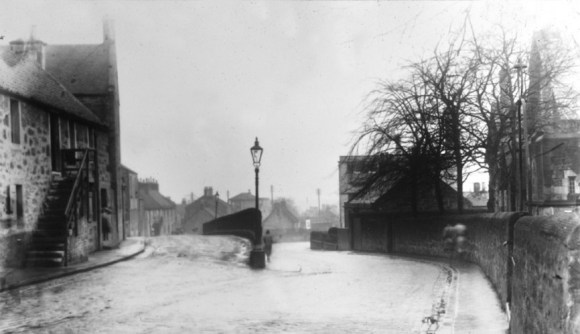
In 1859 a building with ground on the north side of Kerse Lane was purchased for £350. The disposition of 13 May 1859 conveyed the piece of ground
“and the buildings erected or to be erected thereon are to be used as a school for destitute children.”
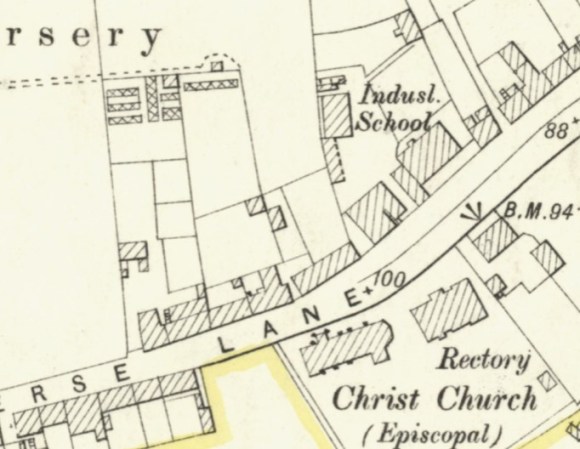
The following year the school was marked on the first edition Ordnance Survey map. To the west of the school was a well-established garden nursery.
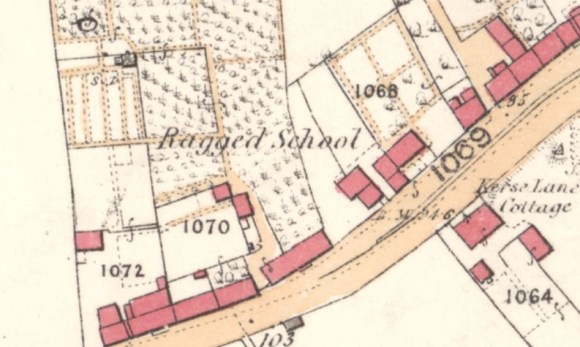
As it was new, the description of the school provided by the Ordnance Surveyors was full:
“Two small but substantial buildings one storey high, slated and in good repair. With gardens attached situated in Kerse Lane… There are a male teacher and a matron attached to it, who are each allowed a fixed salary and apartments in a part of the building. The boys are interested in reading, writing, arithmetic & c, and also in shoemaking. The teacher acting in the double capacity of schoolmaster and shoemaker. The girls are, in addition to reading, writing & c, instructed in knitting, sewing and household work. The institution is supported by voluntary subscriptions and contributions. Average attendance, 40.”
Amazingly, a bazaar held in the Corn Exchange in July 1861 raised £534 16s 6d for the Ragged School and gave it the confidence to continue and expand. The annual report for that year showed that two of the boys had been sent to trades and two girls to service, and two boys and four girls had been removed by their parents (usually to go to work). This left the number attending the school at 24 males and 21 females – 45 in all. The Government Inspector had given a favourable annual report.
The ethos and routine of the school was given by the Falkirk Herald in January 1865:
“There are a good many institutions of the benevolent sort in Scotland that do honour to us as a people. And one of the foremost is, undoubtedly, the Ragged School now common in almost every city and country town… Falkirk, to the credit of its churches and its industry, has its Ragged School. At present, there are about 30 boys and 20 girls on the roll… The children assemble at 7am. First thing done, is the stripping operation for the bath; and after thorough ablutions, the school moleskins and little “wrappers” are put on, in lieu of the home rags, which are stowed away past till evening. Porridge is served at nine o’clock. From 9.30 till two, the “bairns” are instructed in the usual elementary branches – such as reading, writing, arithmetic, geography, grammar & c, when, at that latter hour, dinner comes, consisting of a basin of broth and a “scone,” with two ounces of “kitchen,” for each child. Then, from three till six, the boys are engaged at shoe-making, or spade-husbandry; while the girls are being trained into needle-stitching and knitting-work, by Mrs Macammond. Porridge is again served: and, with the old garments once more dangling about their naked limbs, the little ragged band scamper off to their wretched and cheerless homes. At present there is, however, an airy and commodious dormitory being furnished in connection with the Institution which, when completed, will give some twenty of the children the additional luxury of a clean and comfortable bed. And money thus spent for the moral and intellectual well-being of our Arab community, is money, and more than money, saved. The capital which has been sunk in such well-directed philanthropy will assuredly return into the common treasury by and bye, and that with splendid interest…”
The provision of a dormitory was an important step and was the first of many such extensions. It brought with it problems of parental care and sickness. The children attending the school were already weakened by poor diets and living conditions at home and so were susceptible to diseases. Whilst boarding removed some of these influences it could also lead to the spread of some infections. In 1866 some of the boarders caught a fever, which was relatively mild, and were nursed by their dutiful and caring teacher. James Brown then caught the illness and it proved to be more virulent in an adult. He died at the school on 21 November.
Donations in kind were made by the public from time to time. For example, a local baker occasionally treated the children to meat pies. Towards the end of 1866 Oliver Scott presented sixty warm comforters to help them through the winter. In 1867 another bazaar in the Corn Exchange raised another large sum. Part of the money raised was spent on new buildings and alterations which were completed in February 1869. The new buildings were of two storeys. The new schoolroom and the dormitories enabled the Committee to provide sleeping room for 40 children in place of 20. Now that the school had settled into an established routine the financial pattern had changed:
| Receipts during 1868 | |||
|---|---|---|---|
| Balance in hand on 1 January | 7 | 3 | 2 |
| Subscriptions | 180 | 18 | 3 |
| From Larbert Parochial Board | 3 | 15 | 0 |
| Sale of produce, & c | 12 | 16 | 02 |
| Sundries | 3 | 3 | 10 |
| TOTAL: | £207 | 17 | 1 |
| Disbursements 1868 | |||
|---|---|---|---|
| Salaries | 88 | 0 | 0 |
| Food | 190 | 14 | 5 |
| Clothing | 51 | 9 | 6 |
| Washing, fuel, light | 22 | 2 | 5 |
| Repairs, taxes, insurance | 2 | 11 | 2 |
| Furniture, bedding, & c | 24 | 14 | 8 |
| Printing, postages, books, & c | 20 | 1 | 4 |
| Medical expenses | 2 | 4 | 2 |
| Sundries | 6 | 14 | 5 |
| TOTAL: | £408 | 11 | 5 |
For some reason or another, the Government allowance was not included in these accounts, but it was sufficient to cover the difference between the amount of receipts and that of disbursements. The allowance arose from the provisions of the “Industrial Schools Act” under which Falkirk Ragged School now fell. By this Act children could be placed at the school under an order of detention. Usually this resulted from some minor misdemeanour and was imposed by a court of law. In 1868 some 35 children had been so placed at Falkirk. Two years later, in 1870, it was 44 out of the 50 children at the school. Slowly the character of the school was changing. Over the following years more and more of the “pupils” were coming from further and further away, including Edinburgh, Glasgow and Argyllshire.
From 1868 Falkirk Ragged School was also known as Falkirk Industrial School (certified). Despite the changes it still enjoyed the support of the public. This is exemplified by a comment in the local newspaper in January 1873. It noted that there were 39 boys and 31 girls on the roll and so additional teaching staff had been appointed. Of the 70 children present in the institution, 61 were there under detention –
“in plain language, they had started upon the criminal course, and were arrested and cared for ere crime had corroded their better nature, and irredeemably poisoned their minds to abiding good impressions.”
The 1868 accounts given above show a sum of £12.16.2 resulting from the sale of produce. This came from the so-called “Industrial Department.” The main products were firewood, vegetables and clothing. A wood chopping shed was erected to the north of the school, and one of the rooms became a carpenter’s shop. Tailoring, shoemaking, gardening, animal husbandry (there was a piggery), sewing, knitting, laundry work, and housekeeping were all taught. A janitor, a carpenter and a tailor were employed. The income from the industrial department increased substantially over the following years:
| 1880 | £66 | 15 | 7 |
| 1881 | £86 | 19 | 1 |
| 1882 | £116 | 16 | 4 |
| 1883 | £117 | 19 | 11 |
| 1884 | £161 | 17 | 1 |
| 1885 | £190 | 12 | 4 |
.
1885 was a bad year for the school, which saw the deaths of four of the girls. There had been none for girls the previous nine years. Three of these were cases of constitutional disease – one of disease of the kidneys, one of consumption and the other of very acute bronchitis. The remaining case was already in a dying state when admitted. She had only been admitted because her two elder sisters had been detained there and she could not be left with her drunken father. Infant mortality in the general population was still quite high and these deaths were accepted as an occupational hazard. They were not the last in the school. The medical and funeral expenses were included in that year’s accounts:
| Receipts for 1865 | |||
|---|---|---|---|
| Balance brought forward | 221 | 14 | 3 |
| Government maintenance | 615 | 6 | 9 |
| Subscriptions and donations | 122 | 7 | 6 |
| Wages of apprentices | 66 | 19 | 9 |
| Board by parents and Parochial Boards | 60 | 5 | 0 |
| Firewood sold | 107 | 9 | 8 |
| Produce sold | 11 | 18 | 3 |
| Old beds sold | 1 | 6 | 0 |
| Hair teasing and mangling | 3 | 18 | 8 |
| Interest from Bank of Scotland | 1 | 5 | 5 |
| TOTAL: | £1212 | 11 | 3 |
| Expenditure 1885 | |||
|---|---|---|---|
| Salaries | 246 | 14 | 0 |
| Provisions | 331 | 16 | 2 |
| Clothing | 115 | 17 | 4 |
| Washing, fuel and light | 53 | 10 | 7 |
| Repairs, taxes and insurance | 27 | 13 | 8 |
| Furniture and house sundries | 76 | 15 | 0 |
| Printing, book and stationery | 19 | 18 | 5 |
| Medicine and funeral expense | 6 | 9 | 10 |
| Materials for industrial department | 73 | 19 | 2 |
| Sundries, rewards, & c | 14 | 12 | 7 |
| Gratuity to Mr Clark | 10 | 0 | 0 |
| Collecting subscriptions | 1 | 0 | 0 |
| Balance in Bank of Scotland | 234 | 4 | 6 |
| TOTAL | 1212 | 11 | 3 |
The children at Falkirk Industrial School were well cared for and miscreants were treated leniently. However, the nature of the school had shifted substantially. Increasingly more and more difficult children were being detained there and their influence on the others was detrimental. The late 1880s saw a number of them running away and sleeping rough, leading a life of crime. The police tended to recognise them because they had been issued with corduroy suits as part of their school uniforms. As these tended to be the boys from further afield, their actions did not impact directly on Falkirk. Writing in September 1888 a commentator for the Falkirk Herald did not blame the staff at Falkirk:
“The treatment of boys inside the school is known to be good; in fact, that they are able to run away so freely shows that the place is no prison-house for them. The lesson of the running away of boys is that the admissions to the school should be more carefully regulated.”
Those who persisted were sent to reformatory schools – the next step up.
Given the success of the Industrial Department, it is not surprising that the workshop was enlarged in 1890. That year also saw the setting up of a flute band. The Falkirk Industrial School Band soon became a favourite with the public, playing at garden shows, galas and other public events. These excursions were seen as beneficial to improving the behaviour of the pupils. Financially the school was prospering from the steady income provided by the Government. Further extension occurred in 1892 and in 1894 a sum of £166 was spent on refitting the laundry, building a new lavatory, and altering the drains.
Occasionally the boys were now referred to as “inmates.” With changes in government policy the school became exclusively for boys around 1895. This meant a sharp decrease in the numbers there, reducing them from around 70 to 45. In November 1896 two of the boys, aged fourteen and fifteen, set the workshop on fire. A large quantity of wood was burned, along with tools, consisting of saws, axes, etc. and a quantity of straw and bedding. The damage was estimated at about £100. It was rebuilt. The government continued to reform the sector and now preferred large, centralised schools where a number of different professional skills could be taught. Consequently, in February 1898 Falkirk was informed that her Majesty’s Inspector of Reformatory and Industrial Schools to the Home Secretary was to withdraw its certificate from August that year. The people of Falkirk were astonished and surprised at the prospect of losing a 40 year old institution. Meetings were called and legal advice taken. Inevitably, the decision was taken to close the school and find another purpose for it. An examination of the title deeds of the property showed that the latter course was not actually available as the wording said that it was:
“to be used as a school for destitute children until the same be sold or the destitution thereof otherwise changed by a majority of the subscribers for the time being to the funds of the said Falkirk Ragged Industrial School convened for that purpose.”
It closed in April 1898. The children accommodated in it were disposed of as follows: four discharged, 28 sent to Dr Guthrie’s Industrial School at Edinburgh, and 12 to the training ship Mars. The property of the school, estimated to be of the value of nearly £1,700, was sold. Gratuities were given to the employees to the amount of £450, and the balance of the free proceeds was divided as follows: two-fifths to the Falkirk Town Mission, two-fifths to the Falkirk Cottage Hospital, and one-fifth to the Falkirk Science and Art School evening classes.
“GROUND AND BUILDINGS AT KERSE LANE. To be sold by public roup, within the Crown Hotel, Falkirk, upon Thursday, the 9th day of March 1899, at two o’clock afternoon, the ground and buildings in Kerse Lane, Falkirk, until recently occupied as the Falkirk Certified Industrial School. The ground extends to 871 thousandth parts of an acre or thereby. The front buildings consist of (1) Superintendent’s dwelling house of two storeys, containing, on ground floor, room and kitchen, and on upper floor, three rooms and W.C.; (2) Two storey building containing, on ground floor, dining hall and two rooms, and on upper floor, four rooms; (3) One-storey building adjoining containing two apartments formerly used as kitchen and housekeeper’s room; (4) Two-storey building formerly used as playroom, lavatory, and bathroom on ground floor, and two dormitories on upper floor; and (5) Two-storey building containing schoolroom on ground floor and three dormitories on upper floor. The back buildings consist of open shed, large workshop, lavatory, and office-houses. Feu-duty 13s4d. Upset price £1650. For further particulars apply to A & JC Allan & Co, Solicitors, Falkirk, who will exhibit the titles and articles of roup.”
(Falkirk Herald 18 February 1899).
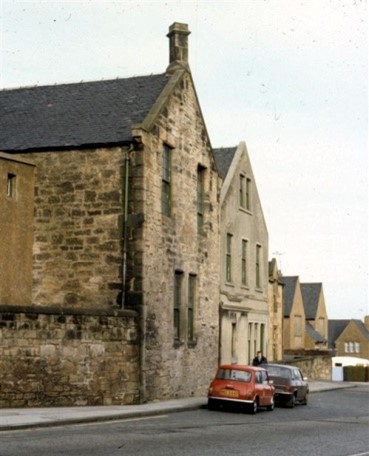
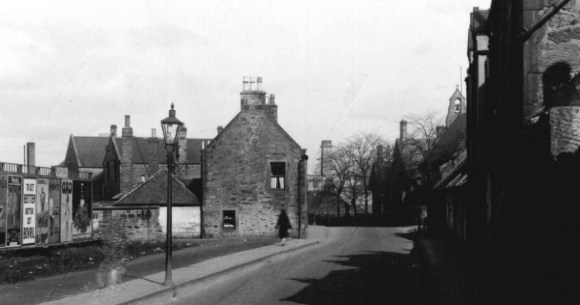
The building was then used as a model lodging house into the late 1980s. It was demolished in 1991 and flats built on the site.
| YEAR ARRIVED | HEADTEACHER | YEAR LEFT | No. PUPILS |
|---|---|---|---|
| 1857 | James Brown | 1866 | 22 |
| 1867 | Andrew S Johnman | ||
| 1867 | John McGilchrist | 1873 | 55, 70 |
| (1886) | John & Mrs. Clark |
| MATRONS | |||
|---|---|---|---|
| (1858) | Mrs Parker | ||
| (1861) | Margaret Anderson | ||
| (1866) | Mrs Macammond | ||
| (1870) | Mrs McLaren | ||
| (1886) | Mrs. Clark | (1899) |
Sites and Monuments Record
| Kerse Lane | SMR 1464 | NS 8923 8005 |
 Falkirk Local History Society