
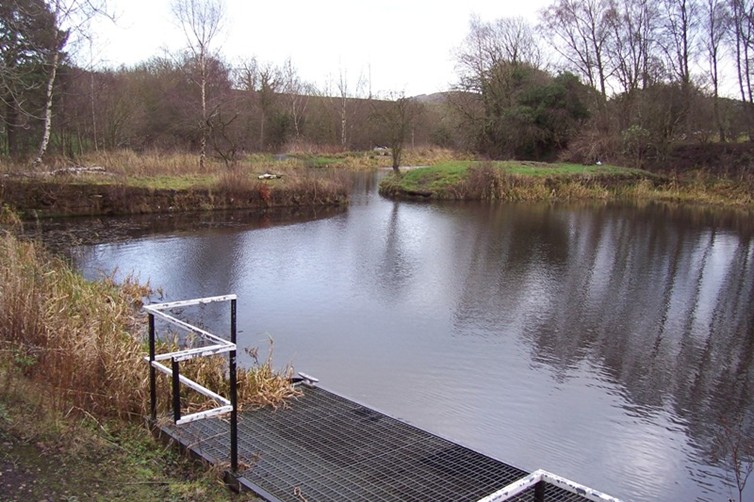
SMR 717 / NS 9613 7613
The Union Canal from Edinburgh to Falkirk was opened in May 1822 and this encouraged the development of coalfields along its route. At Muiravonside coal was carried to the bank of the canal by
“a good cart road [which] passes to the shipping place at Causewayend Bridge” (Caledonian Mercury 13 August 1825, 1).
The Slamannan Railway Bill was put forward in 1835 to construct a mineral line from near Airdrie to the Union Canal in order to open up further coal deposits to exploitation and to feed the energy market in Edinburgh. At the same time it was recognised that the new line would form the quickest communication between Glasgow and Edinburgh and that it could be opened up to passenger traffic. The Union Canal Company was particularly keen to develop this aspect of the business and on 3 August 1835 signed an undertaking to construct facilities to cater for it. The eastern terminus of the line which opened in 1840 was at Causewayend where a canal basin was duly constructed to tranship the cargoes and transfer passengers.
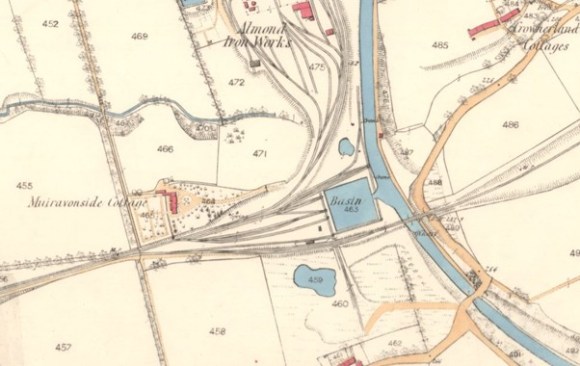
The designs for the basin were submitted to the Slamannan Railway Company by its own engineer, John Macneill, in 1839. They were
“of such size and structure as to furnish adequate accommodation for the mineral traffic and for passengers, quite distinct from each other, and convenient for each.”
It was agreed with the Union Canal Company, that the part of the works bordering upon their canal should be executed by them, and at their expense, and should at all times be patent for the use of the passenger trade, free of wharfage or other claim. For executing the remainder of the works, the Slamannan Railway Company entered into contracts with Michael Fox, which fixed the cost of the basin to it at £809, and put the completion date at 1 April 1840. An inclined plane was required to take the wagons and carriages from the canal basin up the hill to the west, from where steam locomotives were used along the rest of the line. In mid-March 1840 the resident engineer, Thomas T. Mitchell, noted that
“The basin at Causewayend is nearly all excavated, and the masonry of the wharf walls is proceeding as fast as the weather will permit” (Herapath’s Railway Journal 28 March 1840, 3).
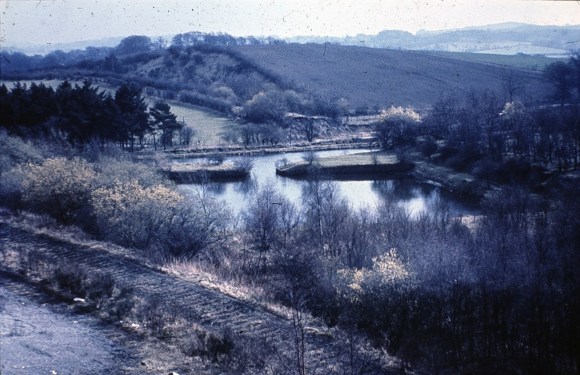
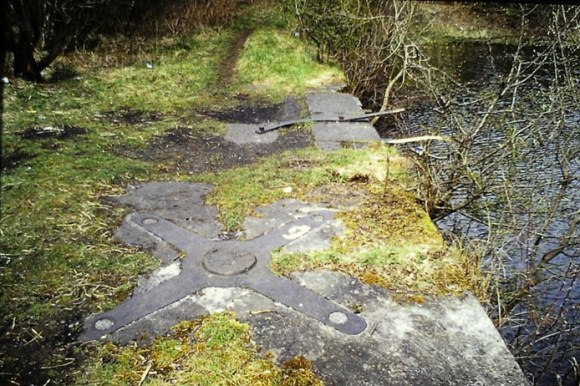
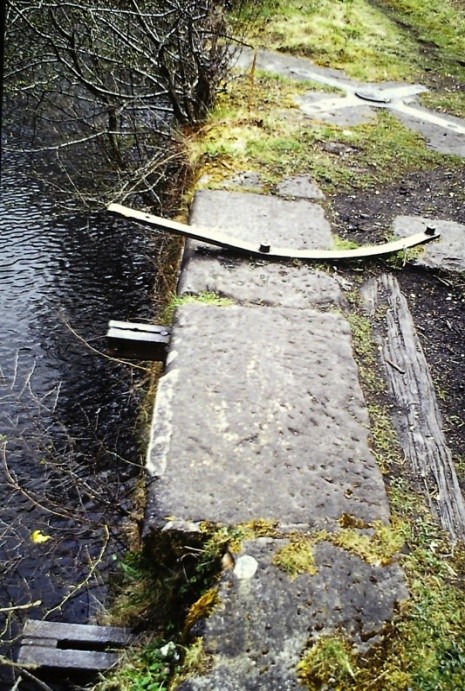
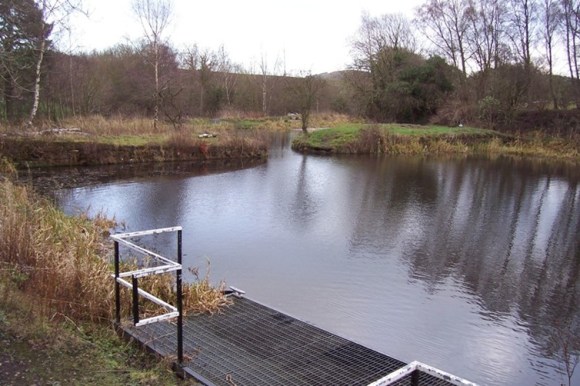
The basin or dock was 150ft square and was separated from the canal on its north-east side by a strip of land only 6.5m wide. In the centre of this side was an opening 15ft wide to allow barges to pass between the canal and the basin. The west side of the basin had a quay of massive stonework, and today its coping bears some remains of loading machinery. Grooves worn into its edge are said to have been made by pigs of iron being slid down into barges. The east side and the entrance are also faced with masonry using smaller blocks.
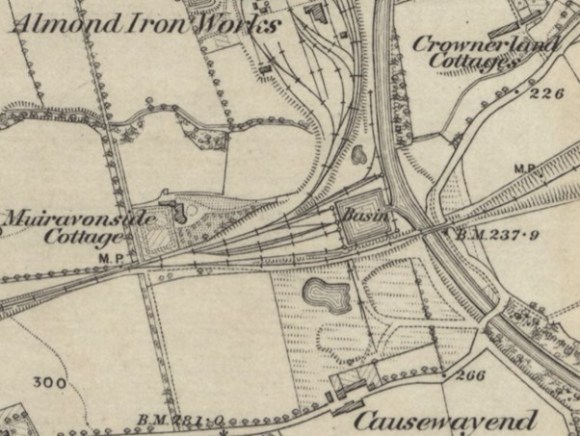
The layout of the rails on the 1863 Ordnance Survey map suggests that the western bank of the basin was the main loading area for coal, but that the northern side would have been used for other cargoes. The rails there extend a short distance along the canal bank where a crane is shown and were fixed to stone blocks rather than wooden sleepers, as were those of the main line.
“NOTICE TO COAL AND IRON MASTERS, DEALERS IN COAL, GRAIN, &, &c. THE SLAMANNAN RAILWAY is OPEN for TRADE from END to END, and by it, and the connecting Railways, and the Edinburgh and Glasgow Union Canal, a Speedy and Cheap Means of Conveyance is afforded between the Cities of Glasgow and Edinburgh, Airdrie, and the other Towns and Places on the Line of the Railway. Copies of the Table of Rates and Dues may be had at the Company’s Office, at Causewayend, near Linlithgow; at the Toll-house on the Ballochney Railway; or at 36 Miller Street.
By order of the Directors,
JAMES MITCHELL, Clerk. (Scotsman 27 June 1840, 1).
Passenger traffic would have been confined to the southern side of the basin and here the railway passengers were met not just with barges but also with stage coaches. When the Slamannan Railway and the basin at Causewayend had been officially opened, officials from the Union Canal Company had joined a special trip from Glasgow to Edinburgh on 30 July 1840 arranged to celebrate it and looked forward to increased passengers on the canal.
“On Thursday last the Directors of the Slamannan Railway along with a number of shareholders, some of the Directors of the Union Canal, and several practical engineers, took an excursion along the Glasgow and Garnkirk, the Monkland and Kirkintilloch, the Ballochney and Slamannan Railways to Causewayend near Linlithgow, on the Union Canal, and thence by the Union Canal to Edinburgh. The party left Glasgow at five minutes past 8 o’clock in the morning, and reached Causewayend at 20 minutes before 10. By one of the swift passage boats the party were conveyed to Edinburgh in two hours and a half – the whole journey from Glasgow to Edinburgh being thus performed in four hours with the utmost ease and pleasure. After partaking of an elegant refreshment, provided, in the most handsome manner, by the Directors of the Union Canal Company, the party returned to Glasgow in time for dinner. We understand that this route to and from Edinburgh will be opened to the public this week, when a speedy, safe, agreeable, and cheap communication with the metropolis, will be opened up to our fellow citizens.” (Glasgow Herald of 3 August).
They were subsequently greatly dismayed by the following notice:
“John Croall & Company beg most respectfully to announce to the Public, that they have entered into an arrangement with the Glasgow and Slamannan Railway Company to carry their Passengers between CAUSEWAYEND and EDINBURGH. They will therefore, on and after MONDAY FIRST, the 30th current, start their new Coaches, ENGINEERS, between Edinburgh and Causewayend, in connection with the SLAMANNAN RAILWAY from GLASGOW. The Coaches are fitted up with every requisite for the Safety, Comfort, and Convenience of Passengers, and will travel at a speed far exceeding the present Conveyances…” (Scotsman 25 November 1840, 1).
That December the minutes of the Union Canal Company acknowledged that a considerable number of passengers had been lost to the coaches. Difficulties developed with the Railway Company in the following month, first because the train failed to wait for the boat when it was a few minutes late, and then because the railway office stopped selling tickets for the canal but continued to sell coach tickets (Lindsay 1968, 82).
However, when the Edinburgh and Glasgow Railway opened to Haymarket in 1842 the passenger service through the basin at Causewayend collapsed. Indeed, the usefulness of the dock was much reduced shortly thereafter when the Slamannan Railway was connected with the Edinburgh & Glasgow Railway and then with the docks at Bo’ness.
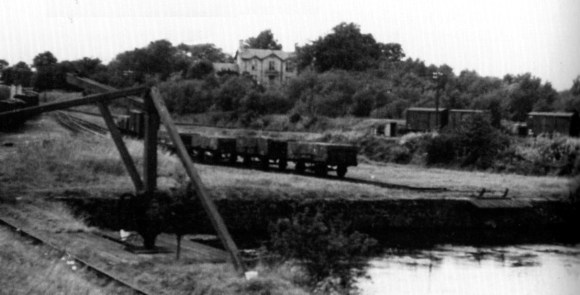
Causewayend was still used for heavy goods such as coal going to the south side of Edinburgh and the railway tracks were extended round all the sides of the basin with turning points at the corners to allow the railway wagons to be rotated through 90 degrees.
Coal was still shipped from Causewayend until well into the 20th century. George Bryson recollected seeing it in use in the period around 1910-1930.
“if there was a barge being loaded with coals, how we stood fascinated o see the wagon being upended by a crane and, of course, the climax when the coals shot over the end onto the barge… quite a lot of coals were shipped from Causewayend to Edinburgh. The basin at Causewayend was constructed for this purpose and is described as having facilities to load barges with coals from railway wagons. These facilities included two cranes and two turntables for wagons. I have mentioned the crane which lifted the end of a wagon right up to tip the coals into a barge, but this crane revolved on one large centre spindle and could go round and round. A trick which the children used to play (and this was not confined to boys) was to get someone to hang onto the hook then wind them up and swing them right over the water in the basin, at times stopping and letting them hang with nothing but a drop into the water. The other crane was of a type more often seen with stay legs and was used to lift large boxes of coals from the wagons and dump them into the barge.
The crane which lifted the ends of the wagons had a turntable quite close and if a wagon was the wrong way round, it was stopped on the turntable and turned. When the wagon was emptied it came back into the turntable and was turned 90 degrees round to take it out of the way of loaded wagons. If there happened to be too many empty wagons they were turned on the next turntable and pushed into a siding. As a boy I saw all this happed quite often” (Bryson 1981, 26)
In June 1854 Messrs Russel & Co obtained a feu from Forbes of Callendar of part of Almond Estate at Causewayend for erecting an ironworks and within a short time it was producing pig iron on a large scale. Extensive railway sidings were placed immediately to the north of the basin to serve the works and it appears that this is when the pig iron was loaded onto the barges there. Almond Iron Works closed in 1881 after a short but very profitable period of trading. Because the Causewayend Basin was used for a relatively short period and for a limited range of goods it never developed the infrastructure of other inland ports. There were no warehouses, workers’ housing, offices, maintenance yards, and so on. Some form of office was necessary to handle the paperwork connected with the transit and transfer of goods – and we do know that passenger tickets were sold here. The initial enthusiasm that led to the construction of the dock must have been extended to an office and it is probable that Almond House (originally known as Muiravonside Cottage) was built for the manager (see SMR 860). It stood on the hill overlooking the basin. It was subsequently acquired for the manager of the Almond Ironworks, and later rented to senior officials at neighbouring collieries. The few workers employed at the basin would have been accommodated in the nearby hamlet at Causewayend. In the field between it and the basin clay was extracted from large pits which flooded upon being abandoned. A light railway took the clay to the loading platforms at the basin and this was routed through an under-bridge when the mainline was extended eastwards.
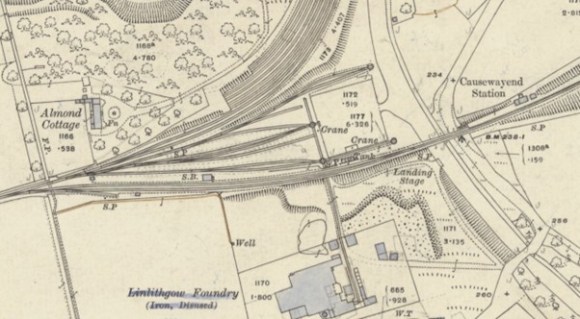
The canal basin was bypassed by the extension of the railway down to Bo’ness and a passenger station was placed to the north of the canal and called Causewayend Station. The rails for this through route were placed on an embankment to the south of the basin and a bridge carried them over the canal. It was the presence of the railway rather than the canal that led to the siting of the Linlithgow Foundry here, though it was able to make use of the 1820s landing stage. This foundry made use of the derelict opencast land and additional housing was erected for its workforce to the east of the existing dwellings at Causewayend.
With the closure of the two ironworks the area went into a sharp decline. The basin was abandoned and vegetation soon encroached upon it. It became a playground for children. In 1973 James Horne relating how as a child they he and his friends used the same crane as mentioned early by George Bryson.
“They were whirling the crane like a roundabout, with one boy hanging from the dangling chain, when the boy’s feet knocked another boy into deep water, They were all so intent on hailing him out that they forgot that the singing boy was now dangling outboard over the same deep water!” (Scots Magazine 1 September 1973, 11).
There was a short respite during the Second World War when the railway sidings were used to store ammunition for the navy and the area had its own protection force.
Then, at the end of the twentieth century, proposals were made to form the Millennium Link and floating stages were anchored to the west and north sides of the basin. Slowly they were populated with residential boats, utility services were introduced, and storage cabins with placed on the old railway lines.
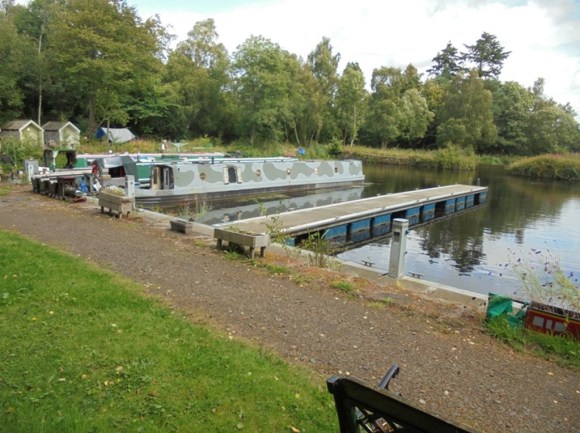
The basin is now linked to a network of country paths which include this section of the Slamannan Railway as well as the towpath of the Union Canal.
 Falkirk Local History Society