
SMR 203 / NS 9558 7696
Muiravonside was originally in the Parish of Falkirk. Haining Castle contained its own private chapel on the second floor. The castle appears to date to the late fourteenth or early fifteenth century and it is possible that at this early date the Crawford family’s priest ministered to some of the local people, for as a result of a petition by Rankin de Crawford in 1454 a papal mandate directed the Bishop of Dunblane to grant to the inhabitants of Manuel the right to elect a clerk-minister to help the chaplain and priest who celebrated divine offices in the church or chapel. The church or chapel was said to have had cemetery, baptistery, chrism vase, burial place, and a priest from time immemorial. Cemetery, or the right to burial, may indeed go back a long way because long cist inhumations were found near the castle in 1873 (SMR 2212). The relative positions of the castle and the later church suggests that the building referred to in 1454 also lay close to the castle, as would be normal at that date, and is not therefore a reference to the “Popish Chapel at Ballenbreich”.
In 1641 Lord Livingstone held patronage of Muiravonside Church, which was still a pendicle of Falkirk. Then, on 10 June 1648 Muiravonside disjoined from Falkirk Parish, the Act stating that “albeit it has been distinctly and separately served by a Minister above 60 years gone” it had been a pendicle of Falkirk. This confusion appears to have been common and even the presbytery record of 1606 is said to have treated it as a distinct charge. At some time in the seventeenth century the church became known as Almond Church, the Castle also passing under this name having taken the title from Lord Livingstone. The old church building at Manuel Nunnery seems to have been adapted for use as a parish church.
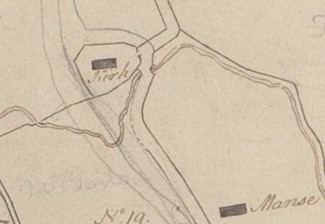
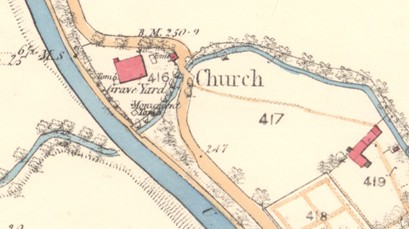
The 17th century church stood on the same spot as the existing one. A plan of 1796 shows it before the construction of the Union Canal (which has been added to the plan in pencil) and indicates that it occupied much the same footprint. The early churchyard was evidently oval in shape suggesting a much earlier origin for it.
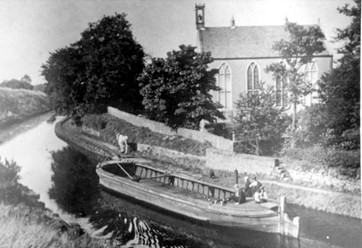
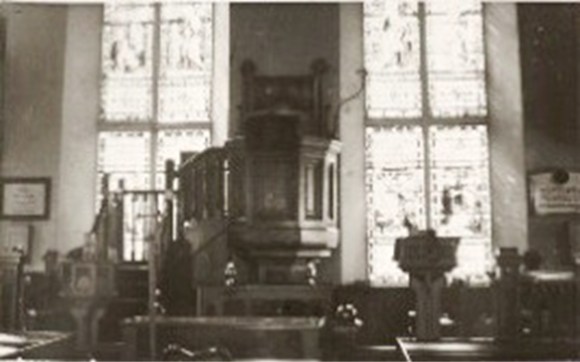
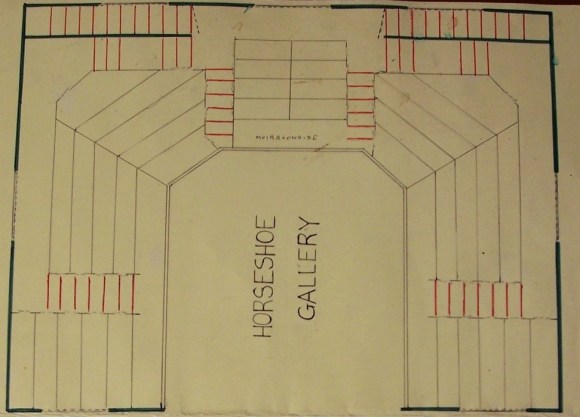
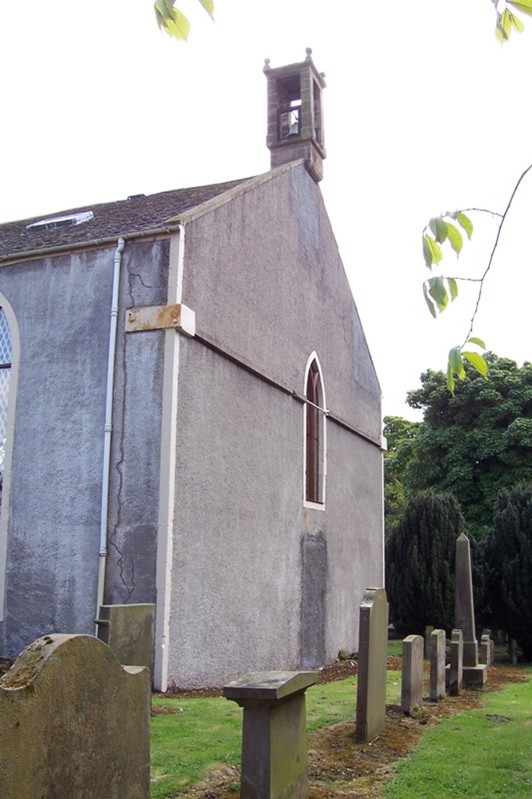
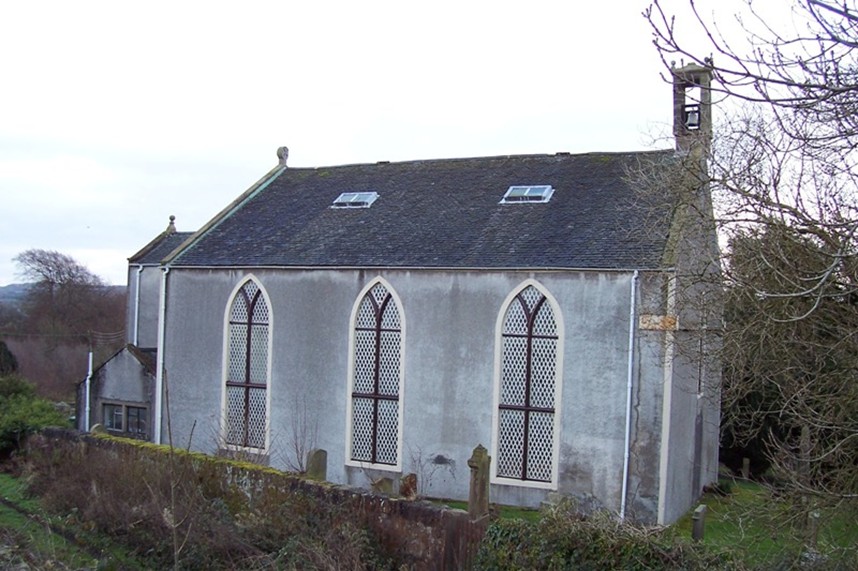
Over the west gable is a large corbelled out bellcote with rectangular uprights and ball finials. The pulpit was in the centre of the south wall facing a horse-shoe gallery wrapped around the other three walls. The doors in the gables opened onto internal stairs to the gallery, and a door in the south wall, just to the west of the pulpit, was for the minister.
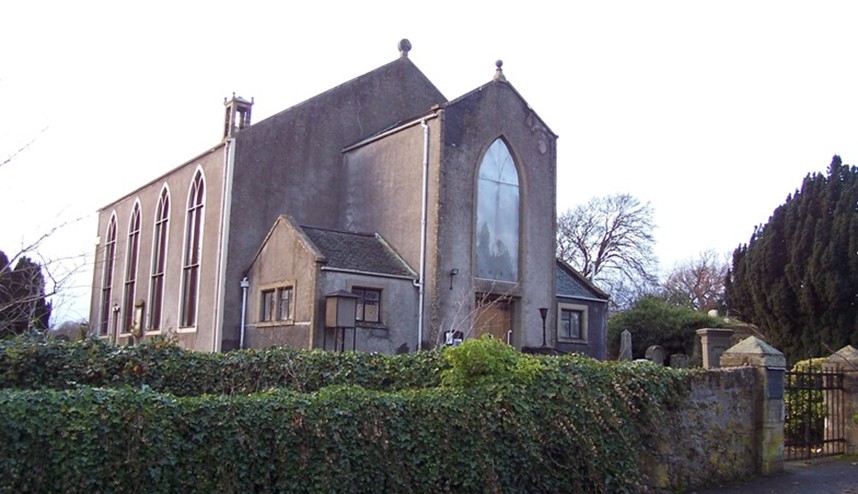
The present church and manse were built in 1804-6. The church is a typical Hall-style building, rectangular in plan with a lofty ceiling. There was a doorway in the centre of both the west and east gables with four tall pointed windows subdivided by wooden mullions and transoms and glazed with diamond panes in the long side walls. The window margins are backset, and the rendered east and west end walls were at one time scored to resemble ashlar.
The session house was on the north side of the entrance gate to the churchyard. In 1822 the Union Canal was constructed immediately to the west of the church. A bridge was provided a little to the north for those attending religious services and was called the Kirk Bridge
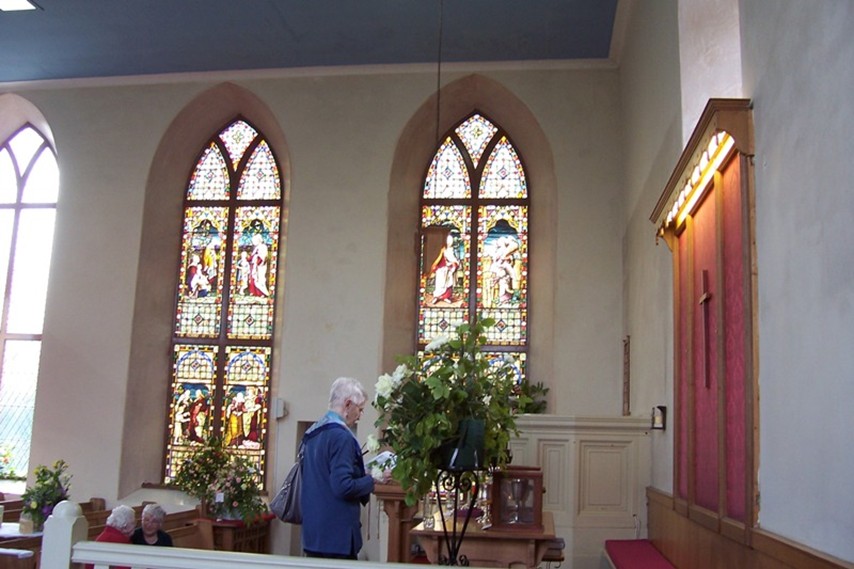
Over the years a number of stained glass windows were inserted and information on these will be found under Stained Glass.
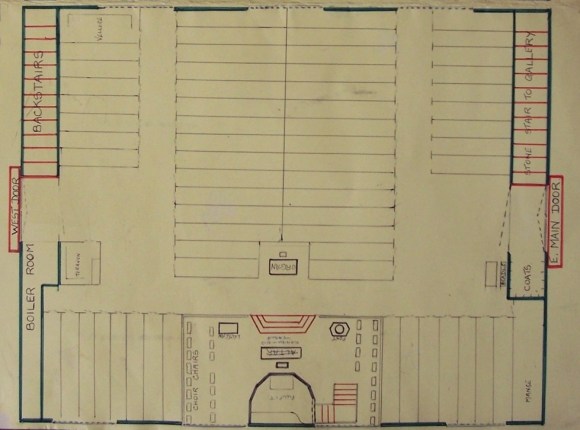
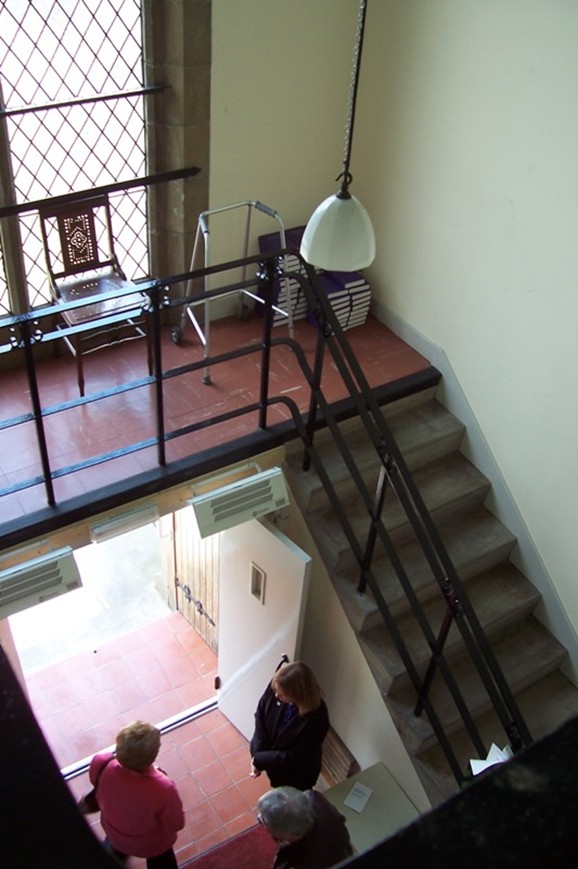
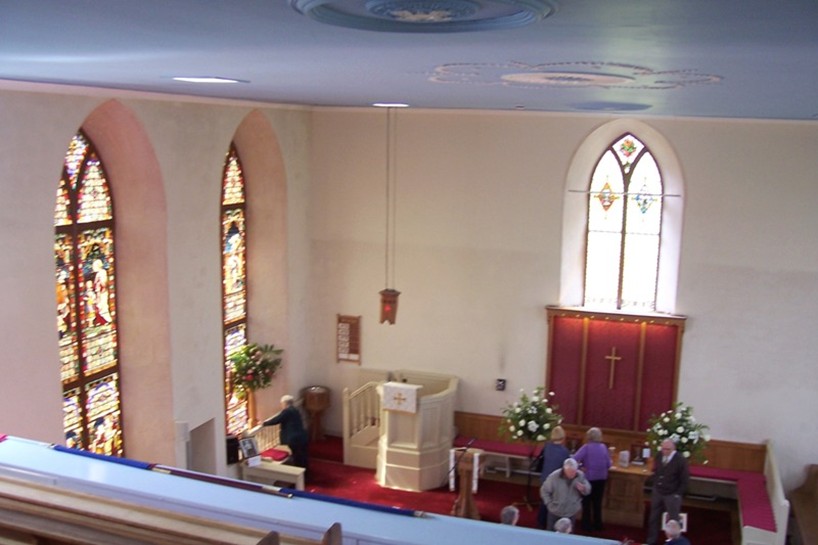
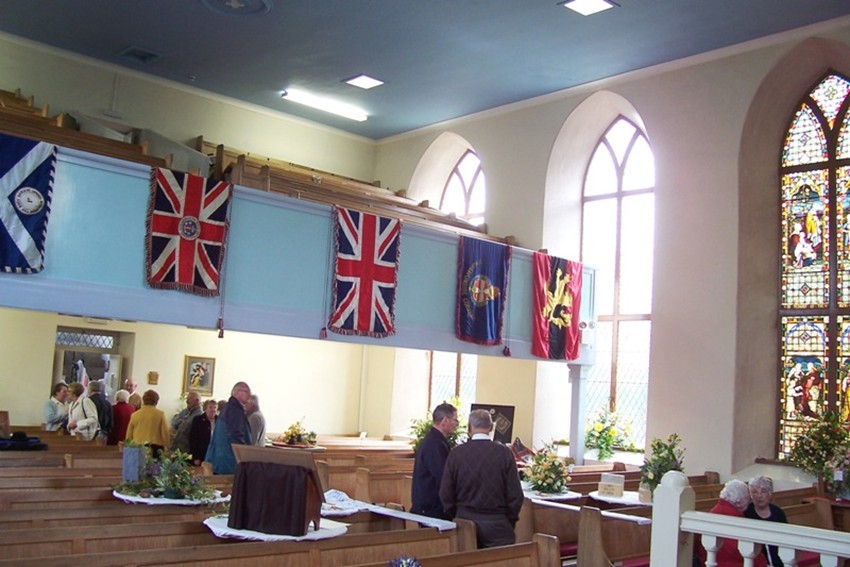
In 1947 it was found that woodworm and dry-rot had taken a hold in the building and fundraising efforts were begun to treat them. The opportunity was taken to make internal alterations to re-orientate the layout. The pulpit was moved from the south wall to the west wall, and a central aisle was placed along the west/east axis. The west door was blocked and the chancel now occupied the west end. The horseshoe lefts were removed and replaced by a broad loftd at the east end. A new vestibule was added outside the east gable to contain the stair to the loft; with a vestry and a session house to either side of it. It was 1951 before building work began and the end of 1955 before it was re-consecrated. The work cost a little under £10,000. The old session house was subsequently demolished and the cross that had been mounted on it was placed on the east gable of the church.
MANSE
- 1806: Built to the south-east of the church.
- 1987: Manse sold and a new dwelling erected adjacent to Cairney Mount Church.
ORGAN
- 1912: Double manual Trayser harmonium gifted by Mrs Brown of Vellore.
- 1980: Omegan electronic organ.
BELL
The bell is about 18 ins in diameter and is inscribed: “FOR THE KIRK OF MUIRAVONSIDE IOHN MEIKLE ME FECIT/ EDINBIRGI 1699”.
A hand bell with an iron grip handle measuring 5 ins in height, 6 ins in diameter at the lip, is cracked and perforated. It reads: “IOHN MEIKL FECIT EDR 1690”.
FITTINGS
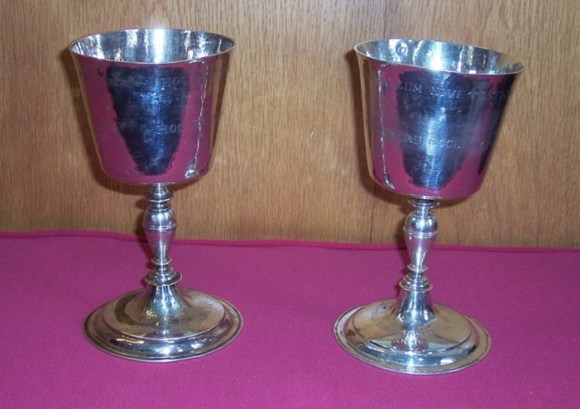
- 1676: Silver communion cups presented by the Earl of Callendar and Lord Almond to the church of Almond and Rev. Andrew Urie. “Hoc potulum as ecclesiam de Almond pertinent.”
- 1911: Two silver communion cups gifted by William Brown of Vellore, inscribed: “MUIRAVONSIDE PARISH CHURCH”.
WINDOWS
See separate entry for stained glass.
WAR MEMORIAL
See separate entry for Muiravonside Parish Church Roll of Honour.
SEATING
- 1806: Pulpit in the centre of the south wall with pews on three sides and a semi-circular gallery.
- 1947: Re-arranged due to woodworm and dry rot. Main axis changed to east/west, with the chancel furnishings placed on a raised platform against the west gable. Seating for 400.
CHURCHYARD
A cemetery and burial place are mentioned in the Papal communication of 1454. The earliest stone in the present cemetery that surrounds the church is 1705. An extension to the churchyard has been made to the east.
MINISTERS OF MUIRAVONSIDE PARISH CHURCH
| 1591 | Kerr, William | 1597 |
| 1598 | Monipenny, Patrick | 1610 |
| 1612 | Thomson, Robert | Oct 1615 |
| 1616 | Halley, Robert | 1626 |
| Apr 1627 | Cornwall, Alexander | 1641 |
| Aug 1642 | Bruce, John | 1672 |
| Oct 1655 | Blair, Hew {helper} | 1661 |
| Jul 1667 | Urie, Andrew | 1689 |
| Aug 1691 | Campbell, Donald | Dec 1693 |
| May 1696 | Bennet, Andrew | Aug 1720 |
| Aug 1721 | Boyd, Robert | Jan 1768 |
| Jun 1768 | Bertram, John | Dec 1802 |
| Sept 1803 | MacCall, William | Dec 1833 |
| May 1834 | Macfarlan, James | Feb 1871 |
| Mar 1871 | Keith, George | Dec 1884 |
| Jun 1885 | Bell, Oswald | Jul 1896 |
| Feb 1897 | Bayne, David | Jan 1940 |
| Dec 1940 | Hamilton, James | Feb 1952 |
| Dec 1952 | Downie, James Calder | 1966 |
| 1967 | McPherson, Duncan G | Jun 1975 |
| 1976 | Goodman, Richard A | |
| 1984 | Hill, Stanley | 1998 |
| 1999 | Ross, J |
Bibliography
| Bailey, G.B | 1997 | ‘The Graveyards of Falkirk District: Part 3. Muiravonside,’ Calatria 11, 1-62. |
| Bailey, G.B | 2009 | ‘The First Parish Church at Muiravonside, Calatria 25, 55-59. |
| Bertram, J. | The Statistical Account of Scotland. “The church is old. The stipend is L 83:6:8, at the conversion of L.8:6:8 the chalder of victual. The glebe consists of 4 acres. The crown is patron.” [p564] | |
| Hunter, R.L. | 1950 | ‘Almond Castle,’ Proc Falkirk Archaol, & Nat. His. Soc. 4, 9-23. |
| MacFarlane, W. | 1906 | Geographical Collections Volume 1; Johnston of Kirkland. “”The Kirk of Morvenside stands upon the north side of Parkhall burn, the manse and schoolhouse are opposite to it upon the south side of the said burn. This kirk stands nearest to the east end of the parish and a mile west of Linlithgow. The house of Almond or Haining stands two large pair of butts north of the Kirk, having a little wood about it. the Kirk of old being the Chapel of that familie… The burn of Parkhall hath its rise two long miles West of the Kirk from a Moss called Bullen Moss. It hath two bridges upon it, both of one arch, one at the Kirk…” [p.316] |
| RCAHMS | 1963 | Stirlingshire: An Inventory of the Ancient Monuments. P.154-5. |
FORBES PAPERS
- “A General Meeting of the Heritors of this parish is to be holden in the Manse of Muiravonside on Saturday the 30th curt. for the purpose of considering the expediency of contracting a little the depth of the Galleries of the new Church & inspecting the Mason Work as it is intended then to take the building off the contractor’s hand” [992/17 – 20 Nov 1811]
- “This will be delivered to you by Thomas Aitken the Contractor for finishing the Carpenter Work of the New Church. The Contract I see is signed by Robert Paterson a Cooper in Camelon a respectable & Substantial Man. Have the goodness to pay your proportion agreeably to the enclosed receipt, as I understand he is Much in want of Money, I have already paid the contractor for the Mason Work.” [998/8 – 12 Feb 1812]
- “A general Meeting of the Heritors of this Parish, was called yesterday Tent to be holden at the Manse of Muiravonside, on Monday the 10th instant, at Mid-day, for the purpose of getting the Kirk yard dyke & Lodges rebuilt, & giving directions to the wright respecting the doors of the seats in the new Church, with some other business relative to said Church” [998/27 – 4 May 1812]
NEWSPAPERS
- The Scotsman, 9 Jan 1873, 4: “A correspondent writes that as a ploughman on the farm of Haining Valley, occupied by Mr A. Reid, was turning up the soil a short distance from the ruins of Almond Castle, and three miles from Linlithgow Palace, a day or two ago, he came upon a stone coffin, and on taking off part of the lid found a portion of a skeleton inside. The skull was entire, and the teeth in the upper jaw were in good order. The body lay with the feet towards the south-west, and within fifty yards other two stone coffins have since been found. Mr Reid caused them to be carefully covered, till an opportunity of examining them may be given to such as take an interest in these subjects.”
- Falkirk Herald, 3 October 1903, 5: The Heritors arranged for the repair of Muiravonside parish Church. During the work the services were held in the Templars; Hall, Maddiston. The interior of the church has been repainted by Mr Graham, painter, Falkirk, whilst a number of box seats have been taken out, and the ordinary kind put in. The memorial window to the late Rev. Mr Keith has also been altered, four new panels being added. The congregation have contributed spontaneously toward the repairs, a new communion table being subscribed for by them. Mr Brown. Vellore, has gifted to the congregation a handsome baptismal font. The choir seats have also been re-arranged. The services were conducted in the church on Sabbath last.
- Falkirk Herald, 27 April 1912, 3: Muiravonside parish Church. A fine double-manual Trayser harmonium has just been presented to the congregation by Mrs Brown of Vellore for use in the services of the church. The organ hitherto in use having become completely worn out, the gift of the new instrument is highly appreciated.
- Falkirk Herald, 26 November 1927, 4: Report on the examination of Muiravonside Church given by the church’s architect.
- Falkirk Herald, 28 October 1950, 6: Meeting showing proposed plans for Muiravonside Church which would provide additional seating capacity. The plans were examined and show the provision of a chancel on the south side and on the east side a vestry, session room, ladies’ and gentlemen’s rooms, with a stairway to the gallery. The present seating capacity is 400, but following the restoration this will be enlarged to 552. The Restoration Fund was nearing £4,000. The total cost of the scheme was to be around £9,900. Work to commence next summer.
- Falkirk Herald, 8 January 1955, 9: Muiravonside CHURCH EXTENSIONS. The Miscellaneous Services Sub-Committee of Stirlingshire Health Committee were informed by the Clerk at a recent meeting that, following the completion of certain extensions at Muiravonside Church, it was the intention of the Church authorities to demolish the building at the entrance gate which was formerly used as a session house. The Church authorities wanted to know whether the County Council wanted to take the opportunity to re-align the churchyard wall to give more room on the road outside the churchyard for vehicles turning….
- Falkirk Herald, 3 December 1955, 4: Muiravonside Church, which was recently renovated, was reconsecrated at the morning service on Sunday. The service was conducted by the Very Rev. Principal G. S. Duncan. 0.8. E., D.D.. D.Th., L.L D., assisted hy the Rev. J. C. Downie, B.D., minister of the church.
- The walls of the church have been re-faced. The side galleries have been removed. The pews and other woodwork are in a natural colour, giving a lighter effect, and a new session-house has been provided.
- Prior to the service the new gates presented by Mrs H Campbell were dedicated. A plaque on the wall reads: “To the glory of God, and in memory of David Robertson, Ashbank, Polmont Station, who died 14th August, 1931, in his 77th year, also his wife, Helen Blair Wallace, who died 21st January, in her 83rd year, who worshipped in this church for many years. Erected by their daughter Helen Joan. ‘Memory will be my happiness. You are enshrined there’.”
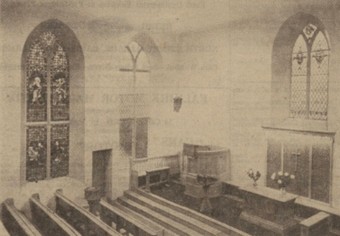
- The west window was a gift from one of the contractors, Mr Robert Bennie, Linlithgow. The window is in two panels pointing into a “Y”-shape. One of the panels depicts the wheat and chalice, representing the Holy Communion, on a red background. The other panel has a representation of the Paschal Lamb, bearing a banner, against a blue background. At the top of the window is the Burning Bush. The inscription reads: “Kirk Restored 1955.”
- Linlithgow Gazette. 19 January 1962, 6: Rev. W. R Lyall convener of the Property Committee. spoke of a recent inspection made by the committee at Muiravonside Church. He said that they had found some dry rot in evidence in the rafters of the church. He pointed out that he had climbed up to inspect it himself…
KIRK SESSION ENTRIES
P 14 25 February 1672
“The Session did unanimously ordaineyt ye north Loft should be brought under lock and key by their officer until ye minister be com in and ye honest and sober men of our owne paroche or others that are grave and sober in other places quhen the xxxxx [women??] may onlie be let in”
P 33 22nd April 1676
“This day the two new Silver Cups for the use of the Communion having been broght home were seen by the Session, And aproven (the pryse Thereof being 190 lb 20 s 8 d Scotts money, the Kirk soume together wt seaventy pounds ten shilling and ten pennyes Money for the new Mortcloath”
P 140 26th Nov 1693
“The same day the session having considered upon the inlarging of the window in the Kirk be-east the pulpit and that in Regard that it is very darkby reason of it being over streat, it was thought very reasonable & proper so to do, having all condescended to it they appointed that it might be done with all expedition & ordered a workman to be spoke to for that effect.”
P 205 21st July 1700
“The session considering that their Communion Cups had lyne long in Lady Callendar’s Custody they therefor recommend it to the Minister to speak with the said Countess that she would deliver the said Cups to them.”
P 205 18th August 1700
“It having been recommended to the Minister to speak with the Countess of Callendar that she would deliver up to them their Communion Cups the minister told the session that he had spoken wt her and that her answear was that she would not deliver up the Cups to the session but if Neuk Manwell milne and Parkhall would give her a receipt for them she would deliver the cups up to them whereupon the session recommends it to the minister to wryt a receipt and to endeavour to procure the subscriptions of the forsaid persons thereto and to make a returne to the session at his convenience.”
P 211 4th May 1701
“It having been recommended to the Minister to procure the subscriptions of Neuk, Manwellmilne and Parkhall to a receipt of the Communion Cups which had been in the Custodie of the Countess of Callendar the minister informed the session that he had procured the said subscriptions and that thereupon the Countess had delivered up the said Cups.”
 Falkirk Local History Society