
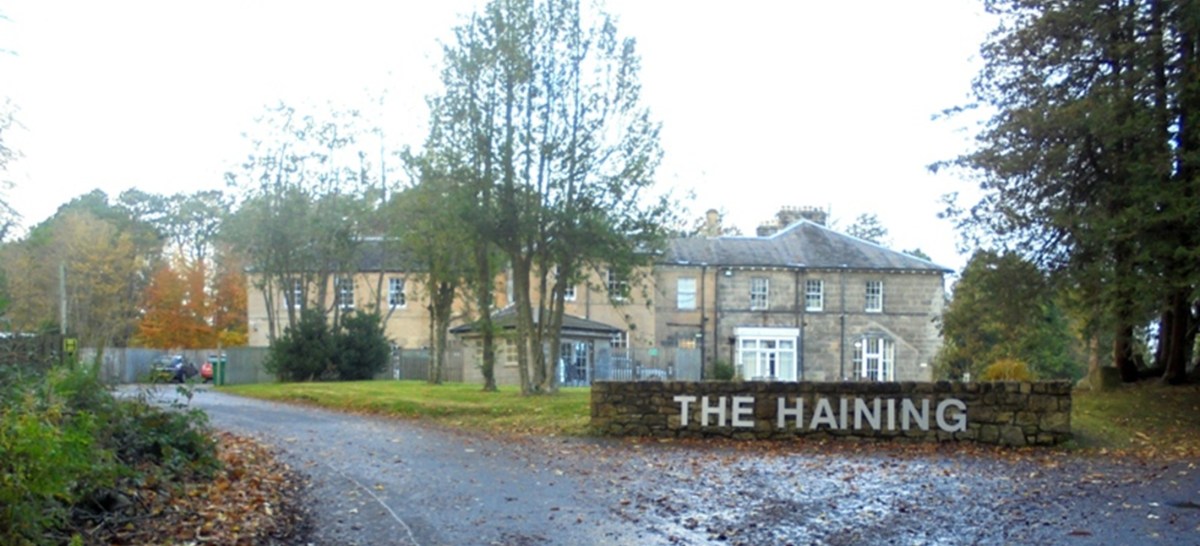
SMR 205 / NS 9476 7720
| c1530 | David Crawford | 1550 |
| 1550 | William Crawford (son) | after 1564 |
| 1647 | Alexander Livingston (purchase?) = Christian Stirling | |
| 1672 | Alexander Livingston (younger son) = Margaret Livingston | 1716 |
| 1716 | Alison Livingston (daughter) & Alexander Mitchell (Livingston) | |
| 1733 | Alexander (Mitchell) Livingstone (son) | 1734 |
| 1734 | William (Mitchell) Livingstone (brother) | 1774 |
| 1774 | John (Mitchell) Livingstone (brother) = Antonia Calder | 1786 |
| 1786 | Thomas (Mitchell) Livingston (son) | 1809 |
| 1809 | Alexander Learmonth Livingstone (nephew) = Jessie Learmonth | 1815 |
| 1815 | John Livingston Learmonth (son) | 1818 |
| 1820 | John Livingston Learmonth (uncle by purchase) | 1841 |
| 1841 | Euphemia Colville Livingston Learmonth (sister) = George Adam | 1861 |
| 1861 | Thomas Livingstone Learmonth (brother) = Christian Donald | 1869 |
| 1869 | Thomas Livingstone-Learmonth (3rd son) = Louisa Valiant | 1903 |
| 1903 | Thomas Livingstone-Livingstone Learmonth (son) | |
| 1928 | Howard John Kennard | 1946 |
| 1946 | The Grail | 1950 |
| 1984 | Haining Nursing Home |
The estate and house of Parkhall seems to have come about as a result of Archibald Crawford of Haining (at Almond Castle) making a grant of land from that barony to a relative so that he could establish a cadet branch. That relative was David Crawford and the grant of Parkhall was made in the early sixteenth century, certainly before 1541 when it was confirmed by Archibald’s eldest son, William (Reid Notes). William died shortly afterwards leaving no male heirs and Haining eventually came into the possession of Agnes Crawford and her husband, Thomas Livingston. Parkhall continued in the possession of the cadet branch of Crawfords as a pendicle of Haining. In 1550 Thomas Livingston and his wife granted an instrument of sasine in favour of William Crawford, son and heir of David, in the lands of Parkhall “extending to 10 acres with houses, buildings, and faulds, and 24 rigs, with the hauch of Haining” (ibid). The “hauch,” or rather “haugh,” was the good quality meadow land beside the Manuel Burn and it may have been the variant of this written as “hall” which was the second element in the name of Parkhall (Reid, 242).
In 1647 the Crawford connection came to an end when Alexander Livingston, son of the late John Livingston of Haining, obtained sasine of the lands of Parkhall and was the first of the Livingstons to be designed as “of Parkhall.” As well as Parkhall with its houses, he received
“parts and portions of the barony of Hayning lying within the muir commonly known as Nicholtoun, Weitscheitt, Hilsyd, Gilmidowland.”
It was now a significant estate. The superiority remained with the Livingstones of Linlithgow and Callendar. A charter to Alexander Livingstone, son of the 2nd Earl of Linlithgow, dated 1663 included:
“The lands, barony, and buildings of Hayning, Manuel, Parkhall, Hillside, Madiston (with the coals and coal-heighs of the same), Gilmoiretoun, Niscoltoun, Gillanderland, Mauelrig, Gilmundieland, Easter and Wester Ballenbreich, mills of Manuel and Ballanbreich, with all the lands, mills, & c of the barony of Hayning.”
In 1681 Alexander Livingston of Parkhall bought the estate of Whiterig from his cousin, George Livingston. The lands of Manuelrig and Maddiston were added in 1768. It continued to grow and in 1773 the lands of Parkhall included Maddiston, Gilmeadowland with the pendicles thereof called Whiterig, Snab, Parkford, Whiteshott, Rowantreeyards or Eastgate, Folds, Nicolton, and Tappuckstone (Reid Notes). In the 1780s Tarduff Muir was divided and the Livingstons of Parkhall received a due share.
A charter dated 29 November 1716 was necessitated by the passing of the Clan Act and the attainder and forfeiture of the superior, James Earl of Linlithgow and Callendar. This resulted in the Crown being the superior and it confirmed Parkhall to the Livingstons there
“in fee and heritage for ever by payment of one white plume at the usual terms in name of blench-ferme.”
In 1716 Alexander Livingston junior of Parkhall settled his estate on his fifth daughter, Alison Livingston, and her husband, Alexander Mitchell, on the condition that the latter adopt the family surname. Her granddaughter, Margaret (Mitchell) Livingston, married John Learmonth, the grandson of Alison’s sister Mary, and the Livingstone Learmonths eventually acquired Parkhall. Another of Alison’s sisters married Richard Burn of Clarkston in 1699 and when he died in 1733 she inherited. In 1752 she assigned her interest in Clarkston (now called Avondale) to her nephew and this was often used as the family home.
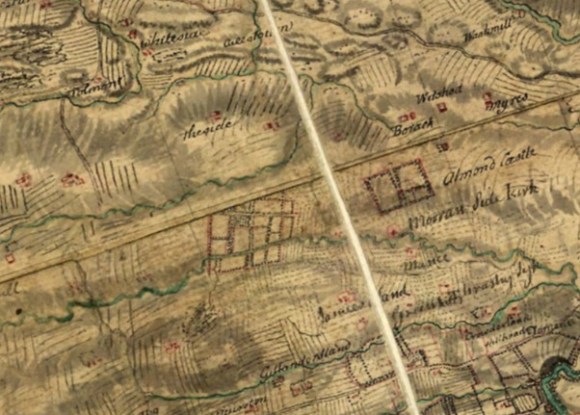
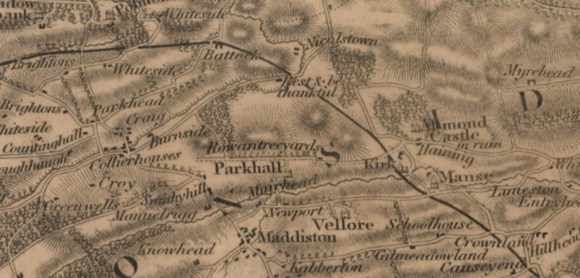
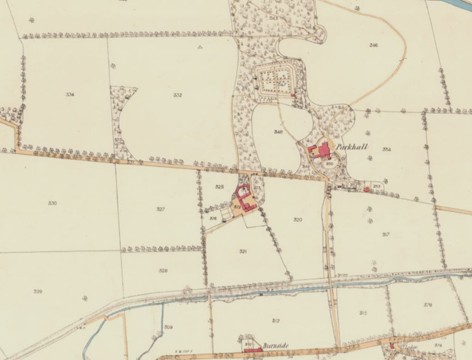
The house of Parkhill at this period stood on the site of the later farm of that name, to the south-west of the present mansion. Roy in 1755 shows it surrounded by numerous rectangular enclosures that extend south over the Manuel Burn to the road from Muiravonside Church to Maddiston. The old public road that ran west from Almond Castle lay to the north of Parkhall House as it was then. The fact that the family preferred to stay at Clarkston shows that the dwelling at Parkhall was not particularly distinguished.
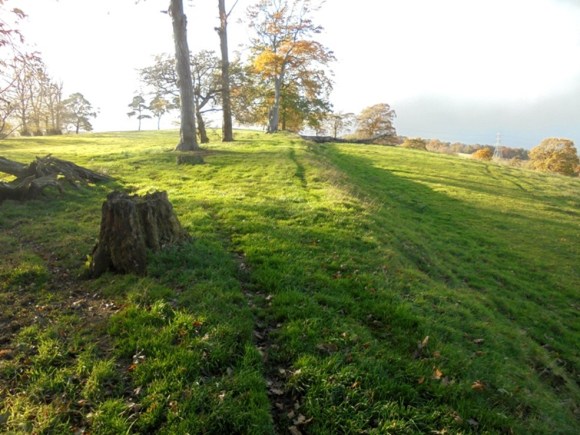
The complex of rectangular enclosure was typical of the period and it was bordered on the north by a terrace lined on either side by trees. This lay more or less along the summit of the west/east ridge and provided magnificent views over the Forth Valley. It would have acted as an observation platform and promenade. Traces of it still survive.
In April 1783 it was rumoured “that Mr Bentley Gordon son in Law to Parkhall Intends to Purchase the Baroney of Almond” when it and Callendar came up for sale. In the end it was purchased by William Forbes (Forbes Papers 2054/1). Just three years later, on 26 July 1786
“died old Mr. Livingston of Parkhall, his death was occasioned by one of his own carts loaded with hay going over his head and body, the horse having taken fright. He survived the accident about thirty hours” Forbes Papers 236/11).
The Valuation of Muiravonside Parish in 1795 gave the following three individuals as the main landowners:
| Landowner | Property | Scots Money |
|---|---|---|
| Mr Forbes | Almond Barony | £929-1-0 |
| Mr Livingston | Parkhall | £260-11-11 |
| Mr Lockhart | for Mr McLeod’s Property | £201-12-0 |
Part of the reason for the high valuation of Parkhall was because good quality coal had been worked on the estate for many years, and at this time ironstone also began to be wrought. In 1806 the valuable Colliery at Rumford was up for sale or let.
“This colliery comprehends a very large and proven field of untroubled coal; is level free; works a seam of 3 feet at a depth of from 7 to 8 fathoms only; will turn out any quantity of coal of the very best quality… the uncommon quality of the coal, and the cheapness and facility with which it is wrought, may be brought to command any extent of sea sale… The proprietor has been at the expence of opening up, and proving the coal field, of erecting the necessary machinery, of making the requisite roads; and, in short, of doing every thing that could possibly render the present colliery an object of the very first importance, either to a tenant or to a purchaser” (Caledonian Mercury 14 August 1806, 4).
The largest task seems to have been the construction of a coal road from Rumford to the Edinburgh turnpike road at Nicolton, today known as Nicolton or Bethankie Bridge Road (not Vellore Road as has been stated elsewhere), a distance of almost two miles. By 1820 the Parkhall Colliery was churning out 14,000 tons of coal a year (though by 1860 the site was used for a tileworks). Part of Gilmeadowland was sold off in the 1790s for Major Duncan Drummond of the Scotch Brigade who had been with the British Army at Fort Vellore in India when it was besieged by Hyder Ali in 1789. He named the house that he built there after the siege and over the years the road there acquired its name.
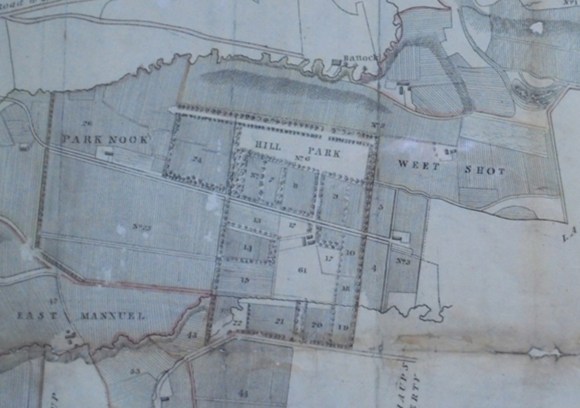
2 – Weet Shot; 4 – Entry Head; 6 – Hill Park; 7 – Paul Park; 8 – Crow Park; 9 – Cushie Park: 11 – Dove Core Parks; 12 – The Ward; 12 – Burn Yeard; 13 – North Haugh; 14 – House Park; – 15 – South Haugh; 16 – Orchyeard; 17 – Garden; 18 – Paddock Haugh; 20 – South Parks; 22 – Park Ford; 23 – New enclosure; 24 – W West Park’ 26 – Park Nook
From newspaper adverts made around 1802 we get an idea of the size of some of the farms on the estate.
| Greenwells | 112 acres |
| Burnside | 46 acres |
| Glenend and West Manuel | 102 acres |
| West Knowhead, Craigend, and the north half of Whiterig | 140 acres |
| East Knowhead | 43 acres |
| Nicolton | 109 acres |
| Parkhall Parks with the Entry-Head | 122 acres |
| Weetshot | 46 acres |
| Craigend and part of Whiterig | 80 acres |
| Snabhead | 82 acres |
| Drumbreeks or Brecks | 33 acres |
Thomas Livingstone of Parkhall was killed while otter hunting in the Avon at Clarkston on 11 March 1809. He had run the estate heavily into debt. He was unmarried and left Parkhall to his nephew, Alexander Learmonth. Alexander Learmonth Livingstone promoted the construction of the Union Canal which was to cut through the lands of Parkhall. It would considerably reduce the cost of transporting Parkhall coal to Edinburgh and increase demand. He acted as the chairman of the Board of Subscribers. However, he was unable to recover the fortunes of the estate and died on 29 June 1815 when his eldest son, John Livingstone, was just six years of age. On 2 April 1818 the creditors obtained a summons of ranking and sale and Parkhall was sequestered, and finally sold by public auction. The judicial sale of Parkhall and Clarkston was held on 20 December 1820 within the Parliament or New Session House of Edinburgh, under the authority of the Lords of Council and Session, and in presence of the Lord Ordinary officiating on the bills (details of the lands for sale may be found in the Caledonian Mercury of 12 July 1819). Parkhall, Rowantreeyards, Nicolton, Wheitshot and Maddiston were purchased by John Learmonth, a younger brother of Alexander Learmonth Livingstone of Parkhall and uncle of the six-year old John. Craigend, Whiterig, Manuelrig, Glenhead, Snabhead, and Battock were bought by William Colville Learmonth, another uncle. He later adopted his wife’s surname and was known as William Colville Learmonth Mackenzie. Clarkston left the family, but was bought back by Thomas Livingston-Learmonth of Parkhall from A.H. Massey Menzies in 1879.
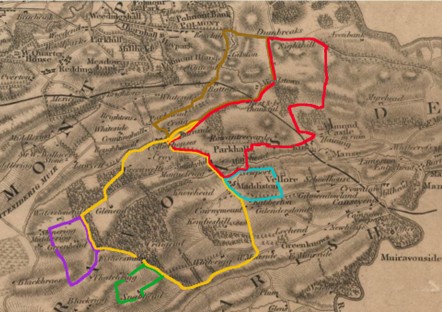
It is at this point that Thomas Learmonth acquired the eastern part of Nicolton from his brother, John. He soon renamed it Laurence Park after his old residence in Edinburgh. Also at this time the Union Canal was finally completed. One of the first boats into Port Hopetoun in Edinburgh on 10 April 1822 was carrying a load of about fifty tons of Parkhall coal (Caledonian Mercury 13 April 1822, 2).
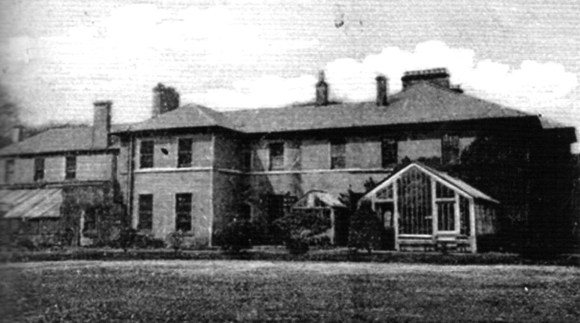
A new mansion was built to the north-east of the old dwelling, further up the hill. The date 1825 appears in large numerals on the north façade of the entrance hall. The two-storey building was made from blond polished ashlar sandstone, now grey with age, under a hipped slate roof having overhanging Italianate style eaves.
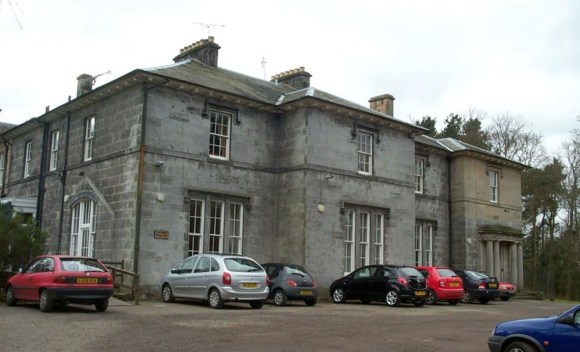
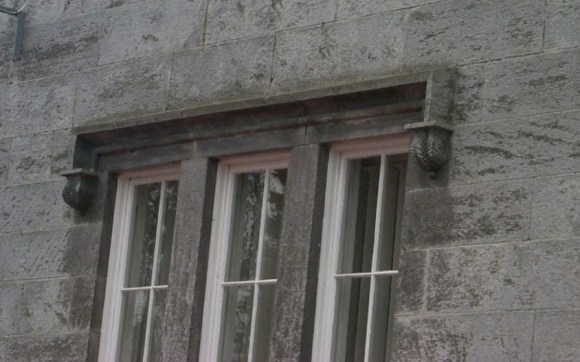
It faced east and the principal façade consisted of three bays of roughly equal size, the central one markedly advanced, each with a three-light hood-moulded window on the ground floor and a hooded sash and case window above, the sill course of the latter continues around the building as a plain stringcourse. The lower hood-moulds terminate in ribbed consoles, whilst those above return outwards at right-angles.
The mass, simplicity and quality of the main block, provided a bold statement that it was the residence of a hereditary landed proprietor. To its right, i.e. north, was a slightly advance single storey entrance hall containing a heavy portico with four Doric columns. A Latin inscription on the entablature may date to this period, but is now too worn to be legible. The north side of the hall had two sets of double lancet windows, and it was here that the date 1825 was carved in between the westernmost arches.
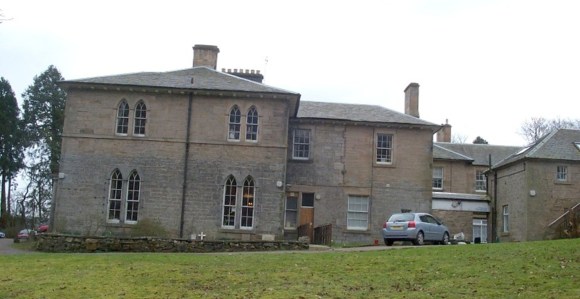
The south facade was dominated by a large conservatory or wing; the roof raggle of which can still be seen above the low-arched entrance. To its left was a single storey bay window.
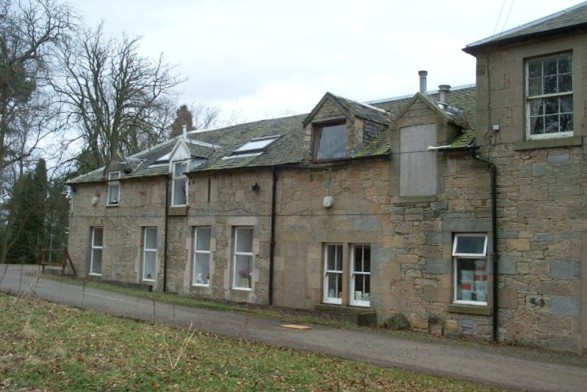
Continuing the south façade westward was a single storey servants’ wing which enclosed that side of a rear courtyard. The north range of the courtyard was of two storeys with an external stair.
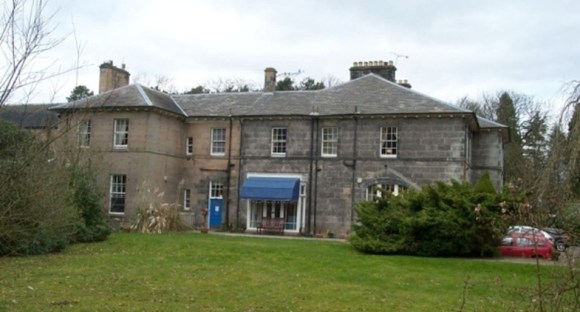
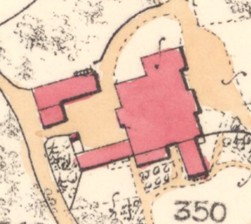
The regimented formality of the earlier enclosures was discarded and more woodland introduced with soft curving edges. A walled garden was hidden away in the woodland to the north-west of the house. The formal approach from the south was retained, but it was now supplemented by a long sinuous drive curving off to the north-east before turning westward and descending the hill to reach the old coal road near Bethankie, crossing the Gardrum Burn by a stone bridge. This provided a shorter route to Clarkston and to the main Edinburgh road.
William Forbes had bought both the barony of Callendar and that of Almond in 1783. A litigious man, he carefully examined all of the available charters to investigate how he might increase the income from his estate. A technicality occurred which suggested that the mineral rights at Parkhall were still part of those of Almond and could not legally have been passed on to the Parkhall Livingstons in 1716 after the forfeiture of the superior. William Forbes had many other avenues to follow up and before getting around to the Parkhall one he died. However, in 1825 his widow, Agnes Chalmers or Forbes, was successful in court in claiming the right to the coal in the lands of Nicoltown, Weitshot, Hillhead, Gilmeadowland and Parkhall. All of that investment by the Parkhall Livingstons in the coal roads and collieries in the late 18th and early 19th centuries had been for nought. Forbes thereafter sold the rights to the Carron Company. The sandstone and whinstone rights remained with the Livingstone Learmonths.
There was now much mature woodland on the estate along the avenues, shelter belts and plantations and in February 1855 some of this was cut down and sold:
“EXTENSIVE SALE OF LARCH SCOTCH FIR, ASH & BEECH WOOD, AT PARKHALL. TUESDAY the 20th February. To be Sold by Public Roup, on Tuesday the 20th day of February 1855 on the Estate of Parkhall, one mile south from Polmont Station on the Edinburgh and Glasgow Railway, the following first-class Timber, comprising-
- 80 large lots of full grown larch wood, fir for railway sleepers, 7 c.
- 15 lots of Scotch fir, mostly full grown.
- 40 lots of larch and Scotch fir pit wood.
- 20 lots of clean grown ash, suitable for shaft wood or riddle-makers, 7 c.
- 8 lots of beech.
The wood is all cut and laid in lots, and the greater portion is lying within 200 yards of the Union Canal…” (Falkirk Herald 1 February 1855, 2).
In 1868 Thomas Livingstone Learmonth drew up a disposition handing over the estate of Parkhall to his third son, Thomas Livingstone-Learmonth (he introduced the hyphen in his surname). The younger Thomas had gone to Australia where he acquired a considerable tract of land, and successfully engaged in sheep farming. This he left in the hands of his eldest son and returned to Scotland and took up residence at Parkhall, later purchasing the neighbouring estate of Craigend. He was very active in the local community. He was chairman of the Muiravonside Parochial Board for many years; president of the East Lothian Agricultural Association being well-known for his prize herd of sheep; a justice of the peace, a member of the local School Board, and an elder of the Brightons United Free Church. He gave generously to local schools and charities. He deeply interested himself also in the welfare of the people of Maddiston village. In 1877 he purchased a licensed property there and converted it into a workmen’s home on temperance principles which was opened in August that year and proved a very popular venue. As well as a meeting room there was a restaurant, a library and a reading-room, with arrangements for several indoor games. The Muiravonside Savings Bank was established in 1876 as a “branch” of the Falkirk Savings Bank at the Muiravonside public school by Rev George Keith. Its trustees included Clarkson of Toravon, Henderson of Redford, Stirling of Tarduf and Thomas Livingstone Learmonth of Parkhall. Both he and his wife were sympathetic to the cause of the miners during their Strike in 1894 and Mrs Learmonth managed the Drumbowie and Standburn Soup Kitchen.
Thomas was also active in business. In 1875 he put forward a scheme to Parliament to reclaim land from the Forth which stretched all of the way from Bo’ness to Grangemouth. Harbours and settlements were to be constructed on this land. Thomas Livingstone-Learmonth also carried out improvements to the estate, harnessing the power of dynamite to clear away tree stumps on an extensive scale in December 1877. The abandoned colliery site at Maddiston was used for a brickworks with an adjacent quarry. In 1885 the sandstone quarry at Maddiston came up for let:
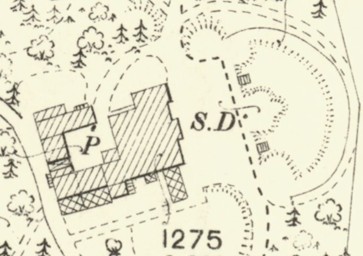
This was evidently the same stone that was used to extend the house at Parkhall. A second storey was put over the entrance hall on the north side of the buildings, its fenestration reflecting that of the existing structure. The south wing was likewise increased in height and extended westwards; and the courtyard was enclosed with an entrance pend to the west.
“To Let, for a term of years, the New FREESTONE QUARRY at Maddiston, now in occupation of Mr Alex Dick. The stone is 38 feet thick, and is of the same quality as that of the Brightons Quarries, but is of a lighter colour.
The BRICKWORK now in full operation, with the seams of fireclay, may also be Let with the Quarry if required. Sidings from the North British Branch Line communicate with both the Quarry and the brickwork. Tenders will be received by T. Livingstone Learmonth. Esq. Parkhall, Polmont.” (FH 11 February 1885, 1)
In 1889 the Carron Company took Thomas Livingstone-Learmonth of Parkhall to the Court of Session because in working the sandstone quarry he had removed a seam of coal and fireclay belonging to the Company. The sandstone lay about 50ft from the surface. Lord Traynor granted interdict with expenses.
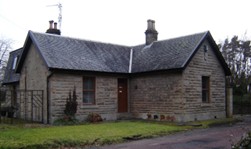
In the 1890s a new South Lodge was constructed on Vellore Road, and a market garden with large greenhouse lay between it and Parkhall Farm.
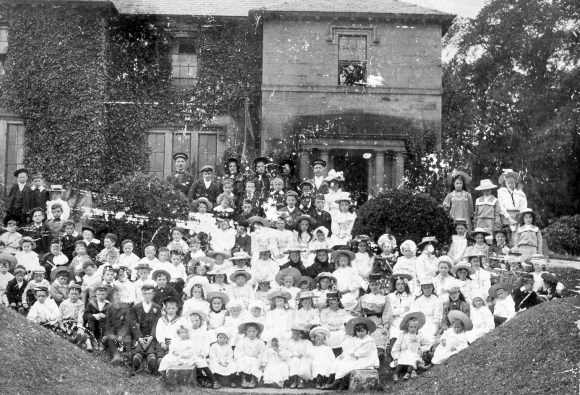
The grounds of Parkhall were opened up for the Shieldhill Sabbath School and other like-minded groups. The children of the Evangelical Union School at Redding arrived by boat along the Union Canal, as did children from Linlithgow. Over the years thousands of children from all sorts of congregations were given the freedom of a day’s exploration of the Parkhall grounds, and free buns and drinks.
Thomas Livingstone-Learmonth and his wife also developed a close relationship with the Salvation Army throughout central Scotland. Salvation Army contingents attended meetings and picnics at Parkhall from Slamannan, Linlithgow, Polmont Falkirk, Coatbridge, and as far apart as Glasgow and Hamilton. When Captain Charles William Fry, staff-bandmaster in the Salvation Army, took ill he was invited to reside at Parkhall, where he died on 24 August 1882. The following month the second Parkhall Convention for the Deepening of Spiritual Life was held and it became an annual event. Free transport was arranged from Polmont Station.
By 1884 it had become a three-day event and was attended by over a thousand people each day. A large barn at the home farm was fixed up to serve as a large hall. In place of the annual convention, a ten days’ mission was opened in a tent on a field at Maddiston in September 1892, but it returned to Parkhall the following year and continued until 1902.
The second edition Ordnance Survey map shows that Parkhall had a gasometer and that it therefore made its own gas for internal consumption. There was also a reservoir on the hill to the north-west of the house to provide water. Thomas Livingston-Learmonth was up to date with such services and knew the value of filtered water. He even made provision for his tenants at the nearby hamlet of Burnside. It consisted of a row of houses tenanted by five families, making a total of 23 individuals. He had a soft water pump well constructed. The water was collected from the roofs of the houses and conducted to an underground tank and filter. However, it was one thing to provide the clean water, but it was another to convince the residents to use it. They used it for washing and cleansing, but would not drink it or cook with it. Instead, they persisted in obtaining a supply from a draw-well located in a hollow at the side of the public road opposite the houses. The water there often had a brownish colour, as surface water from the road ran into it (Falkirk Herald 21 November 1891, 6).
Thomas Livingstone-Learmonth died on 28 October 1903 at the age of 85 years. His widow then moved to Edinburgh and Parkhall fell to his eldest son, also Thomas. Most of the household contents were sold off, including the double lean-to glass conservatory which measured 37ft 6ins by 16ft 6ins with hot-water pipes. It was 1908 before the remaining furniture was sold.
The Parkhall estate was finally exposed for sale by public auction within the Crown Hotel, Falkirk, in July 1920 but failed to reach the reserve price. Sometime later Hugh Brown purchased the house and home farm. He seems to have farmed the land, producing milk from the farm and vegetables and fruit from the market garden. In 1924 he ejected James Strang, joiner, from the South Lodge as it was required for occupation by the man in charge of his market gardens. The dairy buildings were rebuilt on the lines of a model farm, but the old farmhouse, which had been the original Parkhall House, was retained. Brown died in April 1927 and the property was put on the market again. His widow moved to Eastmount in Bo’ness.
The House was bought as a residential retreat by Captain Howard John Kennard R.N. of the Falkirk Iron Company. He had been living in Kersehill House adjacent to the works but that was needed for the expansion of the foundry. He moved to Parkhall in the summer of 1928 and the property was renamed “The Haining,” causing considerable confusion to future historians. In April 1930 he was appointed as a Deputy Lieutenant for Stirlingshire. September 1932 witnessed a large fire at Parkhall Farm, now operated by Andrew Blair. The Convention barn was gutted.
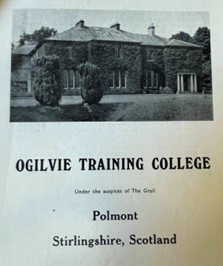
Late in 1946 the Kennard family moved out of The Haining, taking up residence at Guiting Grange in the south of England. That August the Haining was purchased by the Grail, a Catholic lay order for women which had been founded in Holland. In January 1947 the mansion house was formally opened as “The Ogilvie Training College for Youth Leaders” (named after a Scottish martyr called St John Ogilvie) for the training of Catholic young women who wished to qualify for posts as full-time workers in youth service. At the end of a year’s course a certificate, recognised by the Scottish Education Department, was issued to successful students.
The students were drawn from Scotland, Ireland, and South Africa; priority was given to returning Service women, and the college could accommodate 20 pupils who were accommodated in the bedrooms, sleeping two or three to a room. The house had been re-decorated by the ladies of the Grail staff of the college. As well as lecture rooms, there was a sitting-room furnished with armchairs and divans, and a well-stocked library. The first principal was Miss Josepha Gall. The college closed at the end of the 1949 season and the house and ground were put up for sale:
“STIRLINGSHIRE—THE HAINING . Near Polmont. —For Sale by Private Bargain, Attractive Residence, containing 4 Public and 5 Bed Rooms, 3 Bathrooms, Kitchen, and Servants’ Accommodation; Central Heating; suitable Outbuildings, including two Cottages; Walled Garden with Glasshouses; two hard tennis courts; Grounds extend to 43 acres, of which 20 are in crop. Assessed rents: House, &c £135; land £31 10s…” (Scotsman 16 January 1950, 1).
The House reverted to a residential dwelling and among those living there were Sir Henniker Heaton in 1954, and William Hogg Smith, master ironmonger (Gillespie & Main, Falkirk) up until his death in 1972.
Parkhall, or rather Haining House, changed hands several times:
“HAINING HOUSE” A most attractive Georgian country house dating from 1825 set in approximately 45 acres with gardens, woodland and 5 arable/grazing paddocks. Fully modernised and in good decorative order, the extensive accommodation includes entrance hall. Drawing-room. Dining-room, morning room, billiard/games room, children’s room, kitchen and the usual offices, master bedroom en suite, 3 double, 3 single bedrooms, 2 bathrooms, integral modernised flat. Oil fired central heating. Extensive range of outbuildings include loose boxes for 4 horses, garaging for 4 cars, workshop and various stores with loft storage. Lawn tennis court…” (Scotsman 14 April 1983, 32)
“The Haining . Offers over £130,000. Built In 1825 and standing in approx. 47 acres. this distinguished stone built house combines charm and character with exceptionally spacious accommodation. The accommodation comprises: ground floor, large entrance hall, 4 public rooms. large kitchen, utility room, office and toilet. On the upper floor, Master bedroom with ensuite bathroom and separate dressing room, 6 further bedrooms and 4 bathrooms. Self-contained flat comprising lounge, dining-room, 2 bedrooms, kitchen, bathroom and laundry room…” (Scotsman 26 February 1987, 22)
And in October 1987, after alterations, it opened as The Haining Nursing Home. In 2007 the owner was Dr S Ahmed of Bearsden; and in 2014 Netstall Ltd was incorporated to run the home, and dissolved in 2019 following liquidation. The Home is now run by Ion Care and Support Services Ltd, and has accommodation for 34 residents.
Bibliography
| Livingston, E. | 1920 | The Livingstons of Callendar and their Principal Cadets. |
| Reid, J. | 1994 | ‘The Feudal Land Divisions of East Stirlingshire,’ Calatria 6, 79-110. |
| Reid, J. | 1994 | ‘The Feudal Land Divisions of Muiravonside Parish (Part 2) : the principal subdivisions,’ Calatria 7, 21-85. |
| Reid, J. | 2009 | The Place Names of Falkirk and East Stirlingshire. |
| Jaques, R. | 1825? | “THE HAINING, James Gillespie Graham Large grey ashlar, two-storey villa, formerly Parkhall, in established gardens at end of long drive. Handsome portico with four Doric columns, piended slate roof; courtyard to rear.” (p.104). |
Archives
“A Certified Copy of the Valuation of the Parish of Moravonside as it stands in the Rolls by which the Land Tax &c is presently Leveyed by Alexr Littlejohn, Stirling 18th July 1795 —-
Landowner Property Scots Money Mr Forbes Almond Barony £929- 1- 0 Mr Livingstone Parkhall £260-11-11 Mr Lockhart Mr McLeod’s Property £201-12-0 [Muiravonside Kirk Session Records]
Forbes Papers 2054/1 – April 1783
And its Reported that Mr Bentley Gordon son in Law to Parkhall Intends to Purchase the Baroney of Almond
236/11 – 26 July 1786 – On Saturday last died old Mr. Livingston of Parkhall, his death was occasioned by one of his own carts loaded with hay going over his head and body, the horse having taken fright. He survived the accident about thirty hours.
NEWSPAPERS
- Caledonian Mercury 27 June 1774, 3:
On Wednesday, the 22 instant, died at his home of Parkhall, William Livingston of Parkhall; Esq; His friends and relations will please accept of this as a notification of his death. - Caledonian Mercury 29 September 1781, 3:
Last week was married, at Leith, Bently Gordon Bently —, Warwickshire, Esq; to Miss Joanna Livingston, daughter of John Livingston of Parkhall, Esq; an amiable young lady. - Caledonian Mercury 28 December 1793, 4:
Farms to Let. To be Let, Several Farms of various extents, on the estate of PARKHALL, in the parishes of Muiravonside and Polmont, and county of Stirling, for such number of years as can be agreed upon – The entry to be at Martinmas 1794.- James Bartholomew, wright at Parkhall Gate, will show the different farms; and offers may be given in to Hugh Smyth Mercer, writer to the signet, Edinburgh – or Matthew Steele, writer in Falkirk….
- Caledonian Mercury 16 September 1799, 1:
PRESERVATION OF GAME. MR LIVINGSTON of Parkhall, requests that no Gentleman will shoot on his Estates in the parishes of Polmont, Muiravonside, and Falkirk, without his… - Caledonian Mercury 10 October 1801, 4:
Notice to Farmers. The following Farms lying in the county of Stirling, and parish of Muiravonside, are to be LET for 19 years, and entered into at Martinmas 1801, viz. the Farms of Parkhall, Easter & Wester Knowhead, Part of Nicolton Whiteridge, Glenend, and Burnside, Snabhead, Manuellridge, Craigend, Gilmeadowland. The proprietor at Parkhall, near Linlithgow, will receive offers, and inform as to particulars. - Caledonian Mercury 7 August 1802, 1:
Capital Farms in Stirlingshire, to be Let, for such a period of years as may be agreed upon, The following Farms, in the parish of Muiravonside, and county of Stirling, advantageously situated upon the great road, and about half-way bewixt the towns of Linlithgow and Falkirk, Viz:- 1. NICOLTON.
- 2. ENTRY-.HEAD.
- 3. PARKHALL PARKS.
- 4. GREENWELLS.
- 5. BUJRNSIDE.
- 6. GLENEND and WEST MANUAL.
- 7. WEST KNOWHEAD, CRAIGEND, North half of WHITERIG; and,
- 8. East KNOWHEAD.
- As the greater part of the above Farms are in Pasture, and in the natural possession of the proprietor, immediate entry may be obtained thereto.
- For particulars, apply to the proprietor Mr Livingstone at Clerkston, by Falkirk; or to Michael Linning, Writer to the Signet, St James Square, Edinburgh; to either of whom offers may be made in writing, with all due concealment.
- John Graham, the Gardener at Clerkston, will show the Grounds.
- Caledonian Mercury 14 August 1802, 1:
COAL AND IRON STONE. To be Let for such term of years, and on such conditions, as may be agreed upon, THE very Valuable and Extensive COAL and IRON STONE in the LANDS and ESTATE of PARKHALL, situated in the parish of Mauiravonside, and county of Stirling.- The coal in this estate, which has been frequently wrought to great advantage, and for which considerable rents have been recently offered, is admitted to be of very excellent quality, and of great extent. A level might be driven at no very considerable expence, which persons versant in those matters are of opinion, would clear several hundred acres of coal of the very first quality.
- The iron stone, of which there is great abundance, has also been partially wrought.
- The conjunction of the above valuable articles on so extensive a scale, in the immediate neighbourhood of excellent roads, and of the great Clyde and Forth canal, render them well worthy the attention of a Mining Company.
- For further information application may be made to the proprietor, Mr Livingstone, at Clarkston, by Falkirk…
- Caledonian Mercury 20 September 1802, 1:
Stirlingshire. Farms for grazing. To be Let by public roup, for one, two, or more years, within the house of Mr Turner, vintner, Falkirk, upon Monday the 4th of October, at two o’clock in the afternoon, if not previously let by private bargain.- The following Farms for grazing, viz.
- 1. The Farm of GREENWELLS, comprehending 112 acres or thereby.
- 2. The Farm of BURNSIDE, extending to 46 acres of thereby.
- 3. The Farms of GLENEND and WEST MANUEL, extending to 102 acres or thereby.
- 4. The Farms of WEST KNOWHEAD, CRAIGEND, and North Half of WHITERIG, extending to 140 acres or thereby.
- 5. The Farm of EAST KNOWHEAD, consisting of 43 acres of thereby.
- The above farms are very conveniently situated for grazing, being near the great road from Stirling to Edinburgh, and about half way betwixt Linlithgow and Falkirk. As they are almost entirely in pasture, and in the natural possession of the proprietor, immediate entry may be obtained thereto. They are inclosed, well watered, and sheltered.
- As also, the following Farms for tillage, on a Lease of nineteen years:
- The Farm of NICOLTON, extending to 109 acres or thereby. Immediate entry may be obtained to one half of said farm, and to the other at Martinmas 1803.
- PARKHALL PARKS with the ENTRY-HEAD, comprehending 122 acres or thereby- Entry Martinmas 1803.
- These two farms are also very advantageously situated as to the means of improvement, being in the immediate vicinity of coal and lime, near the great road from Stirling to Edinburgh, and within four miles of Falkirk, Linlithgow, Bathgate, and Grangemouth. They are also inclosed, subdivided, well watered and sheltered.
- Proposals, with the view to a private agreement, will be received by Thomas Livingstone, Esq. of Parkhall at Clarkston…
- Caledonian Mercury 2 January 1804, 4:
Farms in Stirlingshire, to be Let for such period of years as shall be agreed upon and entered into immediately, The following Arable Farms, situated in the parish of Muiravonside, and County of Stirling, viz.- 1. NICOLTON, consisting of 109 acres.
- 2. WEETSHOT, consisting of 46 acres.
- 3. HIRST and GREENWELLS, consisting of 82 acres.
- 4. GLENEND, consisting of 113 acres.
- 5. EASTER and WESTER KNOWHEAD consisting of 124 acres.
- 6. BURNSIDE and PARKNOOK or Tappock, consisting of 41 acres.
- 7. CRAIGEND, and part of Whiterig, consisting of 80 acres.
- 8. SNABHEAD, consisting of 82 acres.
- 9. West Manuel, consisting of 42 acres.
- The above Farms, (which will be allotted in what ever manner offering tenants may reckon most commodious, and sized accordingly), consist of a very improveable soil, are well watered and sheltered, inclosed and sub-divided. They possess many local advantages, being situated in a populous country, within a few miles of the market towns of Falkirk, Linlithgow, and Bathgate, and within a mile of the great turnpike road from Stirling to Edinburgh. They also possess very favourable means of improvement. Coal of an excellent quality is wrought in the farm of Greenwells and Lime can be procured at no great distance or expence. The Farm-houses and Offices are, in general in good repair.
- For particulars, application may be made to the Proprietor at Parkhall by Falkirk, or to Michael Linning, writer to the signet, St James’s Square, Edinburgh, to either of whom offers may be transmitted in writing…
- Caledonian Mercury 14 August 1806, 4:
Valuable Colliery, to be sold or let, the valuable and extensive Colliery of RUMFORD, upon the Estate of Parkhall, in the parish of Muiravonside, and county of Stirling.- This colliery comprehends a very large and proven field of untroubled coal; is level free; works a seam of 3 feet at a depth of from 7 to 8 fathoms only; will turn out any quantity of coal of the very best quality; possesses the advantages of good roads; is situated in a very populous and thriving country; lies within four miles of the seaport of Grangemouth, and about the same distance from the great Canal connecting the Clyde and the Forth.
- Besides an extensive inland sale, the above colliery, owing to its contiguity to Grangemouth, the uncommon quality of the coal, and the cheapness and facility with which it is wrought, may be brought to command any extent of sea sale.
- The premises, in particular, are well worth the attention of an iron company, as there are abundance of ironstone upon the proprietor’s estate of the very best quality, and as the coal has, upon trial, been found to be peculiarly well adapted for furnaces. A tenant or purchaser may be accommodated with whatever quantity of ground he may wish around the works, either on lease, or by purchase.
- The proprietor has been at the expence of opening up, and proving the coal field, of erecting the necessary machinery, of making the requisite roads; and, in short, of doing very thing that could possibly render the present colliery an object of the very first importance, either to a tenant or to a purchaser.
- Offers in writing, specifying a fixed rent or optional royalty, may be made to Thomas Livingston Esq, of Parkhall, the proprietor, at Clarkston, by Falkirk, or to Michael Linning, W.S. who will shew a plan and section of the Colliery.
- Mr Alison, or Mr Frater at the colliery, will shew the machinery, works, & c.
- Caledonian Mercury 18 March 1809, 4: .
At Clarkston, Stirlingshire, on the l1th inst. THOMAS LIVINGSTON, Esq. of Parkhall. - Caledonian Mercury 20 April 1809, 3:
Hounds, & a Sulky with harness. To be sold at Mr Wordsworth’s Repository, Nottingham Place, on Wednesday first, the 26th instant, FOURTEEN Couple of very fine Lancastershire HARRIERS, the property of the late Mr Livingson of Parkhall. They are exceedingly good, and are well worth the attention of any sportsman or gentleman wanting such. – Also, an exceeding good Sulky with Harness, which has been very little run… - Caledonian Mercury 19 February 1814, 1:
Alexander Livingston Esq of Parkhall chair of the subscribers to the Union canal, leading promoter of the Union Canal. - Caledonian Mercury 29 February 1816, 3:
GRASS PARKS. To be Let by public roup, THE FOLLOWING PARKS, part of the ESTATE of PARKHALL, lying on both sides of the great road from Linlithgow to Falkirk, well inclosed, watered, and sheltered:-- EASTER NlCOLTON, containing above 70 acres, for sheep pasture only.
- DRUMBREEKS or BRECKS, consisting of about 33 acres, for pasture of sheep, or grazing black cattle….
- Caledonian Mercury 8 May 1817, 1:
Parkhall Colliery to Let. To be Let on a lease for three years, by public roup, on Wednesday 28th May current. The well-known and productive COLLIERY of PARKHALL, situate about four miles from Linlithgow, and nearly the same distance from Falkirk and Grangemouth containing excellent coal seams of various thickness, and commanding a very steady extensive sale.- The pits average only about 15 fathoms depth; the works are level free; the roofs secure, and the establishment and apparatus complete.
- The premises will be shown by Mr John Black, at the colliery; and for all other particulars application may be made and offers addressed either personally or in writing to John Stuart, accountant, Trustees Office, Edinburgh, until…
- Caledonian Mercury 12 July 1819, 1:
JUDICIAL SALE OF PARKHALL AND CLARKS’I’ONE. To be Sold by public roup, within the Parliament or New Session House of Edinburgh, upon Wednesday the 17th November 1819, betwixt the hours of five and seven in the afternoon, under the authority of the Lords of Council and Session, and in presence of the Lord Ordinary officiating on the bills,- THE LANDS and ESTATES OF PARKHALL and CLARKSTONE, lying in the parishes of Muiravonside, Polmont, and Falkirk, and county of Stirling, in the following lots:
- Lot I – The Lands of Nicolton, Westshot, Hillhead, or Hillside, Gilmeadowland, and Parkhall, Craigend, or Wester and North Rooms of Madiston, and the other parts of Madiston, and Feus thereof, and the two Manuelrigs, lying in the baronies of Manuelfoulis and Haining respectively; Rowanreeyards, Whiterig, and Easter part of Gilston; under which lands are comprehended as parts thereof the lands known by the names of Parkford, Tappoch, Easter Knowhead, Wester Knowhead, Cairnyhill, Burnside, Croy, Greenwells, Hirst, Glenhead, Glenend, and Snabhead; the lands of Buttock, or Over Gilstone, and the Superiority of the lands of Wester Balmitchell in the parish of Slamanan; and the lands of Maukinlees, part of the barony and lands of Kerse, and the Mid Superiority of that part and portion of the ten pound land of the barony of Haining lying beneath the moor called Nether Gillandersland.
| *The gross land rental of this lot is | £. 1,099.0. 6 3-4ths |
| *Deduction for feu and blench duties, Public burdens, and surface damage To tenant for working coal, quarries, &c. | £. 71. 0. 1 4-12th |
| *Free Land rent | £. 1,028.0.5 5-12ths |
| *Twenty-eight years purchase, as the proven value thereof, is | £28,783.12.7 8-12th |
| *Deduct proven value of the current lease of parts of this lot to Mr Wright | £.1,154.17.1 |
| £.27,639.15 .6 8-12ths | |
| *Amount of feu-duties | £.1.9.8 |
| *Twenty years purchase, as the proven value thereof | £.19.13.4 |
| *Ten years purchase of L.10, the present rent of the stone quarry, Being the proven value thereof | £.100.0.0 |
| *Proven value of the superiority | £.700.0.0 |
| *Proven value of the wood | £. 4,535.12.0 |
| Total proven value, being the upset price of 1st lot | £.32,995.0.10 8-12ths |
| Lot II – The superiority of certain tenements in the town of Falkirk *Amount of feu-duties | £. 63.3..0 2-12th |
| *Value of casualties | £. 50.0.0 |
| *Total proven value, being the upset price of lot 2d | £. 113.0.3 4-12ths |
| LOT III – The lands of Clarkstone, those parts of the lands of Polmonthill, acquired in excambion from the Duke of Hamilton, and those parts of Stephill and Dumbrecks, acquired in excambion from Lord Dundas, and the north part of the Lands of Gislton, and the Lands of Easter Burnbrae, and the Superiority of those portions of the barony and Lands of Kerse (under the exception of Maukinlees, contained in lot 1st) | |
| *The total r ent of this lot is | £. 270,8.10½ |
| *Deduction for feu duties and public burdens | £. 5.16.11 ½ |
| * Free land rent | £. 364.11.11 |
| *Thirty-five years purchase, being the proven value thereof, is | £. 12,760.17.1 |
| *Deduct proven value of current leases on parts of this lot to Mr Wright | £. 844.8.2 |
| £.11,916.8.11 | |
| *Proven value of the superiority | £. 700.0.0 |
| *Proven value of the wood | £. 790.19.9 |
| Total proven value, being the upset price of lot 3d | £.13,407.8.8 |
- The articles and conditions of sale are in the possession of John Pringle, Depute-clerk of Session; and farther information will be obtained upon applying to Alexander Douglas, W.S…
- Caledonian Mercury 4 March 1820, 3:
PARKHALL COLLIERY TO LET. To be LET, for one or more years, from 1st June next, THE well-known LEVEL-FREE COLLIERY, going at the rate of 14,000 tons and upwards yearly, belonging to the Estate of Parkhall, in the parish of Muiravonside… - Caledonian Mercury 5 June 1820, 1:
Lot I – To comprehend that part of the Lands of Parkhall properly called PARKHALL; that part of the said lands of Parkhall called TAPPOCK, lying on the south side of the Parkhall coal road; ROWANTREE YARDS and that part of NICOLTON and GILSTON, lying on the east side of the said coal road, all possessed by Mr James Wright and his sub-tenants; as also that part of NICOLTON, WEETSHOT, and BATTOCK, lying on the east side of the said coal road, possessed by Henry Road; and that narrow STRIPE of LAND, part of BATTOCK, lying on the south side of the said coal road, near Bethankful Cottage; and likewise PARKFORD, part of Parkhall, possessed by Alexander Gibb; and that part of EASTER MANUELRIG, lying on the east side of the road leading from Falkirk to Bathgate, possessed by Alexander Walker, and including the HOUSE and YARD of SMITHYFIELD, or SMITHYHILL, possessed by James White on a long lease, the whole of which lands are bounded on the north partly by the turnpike road leading from Linlithgow to Falkirk, and partly by the foresaid coal road, on the west partly by the said coal road, and partly by the said road leading from Falkirk to Bathgate, and on the south by the road leading from Madiston to Muiravonside church. This lot is also to include the Superiority of Gilmeadowland, part of which is included in Lot 2d; the Superiority of the Lands of Manuelrig, lying within the barony of Manuelfoulis, Craigend, Whiterig, Burnside, Croy, Greenwells, Hirst, and Glenend, included in lot 3d; of Glenhead, forming Lot 4th; and of Snabhead, forming Lot 5th; and the Superiority of that part of the Lands of Nicolton and Tappock, part of Parkhill, included in Lot 6th; as also the Superiority of the Lands of Balmitchell, lying in the parish of Slamannan; and of the Lands of Maukinlees, lying in the carse and parish of Falkirk.
| *The gross rental of this lot is | £. 450.19.11 ¾ |
| *Deductions for feu and blench duties, public burdens, &c. | £. 29.8 .7 |
| *Free land rent | £. 421 .11.4 ¾ |
| *Twenty-eight years purchase whereof is | £.11,803.19.1 |
| *Deduct value of current leases | £. 730.18.7 |
| *Value of land | £.11,073.0.6 |
| *Amount of feu-duties | £. 0.5.6 |
| *Twenty years purchase whereof is | £. 5.10.0 |
| *Value of the superiority | £. 709.0.0 |
| *Proportion of value of wood | £. 610.0.0 |
| Upset price of Lot 1st | £.12,388.10.6 |
| Lot II – to comprehend the LANDS at the VILLAGE of MADISTON and the LANDS of EASTER GILMEADOWLAND. | |
| *The gross land rental of this lot is | £.67.10.7 |
| *Deductions for feu-duties, public burdens, &c. | £. 4.11.10 |
| *Free Land rent | £. 62.18.9 |
| *Twenty-five years purchase whereof is | £. 1,573’8.9 |
| *Deduct value of current leases | £. 53.5.7 |
| *Value of Land | £.1,520.3.2 |
| *Amount of feu-duties | £. 1.4.2 |
| *Which, at twenty years purchase amounts to | £. 24.3.4 |
| *Ten years purchase of £.10, the present rent of the stone quarry | £. 100.0.0 |
| Upset price of Lot 2d | £ .1,644.6.6 |
| Lot III – To comprehend the LANDS of CRAIGEND, WHITERIG , KNOWHEAD, WESTER MANUELRIG, that part of EASTER MANUELRIG lying in the west side of the road leading from Falkirk to Bathgate, BURNSIDE, CROY, GREENWELLS, HIRST, and GLENEND, and those parts and portions of TARDUFFMUIR allocated to the estate of Parkhall, all of which lands are bounded partly on the east by said road leading from Falkirk to Bathgate, on the north by the Parkhall coal road, and on the west by the Drove Loan. | |
| *The gross land rental of this lot is | £. 318.10.0 |
| * Deduct feu-duty, public burdens, & c | £. 20.16.3 10-12ths |
| * Free Land rent | £. 297.12.8 2-12ths |
| * Thirty years purchase whereof is | £.8,930.10.3 |
| * Deduct value of current leases | £. 370.12.11 |
| £. 8,559.17.6 | |
| *Value of the portions of Tarduffmuir | £. 125.0.0 |
| *Proportion of value of wood | £.3,725.12.0 |
| Upset price of Lot 3d | £.12,410.9.6 |
| Lot IV – To comprehend the LANDS of GLENHEAD, lying on the west side of the Drove Loan | |
| *The gross land rental of this lot is | £. 30.0.0 |
| *Deduct land rent | £. 28.5.4 |
| As this possession will be out of lease, and a considerable rise will be obtained, it will be set up at 33 years purchase. Inte upset price of Lot 4th | £ .932.16.0 |
| Lot V – to comprehend the LANDS of SNABHEAD, lying on the west side of the Drive Loan, | |
| *The gross land rent of this lot at present is | £. 40 0 0 |
| *Deduct public burdens | £. 2.6.4 |
| *Free land rent | £. 37.13.8 |
| Twenty-five years purchase whereof being the upset price of Lot 5th is | £. 942.1.8 |
| Lot VI – To comprehend that part of the LANDS of BATTOCK, called AVONSIDE COTTAGE, possessed by William Maxwell Morrison, Esq, that part of BATTOCK and NICOLTON lying on the west and north sides of the Parkhall coal road, possessed by Henry Reid, WHISKYHILL, part of NICLOTON, possessed by Mr Wright and John Binny, his sub-tenant, and that piece of GROUND and PLANTATION, part of PARKHALL, called TAPPOCK, lying on the north side of the said coal road; all which lands are bounded on the south and east by the aforesaid coal road. | |
| *The gross land rental of this lot is | £.192.0.0 |
| *Deduct feu-duty and public burdens | £. 12.2.4 4-12ths |
| *Free Land rent | £. 179.17.7 6-12ths |
| *Twenty-six years purchase whereof is | £. 4,676.18.8 |
| *Proportion of value of wood | £. 200.0.0 |
| Upset price of Lot 6th | £.4,876.18.3 |
-
- The articles and conditions of sale are in the possession of John Pringle, Depute-clerk of Session…
- Caledonian Mercury 13 September 1821, 1:
Lands in Stirlingshire for sale. To be sold by public roup, on Wednesday the 26th September next, within the Royal Exchange Coffeehouse, Edinburgh, at two o’clock afternoon, if not previously disposed of by private bargain, That part of the LANDS of MAIDSTON called NORTHPARKFORD, the LANDS of SOUTHPARKFORD or DAVIESTON, and part of GILMEADOWLANDS, all generally included under the name of DAVIESTON, consisting of upwards of 30 acres, Scots measure, lying in the parish of Muiravonside, within three miles of Linlithgow and eleven of Stirling.- These lands were formerly a part of the Parkhall estate which, with the lands of Mr. Drummond of Valore, bounds them on the east. They are all arable and subdivided, and in a high state of cultivation, having all been laid down in grass this season. A suitable steading is on the ground, and there are several thriving belts of planting on the lands. A purchaser may get the natural possession of them at Martinmas next. The public burdens are extremely trifling, and the terms of payment of the price will be made agreeable to a purchaser.
- The Union Canal passes within a few paces of the ground, and the public road to Edinburgh within about one mile of the property. A more beautiful and convenient situation for a villa could not be had….
- Caledonian Mercury 13 April 1822, 2:
Wednesday [10th] the first boat load, about fifty tons of coal, was brought into Port Hopetoun, and delivered to families in this city and neighbourhood on Thursday, at half a guinea a ton, only two thirds of the price hitherto paid in Edinburgh for that article. They were brought from Parkhall colliery, within four miles of Falkirk, and are of excellent quality. - Caledonian Mercury 30 June 1823, 3:
The question at issue between these parties is, whether the late Alexander Livingston of Parkhall, father of John Livingston the respondent, was partner of the house of Learmonth and Sons of London, and, as such, responsible for the debts of that Company? The Lord Robertson, Ordinary, and the Lords of the Second Division, decided that question in the negative… appeal to House of Lords. - Edinburgh Evening Courant 1824, 6 March, 3d:
To be let for one or more years, the well-known level-free colliery going at the rate of 14,000 tons and upwards yearly, belonging to the estate of Parkhall in the parish of Muiravonside. - Caledonian Mercury 9 July 1825, 4:
Agnes Chalmers or Forbes claiming right to the coal in the lands of Nicoltown, Weitshot, Hillhead, Gilmeadowland and Parkhall… - Falkirk Herald 1 February 1855, 2:
EXTENSIVE SALE OF LARCH SCOTCH FIR, ASH & BEECH WOOD, AT PARKHALL. TUESDAY the 20th February. To be Sold by Public Roup, on Tuesday the 20th day of February 1855 on the Estate of Parkhall, one mile south from Polmont Station on the Edinburgh and Glasgow Railway, the following first-class Timber, comprising-- 80 large lots of full grown larch wood, fir for railway sleepers, 7 c.
- 15 lots of Scotch fir, mostly full grown.
- 40 lots of larch and Scotch fir pit wood.
- 20 lots of clean grown ash, suitable for shaft wood or riddle-makers, 7 c.
- 8 lots of beech.
- The wood is all cut and laid in lots, and the greater portion is lying within 200 yards of the Union Canal…
- Falkirk Herald 11 February 1869, 5:
At Parkhall, Stirlingshire, on the 8th inst., Thomas Livingstone Learmonth, Esq., in the 88th year of his age. - Falkirk Herald 30 August 1877, 5:
… Workmen’s Hall. – On Monday evening this building, which is the fruit of the generous labours of Mr. Livingstone Learmonth, of Parkhall, was opened. The building, which is on the model of those which have recently sprung up in most of our large towns, and known as “British Workman Public-houses, “ is designed as a restaurant, in connection with which is a library and reading-room, with arrangements for several indoor games… Mr Wilson, architect, Edinburgh… - Falkirk Herald 10 January 1878, 3:
This comfortable little hall, which, along with a British Workman Public house, was recently built by T. L. Learmonth, Esq., Parkhall, was completely filled by a respectable and enthusiastic audience. - Falkirk Herald 13 December 1877, 5:
POLMONT. Dynamite Blasting.—T. Livingstone Learmonth, Esq., of Parkhall, has just begun an extensive land-clearing operation upon a portion the Parkhall estate. In his well-known enterprising spirit, Mr Learmonth has adopted the formidable blasting agent, dynamite, for the accomplishment of the work; and by means of this material, a number of stumps and roots have been rapidly got rid of, and growing trees thrown down. We understand the work is to be further proceeded with on Monday next, when persons interested in the most recent methods of land-clearing, may have an opportunity of witnessing the operations any time during the day. - Falkirk Herald 31 August 1882, 4:
On Thursday, the 24th inst., Captain Charles William Fry, staff-bandmaster in the Salvation Army, died at Parkhall. Deceased became ill recently, and on the invitation of Mr Livingstone Learmonth, he resided with that gentleman. Io spite … - Falkirk Herald 11 February 1885, 1:
To Let, for a term of years, the New FREESTONE QUARRY at Maddiston, now in occupation of Mr Alex Dick. The stone is 38 feet thick, and is of the same quality as that of the Brightons Quarries, but is of a lighter colour.- The BRICKWORK now in full operation, with the seams of fireclay, may also be Let with the Quarry if required. Sidings from the North British Branch Line communicate with both the Quarry and the brickwork. Tenders will be received by T. Livingstone Learmonth. Esq. Parkhall, Polmont.
Parkhall Salvation Brigade
- Falkirk Herald 31 August 1887, 5: SLAMANNAN. Parkhall Salvation Brigade.—A large number of the members of this brigade left the village on Saturday last to proceed to Parkhall, Polmont, the scat of Mr Learmonth, J.P., where they joined contingents of the Salvation Army from Glasgow …
- Falkirk Herald 3 September 1887, 4:
but fully double that number took part the day’s proceedings, in which Mrs Livingstone Learmonth, Miss M’Grath, and the Parkhall Salvation Brigade were also engaged. A special morning train from Glasgow, and one from the Hamilton, Coatbridge, and Slamannan… - Falkirk Herald 19 September 1888, 4:
The Religious Convention at Parkhall – Yesterday there was opened the convention held annually at Parkhall, Polmont, for the deepening of spiritual life. The opening day was very favourable, being one of brilliant sunshine and great warmth, with the result that very large numbers of visitors attended the services. Conveyances were in waiting to drive all to and from the station free of charge. The services began at 11 o’clock forenoon in the familiar roofed-in-space, fitted up as a hall, at Parkhall, Polmont. The long lobby leading to the hall was lined with flowering plants of many colours, in rare bloom, and arranged by Mr Murray, gardener to Mr Livingstone-Learmonth… - Falkirk Herald 1 June 1889, 4:
Carron Co v Learmonth – This case came before Lord Traynor in the Outer House of the Court of Session on Wednesday. The Carron Co are owners of all the minerals except the freestone and whinstone in the lands of Manuelrig and Muiravonside, Stirlingshire, and Thomas Livingstone Learmonth of Parkhall and Craigend, which adjoin, has the working of the freestone and whinstone, which lie about fifty feet from the surface. Above the freestone there was a seam of coal and fireclay belonging to the Company, both of which Learmonth, in working the freestone, had admittedly to some extent excavated. Against the further excavation of the coal and fireclay the company sought to have Learmonth interdicted. The respondent averred that he could not work the freestone without removing the coal and clay, and claimed that he had a right to work the minerals as at present. Lord Traynor granted interdict with expenses… - Falkirk Herald 21 November 1891, 6;
PUBLIC WATER SUPPLY TO MADDISTON
The hamlet of Burnside consists of a row of houses tenanted by five families. There is a population of 23. So far as the number of wells are concerned, he residenters are decidedly well off. Behind their houses they have what they term a soft water pump well, constructed by Mr Livingston-Learmonth of Parkhall. That gentleman has had conducted to an underground tank and filter the water collected from the roofs of the houses. His idea was that his tenants would find it more suitable than any local supply for ordinary domestic purposes which they could obtain. The people, however, do not see to favour this view. The water thus collected is only used for washing and cleansing, while a supply derived from a sunk well in a hollow at the side of the public road opposite the houses is utilised for cooking and drinking. The water is obtained from an old-fashioned draw-well. It has for a cover a wooden lid on which there is at least one opening sufficiently large to admit of the mud and dirt, which must frequently be washed into it from the roadside burn. As the well is built below the level of the public road it seems very liable to contamination. The water had on Wednesday a brownish colour, but that, the inhabitants said, was due to the heavy rains. In the summer the supply is said to be pure, and of good all round quality, and when found insufficient in quantity “the level” water fully supplies their wants. Conversing with Mr Livingstone Learmonth of Parkhall, our representative found that gentleman fully alive to the difficulties of procuring a permanent supply for the village of Maddiston…. - Falkirk Herald 30 December 1899, 7:
Christmas Dinner to the tenantry and workpeople at Parkhall Estate – . On Monday evening, in response to the invitation of Mr and Mrs Livingstone-Learmonth, the tenantry and workpeople on the Parkhall estate assembled in the dining-room to enjoy their annual feast, and they received a hearty welcome from Mr and Mrs Learmonth. After doing justice to the good things so abundantly provided for them, the company adjourned to the hall, where stood the Christmas tree, sparkling with burning tapers, gay with its own peculiar fruit, and surrounded by numerous beaming faces of children. The process of stripping the tree of its fruit being ended, the adults withdrew to the dining-room, where a happy and profitable hour was spent in devotional exercises and earnest addresses. - Falkirk Herald 31 October 1903, 5:
Death of Mr Livingstone-Learmonth of Parkhall.—We regret to record the death of Mr Livingstone-Learmonth of Parkhall, which took place on Wednesday [28th] at Dunoon. The deceased gentleman, who had reached the ripe age of 85 years, had been in failing health for some years past… He was a native of Edinburgh, and in his early life he went to Australia. There he acquired a considerable tract of land, and successfully engaged in sheep farming. Over forty years ago he purchased the estate and mansion house of Parkhall in the parish of Muiravonside, and took up his residence there, his eldest son looking after his affairs in Australia. The deceased gentleman also purchased later the neighbouring estate of Craigend. He was chairman of the Muiravonside parochial Board for many years, was one of the oldest Justices of the Peace in the county of Stirling, and one of its best known and most philanthropic landed gentlemen. He took a deep interest in religious work, and started, a good many years ago, the well-known Parkhall Convention for the deepening of spiritual life. This convention was held at Parkhall every year in the month of September, and extended over several days, being attended by thousands of people from all parts of the country. Deceased was connected with Brightons United Free Church, in the affairs of which he took the deepest interest, and to his liberality the congregation were on various occasions greatly debted. He deeply interested himself also in the welfare of the people of Maddiston village. A good many years ago he purchased a licensed property there and converted it into a workmen’s home on temperance principles. The deceased gentleman was twice married. His wife, to whom he was married in 1857, was Louisa, daughter of the late Major-General Sir Thomas Valiant. She died in 1878. He married again in 1879, Jane Florence Harriet, daughter of the late Mr Lestock Reid, of the Bombay Civil Service, and is survived by her. The funeral will take place on Monday from Parkhall to Warriston Cemetery, Edinburgh. - Falkirk Herald 9 April 1904, 4:
Extensive Sale of Household Furniture, Books, Carriages, Pictures, and miscellaneous effects. Also Glass Conservatory, Exotic and greenhouse Plants, &c at Parkhall… long list includes – double lean-to conservatory, 37’ 6” c 16’ 6” with hot-water pipes… - 1906 Mr Colville, Parkhall.
- Falkirk Herald 30 January 1907, 5:
Some time ago Mr Salvesen acquired from Mr Livingstone-Learmonth of Parkhall the beautiful estate of Lathallan, which formerly belonged to the Spens family, and he resides there. Mr Salvesen is one… - Falkirk Herald 11 July 1908, 4:
SALE OF HOUSEHOLD FURNITURE, OAK CABINET, AND OTHER EFFECTS, -At the MANSION-HOUSE of PARKHALL, POLMONT, On SATURDAY, 13th JULY, 1908. MR DOWELL, Edinburgh, will Sell Auction above, including Oak Cabinet, Mirror Doors… - Falkirk Herald 10 July 1920, 4:
The estate near Polmont known as Parkhall was exposed for sale by public auction within the Crown Hotel, Lint Riggs, on Thursday afternoon. The sale was largely attended, and for the estate, which was first exposed as a whole, there were many offers, but none of those reached the desired price. The various lots were afterwards exposed, and a cottage at Maddiston was purchased for £140 by Mr R.A. Cullen, Wallace Street, Falkirk, while a feu-duty at Polmont Station was sold to Mr Salvesen of Lathallan for £200. The estate and other lots were withdrawn from the sale consequent upon the desired price not being realised, - Falkirk Herald 16 August 1924, 5:
A decision in a house ejection case of interest to small land holders and market gardeners, was given by Sheriff Robertson, in the Falkirk Sheriff Court yesterday. The action was at the instance of Hugh Brown, Parkhall, Polmont, against James Strang, joiner. South Lodge, Parkhall, Polmont. Pursuer’s crave was that the South Lodge was reasonably required by him for occupation by the man in charge of his market gardens. Brown produced a certificate by the Board of Agriculture which showed that the Lodge was reasonably required for the occupation of a person engaged in work necessary for the proper working of pursuer’s agricultural holding. The production of this certificate obviated the necessity of proving alternative accommodation. The Sheriff granted decree, and allowed defender two months in which to find other accommodation…- Brown evidently farmed the estate himself and produced milk.
- Falkirk Herald 23 April 1927, 1:
NOTICE All Persons having CLAIMS against the late Mr HUGH BROWN Parkhall, Polmont, are requested lodge the same with the Subscribers within Fourteen days from this date; and all Persons INDEBTED to him arc requested to make payment within the like period… - Falkirk Herald 23 June 1928, Mrs Kinnaird, The Haining
- Falkirk Herald 3 May 1930, 7:
have been signed by the Lord Lieutenant of the County of Stirling appointing Captain Howard John Kennard, R.N. [retired) The Haining, Polmont, and Captain Thomas Harvey, Weedingshall, Polmont, to be Deputy Lieutenants. Dated April 25, 1930 - Falkirk Herald 27 December 1930, 1:
At Eastmount, Bo’ness, on 20th £® -, 1930, Jane Muirhead, widow of Hugh Brown, of Parkhall, Polmont, and Airdrie. - Falkirk Herald 17 September 1932, 4:
Outbreak at Parkhall Farm GLARE LIKE DAYLIGHT. After a strenuous fight, lasting for twelve hours, and during the course of number of miraculous escapes from injury were reported, Falkirk Fire Brigade was successful in extinguishing an alarming outbreak of fire at Parkhall Farm, Maddiston…- The scene of the fire is one of the largest farms in the area, which is conducted by Mr Andrew Blair, on the most modern lines. Parkhall, which was constructed in comparatively recent years as a model farm, is noteworthy for the large number of outbuildings which the steading possesses. Fortunately it was to these and not the actual farm houses that the fire was mainly confined. Principal damage was done to the commodious barn and stock stores, which were practically gutted… originated in the large three-storey barn…
- Captain H.J Kinnaird of the Haining permitted the firemen to use the hydrant installed in his home… The large barn, together with a number of small outbuildings, was completely gutted, but the farmhouse and hay and straw sheds, together with the byres, stables and poultry houses, were saved…
- Falkirk Herald 11 January 1947, 5:
Last August, the Haining, Polmont, was purchased by the Grail, a Catholic lay Order for women which was founded in Holland. On Wednesday afternoon the mansion house, which was formerly occupied by Captain H. J. Kennard, was formally opened as The Ogilvie Training College for Youth Leaders. The college is for the training of Catholic young women who wish to qualify for posts as full-time workers in youth service. A certificate, recognised by the Scottish Education Department, is granted to successful students a the end of the year’s course.- The opening ceremony…
- The visitors were impressed with the way in which the house had been adapted to suit its new purpose, particularly so as all the re-decoration of the rooms had been carried out by the ladies of the Grail who form the staff of the college. The college makes provision for the training of 20 girls, who are accommodated in the bedrooms of the house, sleeping two or three to a room. The various bedrooms, which are economically but gaily furnished, are names with texts from the Bible such as “Hidden Treasure in the Field” – an idea which seemed to amuse certain of the visitors. The lecture rooms are airy and well lit and beautifully decorated and furnished. There is also a sitting-room for the girls, furnished comfortably with armchairs and divans, and a well-stocked library.
- Religion, sociology, psychology and health education are included in the course of studies, as well as subjects such as singing, drama, crafts, public speaking and literature, which will give some of the other qualifications needed by a fully-trained youth leader…
- The principal, Miss Josepha Gall… students drawn from Scotland, Eire, and South Africa.
- [named after a Scottish martyr St John Ogilvie]
- Classes in Scottish country dancing. Garden fetes to raise funds supported by the public.
- Scotsman 6 March 1972, 16:
At The Haining. Maddiston, on Saturday, 4th March 1972, WILLIAM HOGG SMITH, master ironmonger (Gillespie & Main, Falkirk), beloved husband of Jeanette (Alexander)… - Scotsman 17 March 1975, 15:
Maddiston, South Lodge, The Haining, Gate lodge Cottage, built around 1900, in good decorative order, comprising sun lounge with access to attractive garden, lounge, dining-room, 2 bedrooms, kitchen, pantry, bathroom and toilet, 2 storage sheds and brick coal shed… - Scotsman 14 April 1983, 32:
“HAINING HOUSE” A most attractive Georgian country house dating from 1825 set in approximately 45 acres with gardens, woodland and 5 arable/grazing paddocks. Fully modernised and in good decorative order, the extensive accommodation includes entrance hall. Drawing-room. Dining-room, morning room, billiard/games room, children’s room, kitchen and the usual offices, master bedroom en suite, 3 double, 3 single bedrooms, 2 bathrooms, integral modernised flat. Oil fired central heating. Extensive range of outbuildings include loose boxes for 4 horses, garaging for 4 cars, workshop and various stores with loft storage. Lawn tennis court… - Scotsman 26 February 1987, 22:
The Haining . Offers over £130,000. Built In 1825 and standing in approx. 47 acres. this distinguished stone built house combines charm and character with exceptionally spacious accommodation. The accommodation comprises: ground floor, large entrance hall, 4 public rooms. large kitchen, utility room, office and toilet. On the upper floor, Master bedroom with ensuite bathroom and separate dressing room, 6 further bedrooms and 4 bathrooms. Self-contained flat comprising lounge, dining-room, 2 bedrooms, kitchen, bathroom and laundry room… - Scotsman 30 October 1987, 17:
THE HAINING NURSING HOME MADDISTON NEAR FALKIRK OPENING SOON Enquiries are invited for long and short term care for the elderly. The Home is a superb converted country mansion, set in 47 acres and is only 20 minutes drive from Edinburgh. For further information. write to: Miss P M Robertson SRN, Matron, The Haining …
 Falkirk Local History Society