
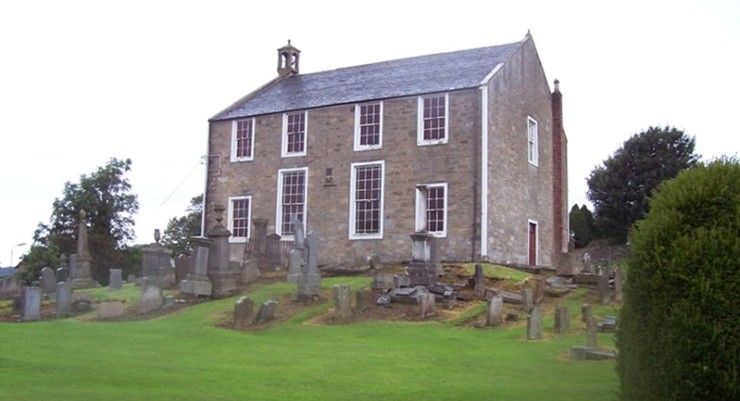
SMR 201/ NS 8561 7339 / Listed B
The church stands on the north side of the present village on a small mound adjacent to the 12th century motte. To its south was the Kirk Burn, later renamed the Culloch Burn, and a little to the north is the River Avon. The flat valley floor of the Avon was poorly drained and marshy, however, at this point the low hillocks approach it from either side, making it one of the few places where it was possible to cross safely. The church is dedicated to St Lawrence, a third century martyr renowned for his service to the poor. Many medieval British churches are named after him. The Parish of Slamannan or St Lawrence is one of the early medieval parishes in the Falkirk district which were formalised sometime around the 12th century. The location of the church suggests that it stood in the bailey attached to the motte.
The church is mentioned in 1176 as one of thirty-three of the Decantus de Linlithgow (Sibbald 1707) and in 1274 the following entries appear “Ecclesia de Slefmanyn 5/1d”;”Ecclesia de Slamannan, 5/-“; “Rector de Slamannan, 11/7d”. On 22 January 1306 the Pope’s Collector received 6 stones of cheese from the Rector of Slamannan (Bogimont’s Roll). From the fourteenth century to the sixteenth the patronage of the church was held variously by the Sandilands, Livingstones, Cunninghams and the Murrays. Latterly it was the King.
The early church building must have been very small and we can assume that like its successor it was aligned west/east, with the altar at the east end. By the 17th century it would have been a narrow single storey stone building. At the Reformation the altar would have been removed and a central pulpit erected with lofts at either end of the building. In the Statistical Account of 1795 it was stated that some of the seats bore dates as old as 1556, with many from 1632. A bellcote occupied the western gable. This was repaired in 1706:
“There was ane accompt given in be Rot Grinnock Smith in Jaw and John David Wright yr for repairing the bell and bellhous of the kirk qch amounted to the sume of 3 lb 2 shill: Scots” (Kirk Session Records 3 March 1706 f.119).
The bell was operated by a chain and on 27 September 1713 it was reported that this had broken. It seems to have remained broken for some time, for it was only on 1 November 1718 that “They appointed Robt Greenock Smith 9sh Scots for mending the bell chain” (ibid f.80). The bell itself was not in the best of conditions and on 11 February 1722 we hear that
“James Waddel of Balquhatstone and Patrick Salmond of Whin to take down the kirk bell and send it to Edinburgh to have it refounded.” (ibid f.113)
Up until the 1720s the entire parish lay on the south side of the River Avon, reflecting the feudal landholdings. This meant that the church, which had been placed adjacent to the principal residence, stood close to the northern boundary of the area that it served. At the same time, it meant that worshippers living within a short distance of the church but north of the river had to travel into Falkirk on a Sunday to attend the sermons there. This was recognised as a great inconvenience and so the presbytery pressed for the southern part of Falkirk Parish to be annexed to that at Slamannan. To accommodate the additional parishioners the church at Slamannan was supposed to be extended eastwards, though it was some time before the enlargement was executed. The terms of the settlement were thus stated:
“…to lift & remove the Easter gavil of the Church of Slamanan eight or ten foot as shall be found needful & make an additionale building for our accommodation to hear the word preached at Slamanan & to keep the said additional building in repair only, at our own expenses ever afterwards; and ingudge us not to alter the present fabrick of the Church o Slamanan its walls or roof; as also to gave to the poor of Slamanan such a sume of money as the pby shall think reasonable for the privilidge of the ground upon qch the said additional building is to be made providing always we receive from the pby of Lithgow, parach of falkirk & other friends the sum of two hundred & seventy seven pounds fifteen shilling & two pennies Scots too our assistance, oblidging us to finish the saids additional building agt the first day of September nixt one thousand seven hundred & twenty nine years … for purchasing part of the Church yeard of Slamanan for burial places as we shall have occasion for them, as also to bear a proportion of the expenses for repairing of the churchyeard dykes conforme to our valuation …” (Kirk Session Records CH2/331/3, f.11A).
The lands of Ellrig, Easter Jaw, Wester Jaw and Croftannie were disjoined from the parish of Falkirk in 1725 and annexed to the kirk and parish of Slamannan. The presence of galleries at either end of the existing church meant that instead of extending it eastwards, an aisle was built on the north side of the church in 1730 to accommodate the people from the annexed lands. Presumably the churchyard outside the south wall of the church was already densely occupied by burials.
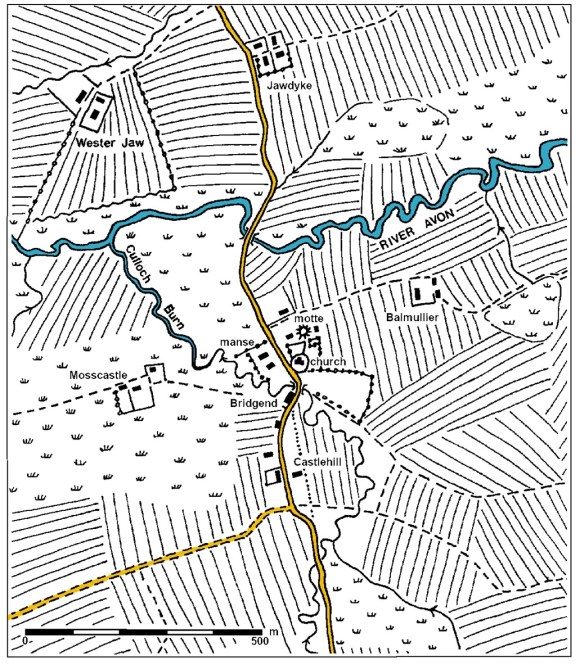
Together the residence at the motte and the church had formed the administrative, religious, social and cultural centre of the parish. There was, however, no numerous population at the centre here, merely a small cluster of houses. Even the school at this small settlement was of a temporary nature, being held for half of the year at the eastern end of the parish.
The church building had to have repairs to its roof and walls (except the gables) in 1753. Inside, the building was dark and, to remedy this, additional windows were desired. The Heritors were loathe to spend money on the building, which some thought ought to be demolished and rebuilt, and so this work kept being put off, as is reflected in this extract form the Records of 23 May 1788:
“two windows were to be put into the church. The one in the north Aisle and the other some where else, to give light to the seats in the north side of the church, near to the west end, and that the same was never done, altho’ there is money in the hands of…” (f.5).
The general state of repair resulted in the aisle roof letting in rain and snow (16 April 1790, f.13). Money was, however, still available for fittings and in 1799 a new pulpit was installed.
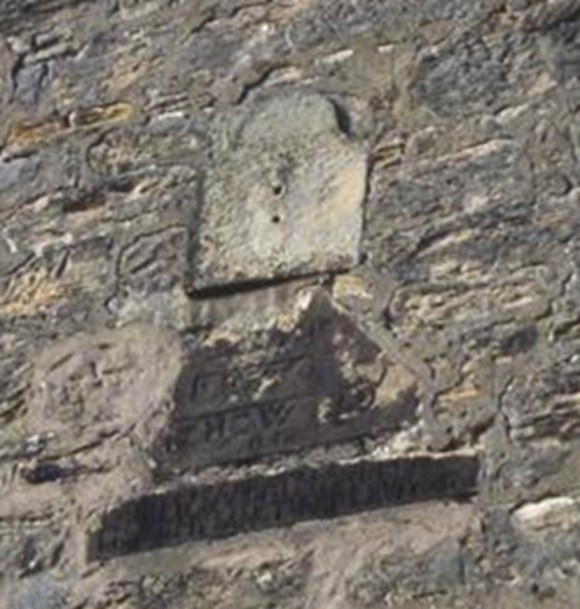
Little remains of this early church. A dormer pediment is built into the south face of the present church, along with a window lintel and a sundial.
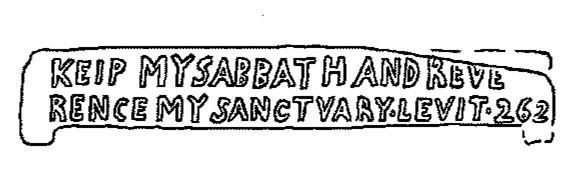
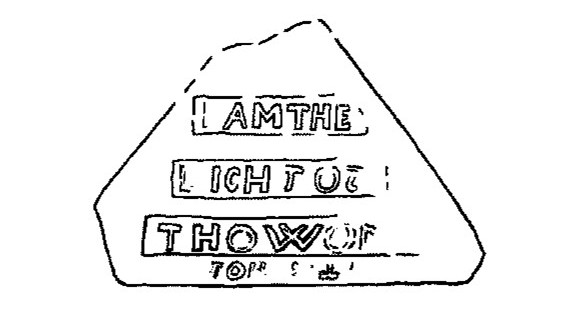
The vertical sundial has a square face with a stepped arched top, similar to the mid-eighteenth century sundial from the Main Street in Bo’ness. The left side of the stone protrudes slightly from the wall whilst the right edge is flush with the new building hinting that the old church was on a slightly different orientation than its successor.
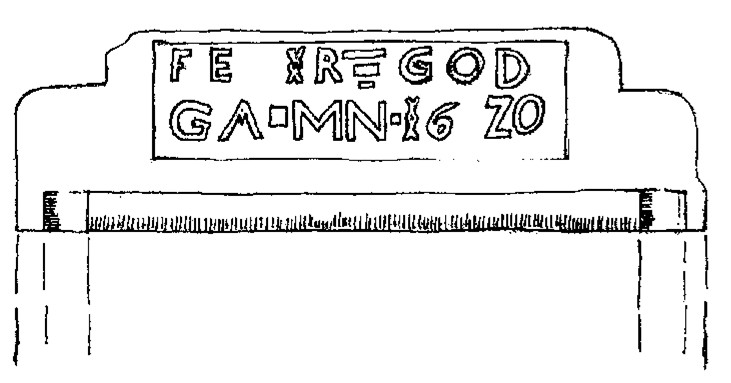
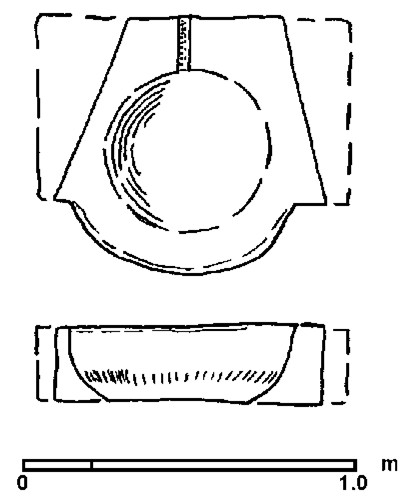
A stone built into Loanhead Cottage is reputedly the old font or piscina; and a dormer pediment built into Binniehill Farm is also said to be from this building. A piece of worn sandstone has been re-used in the present church at hip-height at the southern end of the east wall and bears the date 1722 or 1728 (the last two figures being very faint).
In 1809 the building was declared unsound and the roof was temporarily patched. Mr Brownlee’s church in Falkirk (the Tattie Kirk) was inspected and liked, but was considered to be too expensive. A plan for a new church was made out by Hume & Richardson who were told not to exceed 50ft x 40ft. That December the plan was amended to be 2ft longer & 2.5ft wider and tenders were sought. It was agreed that the stone from the old church should be given to the contractor and that William Arthur’s yard would be used for laying down materials. As it was possible that the lime and the sand could be supplied by the Heritors themselves to reduce costs, a comparison of costs was made with getting the contractor to do it. An advert was placed in the Edinburgh Advertiser & the Glasgow Courier:
“New Church to be built. Estimates are wanted from Contractors to build the Parish Church of Slamannan, the Plan & specifications will be seen by applying to Mr Waddel of Balquhatston any of the last three days of this month, and every information necessary will be given by him. Sealed offers or Estimates lodged with him on or before the 16th Febry next, which day an adjourned meeting of Heritors is to be held in the Church, for the purpose of accepting of the lowest offer, if the terms and Cautioner which must be named is acceptable, and to assess themselves in a sum of money to defray the expence. Slamannan 20th Jany 1810.”
The lowest estimate for building the new church was that of Robert Waddel & Smith at £864.15, but they failed to produce a cautioner. The next lowest was by James Warden, wright in Falkirk, at £924. He named his cautioner as Robert Grossel in Bodom and his offer was accepted. At a meeting of the Heritors and Elders on 24 February 1810 it was agreed to proceed with the building. Warden pencilled a change on the plan in the location of the columns for the gallery to make them more evenly spread and this was accepted. The payments were to be made as follows: the first instalment of £200 on beginning the work; £200 when the roof was finished; £200 when the doors and windows were put in and the floors laid; the final sum upon completion and inspection and the keys delivered. Another amendment was made to the plan for a small doorway to be put in to get access to the space below the stairs. In April 1810 the foundations were measured out on the ground. The church’s building committee kept a close eye on the work and stipulated that no lime was to be used for building until it was mixed with proper sand and soured for at least ten or fifteen days. They had inspected the sand laid out on site and did not approve of it. It was now considered unnecessary to have a base course on the south wall as the ground there was too uneven. There was a corresponding reduction in cost. A further inspection by the Heritors thought that there was too much sand in the lime and it was agreed to get an arbiter in to check.
At the end of March 1811
“The question being put whether the heritors agree to take the church off the contractors hands as it is or refer the whole work to the determination of Alexander Easton the arbiter mentioned in the contract…”
The following month Easton judged the work on the church to be finished and the seating plan was agreed. It had a capacity of 700 worshippers. Easton also checked the standard of the mason work executed by William Aitken, as did Thomas Bain on behalf of the contractors. In June the clerk wrote to James Warden asking him to clean the church yard of the whole wood and rubbish and in December the final adjusted payment was made. The items deducted included the painting of the doors and columns, which had not been requested. Weathering of the lime mortar meant that the west gable and south side wall of the church were pointed using sand from Fannyside Loch in the summer of 1817.
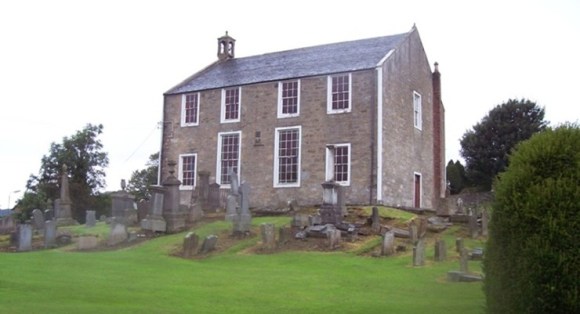
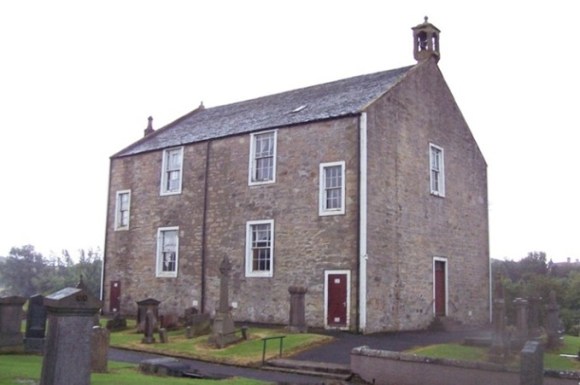
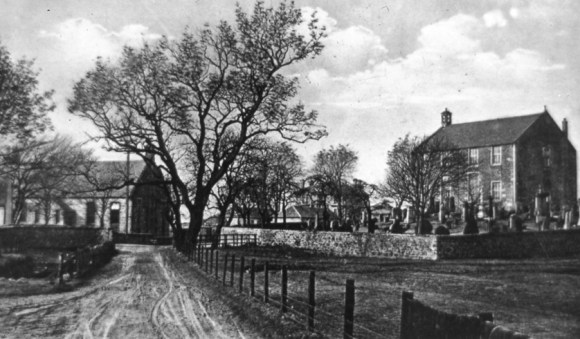
At this point it may be appropriate to provide a fuller description of the church building. It is oblong in plan, measuring 52ft 8ins from east to west by 42ft 8ins transversely over walls 2ft 6ins to 2ft 9ins thick. The walls are of random rubble with dressed and backset margins at quoins and voids, the gables being fitted with plain tabling. In the north wall there are two windows below and two above the level of the gallery, which runs round three sides of the interior; in the south wall there are two rows of four windows, at corresponding heights, the middle ones in the lower row being higher and wider than the rest. In each gable there is a door with a window above it, and on the apex of the west gable a bellcote. The gallery is reached by two internal stairs, one in each of the north corners of the building.
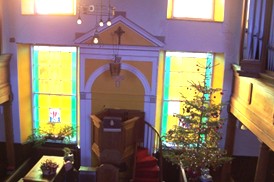
The pulpit is in the middle of the south side and may be of comparatively recent origin, set against a background of older wood panelling forming an arched bay with plain pilasters, entablature and pediment. The ceiling contains an ornamental plaster panel.
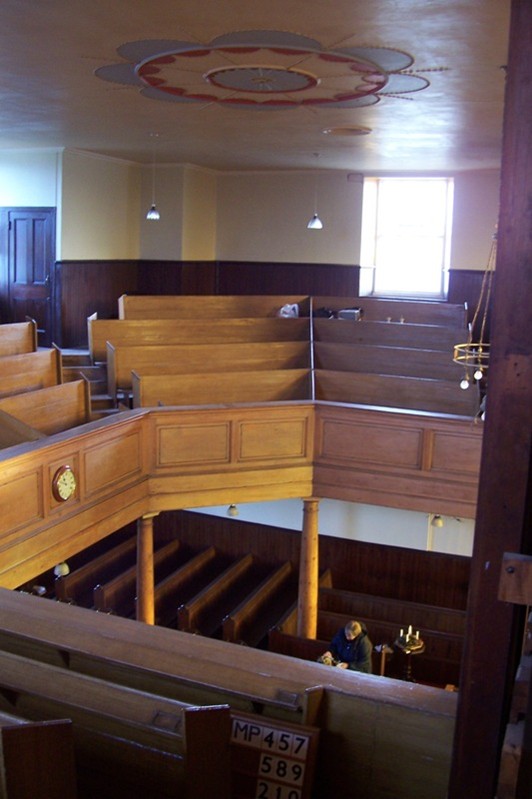
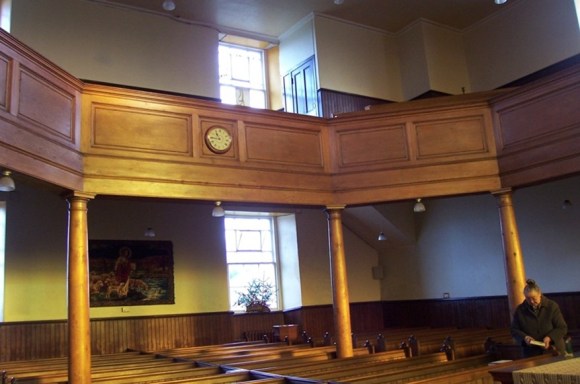
Maintenance and repairs were undertaken from time to time. 1892 saw a programme of repair work and in 1900 heating was installed. That year work began on a church hall (SMR 2327) on the opposite side of the road adjacent to the Culloch Burn. Its east gable faces the road and has a high pitched roof with crow-steps. In 1945 the Parish Church united with Balquhatstone Free Church, and that building was converted into another church hall.
In 2015/16 a major overhaul was undertaken. This included the removal of the raked pews on the ground floor and the installation of toilets and a kitchen below the gallery on the ground floor.
The glebe lay to the west and south-west of the church with the manse immediately on the opposite side of the road. This was rebuilt in a substantial manner in 1857. It lay unoccupied for a number of years in the 1980s and was set on fire in 1985. A new brick bungalow replaced it the following year.
Fittings & Communion Elements
1700: £100 Scots received to be used for silver communion cups.
1706, 17 April: “The session recommend it to the Moderator to exchange the tuo quart stoops belonging to the kirk wt tuo flagons, And to buy ane new basin for the carrieing of the bread at the Sacrement. As also to sell the old silver cups that belonged to the kirk att the best advantage he could.” (f.120). This he did and reported back in May. The broken silver cups were sold for £12 Scots.
1713, July 12: “There were found remaining in the Beddal’s custody, a plate, two flagons, the communion-tokens with a table-cloath, and the fringe of the old pulpit-cloath.” (f.21)
February 15th 1720: Alexander Mitchol of Mitchol writer to the Signet “gave to the Kirk and Paroch of Slamannan and did deliver to the custody and Members of the Session two silver cups to be made use of at the Celebration of the Sacrament of the Lords Supper in this Paroch with this condition, that the paroch of Muiravonside is to have use of these two cups once every year if desired.”
18th October 1721: The Presbytery had mortified 100 Marks for renewing of the Church bell and 500 Marks to be a fund for buying of the Communion elements.
1718, March 7: “The session first proceded to open the box it being now brought to the Minr hous & they found in it the communion tokens, two flagons, a brazen plate; and two table cloaths, an old fring belonging to the pulpit cloath…” (f.27)
1720, February 15: Two new silver cups gifted. (f.90) -presented by Mitchell, Balmitchell Farm.
1764, May: 2 silver cups, 2 pewter flagons, brass collection plate, table cloth, old bible and a baptismal plate. (f.25a)
1838: Two more cups presented by George Waddell of Balquhatstone and John Baird Ralston of Ellrig.
1935: Pulpit, communion table, elders chair and Moderator’s Chair given by Viscount Home, Slamannan.
Ministers of Slamannan Parish Church
| 1574 | Fleming, Richard | |
| 1607 | Ambrose, Thomas | |
| April 1658 | Sempill, Robert | Nov 1660 |
| Aug 1661 | Phin, George | Feb 1689 |
| 17? | Hastie, William | |
| Horne, Robert Stevenson | ||
| Nov 1887 | Rankine, William Henry | July 1891 |
| May 1892 | Reid, Allan | Sept 1922 |
| 1928 | Elliot, Nenion | April 1945 |
| 1946 | Cameron, Alexander Duncan | June 1968 |
| Jan 1968 | Fleming, Thomas Graham | |
| 1982 | Ovens, Samuel B | 1992 |
| 1992 | Thomson, Raymond |
Bibliography
| Bailey, G.B. et al | 1987 | Slamannan and Limerigg: Times to Remember |
| Jaques, R. | 2001 | Falkirk and District, an Illustrated Architectural Guide.(Quoted at 1 below) |
| Macnair, J | 1795 | ‘Parish of Slamannan, or St Laurence,’ Old Statistical Account; County of Stirling’ (Quoted at 2 below) |
| RCAHMS | 1963 | Stirlingshire: An Inventory of the Ancient Monuments. (Quoted at 3 below) |
| Sibbald, R. | 1707 | History and Description of Stirlingshire, Ancient and Modern. |
| Waugh, J. | 1977 | Slamannan Parish through the Changing Years. |
| Historic Scotland | Statutory List: Buildings of Special Architectural or Historic Interest (Quoted at 4 below) |
QUOTES FROM TABLE (Above)
- “Parish Church of St. Lawrence, 1810 On a raised knoll with surrounding cemetery, in rubble and slates, simple domestic-scaled building with wide-awake presence, the result of good proportions and disposition of the tall banded windows. Belfreyed gable with 1822 Maxwell bell; gallery within (see p.4).” [p.109-110]
- “Though this parish bears both the names of Slamannan and St. Laurence, yet the first of these is now universally used. I find the last only used in the old records of session, and in the presentation issued forth by his majesty, who is patron of the church, where the words are,” the church and parish of Slamannan, other “wife St.Laurence:” from which I am apt to think, that St.Laurence was not the name of the parish, but only of the church. It was originally a prebend; and as a great many old places of worship were called by the names of particular saints, this might be called by the name of this saint.” [p597]
- “The parish church stands on the N outskirts of the town of Slamannan, on the slope of some rising ground which separates the River Avon from its tributary the Culloch Burn, the motte being about 50 yds distant on the top of the rise. It was built in 1810, presumably on the site of an earlier church, though the ordnance Survey Name Book states that a mound similar to the motte was levelled to form its site. It is oblong on plan, measuring 52ft 8in from E to W by 42ft 8in transversely over walls 2ft 6in to 2ft 9in thick. The walls are of random rubble with dressed and back-set margins at quoins and voids, the gables being finished with tabling. In the N wall there are two windows below and two above the level of the gallery, which runs round three sides of the interior; in the S wall there are two rows of four windows, at corresponding heights, the two middle ones in the lower row being higher and wider than the rest. Between the two central windows, there has been rest a damaged dormer-pediment inscribed in relief, 16[??] I AM TH[E] LIGH[T] O[F]/ TH[E] W[ORLD]. Below is an incised fragment reading KEIP MY SABBATH AND [REVE]/RENCE MY SANCTUARY LEVIT PXIX 30], and above is an undated tabular sundial. In each gable there is a door with a window above it, and on the apex of the W gable a bellcote. The gallery is reached by two internal stairs, one in each of the N corners of the building. The pulpit is in the middle of the S side; it seems to be of recent construction though set against a background of older wood-panelling which forms an arched bay with plain pilasters, entablature and pediment. In the centre of the ceiling, which is of plaster, there is an ornamental panel (Pl.38B). The older church was dedicated to St Lawrence. 856734 NS 87 SE 20 March 1953 [No. 145, p.155-6.]
- Description: 1810. Refurnished, detached session house and 1722 Maxwell bell in small belfry. Resembles more a 2 storey farmhouse with blacked-out windows. Random stone. Rectangular plan. Ridge roof. References: Inv 145; Scottish Post Reformation Church. Notes: Ecclesiastical building in use as such. SLAMANNAN PARISH CHURCH (CHURCH OF SCOTLAND), INCLUDING SESSION HOUSE, CHURCHYARD, BOUNDARY WALLS AND GATEPIERS 1810. Tall, rectangular-plan, symmetrical gabled church. Random rubble; raised margins. Steps lead to panelled timber entrance door to W elevation with fanlight above; single window above and birdcage bellcote to gable apex with 1722 bell. Rectangular window openings to all elevations; pair of larger window openings to centre S elevation. Bronze sundial and carved inscription to S elevation (see Notes). Predominantly 6-over 6-timber sash and case windows; some coloured glass. Grey slate; raised skews. Wallhead stack. SESSION HOUSE: circa 1850. Square-plan, rubble, piended-roof session house. Timber entrance door. Plate-glass timber sash and case window. CHURCHYARD: surrounds the church and with further area to E and later area to NE. Variety of gravestones, some with sculpted decoration. BOUNDARY WALL AND GATEPIERS: coped rubble wall surrounding churchyard to N, S, E and W with pair of tall pyramidal-capped gatepiers: that to left truncated.
REFERENCES:
John Thomson’s Map of Scotland, (1832). 1st Edition Ordnance Survey Map, 1864-5. J Gifford and F A Walker, Buildings of Scotland, Stirling and Central Scotland, (2002), p656. Other information from http://www.scottishchurches.org.uk (accessed 17-10-12). NOTES: Place of Worship in use as such. This is a fine example of a little externally altered early 19th century parish church with associated session house, situated within its churchyard. Externally, the church is gabled and has regular, rectangular windows. The bellcote on the west gable houses a bell from the Meikle and Maxwell foundry in Edinburgh. It was recast from an earlier bell in 1722. The sundial to the south elevation is possibly of 19th century date. The Buildings of Scotland (2002) notes that the inscription below this is damaged, but reads “I AM THE LIGHT OF THE WORLD”. List description updated and statutory address amended, 2013
Forbes Papers “Intimation was yesterday given from the Desk that “a general meeting of the heritors of this Parish and annexation is to be held at the Church on Friday the 29th Currt at 11 O’clock forenoon to take into their consideration whether the church is finished according to the Contract entered into by the Committee of heritors and the Undertakers, if it is, to take the church of the trade merchants, if not, to take the necessary steps to have it inspected by tradesmen, and to empower the collector to use diligence against those heritors who may be deficient in paying their portion of the assessment, for the building of the church. The meeting will then proceed to a division of the seals of the church amongst the different heritors according to their valuations Sir Your very humble Servt William Cowan Clerk Slamannan, 18th March 1811” [Forbes Papers 966/14]
HERITORS’ RECORDS
[1809 – Plan for new church made out by Hume & Richardson. Told not to exceed 50 x 40 ft. Mr Brownlee’s church inspected and liked, but too expensive.]
16 Dec 1809: Plans to be obtained of Mr Brownlee’s church in Falkirk. An oblong plan by Hume & Richardson amended to be 2ft longer & 2.5ft wider. (f.64)
30 Dec 1809: 3 possible plans for the new church, an octagon; an oblong octagon; and one nearly square (f.65)
Square plan to be built. William Arthur’s Yard used for laying down materials. Stone from old church to be given to contractor. (f.67)
Possible that the lime and the sand could be supplied by the Heritors themselves to reduce costs, this to be compared with cost of getting the contractor to do it. (f.68)
Advert in the Edinburgh Advertiser & the Glasgow Courier: “New Church to be built. Estimates are wanted from Contractors to build the Parish Church of Slamannan, the Plan & specifications will be seen by applying to Mr Waddel of Balquhatston any of the last three days of this month, and every information necessary will be given by him. Sealed offers or Estimates lodged with him on or before the 16th Febry next, which day an adjourned meeting of Heritors is to be held in the Church, for the purpose of accepting of the lowest offer, if the terms and Cautioner which must be named is acceptable, and to assess themselves in a sum of money to defray the expence. Slamannan 20th Jany 1810.”
16 Feb 1810: The lowest estimate for building the new church was that of Robert Waddel & Smith at £864.15, but they failed to produce a cautioner. The next lowest was by James Warden, wright in Falkirk, at £924. He named his cautioner as Robert Grossel in Bodom. He was accepted. (f.69)
24 Feb 1810: At a meeting with elders selected to proceed the building, Warden pencilled a change on the plan in the location of the columns for gallery to make them more evenly spread. This was agreed. Payments to be made as follows: £200 1st instalment on beginning work; £200 when roof finished; £200 when doors & windows in and floors laid; final sum upon completion and inspection and keys delivered. A small doorway to be put in to get access to the space below stair. (f.70)
31 March 1810: Contract subscribed. (f.71)
28 April 1810: Foundations measured out on the ground. No lime to be used for building until it was mixed with proper sand (the committee had inspected the sand on laid out on site and did not approve of it) and soured at least ten or fifteen days. It was considered unnecessary to have a base course on the south wall as the ground was too uneven. There was a corresponding reduction in cost. (f.72)
An inspection by the Heritors thought that there was too much sand in the lime and it was agreed to get an arbiter in to check. (f.73)
19 May 1810: Thomas Bain and Alexander Easton to meet in the Brock Inn in Falkirk to discuss the work on the church. (f.73)
19 Jan 1811: The first Heritors meeting in the new kirk. Church not finished and so meeting adjourned.
29 March 181:. “The question being put whether the heritors agree to take the church off the contractors hands as it is or refer the whole work to the determination of Alexander Easton the arbiter mentioned in the contract…” (f.80)
12 April 1811: Mr Easton judged the work on the church to be finished. (f.81)
PLAN OF SEATING. (f.90-91)
25 May 1811: William Aitken mason for the church had brought Thomas Bain to agree to the standard of his work, the church got Mr Easton. (f.93)
15 June 1811: “the clerk should write Mr Warden to clean the church yard of the whole woud and rubbish in the course of next week” (f.95)
7 Dec 1811: Balance due to Warden & Aitken for the church building now requested. (f.105)
1 Feb 1812: The contractor for building the church was James Warden. He had been paid all the money due, except for items to be deducted – like painting the doors and columns, which had not been requested. Bell still to be hung properly. (f.110)
7 June 1816: Church and manse garden wall should be harled. (f.129)
14 April 1817: West gable and south side wall of the church to be pointed using sand from Fannyside Loch (f.144)
6 Nov 1819: Gun said to have been discharged by Robert Jamieson caused damage to one of the church windows. (f.184)
5 Feb 1820: Firing a gun at the church windows to be investigated and money recovered for the repair work. Robert Jamieson suspected. (f.191)
KIRK SESSION RECORDS
1700, March: “The minr reported in session yt he had advised wth ye heritors anent William Donalds business & had received ane hundred pounds Scots & given a discharge yrof to ye hr of William Donald, and further he reported yt ye Heritors desired yt ye session would apply it for buying of silver cups to serve ye church of Slamannan at ye administration of ye sacriment at ye Lord’s Supper.” (f.65)
1706, 3 March: “There was ane accompt given in be Rot Grinnock Smith in Jaw and John David Wright yr for repairing the bell and bellhous of the kirk qch amounted to the sume of 3 lb 2 shill: Scots”. (f.119)
1706, 17 April: “The session recommend it to the Moderator to exchange the tuo quart stoops belonging to the kirk wt tuo flagons, And to buy ane new basin for the carrieing of the bread at the Sacrement. As also to sell the old silver cups that belonged to the kirk att the best advantage he could.” (f.120). This he did and reported back in May. The broken silver cups were sold for £12 Scots.
1713, July 12: “There were found remaining in the Beddal’s custody, a plate, two flagons, the communion-tokens with a table-cloath, and the fringe of the old pulpit-cloath.” (f.21)
1713, September 27: Chain to church bell broken. (f.22)
1718, November 16: They appointed Robt Greenock Smith 9sh Scots for mending the bell chain and Wm Fyndlay wright 8sh Scots for making a ladder to serve the tent in time of Sacrament. (f.80)
February 15th 1720: Alexander Mitchol of Mitchol writer to the Signet “gave to the Kirk and Paroch of Slamannan and did deliver to the custody and Members of the Session two silver cups to be made use of at the Celebration of the Sacrament of the Lords Supper in this Paroch with this condition, that the paroch of Muiravonside is to have use of these two cups once every year if desired.”
18th October 1721: The Presbytery had mortified 100 Marks for renewing of the Church bell and 500Marks to be a fund for buying of the Communion elements
1720, February 15: Two new silver cups gifted. (f.90).
1722, February 11: James Waddel of Balquhatstone and Patrick Salmond of Whin to take down the kirk bell and send it to Edinburgh to have it refounded. (f.113)
CH2/331/3
1720s annexation of part of the parish of Falkirk.
“… to lift & remove the Easter gavil of the Church of Slamanan eight or ten foot as shall be found needful & make an additionale building for our accommodation to hear the word preached at Slamanan & to keep the said additional building in repair only, at our own expenses ever afterwards; and ingudge us not to alter the present fabrick of the Church o Slamanan its walls or roof; as also to gave to the poor of Slamanan such a sume of money as the pby shall think reasonable for the privilidge of the ground upon qch the said additional building is to be made providing always we receive from the pby of Lithgow, parach of falkirk & other friends the sum of two hundred & seventy seven pounds fifteen shilling & two pennies Scots too our assistance, oblidging us to finish the saids additional building agt the first day of September nixt one thousand seven hundred & twenty nine years … for purchasing part of the Church yeard of Slamanan for burial places as we shall have occasion for them, as also to bear a proportion of the expenses for repairing of the churchyeard dykes conforme to our valuation …” (f.11A)
“the pby ordained the work men to view the church & bring an estimate of how much money it would take to build an Isle”
1718, March 7: “The session first proceded to open the box it being now brought to the Minr hous & they found in it the communion tokens, two flagons, a brazen plate; and two table cloaths, an old fring belonging to the pulpit cloath…” (f.27)
1731, June 16: “The Minr … had bought a hand bell & that the price yrof was eleven shilling Ster. & the Session ordered Robert Ure to reimburse the minister of money in the box and appointed that whosoever did call for the bell at burials should pay six penis two penes of ych should be given to the bidle for his pains in ringing.” (f.157)
1764, May: 2 silver cups, 2 pewter flagons, brass collection plate, table cloth, old bible and a baptismal plate. (f.25a)
18 Nov 1837: John Baird Ralston of Ellrig and George Waddell of Balquahatston presented two communion cups. (f.166).
Falkirk Herald 9 January 1935, 3; plans for a gift proposed to be given to St Lawrence Church at Slamannan by Sir Robert Horne, in memory of his father, formerly a minister at the church, the gift would take the form of a pulpit, communion table, elders’ seats, and moderator’s chair, all in oak. Designed by Mr Greig the architect. Approved.
 Falkirk Local History Society