
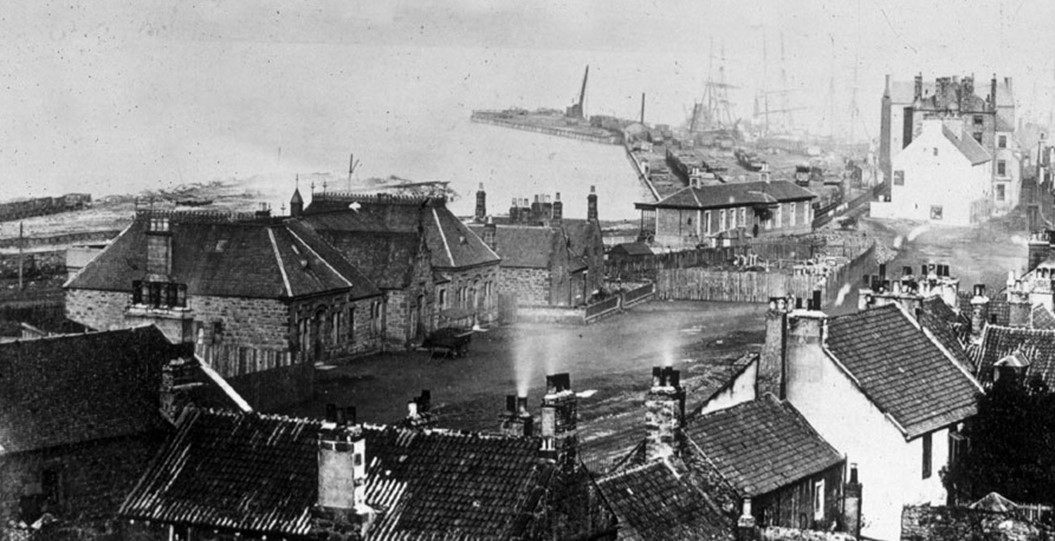
In the middle years of the nineteenth century the want of proper hall accommodation in Bo’ness was keenly felt for many years. The Town Hall near the harbour was poorly maintained and in any case its dimensions were far too small for meetings of any importance. So, the 2nd Linlithgowshire (Bo’ness) Rifle Volunteer Corps, also being unable to find any proper place in which to drill, set about making arrangements for the erection of a drill hall. Around 1872 Captain John R Dawson of Bonsyde opened negotiations with the Duke of Hamilton’s agent for the lease of a piece of ground for 99 years. The Duke’s agent refused to grant such a lengthy lease, but offered one for 19 years instead, at a nominal rent of £1. This offer was refused, and negotiations were stalled. Captain Dawson continued to collect money to fund the venture. After the matter had lain in abeyance for four or five years, they were re-opened by Captain A B Dorward who had, in the meantime, obtained command of the corps. After successfully contending with several difficulties he succeeded in obtaining, at a rate of £20 per acre per annum, a lease of ground on the Kinneil Estate situated on the Waggon Road at Corbiehall facing the Established Church. David Clunes, architect, Edinburgh, was selected to draw plans of the proposed new building. These having been approved of, estimates were obtained, and the following contractors were appointed; Robert Drysdale, Carriden, mason work; Gemmel & Kirkwood, joiner work; Walter Law, Bo’ness plasterer and slater work; and David Draper, Falkirk, plumber work.
In May 1877 Mr S Halliday, the factor for the Duke of Hamilton, submitted the plans for the proposed volunteer hall to the Town Trustees. Having been made public, the proposal gave rise to a veritable storm of criticism from the public, many of whom considered the ground to be common or public property. The inhabitants had already suffered from the closing up of easy access to the foreshore by the construction of the railway. The title deeds of the neighbouring feus on the south side of the road were examined and it was noted that they gave their northern boundary as the shoreline. These were old feus and the original shoreline had been lost by the reclamation of land from the Forth. The anxiety of the inhabitants was strengthened at this time by the enclosing of ground at “the Links” to the east of the town which had been used for decades for fairs and horse races. A legal challenge was considered and funds arranged, but in the end they came to naught as it became clear that the Duke owned the rights to the foreshore. In June planning consent was granted and a couple of months later construction began.
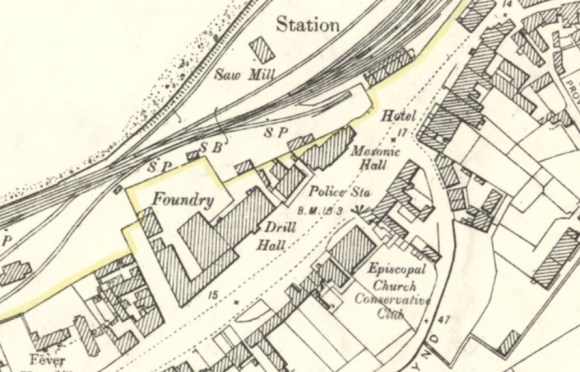
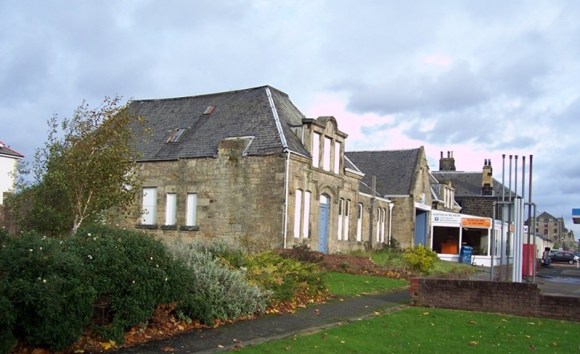
The building was set back from the main road to provide a small parade ground in front of it which could be used by the public. The style selected by the architect was of the early baronial order or free Jacobean. The main façade faced south with the principal arched entrance was placed centrally in a projecting porch finished by a gablet on the apex of which it was intended to fix a flagstaff. This formed the central axis of a long low symmetrical building. To either side were bays containing two double windows, and beyond these were slightly advanced bays with pavilion roofs topped by ornate fretted ironwork. Each of the end bays contained a central low-arched doorway flanked by double windows – all capped by hood-mouldings; arched in the centre over the door and stepped over the windows. The interior of the building was dominated by the large hall which was seated for 740 persons. To the right or east end of the hall was the platform measuring 16 feet by 25 feet 7 inches, on both sides of which retiring rooms were situated. Immediately to the rear of the stage were three apartments for the accommodation of the drill instructor. At the west end there were two large cloak rooms and toilets – one for ladies and one for gentlemen. The hall was heated by means of water with the heating apparatus placed at the north side of the building, around the inside of which the water pipes extended. The building cost about £2,000 and, surprisingly, sufficient money had been raised by the corps in former years through the economy of Captain Dawson. The strength of the Volunteer Corps at the end of 1877 was 6 officers, 6 non-commissioned officers, 1 bugler, and 97 rank and file; making 110 in all.
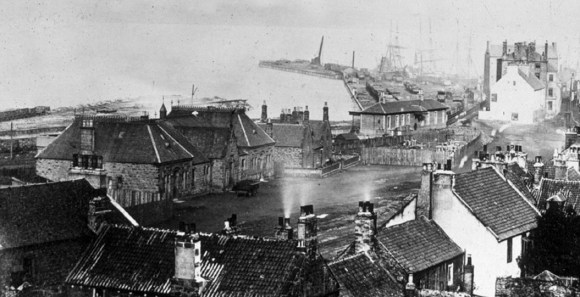
The hall was used by the corps for drill purposes, and when not thus occupied it was opened for lectures, concerts, balls, and other entertainments. It was handed over to the corps on 11 March 1878. Soon afterwards it was used by the United Presbyterian Congregation whilst its own church building was being repaired and cleaned. The drill hall was officially opened at the beginning of October 1878 when the officers and members of the 2nd Linlithgowshire Rifle Volunteers held a grand assembly and invited all the leading gentlemen in the town and neighbourhood. The Kinneil Instrumental Band gave a grand concert there a week later – the first of many. In December the Bo’ness and Carriden Poultry and Pigeon Show took place – also the first of many.
In 1881 the 2nd Linlithgowshire (Bo’ness) Rifle Volunteer Corps was renamed B Company 8th Volunteer Battalion Royal Scots (Bo’ness). The open area in front of the hall continued to be used for parades but before long other buildings were erected in the vicinity. In 1890 William Morrison started the construction of the West End Foundry. At half-past eight on Sunday morning the 19th January the eastern gable of the uncompleted foundry fell before a dreadful gale, smashing part of the roof of the Drill Hall in its descent. The foundry was rebuilt and continued in production until 1907, after which it was converted into housing.
It was at the time of the construction of the new foundry that a dispute arose over the use of the parade ground in front of the drill hall. The Commissioners of the town had been taking rents from people who set up stances there during shows and it was pointed out to them that it belonged to the Volunteers and that they had no right to charge. The Bo’ness Police Commissioners checked their records and carried on charging. So, in May 1896 an action was raised at the instance of Captain John Marshall representing the local company of volunteers asking for £500. The Commissioners denied liability and stated that the ground in front of the Drill Hall has been a public thoroughfare for many years and as such was under their control and that they had been granted permission to levy such toll or custom by the Duke of Hamilton, superior of the land, to whom they paid half of the revenue. It is not known what agreement was eventually reached.
In the middle of this dispute, in 1891, a proposal was made for the public to acquire the Volunteer Hall and adapt it for use as a town hall. John Cadell of Grange suggested that the Commissioners should take up the offer made by the Volunteers to accept £1,340 for the building if they were allowed to continue to use it not more than thirty times a year and to continue to use the drill-sergeant’s house and the armoury on payment of a small annual charge. Any revenue from the lease of the hall to other groups would belong to the Commissioners – for the last ten years the average sum had been about £70 per annum, and for some years after the hall was built it had yielded a return of over £100. The offer was not taken up.
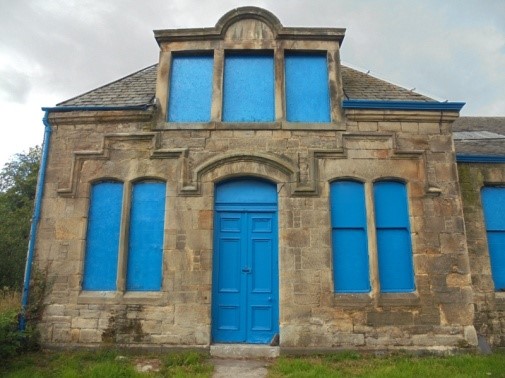
In 1980 the business was bought by Douglas and Robert Haston. Over the years of use as a garage many changes were made to the building. The central doorway was enlarged to take motor vehicles and a modern extension and petrol station were erected in front of the eastern end. Despite this, the original building can still be readily recognised.
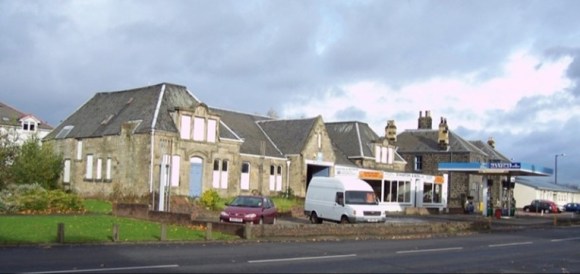
The volunteers continued to use the hall and the opening of the grand new town hall in 1904 caused a decrease in use of the drill hall by other parties. It was, however, at this time that the local Boys’ Brigade became frequent visitors, even making use of the miniature rifle range. In 1914 the hall was the base for “B” Company, 10th (Cyclist) Battalion, Royal Scots. After the First World War it was no longer required and seems to have been sold off. For a short time it was used as a solicitor’s office. It was probably at this time that triple-light half dormer windows were inserted into the two wings. In 1922 it became a short-lived Employment Exchange.
Shortly thereafter it was bought by George Ainslie whose nearby motor garage had burned down in 1922. On his death in 1928 his son, Thomas Waddell Ainslie, took over the business, and upon his death in 1948 it passed to his nephew, George Dundas.
Sites & Monuments Record
| Corbiehall | SMR 1484 | NS 9960 8151 |
 Falkirk Local History Society