
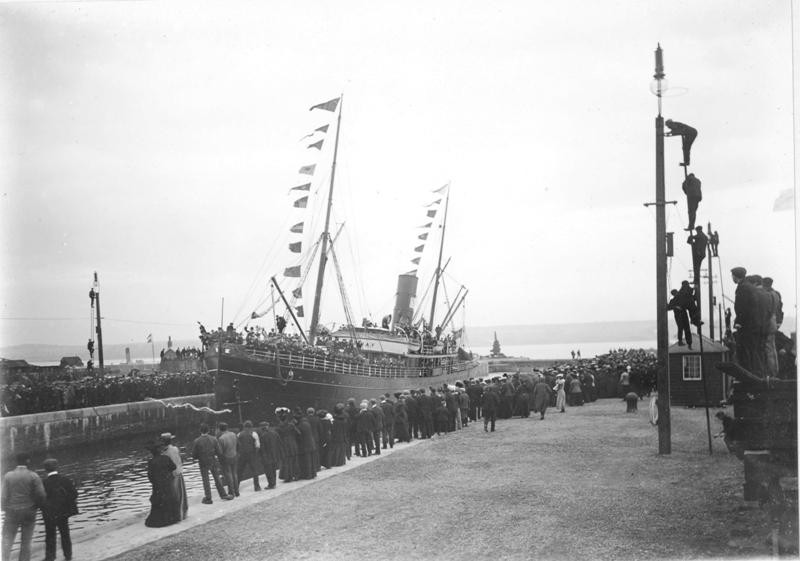
Prizes, Sweepers, Paravanes, Q-ships, Mines, Wrens, & Oil Pipelines.
In 1867 Grangemouth Docks, along with the Forth and Clyde Canal, were acquired by the Caledonian Railway Company. The Company then set about using its vast resources to improve the facilities at Grangemouth in order to make it one of Scotland’s top three ports. Between 1867 and 1876 the tonnage through Grangemouth almost doubled and authority was obtained to construct a new dock. The Carron Dock was opened in 1882 and was a great success. By 1896 traffic through the port had risen to 2,418,878 tons. However, the Carron Dock still opened directly onto the River Carron and it was found to be impossible to dredge a sufficient channel depth due to the rapid rate of siltation. To maintain their lead the Caledonian Railway Company pushed forward with a massive expansion of the port. Work began in 1898 and by October 1906 the immense complex was ready for use. It included the Grange Dock of 30 acres and a large entrance lock to the Forth Estuary. In all there were nearly 100 additional acres of water in the port area. The effect of this great enterprise was soon seen in the tonnage passing through the port and by 1909 this had increased to 3.9 million tons.
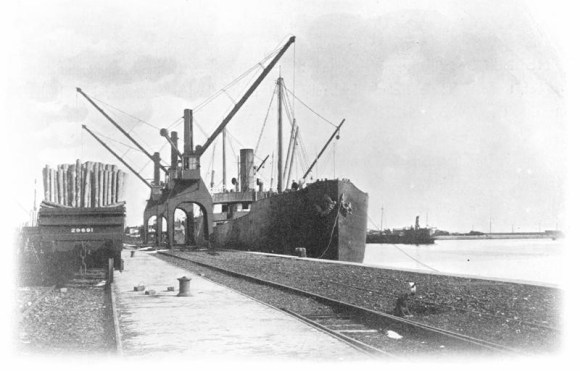
Raw materials were imported from all corners of the globe to feed the industries of Central Scotland. The Falkirk area had become one of Europe’s largest centres for light castings and the ships brought iron ore and scrap iron in large quantities. Much of the iron ore came from Northampton and was brought by the Skinningrove Iron Company. Coastal trade was a significant component of the port’s business. Loam sand for casting came from the Thames Estuary. Chrome ore arrived from Scandinavia. China clay was used in the potteries. Esparto grass from Spain went to the paper mills at Denny. Kelp from Kirkwall and Christansund was processed into chemicals at Port Downie. Tallow and fish oil could be converted into soap at Grangemouth itself. Timber of all sorts arrived from the Baltic and from America. A large part of the port’s basins was devoted to this cargo, which arrived in various forms. Logs were processed in the numerous local sawmills and could be sent along the Canal, made up into rafts, for further work. Pit props were in high demand. Barrel staves arrived ready shaped for finishing work and assemblage at the cooperages. Wood pulp was another material destined for the paper mills.
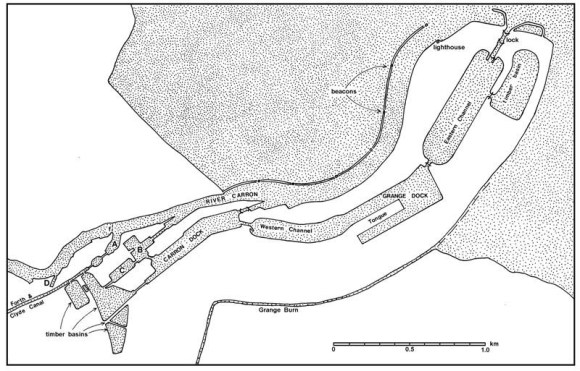
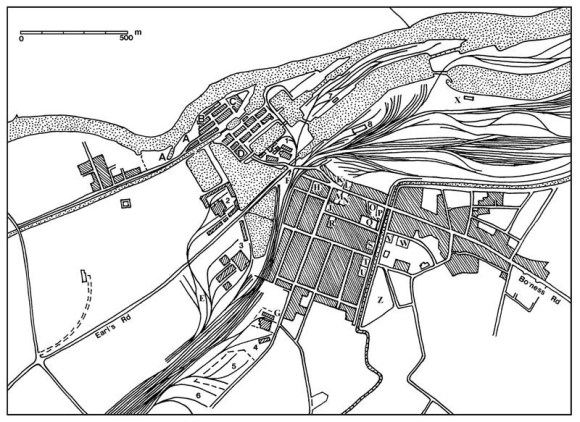
A – Old Harbour; B – Old Wet Dock; C- Junction Dock; D – Dry Dock; F – Ferry.
Building materials flowed in both directions. Cement and slates came in and bricks left. Fireclay was being exported. The iron industry exported pig iron and manufactured goods such as stoves and ranges. Paper was consumed in large amounts in southern England. However, most bulk exports were also raw materials. Coal was perhaps the greatest by volume, some of which went in the form of coke. Pitch and oil were becoming increasingly important as exports. Even “mill cinder” found a use elsewhere.
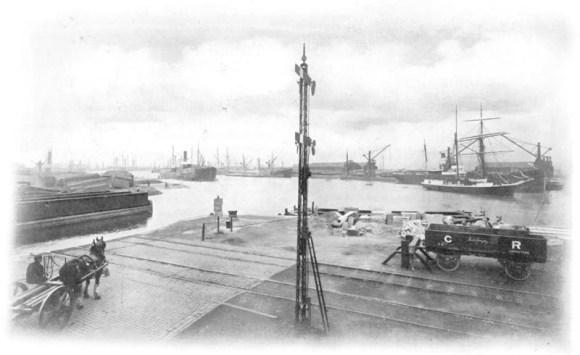
To handle these cargoes a number of shipping companies and agents had been established in the port. By 1914 the main shipping agents with offices in Grangemouth were:
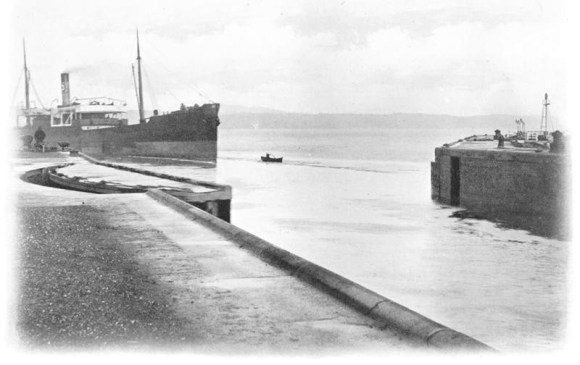
Anglo-American Oil Co; A B & Brown; Burrell, N; Buchan & Hogg; Carron Co; Robert Crawford & Co; J Currie & Co; J C Dick & Pollock; J & J Hay; Gibb & Austine; Gibson, George & Co; Gillespie & Nicol; Hopkin, Paton & Co; Love & Stewart; W Jacks & Co; J Livingstone & Sons; A MacKay & Co; Merry & Cane; Merry & Cunningham; Milne & Allan; J Rankine & Sons; J T Salvesen & Co; Shields & Ramsay; Skinningrove Iron Co; Walker & Bain;W K Watson & Co; P & J Wilkie.
Manual handling was still to the fore and these companies employed large numbers of casual labourers on a daily basis at the Docks.
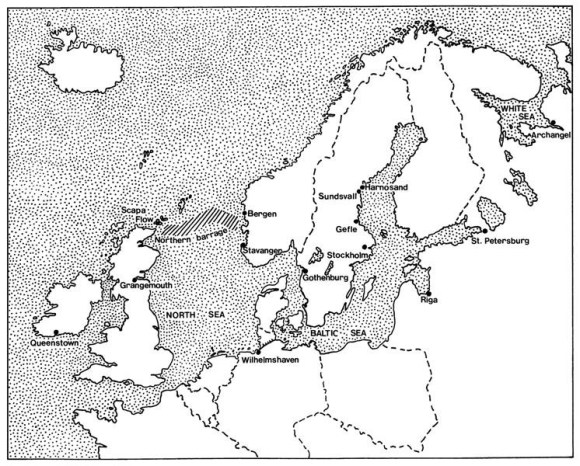
Trade was episodic and seasonal. A large part of the Baltic, for example, an important source of material brought to Grangemouth, could be closed between November and April each year by the build up of ice. Despite the distant threat of war with Germany, the Baltic traders were therefore reluctant to miss any voyages in the summer of 1914. J T Salvesen & Co was no exception. On 16th July the company’s ship Vala sailed from Stockholm and arrived at Grangemouth on the 30th. Vestra sailed from Grangemouth on 10th July to Gefle, Harnosand and Sundsvall, also arriving back at Grangemouth on 30th July. Embla left Hernosand on 31st July and arrived safely at Dundee on 6th August. These three ships were fortunate, for on 4th August Germany declared war on Britain. The four other ships of the Salvesen fleet did not have such good fortune. Germany had sent a naval force to the Baltic on 2nd August to seal off the Russian ports. Now it extended its blockade to include Danish and Swedish ports. 25 Scottish registered ships were thus bottled up, including Salvesen’s Vina, Siva, Duva and Driva. The Vina had sailed from Grangemouth on 30th July, arriving at Sundsvall on the 4th August. Siva put into Gefle from Oscarhamn on 31st July and Duva arrived there from Grangemouth on 3rd August. The Driva had just left there and made it safely to Sundsvall on 4th August.
It was obvious that the ships would be unable to sail home for some time and so they were laid up and the crews were reduced to one or two hands. The remainder of the crew were sent overland to Bergen and then by sea to Scotland, although the crew of the Duva only seems to have arrived back at Grangemouth in April 1918. By the middle of 1915 it appeared unlikely that any of these stranded vessels would be able to return to Britain during the war. Prices for second-hand tonnage had risen steeply and so J T Salvesen & Co decided to sell the Siva and the Driva. The former being sold to Swedish owners in November 1915, and the latter in October 1916. Sweden, Norway and Denmark were all neutral countries and consequently their territorial waters should have been safe. Britain was desperately short of mercantile ships and the Government encouraged those trapped in the Baltic to make their way home by way of neutral waters and a port on Norway’s west coast. Swedish crews were hired and the Vina made a clean break from Sundsvall on 8th June 1916. Two days later she was followed by the Duva. As she left Gefle a U-boat fired a torpedo across her bow to force her back into port. The crew called upon the Swedish navy to ensure her safe passage through their waters and she was escorted out by their destroyers. Both Salvesen vessels arrived at Gothenburg on 14th June. Here British masters took over command of the crews and on 17th June Duva sailed for the Tyne via Norwegian territorial waters. She was the first of the blockaded ships to arrive there on 22nd. Vina arrived four days later.
Many German merchant ships had been caught equally off guard by the declaration of war. HM Customs made a sweep of British ports looking for German registered or German owned vessels. Three – the Angela, Tilly and Hans Jost – were seized in Grangemouth Docks, and the Mientje was taken at Bo’ness. Subsequently the Mientje was taken to Grangemouth, where she arrived on 26th October 1914, to be laid up. The three ships at Grangemouth had already been joined earlier that month by the Katharina and the Hermann, confiscated at Wemyss, and the Wega and the Gebruder acquired at Alloa. Later that year these vessels were declared as prizes of war. Two further prizes, the Alfred and the Theodore arrived in March 1915 in order to be allocated to shipping companies to be managed on behalf of the Government (Appendix 1). In May the Katharina, Angela, Alfred, Mientje, Tilly and Theodore were all handed over to the Grangemouth company of James Livingstone & Sons and sailed to London with cargoes of bricks and fireclay. For the company this was to be the beginning of a long association with the Admiralty. All this went on secretly outwith the public gaze. By contrast everyone knew when the German steamship Nauta was captured and brought to Grangemouth with her cargo of timber in the first week of September 1914. The wood was consigned to local merchants.
Businessmen too had made little provision for the war. Andrew McKay, who had been the first provost of Grangemouth, had shares in a number of German ships, such as the Friedrich Carow and the Grete Cords. These shares were eventually liquidated by the German government.
During the early summer of 1914 the paddle tug Forth, belonging to the Grangemouth & Forth Towing Company, had resumed her annual evening cruises from Grangemouth’s Old Dock.
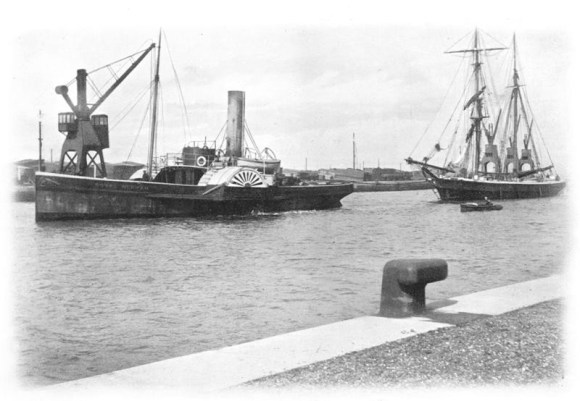
Down river she went to Leith and up river she navigated the Windings beyond Alloa to Stirling. She was fitted out with deck seating and a canvas awning for her leisure role. Over the Falkirk Trades’ Holidays she had been joined by the Flying Bat and connecting trains were provided from Grahamston Station. Local firms chartered these vessels for their employees’ annual outings, as did societies such as the YMCA. However, from midnight on 2nd August 1914 the Admiralty declared the Forth Estuary to be a controlled area and pleasure excursions were prohibited until after the cessation of hostilities.
The Greenock and Grangemouth Dockyard Company already had a good working relationship with the Admiralty. In 1907 five horse boats had been built at Grangemouth, and in 1911 the Royal Fleet Auxiliary Burma was launched by the company at their Greenock Yard. When the war started, the most urgent demand of the Royal Navy was for minesweepers. These were desperately needed to sweep ahead of the large warships. Never before had mines been laid on the scale now seen. During the four years of hostilities the Germans laid some 43,000 mines and over 200 minesweeping vessels were sunk. In all, almost 3,000 trawlers and drifters were commandeered for this dangerous task, working as patrol craft, tenders to warships escorts, boom attendants and supply boats as well. They were manned by the fishermen, supplemented by naval officers. Within weeks of the war starting, drifters of 29-40 tons were brought to Grangemouth from Anstruther, St Monance, Cellardyke and Pittenweem. These vessels were registered at Kirkaldy and Anstruther. They were laid up in the Old Dock, where they were converted for their new role. This involved dismantling their fishing gear and installing powerful winches. Priority was given to the work and was undertaken by the engineers of Dundas Engineering (Tennant’s) and J Cochrane of Bo’ness, as well as the men of the Dockyard Company. The winches were brought through the Canal by the Dockyard Company’s own steam lighter the 20 ton Burnbank. Despite the original urgency, supply shortages meant that it was nine months before the last drifter left Grangemouth under the management of J Bonthron & Son (see Appendix 2).
Whilst all this bustle and activity was going on in the Old Dock, the newer facilities were less busy. The SS Glasgow belonging to Rankine & Son, which had run a regular service from Grangemouth to Amsterdam and Rotterdam, was laid up before being chartered in December by G & W Burns to run from Glasgow to Liverpool. The Kerse Steamship Company had only been formed by Walker & Bain earlier that year and had just one ship – the Saxon Briton.
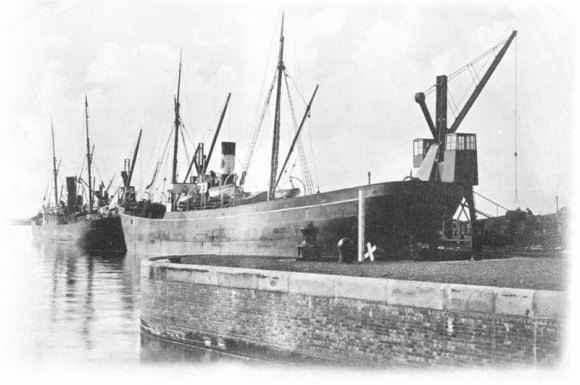

As she had traded to the Baltic she had to be employed in other areas. Buchan & Hogg of Grangemouth laid up their ship, the Dhu Heartach, in Alloa at the commencement of hostilities and sold her the following year. Before the war Thomas Cowan & Co had maintained weekly sailings to Southampton, calling at Treport for a return cargo. As the war settled into its familiar stalemate, the port of Treport had to be omitted due to its nearness to the Somme battlefront, and the number of sailings was reduced.
Trade began to stagnate. Even so, during the second week of November the Docks at Grangemouth were visited by 34 steamers with a total tonnage of 19,439 tons and by one sailing vessel of 205 tons (see Appendix 3). That week the North Sea was closed by the Admiralty to all British merchant ships. The area had been infested with U-boats and strewn with mines. Then, on 13th November 1914, navigation on the Forth was severely restricted. Ships entering had to report to guard vessels off May Island and submit to inspection. At the same time it was intimated that the Forth would close to all merchant shipping above Queensferry from 23rd November, closing the ports of Grangemouth and Bo’ness for the duration. This seemed to spell disaster for Grangemouth, which earned its living by the sea.
“We say: – No Thames, no London; no Clyde, no Glasgow. With equal truth we may add: – No Forth, no Grangemouth. For this reason it looked as if, by a single stroke of the pen, our means of subsistence had been filched away from us”.
Strong canvassing followed and the Town Council put together a delegation that included the powerful Carron Company to lobby Parliament and to persuade the Admiralty of the folly of its ways. Other local industries voiced their concerns and Bo’ness put forward a rather muted response. All were to no avail. The ports remained firmly closed and before long small craft on the river were not permitted any further east than Kincardine. The closure became known as “the unlucky Friday 13th”.
The pressure exerted by Grangemouth Town Council met with some positive responses. By the end of the month the Admiralty had set up a temporary Labour Exchange in the town to find work for unemployed dockers and men related to the Docks. It also offered to take men on at the rapidly expanding facilities at Rosyth, intimating that it might be possible to run a regular steamer service between the two ports for the workforce.
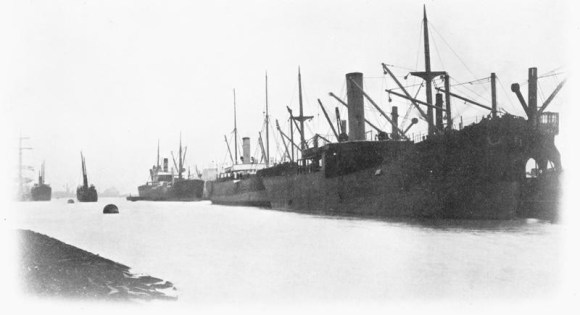
This service never materialised. Another Admiralty promise, to direct more of their work to the Dockyard to make up for the loss of work in the Docks, did happen. Amongst many others, the Dundee Council wrote stating that there was plenty of work in their docks for the Grangemouth men – though this may have felt like it was rubbing salt into a wound.
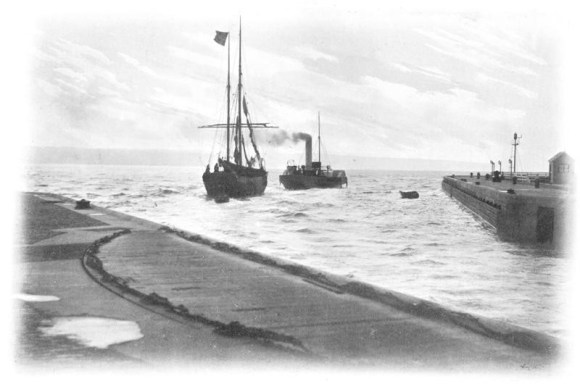
The closure of the Docks meant that those ships already there had to leave or risk being trapped by delays caused by red tape. Two of Salvesen’s ships, the Vestra and the Vala, had been laid up there since the last two days of July. Both sailed on 17th November. The Embla, after her narrow escape from Harnosand, had arrived at Grangemouth via Dundee on the 19th August. With her regular trade closed she too had been temporarily laid up.
Now, like most of the ships caught in the port when its closure was announced, she left without a cargo (see Appendix 4). Some of the cargoes en route for Grangemouth were considered essential to the war effort and so the Kinsale, Najaden and Samara were all allowed in. The Samara had deals from Archangel – useful for the manufacture of ammunition boxes, huts, and so on. Overtime was worked on the weekend of 5th and 6th December 1914 to clear these vessels. They sailed the following Wednesday and were the last true commercial ships for four years. For that long four year period the Docks were only used, with few exceptions, by the Admiralty and its shipping agent, W Mathwin & Son. One exception was the dredgers from Leith and Rosyth under the management of Topham, Jones and Railton.
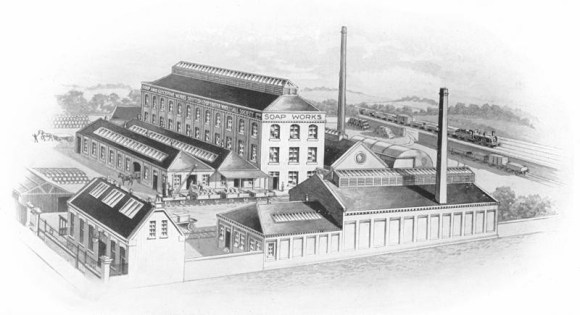
W Mathwin & Son took over the supply of caustic potash to the Scottish Co-operative Wholesale Society’s Soapworks in Grangemouth. This supply was vital to the war effort, as glycerine was one of the by-products of soap manufacture and an essential ingredient in explosives. The works, in South Lumley Street, had been established since 1897 and were the second largest in Scotland. Peacetime supplies of caustic potash had come almost exclusively from Germany and the British Government put considerable effort into finding alternative sources. It took over the supply of raw materials to all the soapworks in Britain and controlled the Grangemouth plant. Despite the wartime restrictions, the SCWS works in Grangemouth were still able to turn out 130 tons of soap weekly – the total product for one year being 6,719 tons of soap and 320 tons of glycerine.
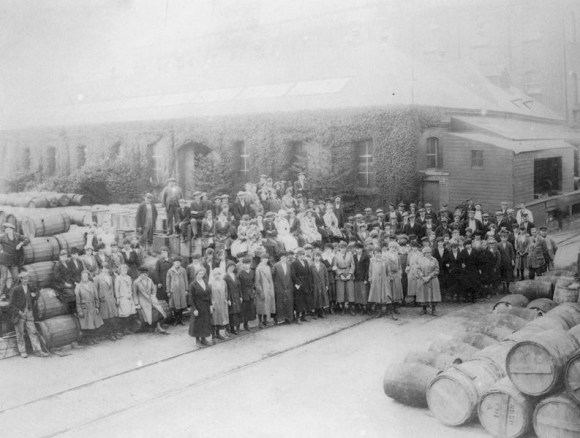
Before the war the Carron Company had a fleet of five ships sailing from either Grangemouth or Bo’ness to London. The passenger/cargo ships Forth, Thames and Carron were all relatively new and the Avon had been recently refurbished. The remaining ship, the Caroline, was a cargo vessel. On the day war was declared the Carron and the Caroline were in Grangemouth, where they were joined by the Avon four days later. The Thames and the Forth were at their base at Bo’ness. The Company suspended all sailings for two weeks until arrangements had been made to have the vessels covered by a new Government War Risks scheme. A convoy system of sorts was hastily put together and sailings of the Forth, the Caroline and the Thames resumed from Grangemouth. When Grangemouth and Bo’ness were closed to merchant shipping, the Carron Company transferred its Scottish shipping activities to Leith. This entailed hiring a new labour force at that port as well as lodging its clerical staff in the town at a cost of £1,175 per month. Goods had to be transported to and from Leith from Grangemouth by rail. Their trade suffered from a decrease in the tonnage carried and with the higher costs came a steep fall in revenue.
Thomas Cowan had little choice but to move his operations to Leith as well. He established an office at 34 Leith Walk, before moving to 125 Constitution Street. J T Salvesen already had family connections in Leith and so the move was easier for that firm. Denholm of Bo’ness did likewise. By the end of November 30 railway workers from Grangemouth Docks had already made the transition.
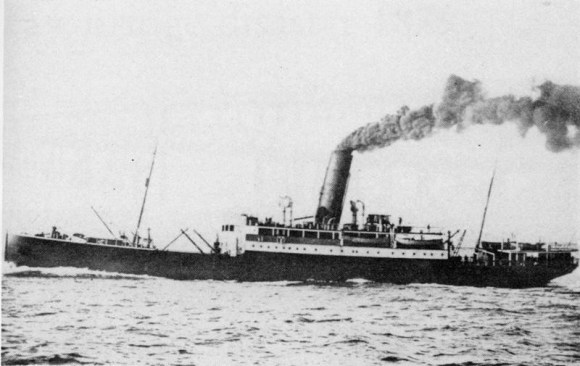
In February 1915 two of the dock workers who had been transferred from Grangemouth to Leith, being unfamiliar with their new place of work, fell into the docks there during the hours of darkness. One of them drowned. The following month the Caledonian Railway Company agreed to concessionary fares between the two ports to allow dockers to visit their families. By December the exodus was so complete that the Seamen’s Mission of Bethel in Grangemouth had to close due to lack of use. This once busy religious meeting hall and its reading room in South Harbour Street had been erected by the Marquis of Zetland in 1891 for the use of all nationalities frequenting the port. It had had its own resident Norwegian missionary, who held services on Sundays and Wednesdays, and a visiting missionary from Edinburgh for German seamen on Tuesdays.
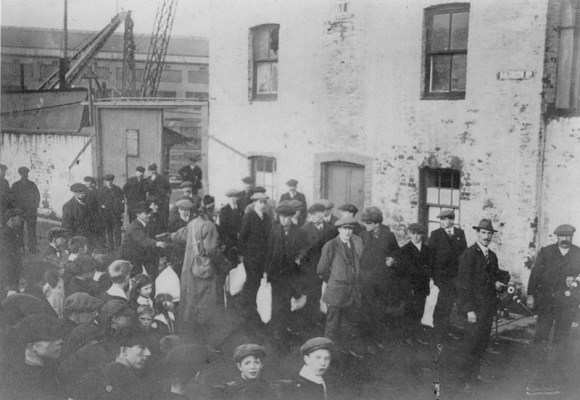
All casual dock work at Grangemouth ceased and the council’s health officer noted that:
“large numbers of the healthy males of the burgh were transferred to Leith or sought employment elsewhere; the lodging houses, where over 300-400 unskilled labourers have been hitherto housed, became deserted – rapidly reducing the permanent population of the burgh – quite apart from the reduction consequent on the enlistment of at least 560 men in His Majesty’s Forces.” (February 1915).
At the beginning of December 1914 the Grangemouth Branch of the National Union of Dock Labourers reported that out of the 1400 members on its books on the outbreak of hostilities, some 500 were already either at the Front or in camps preparing to go there.
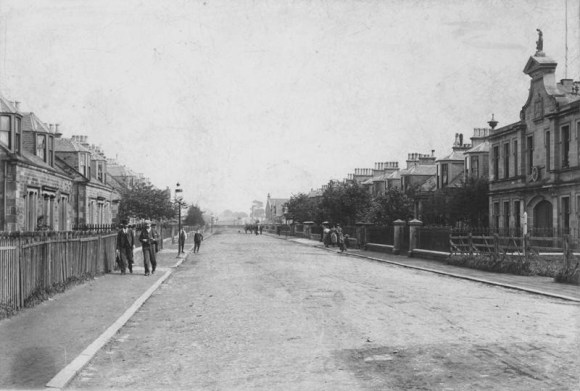
At the very beginning, on 4th August 1914, Grangemouth’s 65 Territorials and their two officers had been mobilised. Two days later they marched out of Grangemouth to Stirling, under the command of Captain (afterwards Lieutenant Colonel) Henry Wilson, and Lieutenant (afterwards Captain) George Ritchie. These men, after a few months of training, went to France in April 1915, and were known as 2nd Coy. 51st Divisional Train. Recruiting went steadily on until the number on active service rose to 1,655 of whom 281 made the supreme sacrifice.
The port became a prime recruiting ground for the Army Service Corps, which was looking for men to help with the supply logistics of the army in France. Even before the port closure announcement, a large number of recruits left in the first week of November for the No. 2 (Home Service) Company of the Army Service Corps (Territorial). In January 1915, 90 dockers left for France as Transport Workers with the Army Service Corps to undertake stevedore work and to help with the formation of supply roads. In May, 80 more men from the Docks and the local sawmills went for transport work. A final detachment of 40 men left Grangemouth by train for work in France that July. The town’s ultimate contribution to the road building programme in France came early in 1918, when the Town Council sold its old heavy steamroller to the Army for £525. As it had cost less than £490 when new, this was sarcastically referred to as quite a patriotic act! It allowed the Council to purchase a lighter roller, more suited to the tar that it was now using on the local roads. The slack in trade at Grangemouth Docks gave the government an opportunity to request equipment as well as men for handling material at the French ports. Six of the Caledonian Railway Company’s 2-ton hydraulic cranes at the Grange Dock were dismantled and sent to Rouen in March 1917. The work of dismantling and of reconstruction in France was done by the company’s hydraulic foreman, who, at the beginning of 1919, was sent again to dismantle the cranes for their return to Grangemouth.
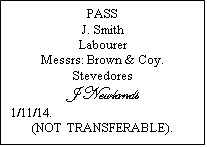
Whilst the dockers and recruits had been vacating Grangemouth, army personnel had been moving in. Eight days after the declaration of war a military guard had taken up post at the Docks. At night they used a system of passwords and countersigns, which they shared with the customs officials. Any civilian wanting to enter the area thenceforward had to obtain a pass. Brigadier-General S A Hare, Commanding No. 3 Brigade Area, was responsible for security at the Docks and he insisted that only one form of pass should be used, in order to make the task of checking them easier for the sentries. All passes were to be signed by J Newlands, the dock superintendent for the Caledonian Railway Company. Accordingly, on 23rd October 1914, Newlands wrote to all users of the Docks:
“It has been arranged that on and after 1st November, 1914, the existing passes to the Docks, including the recognition of Dock Labourers’ Badges, will be discontinued, and no pass will be recognised by the Sentries on duty unless it bears the signature of the Canals & Docks Supt.
There will be separate passes for day and night; the day pass will require to be of white paper; and a very limited number of night passes, of red paper; these should bear the name and designation of the bearer, together with the name of his employer.”
An example was given:
At first the officers of the Dock Guard, commanded by Captain William Bird of the 7th Scottish Rifles, were billeted in the still immobile SS Avon. On 17th September they borrowed a dinghy with two oars and a boathook from the Customs House to get to the ship. By the 24th October the Customs officials wanted the rowing boat back and suggested that the Carron Company ought to supply one. Captain Barclay of the Avon did not have a suitable boat, and in any case the ship was to resume her travels on Sunday 28th and would no longer be available for use as quarters.
British shipmasters and friendly aliens were to be supplied with passes by the harbour master, the aliens also requiring a customs pass. The Collector of Customs at Grangemouth, J B O’Sullivan, strongly objected to having to cede any authority to the dock superintendent and tried to pull rank, using his contacts at Rosyth and Queensferry. In the end, however, he too had to follow the military chain of command.
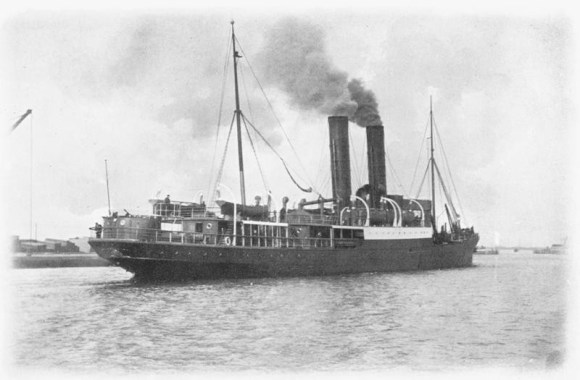
The Dock Guard still considered a boat necessary, particularly as the harbour master’s was out of repair. So they asked the Admiralty for a boat off one of the war prizes in the harbour and were given the use of a boat from the Angela, two oars, two rowlocks and a boathook from the Hans Jost, and a rudder from the Nauta. All of which were duly signed for by Captain Smith.
The Dock Guard stood sentry at the various entrances to the Dock complex and patrolled the grounds. The imposition of a black-out made guard duty rather hazardous for men unfamiliar with the local terrain. Early on the Saturday morning of the 21st November 1914 it was pitch dark and the weather was icy cold, “when the Territorial guard was being changed at the dock gates, and while a thick fog hung over the landscape, a cry of distress was heard proceeding from the water. One of the Territorials, Private Hugh Brown, D Company, 7th Scottish Rifles, who had just been released from guard, immediately divested himself of his overcoat and jumped into the dock. He was successful in saving the individual from whom the cry of distress had proceeded, and who turned out to be Mr Harvey, a water clerk [a Customs House officer]. Although a lifebelt was thrown in after private Brown’s jump, it was twenty minutes before they were taken out of the water, when both rescued and rescuer were naturally very much exhausted. Restoratives and other necessary treatment were applied in one of the customs offices, and by next day both men were said to be none the worse of their immersion. The rowing boat had proven essential.
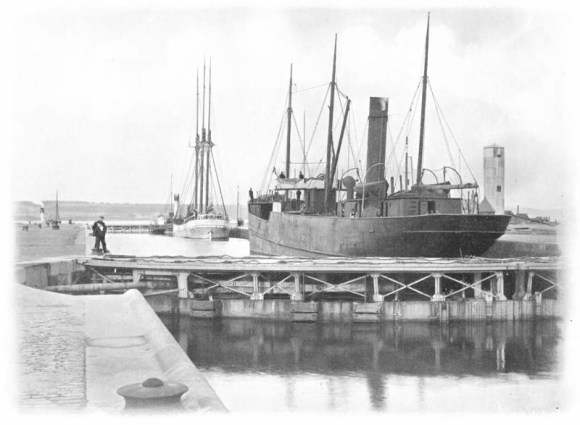
All too often these incidents ended with a man drowning (see Appendix 5). In the first week of May 1915 the body of 32 year old Private David Carsel Wilson was found drowned in the Grange Dock. He was a Glaswegian in the 7th Scottish Rifles (Territorials). About 1.45am, he and another guard had heard the whistle of a ship using the Forth. The other man went to inform an NCO whilst Wilson continued the patrol.
On his return Wilson could not be found and a search was instituted. Over the coming months several more soldiers fell into the water and were rescued. Then, at the beginning of September, Private William Wilson of the supernumerary company of the Royal Highlanders (Second 7th Black Watch) and a companion fell into the Old Dock as they were retuning to their billets at 10pm. Other members of the Dock Guard heard their cries for help and were able to rescue the second man, but Wilson had vanished from sight. He had been a baker in Kirkaldy and was 37 years old. He was the third soldier to drown. The following week he was buried at Grandsable Cemetery with full military honours. A six-horse gun carriage was loaned by the Ayr and Galloway Artillery Battery stationed at Larbert and was accompanied by a uniformed guard of 200 composed of Royal Highlanders, Royal Scots Fusiliers and a detachment of the Argyll & Sutherland Highlanders. The Royal Scots Fusiliers supplied a pipe band and were represented by their commanding officer. Captain Ovenden.
The long winter nights took their toll the following year. In October 1916 Private R Carlyle of the 205th CR Protection Company, Royal Defence Corps, drowned in the entrance lock to the Carron Dock. He had only arrived at Grangemouth the day before. Aged 50 years he was a native of Falkirk. The twelfth victim, Private William Archibald RDC, drowned later that month and was also buried with military honours at Grandsable.
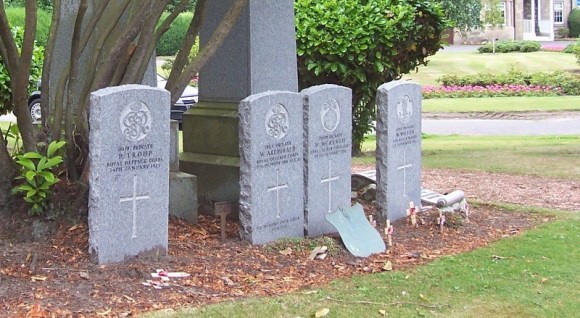
The 2nd January following, Private Peter Troup of the 205th Protection Company was on night duty at the pier head. Around 3am he went to cross the dock gate, but unseen to him the tide had forced the gate open and he fell into the resultant gap. It was 3 months before his putrefied body was found floating in the Docks. He was 46 years old and from Aberdeen. It was not just the steep sides of the dock that presented a problem. Private Thomas Rankin, aged 55 years, from Gateshead, drowned in the Grange Burn. In a port accustomed to finding drowned sailors the casualties amongst the soldiers still came as a shock.
The water was not the only dangerous obstacle in the Docks. In August 1916 Private James Henry of the RDC was knocked down by a goods train during shunting operations whilst on sentry duty. He was taken to Craigleith Military Hospital (known as the Second Scottish General Hospital), Edinburgh, where his right arm had to be amputated at the shoulder. In November Private Gordon caught his eye on a spike of a swing gate at a level crossing in the dark. He too went to Craigleith, where his eye was removed. Both men were from Aberdeen.
From early in the war Grangemouth had been designated a Prohibited Area, which meant that no enemy aliens were allowed in the town or docks. In practice this led to all foreigners in the Docks being challenged by the guard. In August 1914 a Russian Finn from one of the ships threatened a Territorial sentry at the entry to the Docks. His abusive manner and the heightened tension of an invasion threat almost got him shot and it was only the admirable constraint of the guard that stopped the offence becoming a “sudden death enquiry”. On 1st May 1915 the exclusion was extended to all aliens irrespective of nationality. In July the order closing the area of the Docks to the public was more rigorously enforced. Prior to this it had only been applied in practice to the north side. Before long more fences were erected and extra sentries placed along the perimeter. Passes became harder to obtain and local businessmen faced further restrictions.
It was, of course, impossible not to have foreign seamen at the Docks, so passes were diligently issued and enforced. In September 1915 a Russian named John Richto and a West Indian named Louis Fay appeared at the Falkirk Sheriff Court. They were a fireman and seamen respectively on board the Government transport ship Pelica. They were charged with “having on 31st ult., on the south side of the western channel, Grange Dock, Grangemouth, near to Carron berth, they being required by Roderick Melville, private, No. 5 Supernumerary Company, Second 7th Scottish Highlanders, then quartered at the docks, Grangemouth, being a soldier engaged on patrol duty, to stop and answer to the best of their ability and knowledge any question which might be reasonably addressed to them, and in particular the questions as to where they were going and what were their names, each refused and failed to do so, contrary to the Defence of the Realm (Consolidation) Regulations.”
Another strategic location in Grangemouth that received a guard in 1914 was the water reservoir at Millhall. At the outbreak of the war the Falkirk Town Council and the Eastern District Committee of Stirlingshire had placed armed special constables at their water works at Buckieburn. This action prompted the Grangemouth Town Council to swear in two of their own men as special constables and to issue each of them with a double-barrelled breach loading shot gun and a revolver. The men were James Cowan, waterman, and Archibald Buchanan, a burgh employee. They were paid extra to undertake night duty at the water supply and were to challenge anyone in the vicinity after dark. The Council received a letter from Colonel Eggerton, commanding the Lowland Division, stating that such guards were unnecessary and displayed an “undue anxiety”. The Council continued the scheme for another month.
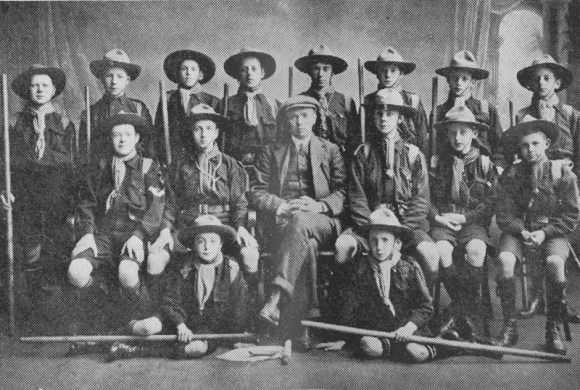
The anxiety over the possibility of an invasion or the presence of spies had other manifestations. The 15th Stirlingshire Boy Scout Group, which had been formed in 1909, met in the main hall of the YMCA in Abbots Road. With the outbreak of war arrangements were made by which, if necessary, the entire scout troop could be gathered together at short notice. They would then have assisted the regular soldiers by running messages and so on.
Throughout the first week or two of the war the boy scouts maintained posts at strategic points around the town – notably at the Avon Bridge. The aim was to intercept a German spy who was suspected to be moving in the area. In fact, the spy was arrested before getting that far. The scouts’ only success in this duty was the forcible stopping of an unregistered alien who failed to obey their summons. By the end of September 1914 a request was made for scouts to act as coastguards at stations all round the Scottish coast and, at a day’s notice, a fully-equipped patrol led by patrol leader Campbell Fisken was on its way to Fort George, Inverness, where it remained for eight months.
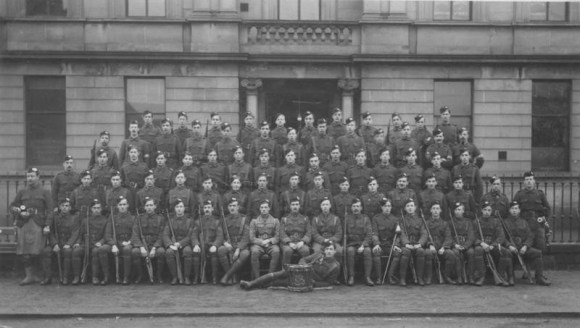
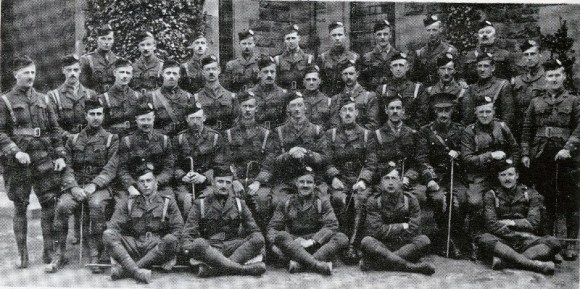
The decrease in the population of the port was made up for by the use of the town as a military billet. Early in September 1914 close on 1,000 men of the 7th Scottish Rifles (Territorials) arrived. Although they left on 21st May the following year, they were succeeded by the Royal Highlanders (second 7th Black Watch), who in turn left in the winter of 1915. Militarily, the parish of Grangemouth fell under District (No.10) administered by Major-General H L Gardiner, commanding Scottish Coast Defences. For a time a detachment of the Second 9th Argyll and Sutherland Highlanders remained, but by the end of February 1916 the town was deserted. It was probably the presence of this garrison that led the German Prize Court at Hamburg to classify Grangemouth as a fortified port. Hence, according to a ruling of that court made in August 1915, which stated that it was alright for ships bound for fortified British ports to be sunk no matter what they were carrying or what nationality the ship, the closure of the Docks was reaffirmed.
At first there was a certain antipathy to the incoming soldiers by local tradesmen already smarting from the loss of trade at the Docks. This was heightened by the accidental shooting of a council employee going about the course of his duties on 4th December 1914. Before long the traders came to appreciate the large numbers of new consumers and were sorry to see them leave.

The shooting was particularly unfortunate and is probably best told through the words of the Falkirk Herald reporter:
“Widespread sensation was aroused in the Grangemouth district by a tragic affair, possessing extraordinary features and involving the death by shooting of a Grangemouth burgh employee, which occurred at an early hour yesterday.
The circumstances surrounding the startling affair are peculiar. It appears that one of the members of the 7th Scottish Rifles (Territorial Force), at present stationed at Kerse Parish Church Hall, who had been on sentry duty on Thursday evening, reported to his superior officer that he had heard a sound apparently resembling the discharging of a firearm from the direction of the Public Park and the Grange Burn. The sound, it appeared, was repeated more than once. In view of this report it was considered a desirable precaution against possible danger to sentries on duty to provide the latter with rifle ammunition, instead of as is customary, in the case of men merely on billet watch, to allow them to take up duty without having ammunition in their possession.
Two sentries were placed on guard, and at a time approaching 4am, while they were on duty, in the darkness which pervaded at that early hour, they saw, under what they regarded as suspicious circumstances, the figure of a man in the vicinity of Grange Burn. Challenging him, they received no reply. Then they discharged their loaded weapons in his direction, with the result that one bullet struck the man on the hand, and the other pierced his heart, killing him instantaneously.
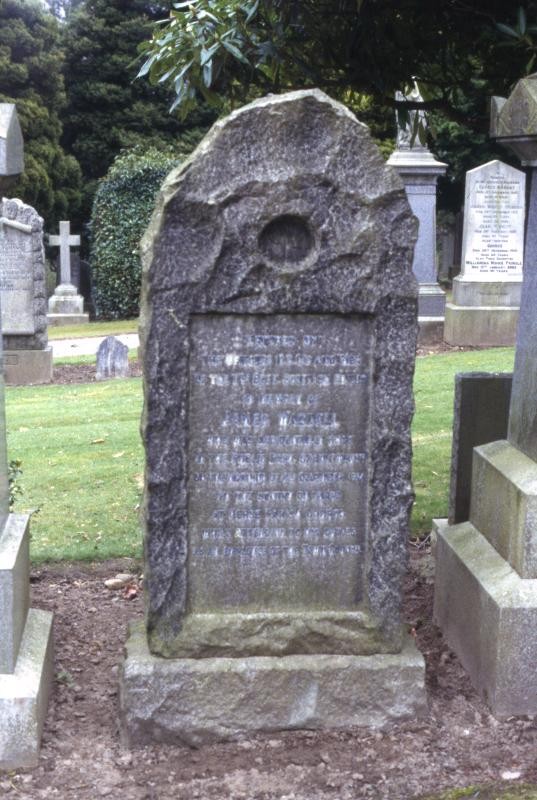
The unfortunate man who met his death was James Waddell, 65 years of age, residing at 57 Dundas Street, Grangemouth. He was in the employment of the burgh engineer’s department, and was engaged in duties connected with his work when the painful affair occurred.
As a result of the heavy rains of this week flooding has been caused in the town, and the Grange Burn overflowed its banks, and in consequence of this – especially the overflowing of the burn – several employees of the burgh engineer’s department have been almost constantly on duty at the burn, for the purpose of doing what they could, by the cutting of trenches and the making of banks, to prevent water flowing into the Public Park. From an early hour on Friday evening three employees, one of whom was Waddell, were on duty together at this place. About ten o’clock two of them suspended work, and Waddell was left alone, his duty being to watch over the place till about half past five, when he was to be relieved. While he was thus engaged, about four o’clock, the tragic occurrence which resulted in his death occurred. At the time he was struck by the bullets he appears to have been in the act of lighting his pipe, for it and a match were found clutched in his hands.
Had the unfortunate man replied to the sentries challenge, it is obvious that the painful affair, with its pathetic result, would not have occurred. That he did not, however, is not perhaps surprising, as he is said to have been somewhat deaf.
As regards the sound resembling shooting heard on Thursday evening, the theory had been advanced that they were the results of the actions of some mischievous boys who had got hold of a weapon of some description and were amusing themselves on their way home. The sounds, it may be mentioned, were heard not only by the sentry who reported hearing them, but by other people in the town.”
John Waddell was buried in Grandsable Cemetery with an escort of 160 (the section based at Kerse Church) and members of the Town Council.
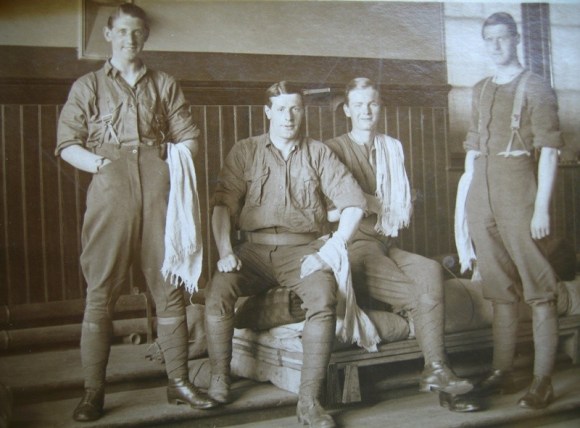

A sense of the activity and bustle that the presence of the soldiers created may be gauged by the following extract from the town’s roll of honour:
“A battalion of Scottish Rifles [Cameronians] was billeted in the town, under the command of Colonel Wilson, who, along with many of his men, fell at Gallipoli. Their presence made things hum and men in khaki were almost a more common sight than those in civilian dress. Great favourites these men became, and, when they marched away on 21st May 1915, the whole community was deeply stirred. As one thinks of these fine lads it is pleasing to recall that, while they were with us, everything was done to make them feel at home. The Burgh Court Building was transformed into a reception room, where refreshments were provided, letters written, games played – ladies and gentlemen giving ungrudgingly of time and strength to minister to their comfort.”
What the booklet does not mention is that the battalion was immediately sent to Gallipoli and on 28th June 1915 took part in the Battle of Gully Ravine, when it was decimated. The casualty figure was unusually high because the general in charge had decided to deploy his artillery elsewhere.
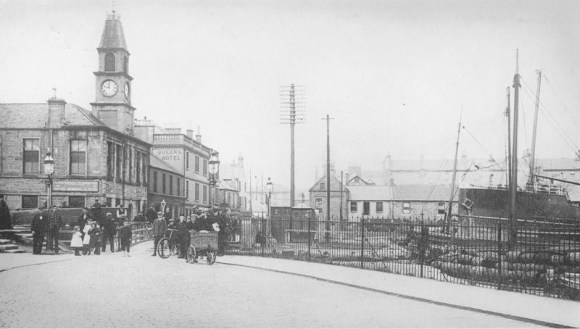
The practicalities of this large influx of men is illustrated less prosaically in the report of the town’s Medical Officer of Health:
“accommodation had to be found for them in such centres as would permit of proper discipline and economical arrangements as to commissariat, etc. At first the military authorities made a good many arrangements independent of the local sanitary staff, but especially since the issue of the Board’s circular of 10th September, there has been constant and harmonious co-operation between the civil and military officials. Despite the very varied degree of suitability of the buildings employed, the health of the troops has been very good. Some 3 cases of scarlet fever and 1 of diphtheria occurred at an early stage, in no way traced to any local infection. In December there was an epidemic of follicular tonsillitis among them. No one billet seemed to yield a large percentage of illness than another. Five church halls, the Town Hall, YMCA, and Rechabite Halls. Two lodging houses, a large railway goods shed in the docks, a large granary (of 3 stories), and several lesser stores, etc have been adapted – fitted when required with dry closetlatrines on an impervious base: cooking and washing houses – appropriate to the needs of each unit, have been erected. In certain cases heating pipes and electric light were introduced. At the close of the year arrangements were made to take over the Infant School for the use of the troops. Our cleansing department removes daily all excreta and refuse from these quarters. We have also disinfected by spray, when required on several occasions, and much work has been done at our hospital in the way of dealing (in our steam disinfector) with clothing and bedding infected with pediculi or scabies. A number of bacteriological reports have been made (especially during the epidemic of sore throats), and a weekly report of our sanitary state has been sent to our military medical headquarters at Bridge of Allan . I have also consulted with the military medical men in cases of doubtful illness among the troops.” (24 Feb 1915).
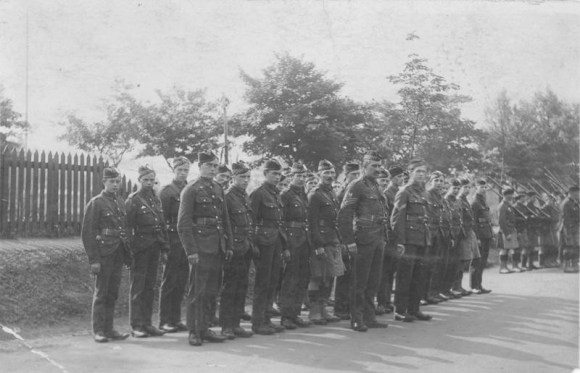
The Board’s circular of 10th September noted that
“The closet accommodation is in some cases inadequate and a special provision will be made behind the public Library, at the Town Hall, and between the Parish Church and Grange Churches. They have been using for this purpose improvised sand or earth closets with pails, which should also be emptied once daily. In addition they employ two handled tubs for urine, etc., to be emptied twice daily, in some cases, when convenient, into the street manholes. These will also have to be handled by our staff. It is also emphasised that this be done on Sunday as on week-days. If we choose in any case to relieve our staff by making a connection with a drain for any of these purposes we may find it well to do so, though no return for such expenses need be expected.”
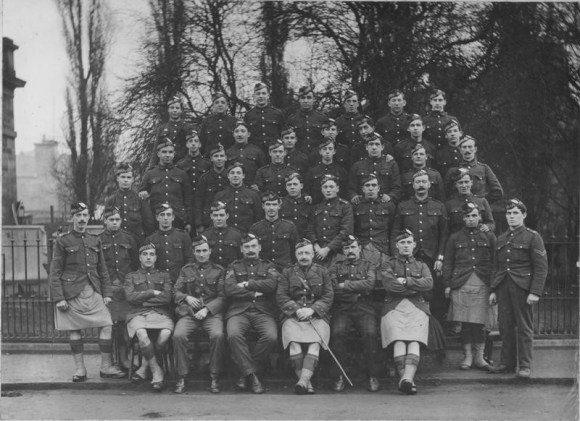
Sand for the latrines was charged at 4s per load, including delivery. Removing the refuse and the contents of the latrines was done at cost. Water was provided at the rate of 6d per 1,000 gallons. This was not metered and the consumption was taken to be at the rate of five gallons per man per day and ten gallons per horse per day. The army furnished the number of men and horses weekly.
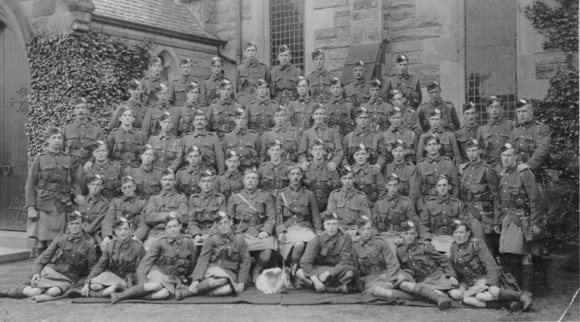
The first properties to be requisitioned that September were the Town Hall, public library, YMCA Buildings, Parish Church Hall, Grange U.F. Church Hall, Charing Cross U.F. Church Hall, Trades Hotel, Grange Working Men’s Home, and buildings in the Docks. The Kerse Church Hall and the Dundas U.F. Church Hall were soon added, as was the old granary in the Old Town. The Greenock & Grangemouth Dockyard Company fitted up 20 baths in one of its sheds for the Territorials to use. A military canteen was set up in Kerse Road. At the end of October the Infant School was acquired.
As the Victoria Public Library was occupied, the library leased a room in a new building on Station Road for use as a Reading Room. In June 1915 the lease of this room was taken over by Walker and Bain, shipbrokers, and the library was forced to move again. Upon the arrival of the Scottish Rifles, in September 1914, Mr and Mrs Harvey of Weedingshall paid for the Burgh Court House to be transformed into a soldiers’ institute. One of the rooms in the YMCA was also set aside for recreational use. The Town Council allowed some restaurants to open on a Sunday, but only to Territorials in uniform.
The Town Hall was originally let at £10 a week, plus the cost of any gas used. A month later, once it was realised that this was to be a longer term arrangement, it was changed to £22 a month plus the gas consumed. The Public Library cost £2.10s plus electricity. The Burgh Stables in York Lane, which were used to accommodate the horses of the 7th Scottish Rifles together with their stores and grooms, was rented at £5 a week plus the gas. When these billets were released at the end of February 1916 the Council claimed £17.9.6 for damages to the Town Hall and £13.4 for the Burgh Depot. In the event they accepted an offer made by the Military Authorities of £16 for the two properties. Damage to the Infant School was so extensive that at the end of the war the Scottish Command paid £85 in compensation. The Custom House and the Post Office remained in permanent military occupation by the Dock Guard until the last few months of the war.
During the military occupation of the town there were naturally numerous incidents of drunkenness and rowdy behaviour, but by and large the military and civilian populations mixed well. To reduce the effects of drunkenness the Defence of the Realm Regulations were stringently applied. The sale of alcohol to servicemen for consumption off licensed premises was forbidden. The publican of the Ship Inn fell foul of these regulations in August 1916 when he sold bottles to Private John Russell of the Royal Defence Corps for stocking the messroom of the Dock Guard. Other transactions took place. In November 1916 Thomas McFarlane, cooper and marine stores dealer living at Killin in Grangemouth, bought four cart loads of loose hay and chaff from Staff-Sergeant John Elrick of the Army Service Corps. This material was of too low a quality for the army to use and represented the sweepings of the stores. Large amounts of hay were stored by the armed forces in Grangemouth for shipment overseas. The officers believed that they had authority to sell the scrapings from these stores to local people and the court found that the position had not been made clear.
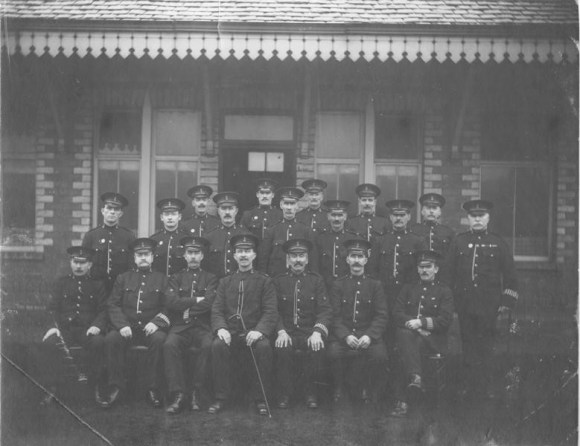
The Dock Guard became fully integrated with the local community, thanks to the efforts of their commanding officer Captain Ovenden of the 5th Royal Scots Fusiliers. When the Scottish Rifles had arrived in September 1914 they had immediately taken over the onerous responsibility of providing the Guard, and were in turn replaced by the Royal Highlanders. In November 1915 Captain Ovenden arranged for a large hut, measuring 68ft by 28ft, to be erected at the Dock near the offices of the Carron Company. The hutment had cooking facilities, lavatories, a bathroom and a counter where provisions could be sold. Upon completion it was handed over to the YMCA and staffed by local women volunteers who had agreed to provide the provisions. The women were to be conveyed each evening to the hut in a cab provided free by a local businessman. The YMCA Institute, as it became known, was officially opened that December. It quickly became the centre for many concerts that were organised to entertain the Dock Guard and the sailors still using the port. In this way money was raised for various good causes.

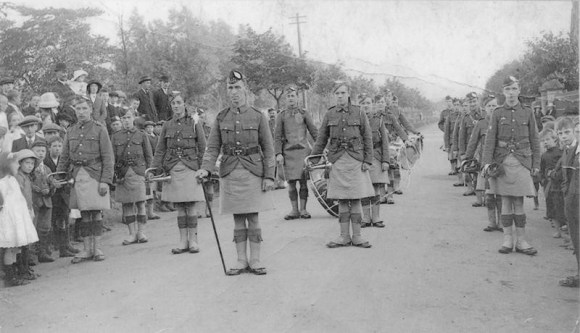
At the end of February 1916 the Dock Guard found themselves the only military left in the town. Lieutenant Greenary was transferred and the men settled in for a long tour of duty as second-rate troops. Permanent Dock passes were now issued to certain Grangemouth traders. When the Forth, a tug belonging to the Forth Towing Company, burst into flames in the Docks, the Guard assisted the Grangemouth Fire Brigade in putting the fire out. One of her crew fell into the water and was rescued by the Dock Guard. During the summer of 1916 the Dock Guard’s pipe band played at many local venues, including the convalescent hospital at Carriden House. However, by September that year significant numbers of the pipers had left for service elsewhere and Captain Ovenden made a public appeal for the donation of pipes so that they could be used by the older members of the Guard who had been left at Grangemouth.
March 1917 saw the resuscitation of the Grangemouth Volunteer Company. This venerable institution had its origins back in the Napoleonic Wars, when the threat of invasion had also been high. It was, in many ways, like the Home Guard of the Second World War, consisting as it did of men not available for the regular army. As with the later Home Guard it started of as a voluntary organisation from which its members could resign under the Volunteer Act of 1863. However, as the war bit deeper and the population was mobilised for total war, this legislation was replaced by a new Act in December 1916 that stipulated that service was for the duration.
By 7th April 90 men had come forward. The following week the number stood at 120, and 135 the next week again. At the end of that month Captain Ovenden was awarded a military medal and received orders to take up a posting elsewhere. His sergeant, Sergeant Gallacher, went to Inchkeith. Lieutenant Florence took his place, but clearly the Dock Guard was being downgraded. The reason for this became evident in May, when it was announced that the Grangemouth and Falkirk Volunteers would take over the guard duty on the Docks at nights.
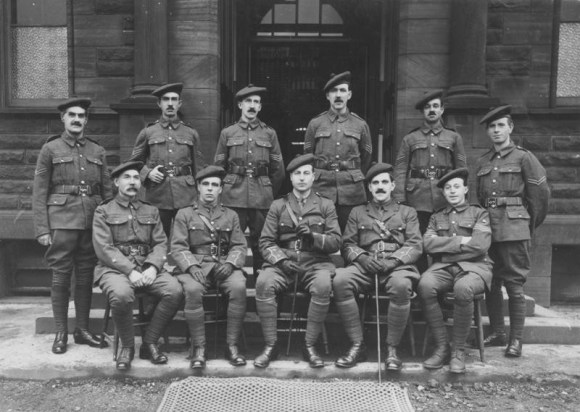
Captain William Simpson was made the commanding officer of the Grangemouth Volunteers, with Lieutenant Yuill as second in command. Walter Bain was made temporary Second Lieutenant in November. The Grangemouth Company was officially designated as “E” Company of the 1st Battalion Stirlingshire Volunteer Regiment. It originally comprised of sections A, B, C, D, R and P, but sections R and P were soon abolished throughout the country. They had consisted respectively of railwaymen and special constables, who were needed for other duties. Unfortunately for “E” Company this meant the loss of a large proportion of its membership and for a while it forced the prospect of amalgamation with another company. The last thing the men wanted was to become a section of the Falkirk Company!
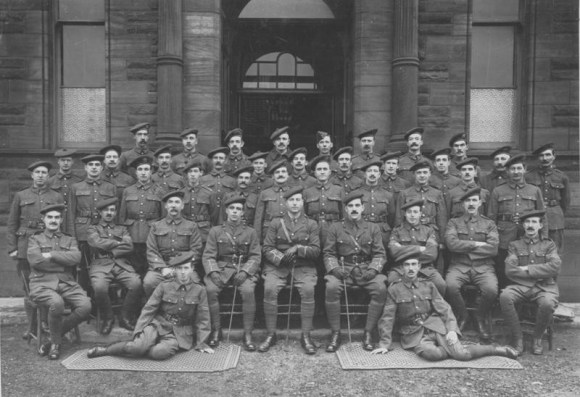
The Volunteers took their task seriously and displayed a great esprit de corps, based as they were in the community. This is exemplified by their second route march in May 1917. This took them from the Old Town to Glensburgh, Bothkennar, Langdyke, Carronshore and back – a distance of 8 miles. Over a hundred Volunteers took part and were joined for part of the way by a crowd of local youths, including a three-year old. The youngster was not accompanied by anyone and having exhausted himself by reaching the Langdyke it was evident that the men could not abandon him. Willingly, he was taken up and carried to Bothkennar by an NCO, where he fell asleep. The charge was passed to a private, then two more NCOs, before being returned to his family in Grangemouth.
Rifle practice for the Volunteers was conducted at the Shelly Bank (the mudflats to the east of the Dock). The Volunteers commenced their guard duty at the Docks on the night of 4th June 1917. It was arranged that the Falkirk Company should guard the Docks on the nights of Monday, Tuesday, Wednesday, Friday and Saturday, with the Grangemouth men covering on Thursday and Sunday nights. When the great day arrived the Falkirk Volunteers assembled at Grahamston Station and were given great coats and ammunition. They then boarded the 7.22pm train and disembarked at Grangemouth Station. A large crowd of well-wishers had gathered on the railway bridge at Station Brae beside the Dock entrance to cheer the Volunteers as they paraded past. Rifle practice for the Volunteers was conducted at the Shelly Bank (the mudflats to the east of the Dock). The Volunteers commenced their guard duty at the Docks on the night of 4th June 1917. It was arranged that the Falkirk Company should guard the Docks on the nights of Monday, Tuesday, Wednesday, Friday and Saturday, with the Grangemouth men covering on Thursday and Sunday nights. When the great day arrived the Falkirk Volunteers assembled at Grahamston Station and were given great coats and ammunition. They then boarded the 7.22pm train and disembarked at Grangemouth Station. A large crowd of well-wishers had gathered on the railway bridge at Station Brae beside the Dock entrance to cheer the Volunteers as they paraded past. However, the Volunteers marched along the railway track under the bridge and proceeded, unseen, into the Docks. There they remained until 6.30am the next day. As the number of the Grangemouth Volunteers fell to only 127, which was not enough to cover the guard duty at the Docks, 30 men from Fallin were used to make up the numbers. Knowing that the usual guard on the Docks was 21 men and that the Company was there for two nights, we can assume that there were three watches a night.
All this time the Docks were made extensive use of by the Admiralty. It used it not only for coaling the Fleet, but also as a mine depot, a victualling yard and an oil-storage depot. The port was also available to the Government and War Office for storage purposes. The pre-war operating conditions had limited shipping arrivals and departures to a period of seven hours each tide; four hours before and three after high water. In order to prevent delay to HM vessels it was found expedient to withdraw this restriction, allowing access at any state of the tide.
As the number of the Grangemouth Volunteers fell to only 127, which was not enough to cover the guard duty at the Docks, 30 men from Fallin were used to make up the numbers. Knowing that the usual guard on the Docks was 21 men and that the Company was there for two nights, we can assume that there were three watches a night.
In October 1918 the Volunteers were relieved of their guard duty at the Docks and the task was taken over by special police appointed by the Military Authorities. There was a slight delay in obtaining uniforms.
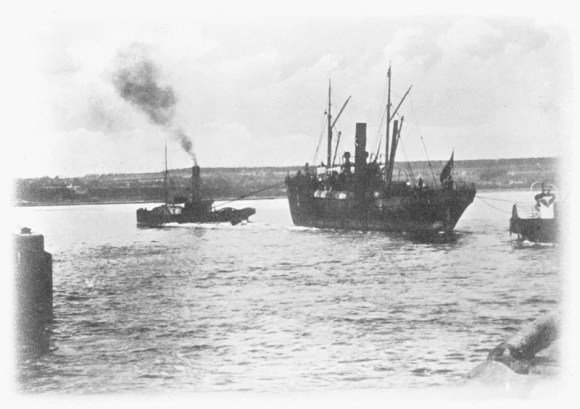
Extra dredging was necessary to provide a channel to the entry lock. The gates on the entrance lock were kept closed, but the sluices were left open. Private Troup evidently had reason to believe that the gate was closed when he made his fateful journey across it (see above). Normally, the pressure of the water in the dock would have prevented the incoming tide from opening the gates, but this wartime measure cost Troup his life. The loss of constant pressure on the dock walls cannot have been good for their stability. Fortunately, these structures were still relatively new and the risk seems to have paid off.
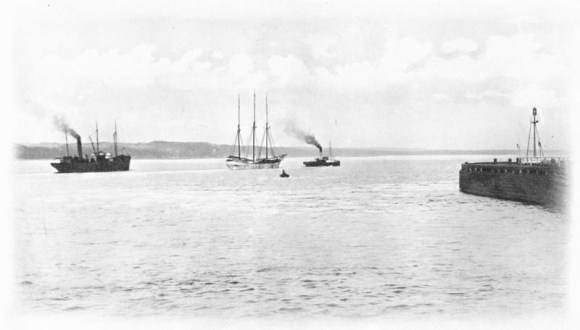
The Government was concerned about bombing raids, sabotage and the possibility of invasion. It therefore decided to disperse the country’s food stocks. At different times between March and June 1915, a total quantity of close on 8,000 tons of Government flour was stored in seven sheds in the docks, the flour having been conveyed there by rail from various flour mills in England.
It remained in store for periods ranging from three months to seven months, and was then reloaded into the railway wagons and sent elsewhere. Food shortages began to tell on the civilian population. The Caledonian Railway Company made a special effort to induce its employees to cultivate allotments, newly formed from land within the fences of its railway lines and of the Forth and Clyde Canal. This facility was subsequently extended to non-railway men.
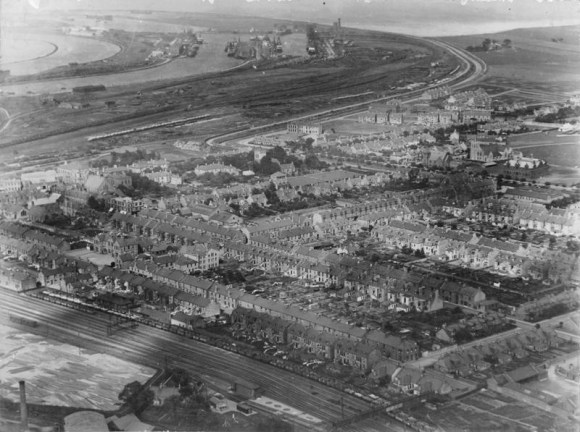
In 1915 and 1916 the War Office utilised five of the Dock sheds, several large timber sheds and some of the available land for the storage of hay. 19,000 tons of hay was brought in by rail and 14,700 tons were sent to the Continent or units in Britain. The quantity of hay required to keep an army in the field was staggering. The Admiralty also leased part of Salvesen’s large yard between the Caledonian Railway and Earl’s Road for the storage of hay. The yard measured 120 by 250 yards and in July 1917 contained ten large stacks with a total of 4,500 tons of hay. The stacks averaged 80ft long by 30ft high and were built from hundredweight bales. These conditions were, unfortunately, ideal for hot spots to develop producing spontaneous combustion. That seems to be what happened, for one morning at 7am a soldier spotted flames. The fire brigade was immediately summoned by phone, one being available in the adjacent woodyard of Brownlee & Co. By the time that the Grangemouth Brigade arrived the fire had a strong hold, fanned by an easterly wind. Even with the help from brigades from Falkirk and Glasgow it was impossible to stop the fire from spreading. All ten stacks and a neighbouring corrugated iron shed full of hay, measuring 40 by 100ft, were consumed. However, a similar shed loaded with timber was saved. The fire was characterised by the high flames and luminosity and was visible from Stirling. When finally brought under control the remnants of the stacks smouldered for days. It had been a colossal spectacle, but to the local farmers suffering from a severe shortage of fodder it was heart wrenching. The Admiralty rejected liability and refused to contribute to the cost of the fire services.
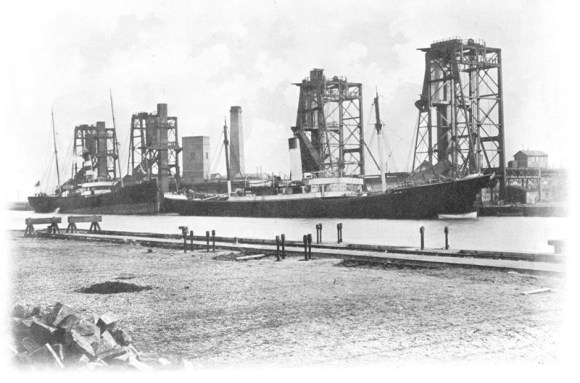
Welsh coal for the Fleet began to arrive by rail at Grangemouth on 10th August 1914 and huge quantities were received from then on for immediate shipment to Scapa Flow. At the core of the Grand Fleet were 24 advanced Dreadnought class battleships that could easily consume 30,000 tons of coal a month, especially as Admiral Jellicoe kept them at sea to avoid U-boats. Welsh steam coal was favoured by the fighting ships because it burnt with less smoke than that from other sources and so did not give away their position to the enemy.
It also had a higher calorific value than Scottish coal. Right up until the outbreak of the war the coal had been carried by colliers from ports on the south coast of Wales. The Admiralty had considered using rail transport to Grangemouth as early as 1911, but at the commencement of hostilities it did not even possess a single coal truck, nor did it have one on hire. By the end of the month it had secured 4,000 trucks on hire and had negotiated with the Rhondda coal owners for the fuel. The first of a regular series of wartime special trains left Pontypool Road at 12.35pm on 27 August on the 375 mile journey to Grangemouth. It was to be the first of many that became known as the ‘Jellicoe Specials.’
At first these trains supplemented the coal supplies carried up the west coast by the colliers. The colliers were vulnerable on this long trip and increasing numbers were lost to U-boats. The transition from sea to rail was gradual with additional trucks, two or three hundred at a time, being engaged as occasion required. Eventually the number on hire to the Admiralty for this purpose was 16,000. From Grangemouth the colliers, still at risk of attack, plied a slow 200 miles to Orkney. It was some twelve months before the port was adopted as the main base for the coaling of the Grand Fleet. The railway lines north of Perth simply did not have the capacity to deal with such loads and, in any case, were already crowded with naval personnel for Thurso.
Early in 1918 the traffic had assumed such proportions that an average of 79 special trains, carrying 32,000 tons of coal, were being run to various ports every week. Yet even this number proved inadequate and it was necessary to increase this by 30 for the conveyance of an additional 12,100 tons a week. 15 specials were run each day of the week, with four sent as convenient to make up the total of 109. This meant that good stores of coal for the Fleet were always available at Grangemouth and it was arranged that there was always a loaded stock on hand in case of emergencies. This was kept in 10-ton and 12-ton wagons ready for movement to any point in the docks. A further quantity was stacked as a reserve, to be loaded into trucks as required.
The total number of specials run from South Wales to the ports between 27 August 1914 and 31 December 1918 was 13,631. With an average of 40 trucks per train this was equal to 545,240 wagons. Allowing for 10 tons of Admiralty coal per wagon this gives an approximate total of 5,452,000 tons. Almost half of this was to Grangemouth. The normal sort of journey time from Pontypool Road to Grangemouth was a little under 48 hours. Thereafter, the empty wagons had to be returned. These were formed into longer trains, numbering only 8,161, though due to the acute shortage of rolling stock latterly many were given return loads by more circuitous routes. This was quite a feat of engineering and organisation.
Numerous ships were employed in the transport of coal, but the most frequent visitors to Grangemouth in 1916 and 1917 were:
| NAME | NET TONNAGE | No. OF VISITS 1916 | 1917 | HOME PORT |
|---|---|---|---|---|
| Agnes Duncan | 1472 | 15 | 20 | Cardiff |
| Ashtree | 758 | 3 | 14 | Cardiff |
| Cedartree | 1012 | 2 | 20 | Cardiff |
| Constantine | 880 | 1 | 14 | Newport, Mons |
| Divis | 929 | 16 | 17 | Belfast |
| Ethel Duncan | 1091 | 16 | – | Cardiff |
| Fernhill | 1475 | 15 | 13 | Cardiff |
| Francis Duncan | 975 | 15 | 17 | Cardiff |
| Kawarra | 1215 | 12 | 22 | Liverpool |
| Mostyn | 1005 | 15 | 17 | Newport, Mons |
| Rotherhill | 1452 | 18 | 1 | Cardiff |
| Sheaf Arrow | 1175 | 8 | 20 | Newcastle |
| Simoon | 1365 | 20 | 1 | Newport, Mons |
| Singleton Abbey | 1526 | 17 | 2 | Cardiff |
| Slav | 1379 | 18 | 18 | Newport, Mons |
| Transporter | 868 | 20 | 22 | North Shields |
| Uskside | 1378 | 14 | 10 | Newport, Mons |
J T Salvesen’s vessel the Vestra was requisitioned as collier 447 and made her first voyage from Grangemouth to Scapa Flow on 17th November 1914.
.
Some Admiralty ships based at Leith and Granton were bunkered at Grangemouth. All work in connection with the handling of the coal was done by the Admiralty agents at Grangemouth. The total quantities dealt with down to April 30th, 1919, were:
| Received | 2,306,000 tons |
| Shipped | 2,092,000 tons |
| Stored on ground | 333,000 tons |
| Reloaded | 246,000 tons |
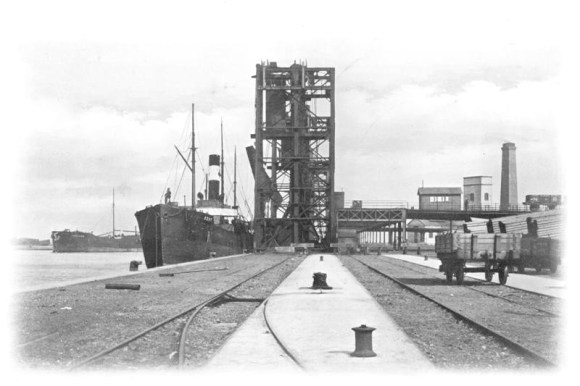
In June 1916 an Admiralty Victualling Yard was opened in Carron Dock, five sheds and some offices being taken over, either then or subsequently, for the purpose. The work in connection with the depot was done by a local firm of stevedores, who employed forty hands thereon. Up to the end of May 1919 over 51,000 tons of foodstuffs and stores for the East Coast fleet had been brought to the Victualling Yard by the Caledonian and North British routes, in addition to 9,000 tons which had come by sea.

Towards the end of the war steam lighters were in great demand to supply the fleet in the Forth and the base at Rosyth. One Grangemouth ship owner employed 21 men on such vessels in June 1917. A number of Carron Company’s steam and dumb lighters were employed on supply duties. In the six months to June 1918, the Company received £1,198 for their use (excluding the fee paid for Lighter No. 10, which was used to carry ammunition).
Over the half year to December 1918 they earned £1,395 and as the Fleet wound down this decreased to £872 for the period to June 1919.
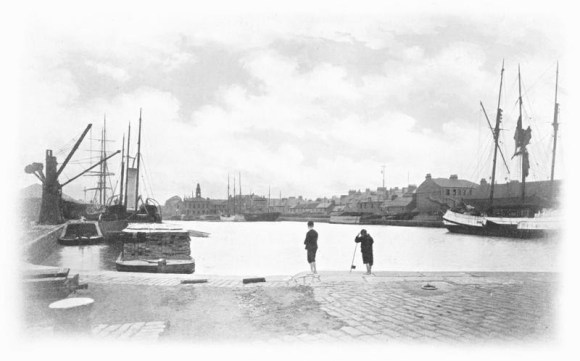
J & J Hay’s 34 ton lighter Saxon was chartered by the Government and spent much of her time at Rosyth. She was in attendance to a battleship there, taking passengers and stores from the shore to the ship. As had become customary the sailors on the warship passed over some useless and damaged equipment to the crew of the tender. This material was then brought back to Grangemouth on the next occasion that her boiler had to be cleaned, in August 1917. Here the crew tried to sell the “scrap” and were charged with misappropriating Government property. As part of a general clamp down the crew of the tender Western Light (47t), owned by Hopkin, Paton & Co, were charged with the same offence. It became clear in the hearings that the collection of “scrap” had become a common occurrence, though it was not accepted as a “custom”.
Grangemouth was also on standby to receive injured servicemen via Rosyth in the event of a major battle, raid or evacuation. In March 1915 a Government motor launch arrived at the port from Rosyth carrying fever cases. It was met by an ambulance crew from Linlithgow fever hospital. However, news of the medical mission had become distorted and exaggerated, leading the port authorities to believe that a major incident had occurred. Several local doctors and 20 men from the Caledonian Railway Ambulance Brigade rushed to the dock side to greet the vessel.
Although the heavy cruiser squadron was based at Rosyth for much of the war, the capital ships of the Grand Fleet used the anchorage at Scapa Flow. This safe haven had not been fully developed when the war had begun and one of the chief difficulties lay in communications between there and London, the distance being too far for good wireless reception. Falkirk lay roughly equidistant between the two and a wireless relay station was set up in the fields between it and Grangemouth. Men from this signal station were part of the Naval establishment of Grangemouth. Jim Reid, a local resident, described the location:
“On the approach road into Middlefield there were three wooden huts and a very tall steel mast and I think two much smaller ones. This was during the 1914-18 war and the mast marked a wireless repeater station… There was always a small number of soldiers guarding the place and it was fenced. No one was encouraged to leave the farm road.”
A regular traffic in timber was dealt with at Grangemouth for the Timber Control Department of the Board of Trade. In peacetime timber had arrived in large quantities by sea from the Baltic and Scandinavia. During the war this trade all but ceased and most timber arrived by rail. Approximately 30,000 tons came by rail in this period and only 2,700 tons by water.

It was mainly stored on ground belonging to the Caledonian Railway Company in the Docks or, in the case of heavier timber, in the timber basins. Before the war, timber had been one of the main cargoes carried on the Forth & Clyde Canal. The closure of the port starved the Canal of its trade and meant that it was no longer of use as a cross-country waterway for commercial traffic. As a consequence a number of firms laid their boats off for the duration. Examples were:
| Leith, Hull & Hamburg Steam Packet Co. | 12 boats |
| Carron Co. | 5 boats |
| James Rankin & Co | 8 lighters |
| J & J Hay | 6 steamers & 20 scows |
| Wm Jack & Co | 5 steamers & 10 scows |
| J T Salvesen & Co | 8 lighters |
In any case, because the Government had taken over control of the railways and the Canal belonged to the Caledonian Railway Company, it had affectively taken over control of the canal. It was March 1917 before they took over all the other canals in Britain, using their powers under the Defence of the Realm Regulations. At least six of Salvesen’s iron lighters were sold in April 1916 to Rea Transport Co Ltd of London. These were the Dart, Express, Flash, Glance, Gleam and Prompt.
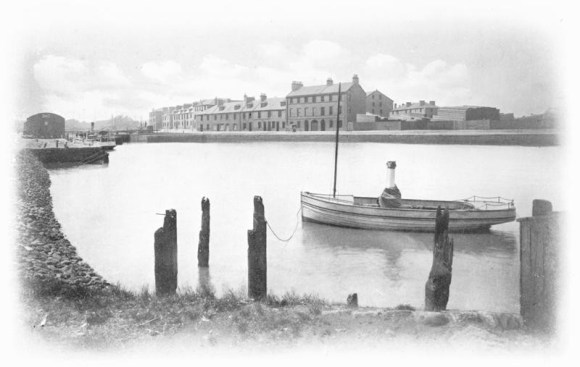
The canal could be opened when the occasion required. Early in August 1916 the Dutch fishing fleet was escorted from Leith Roads to Grangemouth for passage through the Forth & Clyde Canal. The herring were on the west coast. Almost 100 fishing boats were involved and must have formed an awesome spectacle as they made their journey along the canal (Appendix 6).
Some of the timber was used for making ammunition boxes in the local sawmills. Many women were brought into the works to deal with this monotonous task, though men still held key jobs such as wood buying and saw sharpening. In January 1917 part of the box department at Muirhead & Son’s sawmill was destroyed by fire. Production continued in other buildings and none of the female workforce was injured. In March that year a woman there was hurt whilst operating a crosscut saw. Wood continued to be used in Grangemouth for making and repairing barrels for munitions and the collection of scrap metal. One 38 year old cooper in the town was the sole proprietor of his business and therefore had his military exemption renewed as late as October 1918. Men involved in the timber trade – measuring, surveying, buying the wood and other skilled tasks – were also exempted. Some of the wood went to Bo’ness, where it was made into huts. The prefabricated sections were then dispatched to Grangemouth by rail for loading onto the army transport ship SS Sceptre and so on to France.
Trade on the canal was not alone in its decline. The passenger traffic carried to London by the Carron Company’s ships slumped from 9,545 in 1913 to only 3,252 in 1914, and even that low number was due to military personnel travelling to their units. As a consequence passenger services were terminated for the duration and in fact never resumed again. In 1915 the Carron Company reported a loss of £5,911 on its shipping concerns, despite receiving £10,412 from the Admiralty for the hire of the SS Carron. Worse was to come. On 9th April 1916 the Avon hit a floating mine laid by UC-7 near the North Foreland on the return journey from London. Captain Shaw and 29 of her crew were rescued, but two drowned. Later that year, on 9th December, the SS Forth was sunk by a mine off Suffolk.
By this stage in the war the German onslaught on Britain’s vulnerable mercantile fleet was well advanced. For the first few months of the war the U-boats had restricted their targets to military vessels, but as Britain’s blockade of their ports began to bite deeply into their supplies they were given orders to retaliate. At first the submarines were expected to sink or capture British mercantile ships within the framework of international law. Accordingly each ship had to be given a warning and stopped so that her papers could be examined to uncover ‘contraband’, that is war supplies. If these were found then the ship could be sunk or taken prize, but only provided that the safety of the passengers and crew was ensured. Refuge in a lifeboat on the open sea was not considered sufficient. Sinking a merchant ship with people on board was only permissible if she had persistently refused to stop or had offered active resistance. The first British merchant ship to be sunk by direct U-boat action was the 866 ton Glitra on 20th October 1914. She belonged to Christian Salvesen of Leith and was outward bound from Grangemouth to Stavanger with a mixed cargo of coal, iron plates and oil. 14 miles from the Norwegian coast she was sighted by U-17, which pulled alongside the steamer and ordered the crew to abandon ship within ten minutes. A party of submariners then boarded the ship and opened her sea-cocks, sending her to the bottom. Mindful of international law, the U-boat then towed Glitra’s lifeboats for several miles before casting them free within easy reach of the shore. Less than a fortnight later Britain designated the North Sea a military area and escalated a long series of reprisals which resulted in the unrestricted submarine warfare that paid little regard to the accepted codes of war.
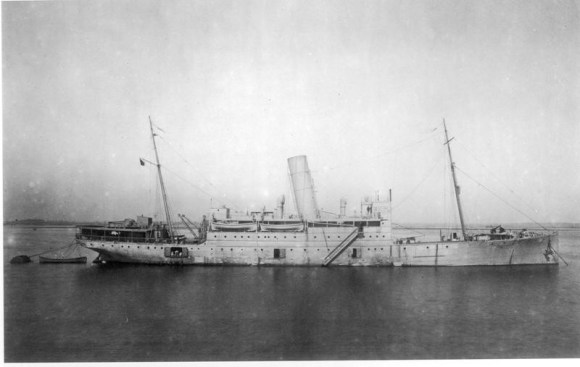
On 15th February 1918 the Thames was attacked in the North Sea by a U-boat, but the torpedo missed. She was not so lucky on 26th May that year, when she sank off Seaham as a result of another torpedo. Four lives were lost, including that of the master. Earlier that year the Caroline had sunk after a collision with a Newcastle steamer off Flamborough Head, Yorkshire. Ironically, of Carron Company’s fleet of five ships the only one to survive the war was Carron, which had been requisitioned by the Admiralty in November 1914. She was commissioned as a boarding ship and undertook patrols in the English Channel. In 1915 she supported the landings on the Dardanelles, and was there for the evacuation. From April 1916 she operated in the White Sea off Murmansk. It was 3rd January 1919 before she was finally paid off.
J T Salvesen did not escape unscathed. On Christmas Eve 1915 the Embla struck a mine in the Thames Estuary and became a constructive loss. While on passage from the River Tyne to Rouen with a cargo of coal the Vestra was torpedoed and sunk by UB-35 on 6th February 1917, 5 miles NE of Hartlepool. The Vala was torpedoed on 21st August 1917 while in Government service – more of which later. The Siva and Driva had been sold to Swedish merchants, after they had been forced to remain tied up in Swedish ports on the outbreak of war. The Duva was sold in January 1917 (and was torpedoed 14 months later). Out of a fleet of seven ships at the beginning of the war this left only the Vina. In February 1918 the Government placed the Cresco under the management of the company until she returned to her Norwegian owners in January 1919.
The losses mounted (Appendix 7a, 7b & 8). Walker & Bain’s ship Saxon Briton was torpedoed and sunk off the north Cornish coast on 6th February 1917. That same year, on 2nd November, the Jessie was attacked by a U-boat using its deck gun. Although beached she became a total loss. To add to the company’s disastrous year, David Walker, one of the partners, was killed in action serving with the Seaforth Highlanders.
The loss of mercantile tonnage was tremendous and shipyards throughout Britain worked hard to replace it. Grangemouth Dockyard was particularly busy, as the Admiralty had kept its promise to direct work there. On 19th December 1914 Admiral Lay sent Captain-Engineer Percy to inspect the yard’s facilities, and those of the Dundas Engineering Company in the Docks. He found one vessel of 3,000 tons (the Traquair for George Gibson & Co of Leith) well under way and the keels of two steamers of 3,500 tons (the Denpark and the Hazelpark) laid down for J J Denholm of Greenock. Within weeks the Greenock & Grangemouth Dockyard Company received orders for a series of sloops for the Royal Navy.
The first order came in January 1915 and was considered to be extremely urgent. The drifters being converted for minesweeping duties were not versatile enough and did not have the range required for the Grand Fleet. So 36 Acacia class sloops were ordered, three from the Grangemouth yard. Construction began immediately and the work on two of the merchant ships already underway had to be put aside. The Traquair was so far advanced that she was launched on 2nd February, but she was then sent to Leith to be engined before returning to Grangemouth for her final fitting out, which was only completed on 27th November. The Denpark and the Hazelpark were not launched until 4th March 1916 and 19th April 1916 respectively. Indeed the Hazelpark was not completed until October that year. Emphasis was placed on the minesweepers, which at that time of year meant working by artificial light. The dockyard was lit up and received many complaints that it was not observing the black-out, which was being enforced everywhere else including the Docks where men drowned for want of light. The Admiralty obtained a waiver.
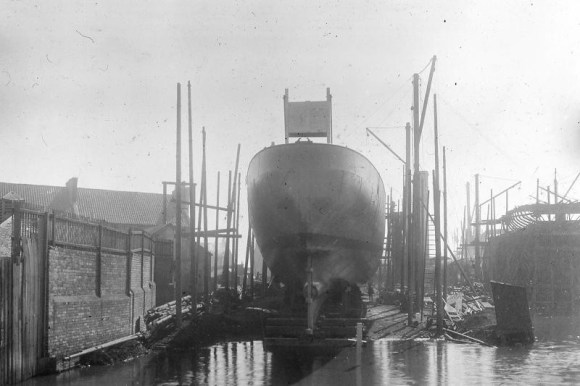
Considering that the Acacia type sloop had a displacement of 1,200 tons, measured 250ft by 33ft, and carried two 12-pounder guns and two 3-pounder guns, it is remarkable that the first was launched on 29th April 1915. She was HMS Lilac and her sea trials were held on 26th June from Inchkeith to May Island.
She was followed in quick succession by HMS Clematis, launched on 29th July 1915, and HMS Carnation launched 6th September 1915. These were fast ships. The Clematis achieved a mean speed of 16.5 knots on her trials on 7th October and the Carnation 17.4 knots on 4th November. They were therefore also used as convoy vessels to guard against the increasing submarine menace.
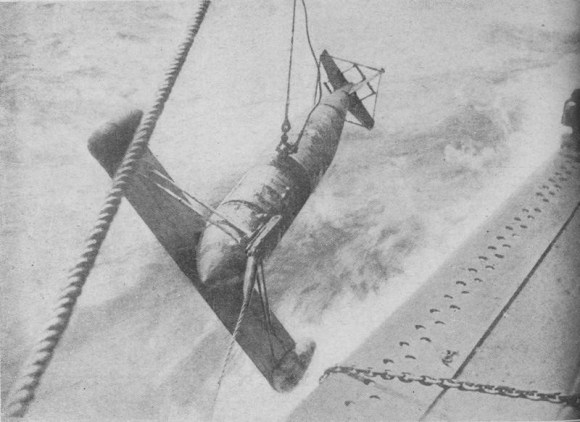
It was at this stage of the war that the Grangemouth Dockyard started fitting paravanes to Navy ships in order to give them a measure of direct protection against mines. It had been invented by Lieutenant Burney only months before and at first fabricated units were in short supply. “Kites” and floats arrived at the dock side by lorry in April and May 1915. All Royal Navy vessels were fitted in utmost secrecy and only then were they made available to merchant ships, which were also fitted out in large numbers at Grangemouth. The paravane worked on the observation that few ships ever hit a mine head on. Most mines exploded along the sides and not at the bow. The idea was to use a system of submerged wires to deflect the mines away from the sides and out to a safe distance. The paravane consisted of a torpedo shaped body fitted with hydrovanes, at one end of which was a float, and at the other end a weight. Towed in the water the hydrovane or “kite”, with its sloping metal surface, forced the paravane down into the water when the tow wire was taut, just as a kite rises in the air from the pull of its string.
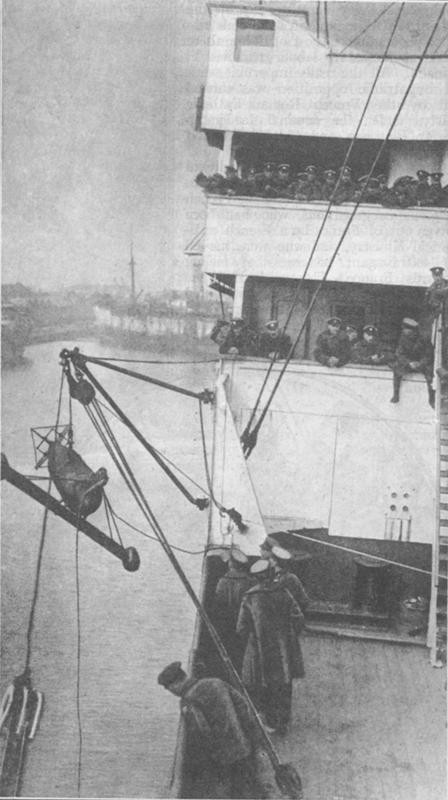
It was equipped with a rudder that regulated the depth of flotation by means of a hydrostatic valve. The “Otter” paravane was used defensively. A pair of paravanes was towed, one on either beam so that the tow wires lay obliquely outwards from the prow of the ship. The wire was of strong flexible steel 1.5 inches or so thick. As it swept through the water this wire would come into contact with the mooring chain under a mine.
The mooring chain then slid along the tow wire, away from the ship, until it reached the paravane. The nose of the paravane was fitted with a heavy cutter bracket and serrated knife blade that, on contact, snapped the mooring chain and released the sinker causing the mine to rise to the surface. Here it was detonated at a safe distance by gunfire from the ship. The paravanes could be towed at most speeds and only reduced the progress of the vessel by a little over half a knot.
The next Admiralty order for minesweepers was for two Arabis type sloops, one from the Grangemouth yard and one from the Greenock yard. Both the Acacia and Arabis type were Flower class sloops, the latter being slightly larger at 1,250 tons displacement and measuring 255ft by 33ft 5in. Their armament consisted of two 4in guns (or 4.7in) and two 3-pounder guns. In all 36 of these were ordered from British yards. HMS Geranium was launched on 8th November 1915 at Grangemouth, and HMS Gentian at Greenock on 23rd December 1915. They too were initially fitted for minesweeping operations, but were later used for anti-submarine patrolling.
The Aubrietia type of sloop was similar to the Arabis. Only six were ordered in 1916 and one of these, HMS Heather, was built at Grangemouth. They were specifically built to answer the submarine menace and acted as convoy sloops, as did the following Anchusa type. Both Aubrietia and Anchusa types were built with merchant ship profiles. Two out of the 33 Anchusa type sloops that were ordered in 1917 were built by the Greenock & Grangemouth Dockyard Co. These were HMS Marjoram at Greenock and HMS Mistletoe at Grangemouth. They were each 1,290 tons, 250ft by 35ft, with two 4in guns and two 12-pounder guns. The final type of minesweeping sloop was the “24” type. 24 were ordered in 1917, but many were only completed as the war was ending. It continued the trend to larger vessels, at 1,320 tons, 267ft 5in by 35ft. HMS Hibiscus was launched at Greenock in November 1917, and HMS Donovan, HMS Sanfoin and HMS Sir Hugo in 1918. HMS Isinglass was the last minesweeper, launched as late as 5th March 1919 (Appendix 9).
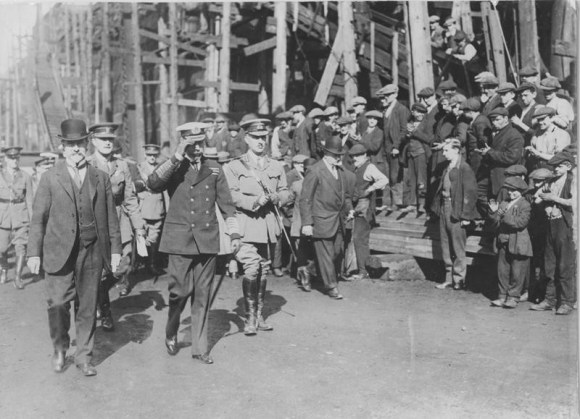
The importance of the work of the Greenock & Grangemouth Dockyard Company to the war effort was acknowledged when the King launched a vessel from the Greenock yard on 17th September 1917 by cutting a rope with a small axe. Dockyard workers from Grangemouth went through to witness the event and played a bowling match against their counterparts there.
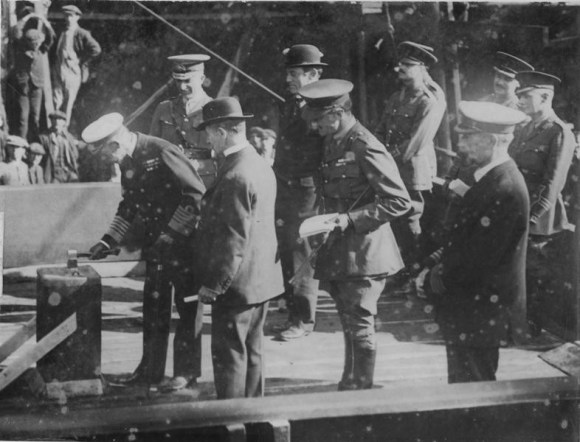
The importance of the work was reflected in other ways. It strengthened the hand of the men in wage negotiations, though they did not always get what they expected. At the beginning of the war many of the riveters joined the Forces, leaving the yard depleted just when it received the first Admiralty work. Four squads of apprentice riveters had enlisted and so, in May 1915, the Dockyard Company brought three squads in from Greenock and provided them with accommodation.
This enraged the local men, who were on piece work and had the prospect of huge pay packets. Before long 100 riveters and caulkers were out on strike. Then the strike spread to a further 100 boilermakers and platers. The wildcat action threatened vital production. Union delegates arrived in the second week of June to handle the situation. They urged the striking dockyard workers to go back to work, pointing out that a national agreement had been made that dockyard workers would be more mobile for the duration of the war and that the various Munitions Acts made the strike illegal. Reluctantly, after a total stoppage of ten days, the men returned, but the event left behind a smouldering kernel of resentment. Later the same month 30 labourers went on strike. They were paid £1 a week plus a war bonus and wanted the same rate as their fellows on the Clyde, that is 26s plus the war bonus. After two days they agreed to accept £1.2.6d plus the bonus.
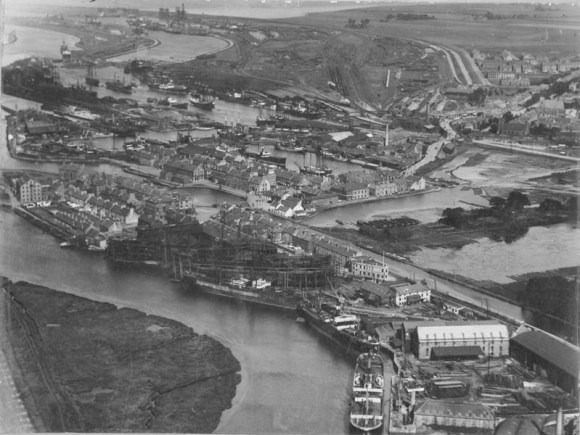
The riveters had only been quelled by the threat of Government action arising from the contravention of the Munitions Acts. As soon as they were switched from Admiralty work to work on a merchant ship, in December 1915, 40 of them came out on strike again demanding higher wages. However, the Dockyard Company successfully argued that the work on the merchant ship was kept in hand so that the men could be employed during slack periods on Admiralty contracts. It was thus considered part of the policy of the Ministry of Munitions and came under their remit, which meant that the men could be prosecuted for failing to work on it. The problem resurfaced in July the following year. The riveters had been put onto shell plating three merchant ships and refused to work for the rates given. They were therefore transferred to other work within the yard and had left this work standing for six weeks from 3rd July 1916. Indeed, for the latter part of this, from 31st July to 7th August, they had not even bothered to turn up for work. At the time of this dispute they were paid for every 100 rivets they put in and were earning £3 a week. This was three times more than most people and they received little sympathy. The Falkirk Herald was outraged and named the individuals concerned. It pointed out that the soldiers at the Front were only paid 1s a day. At a general Munitions Tribunal for Scotland ten of the riveters were charged with infringing the provisions of the Munitions of War Act 1915/16 in respect that they were employed by a firm that was engaged at munitions work and had left their employment to take part in a strike. They were each fined £20 and asked to return to work. Seven of them refused to promise to do so. One of the seven did subsequently appear at the dockyard. For the remaining six it was like drinking at the “Last Chance Saloon”. Within a month they were all called up by the army. In the intervening period one riveter had obtained work at Port Glasgow with Dunlop & Bremner, but as this was classed as a different line of work his exemption badge was useless.
It seems that other tradesmen in the town did not learn from this lesson. Some Grangemouth bakers, who had been exempt from the call-up due to the essential nature of their trade, went on strike in October that same year and were consequently called up. The following February the Grangemouth Co-op took on its first woman as an apprentice baker. Thereafter labour problems at the Dockyard seem to have eased and more riveters and caulkers were brought in from Clydeside.
Despite these tensions it was a busy and prosperous time for the Dockyard. In 1912 the Dockyard Company’s wage bill had been £50,000, at the close of 1918 it stood at £120,000. In 1916 the site was extended on the east by the acquisition of the old burgh slaughterhouse, stables and fire engine shed for £750, and Paisley’s Model Lodging House. The Town Council also gave permission for the Dockyard Company to close up parts of two public streets, taking in Middle Street up to North Bridge Street. The right of way from the bank of the River Carron to Middle Street was temporarily removed. This gave space for a third berth. A blacksmith’s shop was erected on the site of the slaughterhouse, with a plater’s shed beside Dalgrain Road. 1916 also saw the Dockyard Company extend the wharfage where it fitted ships out after launching, by taking over the Carron Old Wharf to the west. At the same time it acquired some of the land behind this from the Carron Company, including their granary of 1817.
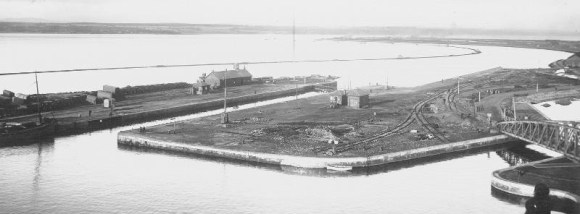
Even with the additional berth the old graving dock of 1811 was constantly used for new build instead of for repair and maintenance work. In 1916 the Dockyard Company therefore sought and obtained permission from the Caledonian Railway Company to convert the two obsolete entrance locks from the River Carron into dry docks. The older of the two had been constructed in 1843 between the River Carron and the Old Dock. The newer one linked the river to the Carron Dock in 1882. Both had been supplanted by the 1906 entrance into the Grange Dock direct from the Forth. The conversion work was long and arduous and required the construction of a small powerhouse and the introduction of a fresh water supply. They became known as the Carron Dry Dock and the Middle Dry Dock. The Carron Dry Dock was only officially opened at the beginning of October 1918, a month before the war ended. At the ceremony a ribbon was broken by the steamer Fernhill of Cardiff as she docked for repairs, with Captain Hoskins at the helm. The dry dock was 350ft long and could cope with ships taking a maximum of 20ft draft of water. This was far bigger than the old dry dock, which had had the further disadvantage of opening into a tidal river. The new dry dock opened from the Old Dock, which was a wet dock and therefore not dependent upon the tide. The option on the Middle Dry Dock was only taken up in 1920.
Most of the ships that the Dockyard Company worked on did not require dry dock facilities. Much of the repair work was to damage above the water line. On top of launching 20 vessels the Dockyard carried out 850 repair jobs to all kinds of ships during the war. As well as fitting paravanes to merchant ships the Company mounted a small deck gun on each vessel so that they could at least offer some defensive action if attacked. This work was probably done in the Old Dock. It was at the Carron Wharf and the old dry dock, away from prying eyes, that work was carried out to arm a series of special merchant ships with guns for offensive action. (Lieutenant-Commander W Atkinson RNR stated that for one of the first of these ships: “All the guns were fitted, and the strengthening of the decks was performed by the crew in the middle of the river off Grangemouth”. This is surely a misunderstanding, as the crew would not have had enough knowledge to perform the task and the river was probably the Carron and not the Forth.) These were the infamous Q-ships. Their incredible feats of bravery and daring during the conflict read like something out of a Boys’ Own annual. Q-ships were designed to deceive and destroy hostile submarines and became known in popular legend as Q-boats, mystery ships, hush-hush ships, decoy ships or U-boat traps.
The U-boats could only carry a limited number of the scarce and expensive torpedoes, whose accuracy in use was not always good. Added to this, the U-boat crews were paid bonuses according to the amount of shipping they sank. Their tactic therefore was to surface and shell the lone merchant ships from a distance of up to three miles using their deck guns. It mattered little whether the merchant was sailing under the flag of a neutral country or a Red Ensign, as long as it appeared to be bound for an Allied port. Upon this barrage of artillery shells the merchant ship stopped and let off steam to vent the boilers. At the same time the crew took to the lifeboats. The submarine then closed on her prey to finish her off from close range with either further salvoes or by boarding her and placing explosives or by opening her valves. This done, the U-boat ascertained from the men in the lifeboats what the name, cargo and destination of the ship had been. The captain’s name would also be recorded and often he was taken aboard the submarine as a prisoner of war. The demand for proof extended to the procurement of the merchant ship’s log. Long-winded as these activities may seem, they were very successful and the amount of shipping being lost became untenable. The Royal Navy had to respond.
To counter the activities of the U-boats the “special service” of the Navy evolved a stratagem of deploying the innocuous looking but heavily armed merchant ships and fishing vessels to lure the U-boats into an attack on them. These bold ships and their crews sailed to any location where enemy submarine activity had been reported. The Q-ships had a double crew, all dressed in merchant seamen’s clothes. Half of the crew, equal to that of a normal merchant ship of that size, were usually taken from the merchant navy and were responsible for the day to day running of the ship under her Captain. The second half of the crew was taken from the RNR and was well drilled in the art of gunnery. They were under the direct control of the ship’s Commander or Lieutenant-Commander. It was he that took over when the vessel went into action. Once the submarine opened fire the ship released steam, indicating that it was dead in the water. The sailing crew formed what was known as the “panic party” and abandoned ship. The remaining crew had to stay hidden, some lying flat on the deck beside their disguised guns, despite the shells falling around them. Smoke might be released to simulate a fire. All the while the enemy would be drawing closer, observed by the Commander through peepholes in the superstructure of the bridge. At what he considered the crucial range or moment, the Q-ship Commander gave a signal to his crew. The White Ensign was hoisted and the disguise fell away to reveal the ship’s big guns. Accurate firing was essential to hit the startled submarine before it was able to dive to safety.
This was a risky business and all too frequently the submarine’s guns put those on the Q-ship out of action before they could be engaged. Real fires also broke out on the Q-ships, setting off the stores of ammunition. With the ship sinking below him the Commander’s first duty was to dispose of the official documents by dropping them overboard. Obviously the U-boat skipper would have his suspicions aroused by the number and behaviour of the crewmen and would proceed to cross-examine the survivors, who had a cover story ready in anticipation of such a turn of events. The crew of the Penhurst, for example, rehearsed their sad tale: “This is the SS Penhurst, owned by the Power Steam Ship Company of London. Her master was Evan Davies, but he has gone down with the ship, poor man. Cargo? She was carrying coal, but she was not an Admiralty collier.” Then the enemy would ask where from and to. If it happened that Penhurst was in a likely locality the reply would be: “From Cardiff”; otherwise the name of a well distant coal port, such as Newcastle or Liverpool, was decided upon. When the German commented on the singularly large number of the crew, he would get the reply: “Yes, these aren’t all our own chaps. We picked up some blokes two days ago from a torpedoed ship”. Then in answer to further questions one of the survivors from the latter would back up the lie with the statement that they were the starboard watch of the SS Carron, owned by the Carron Company, 2,350 tons, bound with a cargo of coal from Barry (or Sunderland) to a French port. In this case Captain Grenfell would pretend to be the master of the Carron, and of Penhurst’s four officers one would pretend he was the first mate of the Carron, another the first mate of the collier Penhurst, another the Penhurst’s second mate, whilst the assistant-paymaster, not being a navigator, passed as chief steward. Thus every detail was thought out. To surprise the enemy and yet not to let him surprise you was the aim.
Most actions between Q-ships and submarines were indecisive, but in each case the identity of the Q-ship then became known to the enemy. The ship merely went to the other side of the horizon and altered her appearance. The greatest part of Britain’s sea-borne trade was carried out by small steamers of more or less standardised types and so there was no great difference between them. Their distinguishing features, such as the colour of the hull, topmast, derricks, cross-trees, and so on, were easily changed. The Penhurst could alter her outward identity in a matter of hours to become any one of a number of ships. For instance, by painting her funnel black, with red flag and white letters thereon, she might easily be taken for one of the Carron Company’s steamers, such as the Forth.
As the war progressed the tactics were varied to take into account the enemy’s reactions. Disguises had been quite primitive at first and had to become more realistic with considerable cunning and versatility being displayed. U-boats had no compunction about using torpedoes to sink ships they suspected of being traps. Procedures during the encounters became more hazardous and required amazing courage. Later Q-ships serving in the Atlantic and Mediterranean were filled with cargoes of timber to increase their buoyancy so that they took longer to sink. This gave them an extra few hours in which to lure the U-boat in and sink her. There is even a case on record of a Q-ship Commander deliberately turning his ship into the path of a torpedo that might otherwise have missed.
The main Q-ship base was at Queenstown (modern Cobh) in Ireland and it is probably this that gave them the Q prefix. They also operated from Granton, Peterhead, Stornoway, Lowestoft, Longhope, Portsmouth, Plymouth, Falmouth, Milford Haven, Gibraltar and Malta. Each of these ports had its own secluded dockyard where work on the ships could take place out of the public gaze. Haulbowline Dockyard, for example, was well away from the commercial areas at Queenstown. In the case of Granton the facilities at the closed port at Grangemouth were used.
For the Greenock & Grangemouth Dockyard Company there were two tasks – installing and hiding the guns; and providing alternative disguises for the ships. Merchant ships were not designed to take heavy armaments and their recoils when in use, so the first job was to stiffen the decks. A store for the ammunition and extra accommodation was installed below decks. The guns were hidden in a variety of ways. They night lie close behind the bulwarks, which were cut and hinged to allow them to fall away and open up a field of fire. However, in this position they might be seen by spies on neutral ships docked alongside in the port. So the guns were further concealed under hatch covers, or inside collapsible cabins and false parts of the superstructure, or under deck cargo or fishing tackle. Even lifeboats were cut in half and placed around the guns. One was made to look like a yardarm of a mast. Wireless aerials were hidden in the ships’ rigging – it was essential for Q-ships to have news of the latest submarine sightings, and to be able to signal for help. Disguising the ship was largely done at sea by the crew. Tins of paint and brushes were the essential elements and were easily provided. False spars, masts, derricks and superstructural elements were prefabricated in Grangemouth. Scaffolding, for example, was provided so that it could be readily erected into the pre-formed shape of a second funnel, over which canvas was stretched. Extra nameplates were prepared to change the ship’s name and flags of neutral countries were stored on board.
Due to the secrecy surrounding this branch of British naval tactics we cannot be sure just when Grangemouth became involved (Appendix 10). The ships used for the special service were ordinary merchant ships, converted at Admiralty controlled ports and commissioned by the Navy. What we do know is that Grangemouth was responsible for the first sailing ship to be used as a Q-ship. She was a two-masted brigantine of 179 tons named Thyrza. She was an old ship, having been constructed in 1865 at Prince Edward Island and, although registered at Whitstable, had been laid up in the Tyne. She was purchased with great secrecy by Captain James Startin, the senior naval officer at Granton, for £800. From the Tyne she sailed to Leith and on to Grangemouth. Here Startin had purchased an old engine for £450 from James Livingstone & Son, shipbrokers, and it was installed at the Dockyard. The auxiliary engine was necessary to avoid the ship being becalmed during an engagement. She was armed with two 12-pounders, two 6-pounders and a Gardiner gun. She left Grangemouth on the night of 27th August 1915 bound for Middlesbrough with a cargo of pit props, part of which was stored on deck and hid the guns. On the way she called in at Granton, where she was commissioned by the Royal Navy on 30th August under the name Ready. She was to have numerous aliases, including Q.30, Elixir, Probus and Thirza. Most of her volunteer crew were from Orkney and had been together on the schooner Sunbeam when it was sunk off Wick by a submarine on 15 July that year. They, and their skipper, William Moodie of Finstown, had visited Grangemouth in the lost schooner and now they had a score to settle with the German submariners. Shortly after midnight she sailed down the Forth disguised as a neutral ship.
“Among her crew were the SNO Commander Ball, Lieutenant Walker, Lieutenant Charles, and myself. We were a very happy party, and it was a lovely joy ride, experiencing glorious weather throughout. We all got into our oldest and raggiest clothes, and looked as much like pirates as possible. Of course, a very bright lookout was kept at all times for enemy submarines, for the “Ready” being disguised as a small Danish brigantine, who on her lawful work would carry a crew of about seven men, it was necessary for us to keep out of sight as much as possible, with the result that some of us got very bored. Our CO at times got desperate, and used to retire to the fore-top with his pipe. When becalmed we had some very pleasant dips overboard.”
She often pretended that she was coming across the North Sea, though at first she never went many miles from land, carrying only ballast. Early in 1917 it was decided that due to the lack of mercantile tonnage the Probus (as she was by then) should become a trader with a real cargo. Although the ship was now managed by James Livingstone & Son in so far as her cargo was concerned, she did not take on the character of an armed merchant ship, which were only armed defensively. She remained a properly commissioned warship carrying cargo as well as her offensive armament.
On 4th May 1917 the Probus left Granton loaded with coal for Treguier. From there she proceeded to Swansea with a much needed supply of pit props for the Welsh coal mines. She then sailed round to Falmouth, where she joined a convoy of 12 sailing ships bound for Morlaix in France – a sight reminiscent of the Napoleonic War. The convoy sailed on 20th June, with the armed trawler Harlech Castle a mile ahead. The 12 ships were spread out over three miles, and four miles astern of them, looking like a straggler, was the Probus. Almost a day passed without incident and the Probus was making about 4 knots, when at 2.15pm on 21st June she observed a ketch-rigged vessel. The ketch’s rapid movements arose suspicion and at 2.30pm the ketch proved her U-boat identity by opening fire at 4,000 yards, the first shot falling 10 yards clear of the brigantine’s beam.
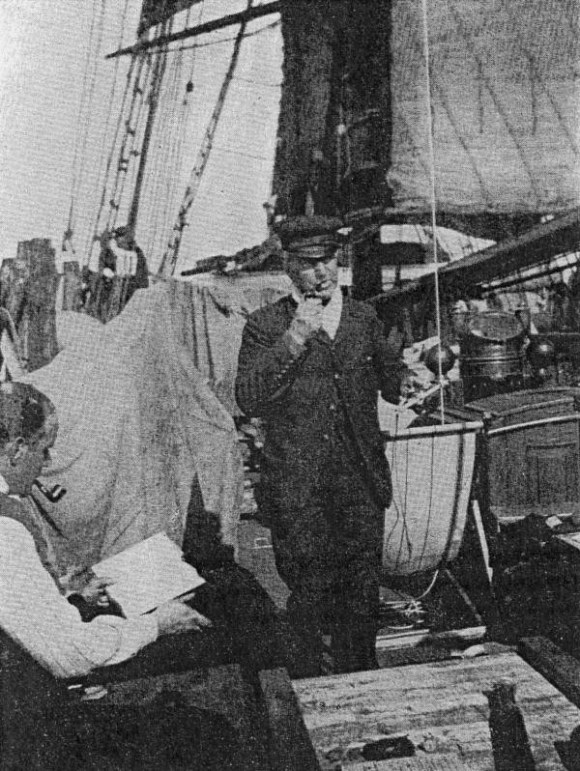
After the submarine had maintained a continuous fire for ten minutes, shells falling uncomfortably close, the Probus ran up the White Ensign and at 3,500 yards opened fire with her starboard 12-pounder. The first shot fell 500 yards short, but the crew of the submarine’s gun hurriedly left their station and made for the conning tower. The second shot seemed to be a hit, for a large cloud of smoke went up from the U-boat and she did not return fire. Probus then had to tack to bring her guns to bear again and the enemy took advantage of this to resume firing. With shots falling all around her the port gun of the brigantine now came into action and the fourth shot dismantled the U-boat’s sails and mast and another cloud of smoke rose from the fore part of her conning tower. It had had enough and submerged.
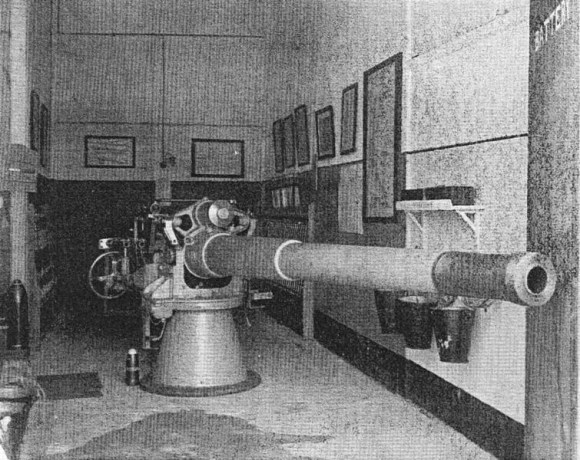
It had been an hour since the first shot. Quarter of an hour later the U-boat returned and was sighted at a distance of six miles. It had probably been stopping up the shell holes and was returning to finish off its prey. By now the armed trawler, with its fishing boat crew, was eagerly making its way to the scene and the German was forced to scurry off. Probus resumed her journey and arrived at Morlaix on 25th June. The scheme of carrying freights was a financial success and Probus paid for herself many times over. It was not unusual for her to earn over £1,000 a month.
Towards the end of her engagement with the U-boat the Probus had become becalmed and was unable to use her auxiliary engine because the starboard propeller had fouled the log line. She was a sitting duck with the submarine able to run rings around her. In rough weather the gun platform of sailing ships was too unstable to be used with any degree of accuracy. Despite such limitations many more sailing ships were commissioned as Q-ships. We know, for example, that the Ilma alias Merops, an auxiliary barquentine (Q.28) left Grangemouth on 23rd August 1917. She had been fitted out “in the Firth of Forth” in February 1917 with a couple of 12-pounders and a 4in gun. At the end of May she was badly damaged aloft during an engagement with a U-boat. In July she caught fire and eight of her crew were badly gassed by lyddite fumes from the burning ammunition and this may have been the occasion for her recorded visit to Grangemouth.
The 176 gross ton brigantine Dargle (alias Q.29, J J Bibby, Grabbit, Peggy) was commissioned on 23rd February 1917. She carried cargoes to the Orkneys and Shetlands and had at least one engagement during which she damaged a U-boat, which later surrendered to trawlers from the Tyne. The three-masted iron barquentine Cymric (alias Olive) was commissioned at the same time. She had the dubious honour of sinking J.6 on 15th October 1918 – dubious because it was a British submarine!
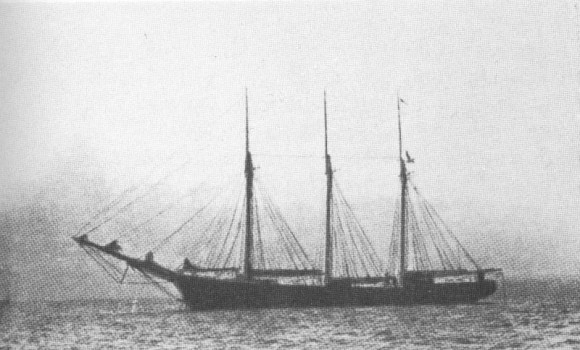
The John B Curtis, a three-masted schooner of 800 gross tons built in Halifax, United States of America, was fitted at Grangemouth with an auxiliary motor as well as two 4in guns, two 12-pounder guns, one 3-pounder gun and a 7.5in howitzer. She was commissioned as the Fresh Hope on 8th November 1917 and served until well after the end of the war. Early in the war she had been captured in the English Channel under suspicion of carrying contraband.
HM Customs sold her to a Liverpool company and in 1917 the Admiralty had bought her back. Her aliases included Edith S Cummins and Iroquois. As a decoy trader she made several trips to French and Portuguese ports, carrying cargoes for WK Watson of Grangemouth. On her second trip she lured a submarine and badly damaged it. In March 1918 she was badly damaged herself and had to be dry-docked at Grangemouth, leaving on 28th March 1918 with a cargo of coal bound for St Malo. Immediately after the war ended she was put on public display at Granton. A charge of 1s was made and the proceeds went to naval charities. A Falkirk Herald reporter gave the following description of the vessel
“very graceful she looked as she lay in her berth gaily dressed with bunting. Standing on her lor deck the most experienced seaman would be deceived. Only one gun is visible, a poor little six-pounder, this the real decoy of the ship. Up among the rigging are cunningly concealed wires to catch the messages floating through the air. Nothing could be more innocent looking. Yet at the word of command this piece of deck lumber falls away revealing a 7.5 howitzer; on either side a section of the bulwarks folds over and a 4-inch gun pushes out its nose; forward a bit of deck slides away and a 12-pounder is ready for action. Every man of the gun crew – disguised as merchant seamen – is at his post. Another hauls up the White Ensign, the outward marking of the change from peaceful trader to man of war.”
From Granton the Fresh Hope went on display at Aberdeen and Dundee, At the former she attracted over 7,000 visitors. Grangemouth’s provost managed to arrange for her to visit Grangemouth on the weekend of 25th and 26th January 1919. On the Sunday almost 500 people, most of whom were from Falkirk, toured the vessel. The ship stayed another five days but drew few more curious sightseers. The explanation given for this poor turnout was that the people of Grangemouth were already quite familiar with the ship and her “secrets”. In truth it may have had more to do with the 48 hour working week that had just been imposed.
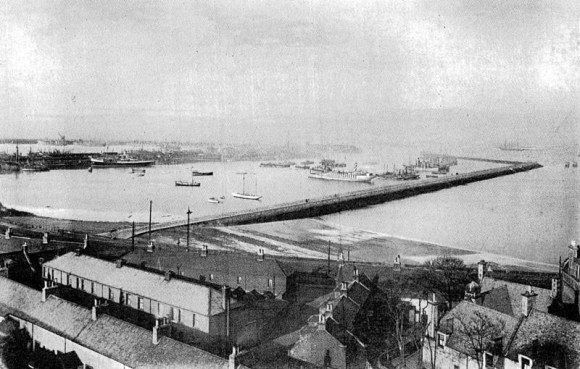
By the end of September 1918 there were no fewer than 19 decoy ships based at Granton, most (if not all) of which had been fitted out at Grangemouth (Appendix 11). Of these nine were sailing ships engaged in trade. In that month, for example, the barquentine Merops was discharging a cargo at Runcorn preparatory to loading coal for Cherbourg. The topsail schooner Dargle was discharging a cargo at Lerwick, and then loading herrings for Farnborough. The Fresh Hope was about to leave Liverpool for Belfast, where she would load with cork ballast for Halifax, Nova Scotia. The Baron Rose, another 900-ton schooner, was about to leave Newcastle with cork ballast for Halifax also. The barquentine Rentoul was on her way with coal to Cherbourg, the barquentine Imogene was bound for Lerwick with coal (before commissioning she had been used to carry china clay from Fowey to St Malo). The topsail schooner Viola (alias Vereker) left Granton with coal for St Valery-en-Caux. The iron schooner Cymric was taking coal from Granton to Cherbourg. Elizabeth, a three-masted schooner, was also carrying coal from Granton to St Valery-en-Caux.
From July 1915 to November 1918, 29 vessels were engaged at various times in special service duties based at Granton. Of these 13 were trawlers, four coastal steamers, one a tug, and 11 sailing ships. Six of the last only went into commission in the autumn of 1918, and not surprisingly only the Fresh Hope of these saw an action.
The origin of the Q-ships is obscure and the idea seems to have developed in different ways at various ports. In March 1915 when Captain (later Commodore) Startin was appointed to take change of the rather limited facilities then at Granton, he only had an armed trawler and some converted minesweepers. The Admiralty trawler, HMS Gunner, had been equipped with guns at Grangemouth in February of that year.
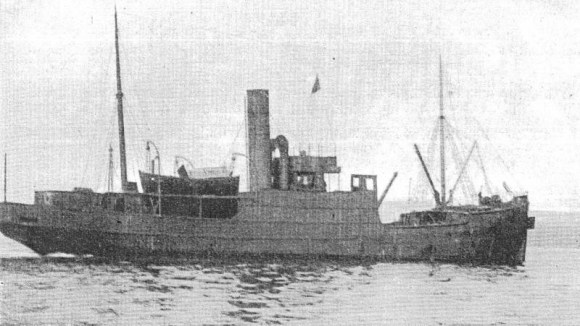
As the senior vessel at the base this was his command ship and the Granton base became known as “HMS Gunner”. The U-boat scare was then at its peak and the public, perceiving that there was no ready answer to their threat, was in a state of near hysteria.
“Poor Granton! We had very little rest, day or night, in those days; everybody was seeing submarines. Ladies saw them from trains, children from the coast, and farmers from their farms… Once a unit of trawlers was sent out in the middle of the night to hunt a submarine in Mortimer’s Deep. The officer-in-charge, seeing what looked like the conning tower of a submarine, did his job manfully, and rammed it full speed; but, unfortunately for the trawler, it was a beacon on a rock.”
Then there was the famous battle off Inchkeith, which resulted in the ramming and sinking of a small launch!
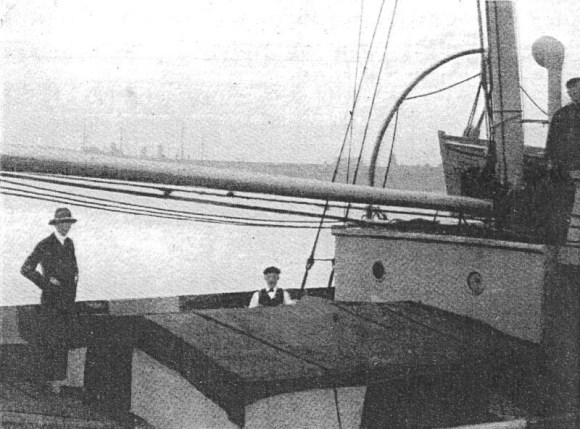
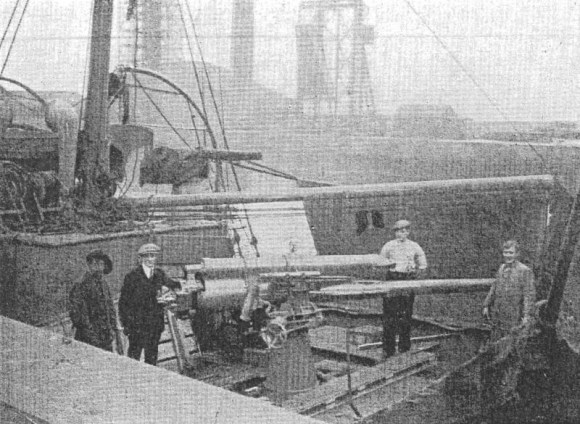
In June 1915 Startin organised a fishing expedition, taking 22 trawlers to a position 180 miles east of Peterhead, where U-boats were known to pass. HMS Gunner was present and several of the trawlers had their guns covered.
“We caught lots of lovely fish, but no submarines, the whole thing being spoilt by the Dutch fleet being all about, who, no doubt, gave the show away to Fritz. During this trip it was suggested that the Quickly could be made to look like a peaceful trader with very little alteration; so one evening she was sent away to go and disguise herself, and next day she steamed through the fishing fleet with the Danish flag flying and Danish flags painted on either side amidships, black canvas stretched along each side of the fore-deck, which made her look a very good imitation of a small cargo boat. The fleet returned to Granton and the Quickly was fitted with two 12-pounders, one forward, covered with bags of sawdust to represent deck cargo, and the after-gun covered by a box. This ruse proved successful, for on 19th July she destroyed what was supposed to be U42, about 100 miles east of May Island. This, in all probability, was the first disguised trawler in the war to destroy an enemy submarine.”
Quickly had been a fish carrier and upon being commissioned that July was renamed Master (Q.32). The crudeness of the early disguises is well illustrated by the use of bags of straw on the deck to represent potato sacks and often her 12-pounder gun was only covered by a tarpaulin. She had no further luck till 12th June 1918, when she had an indecisive fight with a U-boat. HMS Gunner had come to Quickly’s assistance during her first submarine encounter and later that year was herself disguised, chiefly with canvas on a wooden frame, and sailed as a small merchant to and from Norway armed at first only with her two 6-pounder guns. Redeployed on the East Coast she had two actions in the same day in August 1916 and badly damaged one submarine.
Another trawler, Speedwell II, of 273 tons was armed with a couple of 12-pounders, a 6-pounder and two torpedoes. She traded as Glendale. On 21st March 1916 she was patrolling off the Norwegian coast when she captured the new German ship SS Valeria with 2,200 tons of iron ore. The attempt to bring her prize back to Lerwick failed due to the bad weather and the fact that Valeria ran out of coal. She was deliberately sunk, but at least the enemy war production was disrupted.
As well as sailing vessels of the coaster class and the trawlers made to look like small cargo boats there was a third kind of special service ship converted at Grangemouth for the Granton station. These were the fishing trawlers that kept their original appearance and were usually armed with a 12-pounder gun and a 6-pounder decoy gun, the former being mounted over the ship’s engines and covered by the engine-room skylight, the inspiration of Lieutenant-Commander G Atkinson. The trawlers in this class were the Commissioner, Rosskeen, Strathallan, Strathearn, Fort George, WS Bailey, Coote, Auk, Defender and Izaak Walton. Of these the WS Bailey, Auk and Rosskeen were privately owned and acted as fishing guards. They were hired for this duty by the Admiralty, but were crewed entirely from the fishing fraternity. This scheme was inexpensive for the Government and proved most successful in preserving the fishing fleets, which prior to their introduction had been severely mauled by the U-boats.
Lieutenant F W Charles RNR was in command of the fighting portion of Commissioner’s crew, but her fishing skipper was otherwise in charge of the ship. She joined the Granton fishing fleet in March 1917 and fished alongside them. On the very first day a submarine attacked. Commissioner cut away her fishing gear and pounced, but the enemy escaped. Similarly Rosskeen went to fish about 20 miles east of the Longstone. Three days later she was about to shoot her trawl when a shot whistled over her wheelhouse and a large submarine appeared 8,000 yards away. After twenty minutes, during which the enemy’s shells fell frighteningly close, Rosskeen cut away her gear and “abandoned” ship. The submarine then obligingly approached on the surface towards the rowing boat. When the range was down to 1,200 yards Rosskeen opened fire with her 12-pounder, hitting the target several times before it dived and was lost. Rosskeen was commanded by Lieutenant Petersen, who was considered to be the Granton Q-ship “Ace”. On one occasion he was wounded and allowed his ship to be shelled for another 40 minutes before giving the order to engage.
During May 1917 the trawlers Strathallan and Strathearn were commissioned, as was the steam drifter Fort George. Strathearn was fired upon by a submarine on 13th June whilst fishing 19 miles east of the Bell Rock, but the enemy disengaged before any damage was done. The following night Fort George was fishing 35 miles east of May Island when she was attacked by a submarine at 2,000 yards. After the third shot the drifter secured her fishing gear and returned fire. The enemy was clearly surprised and broke off the engagement after just three shots had been fired at it. However, the fourth and fifth rounds from the U-boat had hit Fort George, killing two and wounding another couple. The little ship’s next encounter was on 28th January 1918. She was about 14 miles east of May Island with W S Bailey (Lieutenant C H Hudson in command, J H Lawrence skipper), when they heard a submarine engine on their hydrophones. For an hour and a half they tracked the submerged enemy and W S Bailey then dropped two depth charges. Two periscopes were seen only 20 yards from the decoy trawler and so a third depth charge was dropped over that spot. UB 63 still lies at that location. As well as fitting out merchant and fishing vessels for special service the Greenock & Grangemouth Dockyard Company built several new ships for this purpose. The most famous of these was HMS Heather (Q.16). In many ways she was an unlucky ship. At her launch into the River Carron on 16th June 1916 she stuck in the muddy bank opposite her berth and had to be refloated the following day. She was highly engined and had a top speed of around 20 knots. She was armed to the teeth with three 12pdrs and a DAMSG 12pdr aft and had a crew of between 80 and 100. Heather sailed under various aliases such as Bywater, Lisette, Lizette and Seetrus to give the impression that she belonged to one of the neutral nations. For a long time she sailed from Queenstown off the west coast of Ireland, but it was 19th March 1917 before the bait was taken. The main problem was that the clean cut lines of the Aubrietia type sloop clearly picked her out as a fast vessel. A month later, on 21st April, she encountered another U-boat. On that fateful day she was commanded by W Hallwright. Lying on his stomach, watching through a peephole on the bridge he saw the U-boat start to shell from a distance and slowly approach. He was waiting to see how close he could entice her in when a piece of shrapnel entered his brain, killing him immediately. The rest of the ship’s crew were unaware of this and consequently the order to raise the White Ensign was delayed. The initiative was taken by a junior office, but for a while Heather fought under a neutral flag, contrary to the rules of war. The outcome of the encounter was indecisive on both sides. At Grangemouth Dockyard they started to armour the lower superstructure of the bridges of Q-ships. Command of Heather was then given to Harold Auten and she continued to patrol out of Queenstown and Inishtereght. A further 4in gun was added. Although involved in another U-boat incident that April she was never again a success in this role. Auten asked for and got an old collier in her place. (For the story of the Heather see Auten 1919.) The Mistletoe, launched at Grangemouth on 29th November 1917, was also taken up for special service. She was an Anchusa type sloop of standard design, but by this stage in the war the details had been refined.
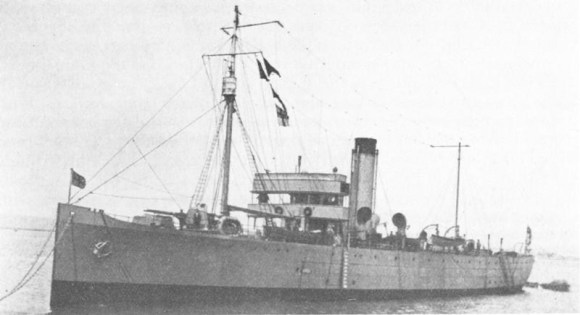
Periscopes were placed in mushroom-shaped deck ventilators at fore and aft and were connected by a corridor below the deck so that the commander was able to make his observations in safety. The corridor also enabled the crew to move about unobserved. The alterations and innovations of design added to the work and it was 25th April before she was completed and commissioned. She consequently never had the opportunity to test her metal and was at Liverpool when the war ended.
Due to its very nature, the Q-ship service was kept secret and many mysteries remain around it. Other new ships from Grangemouth may have been used. HMS Lilac, for example, was an Acacia type sloop launched on 29th April 1915 and rather surprisingly the Falkirk Herald announced that the Government ship launched that day was for “special service”. It is not known to have been a Q-ship.
Older vessels were much preferred by the Q-ship commanders and one of the ships built at Grangemouth in 1904 was purchased for this role in February 1915. She was the 1459 gross ton coastal steamer Peveril employed by the Gibson Line on the Leith/Grangemouth to Rotterdam route and latterly on the Leith to Antwerp run. She became Q.36. On 6th November 1917 she was sunk by U-63 off Gibraltar with the loss of all her crew. Likewise, the collier Vala, built at Leith but belonging to J T Salvesen & Company of Grangemouth, was requisitioned on 7th August 1915 as Q.8. She was torpedoed and sunk by UB-54 on the approaches to the English Channel on 21 August 1917.
It is difficult to judge the success of Q-ships against the submarine terror. They are now only credited with 20 or so kills, far less than accounted for by mines. However, at the time it was believed that they had eradicated more and many were indeed severely mauled, putting them out of action for long periods. Their apparent success at the time despite, or even because of, the secrecy surrounding it, was a great moral booster for the Allies. On the other hand, the Germans hated the trap ships.
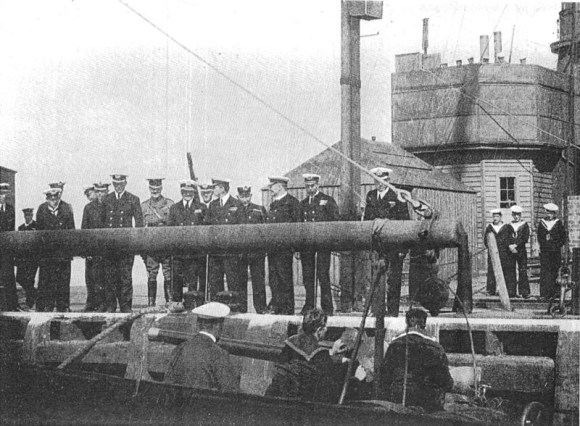
They never knew when a trader was what she seemed and consequently many ships escaped unharmed. With Grangemouth men amongst the crews of Q-ships it is not surprising that the legend of their visits to the port remained for many years, though it has become rather blurred down the decades.
One such crewman was first stoker petty officer James Sligo of 34 Forth Street. He had been a coal hoist operator before the war, but in February 1918 was awarded the Distinguished Service Medal. Upon receipt of this honour he was given leave and returned to Grangemouth. He was evidently an eloquent speaker and entertained crowds for some time with his tales of daring adventure. Many of Grangemouth’s war medallists had been shy and retiring, but here was a man who could spin a yarn – and he had quite a story to tell. On 27th September 1917 he had been on a Navy “cruiser” when she sank a U-boat. Then in February 1918 his ship had a lively encounter with another U-boat.
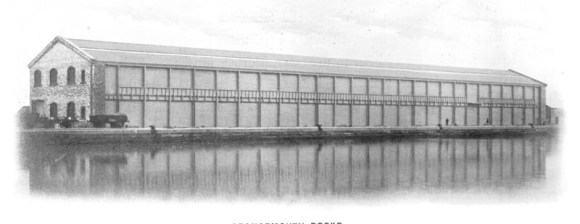
For 14 hours Sligo stoked the boiler while the damaged submarine was chased. However, they appear to have lost it, only to be torpedoed themselves on 11th February. The crew were picked up 5 ½ hours after their ship sank. For a convoy ship this might be considered an active vessel, but the dates show that the “cruiser” had been the Q-ship Cullist.

The use of explosive mines to contain the U-boats was also promulgated from Grangemouth. A Royal Naval Mining Depot was instituted there in January 1916. The three largest Caledonian Railway Company sheds at Grange Dock were requisitioned by the Admiralty for the storage of mines, sinkers, etc, these being removed as wanted and, with the help of the company’s hydraulic cranes, placed on board vessels of the destroyer class of mine-layer. One of the first people to start work packing the mines with their explosive charge was 14 ½ year old Isa Gibson. She was able to earn 27s a week at this dangerous task, though some of the men received 49s.
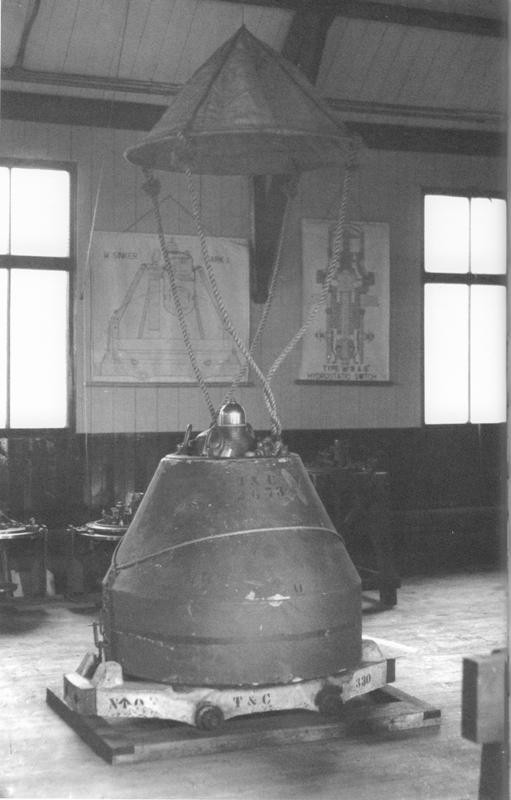

The first batch of mines that Isa worked upon were taken away to a mine-laying depot near the mouth of the Thames Estuary by the SS Avon. Shortly afterwards, in the second week of April 1916, news reached the town that the Avon had been lost. There was great distress and many believed that she had blown up with her deadly cargo aboard with little chance for the crew of local men to survive. Great was the relief when it was found that she had already discharged the mines and had struck the German mine on her return voyage on 9th April.
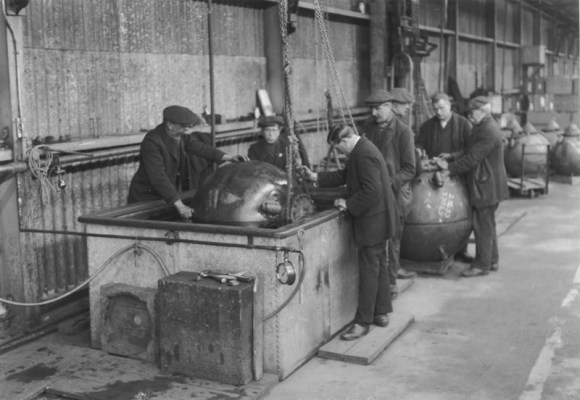
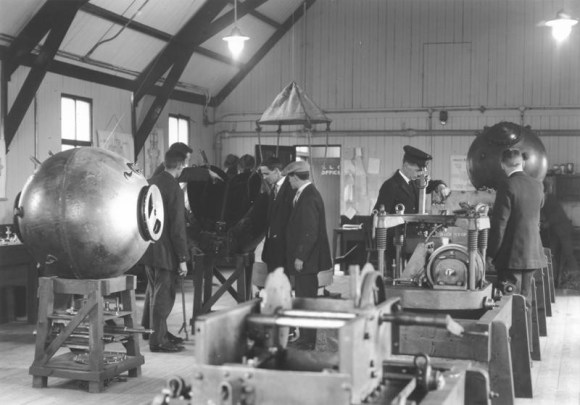
At this time the depot was in charge of the Officer-in-Charge at Crombie Ammunition Depot. In June 1917 an Engineer-Commander took charge. He and his staff were accommodated in the Caledonian Company’s premises within the Grange Dock. A month later, operations were begun to convert the largest of the three sheds into a workshop for the assembling of mine parts, the testing of mines, and various other operations in connection with them: though this new departure was not fully developed until the end of the year. By that time an area in the Grange Dock extending to 31 acres had been acquired from the company, and six large sheds were erected thereon by Admiralty contractors, lines of railway being also laid to connect the sheds with the Caledonian Railway system. About 85,000 tons of slag and ashes were required to bring the land up to the required level. Three of the new sheds were used for the assembling of mine parts. The others were utilised for the storage of mines ready for shipment on the mine-laying vessels. The sheds became available for use in April 1918. Several dock sheds were also converted into Admiralty workshops; spacious dining halls, laboratories, instruction rooms, etc, were erected, some additional acres of ground being taken over for the purpose, and before long the Admiralty controlled, within the limits of the Grangemouth Docks, an exceptionally large and well-equipped mining depot where hundreds of men and women were employed on work in connection with the mines. In May 1916 the Grangemouth Town Council wrote to the Military Authorities asking for local unskilled men to be taken on to do the work in the Docks instead of drafting in unskilled soldiers. The Military promptly wrote back saying that service labour was cheaper and more disciplined.
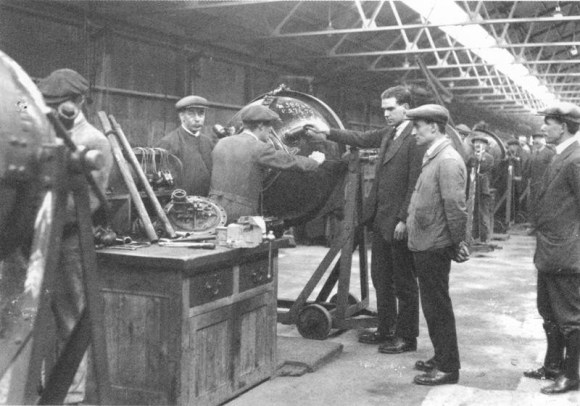
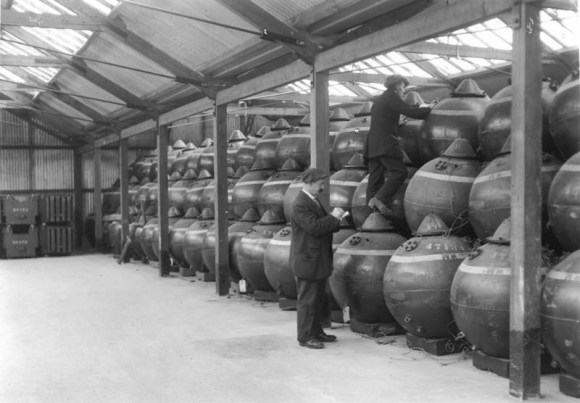
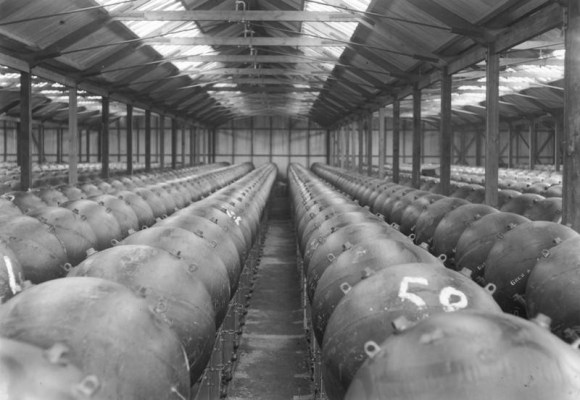
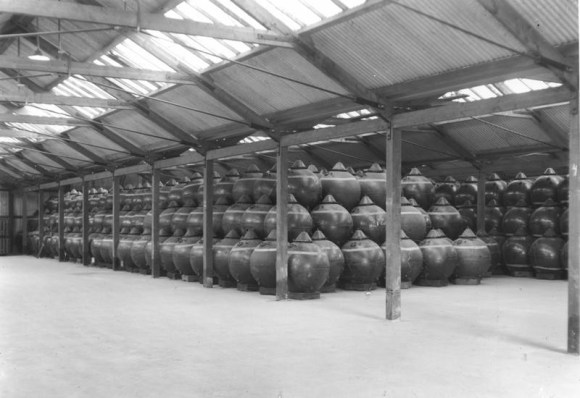
The shipment of ammunition and mines to and from the port of Grangemouth had begun in March 1915. The consignments imported came principally in vessels from Crombie and Rosyth. Those that were not stored at Grangemouth were either sent on by rail to various depots or shipped to the Fleet in the Firth of Forth. The exported ammunition and mines were largely received by rail from Government depots in England. The wagons containing the mines arrived at the Caledonian Company’s marshalling yard alike by Caledonian and by North British trains. They were then taken by Caledonian engines and men to the exchange sidings, where they were handed over to the Admiralty, who sent them on to the depot with their own engines and men. After being inspected and fitted up in the depot, the mines were shipped on to the mine-laying vessels either from railway wagons or from the dock sheds. The Admiralty had four engines and 200 wagons to assist in working the traffic.
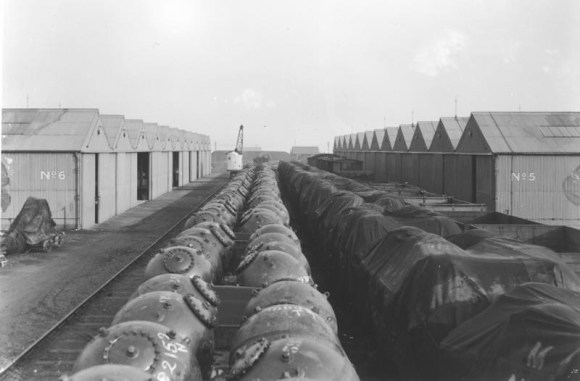
It was unusual for the Caledonian Railway to allow private parties to run their own engines over the company’s lines, but the contingencies of the war led to an exemption at Grangemouth for the Admiralty. We know of at least three locomotives that were based here. These were an LSWR loco (737, a 2-2-0 side tank locomotive produced by Dougald Drummond as an auto train in 1906; ten of this series were used by the armed services in the war) and two NER locos (2188 and 2189, these were new 0-6-0T class E1 (LNER J72) having been built at Darlington in 1914).
Imports and exports were as follows for the periods mentioned:
| AMMUNITION AND MINES | ||
|---|---|---|
| YEAR | IMPORTED | EXPORTED |
| 1915 | 2,445 tons | 11,442 tons |
| 1916 | 13,391 tons | 4,608 |
| 1917 | 12,017 tons | 5,426 |
| 1918 | 5,603 tons | 22,128 |
| 1919 (to April 30) | 5,356 tons | 1,223 |
| TOTALS | 38,812 tons | 44,827 |
The traffic by rail in ammunition and mines amounted to 57,600 tons received and 45, 875 tons dispatched, a total of 103,475. These figures include both Caledonian and North British traffic into and out of the docks, where all the railway working was done by the former company.
The early mine laying operations of the Allies had concentrated upon the continental coast around Germany, Poland, Holland and the English Channel. Towards the end of 1917 the focus of these operations began to move northwards in order to further restrict U-boat movements in the North Sea. In October 1917 Rear-Admiral L Clinton Baker was appointed to take charge of the mine laying squadron operating from Grangemouth. In keeping with Naval tradition, the land-based facilities of the Admiralty at Grangemouth were given a ship’s name – HMS Rameses. The commanding officer and his headquarters’ staff were based in the 3-storey red sandstone building in Lumley Street known as the Baltic Buildings. Its name was temporarily changed to Rameses House and hot water pipes were installed as part of a new central heating system, much to the annoyance of local taxpayers. The facilities at the port were further improved in anticipation of the Admiralty decision, finally taken in January 1918, to lay the “Northern Barrage” – a minefield stretching all the way from the Orkneys to Norway, some 240 miles, leaving only a 10-mile gap off the Orkneys for use of the Grand Fleet in an emergency. This was an enormous task, beyond the existing capacity of the Royal Navy and so the Americans eagerly joined the venture. This gave the Americans an opportunity to trial their new antenna mines. The British continued with their H.II contact mines. Mine depots for the Americans were set up at the Dalmore Distillery at Alness near Invergordon and in the Glen Albyn Distillery at Inverness. The mines crossing the Atlantic were transported by rail from Kyle of Loch Alsh on the west coast, or by lighter through the Caledonian Canal. For handling the British mines, the existing facilities at Grangemouth were extended. The British operations began on 2nd March 1918, when the first deep mines were laid by the Paris, followed by the Princess Margaret, Angora and Wahine.
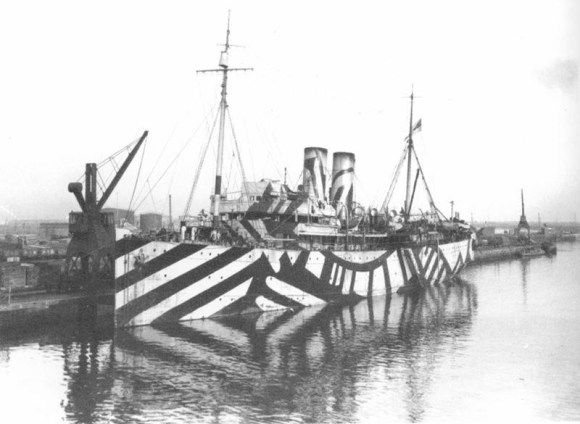
SS Wahine, a passenger ship of 4,630 tons with a speed of about 19 knots built in 1913, previously engaged on the New Zealand coastal trade by the Union SS Co. Requisitioned by the Admiralty 17 July 1915, along with the crew. Limited radius of action and carried rather a small number of mines for her size (180).
SS Paris, a passenger vessel of 2,030 tons displacement and a speed of 21 knots also built in 1913, normally employed on the Newhaven-Dieppe route by the London & Brighton & South Coast Railway Co. Her chief disadvantage was her small radius of action.
SS Princess Margaret, 5,440 ton passenger ship built in 1914 with a speed of 21 knots. Just completed for the Canadian Pacific Railway when taken over by the Admiralty, being specially designed for the run between Vancouver and Seattle. Large carrying capacity (500 mines), light draught.
SS Angora. A combined passenger and cargo ship of 4,298 ton built in 1911s, normally employed on the Calcutta-Rangoon run by her owners – the British India S N Co, Glasgow. She carried 300 mines and had a large radius of action, but was large and slow. (Appendix 12)
On 30th April 1918 the battleship London and the cruiser Amphitrite, both converted for mine laying, were sent to Grangemouth to replace the Paris and the Wahine, neither of which had sufficient endurance to be operated in the eastern area of the barrage with an adequate margin of safety (Cowie1949, 67). Problems arose and the main mine laying operations took place between June and October. In the space of those five months the four British minelayers based at Grangemouth laid 15,093 mines.
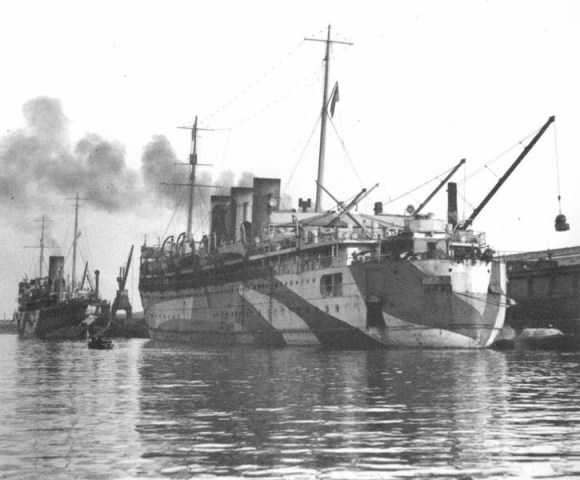
Steam lighters were chartered from local firms to take ammunition and mines to the Fleet in the Forth and to the bases at Rosyth and Crombie (Appendix 13). The Carron Company lighter No. 10, for example, made 41 journeys from Grangemouth in 1917. Her hire in the six months to June 1918 cost £301, but this fell to just £49 in the half year to December 1918 and rose again to £123 in the period to June 1919. Even James Aitken’s lighter Arab, accustomed to carrying beer on the Forth & Clyde Canal, was hired to take mines to Crombie on at least one occasion. The constant demand for lighters led the Admiralty to purchase some outright and one, of 40 tons, was appropriately renamed Rameses. As equipment improved a series of 80 ton motor launches became available. These had the rather unremarkable names X212, X214, X215, X218 and X219. As the Fleet’s use of the Forth Estuary increased more, resources were brought into the area. In January 1918 a large number of government barges were towed from Chatham, London and Immingham for use at Grangemouth. These did not have names, not even prefixes, and were allocated numbers. From the end of May to mid December the Forth was crowded with these small vessels plying backwards and forwards to the vast armada of ships that made up the Grand Fleet.
The total tonnage of the mine-traffic received at Grangemouth – that is to say, mines, sinkers and appliances connected therewith – was 19,150 tons. The principal forwarding places were: Attenborough near Nottingham (550 tons), Bolton (360 tons), Degenham (4,680 tons), Fareham (1,100 tons), Faversham (860 tons), Littlemore (6,570 tons), Portsmouth (400 tons) and Woolwich (1,180 tons). Not the whole of the traffic was shipped direct from Grangemouth, about 2,790 tons being sent on mainly to places in the north of Scotland. It is difficult to estimate with any degree of exactitude the number of actual mines represented by the tonnage mentioned, but the sum total of those passing through the docks at Grangemouth under the conditions here described would probably be not far short of 60,000.
1,500 lineal yards of quay, with hydraulic cranes, were placed at the Admiralty’s disposal for handling the mines. In order to facilitate the operations, the Caledonian Company dredged these quay berths to the fullest extent. Admiralty contractors dredged in the River Forth, outside the dock entrance, a deep channel 1,500 yards long and 250 yards broad. The course of this channel was clearly defined by lighted buoys and beacons. The docks being lighted by electricity, the Admiralty were given the necessary electric current for their extensive signalling.
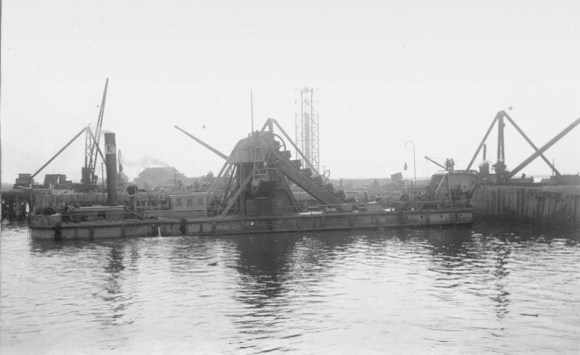
The Caledonian railway Company dredgers based at Grangemouth were the Forth and the Caledonian. Amongst those chartered by the Admiralty was the Gadsen, Alex McLennon master. When operating, an Admiralty representative was always on board her to ensure that the correct channel was maintained. During the course of this work an assortment of shipping debris was brought up. This included old ropes that had been lost or thrown overboard over the years by ships using the port. William Short, the mate, carefully sorted these items out and was able to get a small amount of money by selling them to other ships or for use at the paper mill in Denny. However, he was soon in court on a charge of stealing rope, which the Admiralty, as the charterer, laid claim to. At his hearing he claimed a traditional right to such material and was fully backed up by all the other operators. It was also clear that the Admiralty representative on board had not laid claim to anything at the time. The case was thrown out and the newspapers had a field day with the over zealous officialdom.
The dredgers required a lot of maintenance work and this too fell on the Dockyard Company. As well as those dredgers working at Grangemouth the Dockyard attended to ones employed at Rosyth and Leith. These had to be towed to Grangemouth, often by a naval tug, and occupied much of the spare capacity of the dry dock.
The increase in the activity at the mining depot at Grangemouth required a far greater workforce than before. Clinton Baker oversaw this rapid growth and soon after his arrival it was announced that 600 English dockers were to be brought north. Preparations were well underway by December 1917 and buildings were once more requisitioned for the incomers. The old granary at the end of North Charlotte Street, which had previously been used for Territorials, was again taken over. On the first occasion the Town Council had installed gas, but now that a longer term occupation was planned for an overhead electric cable was led in via Dalgrain Road and Middle Street. Electricity was considered safer. By the end of that month the conversion was complete and local residents grumbled about the unnecessary level of comfort being provided. The standard of accommodation at the granary became exaggerated in the telling and there was a growing feeling of dissatisfaction in the town. If it had been good enough for their own boys to use why wasn’t it for the English? Before the anti-English sentiment had time to ferment the foreigners were in occupation. Within a month of their arrival Charles Bruce, a lighterman from London, was killed in the Docks when a load fell on him.
There was great sympathy amongst the local population. Their grievances were finally quelled when, on 23rd February, the Falkirk Herald printed information that the incomers were:
“being treated on exactly the same footing as ordinary residenters in respect to food distribution. Cards have been issued to them from the Local Food Control Office in the ordinary course. ‘A certain class of workmen’ should be satisfied now, and no-one should feel defrauded of their rightful share of whatever is going.”
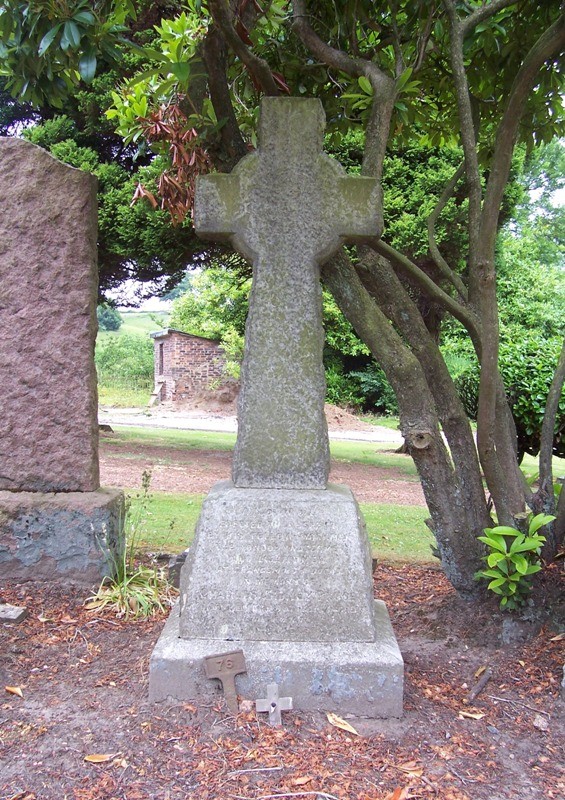
It was also learned that the 600 men were part of the Royal Marine Labour Corps. Far from being English slackers avoiding conscription they were in fact discharged soldiers, most of whom had served at the Front.
A few weeks after their arrival these men set up an “English Boys’ Entertainment Committee” to liaise with the local residents and to establish a rapport with them. In March the Englishmen hosted a concert at their barracks, the old granary, to demonstrate their goodwill and to prove that they were not living in luxury. More concerts quickly followed and were very well attended. At the second concert the hosts were generous in providing free coffee and biscuits, but unfortunately had to give this up when their mugs were stolen by some of their guests. The boys became accepted by the community and were known affectionately as the “Marines”. In October the Grangemouth Freemasons were given a gift of a gong made from an American mine by the English Freemasons working in the port.
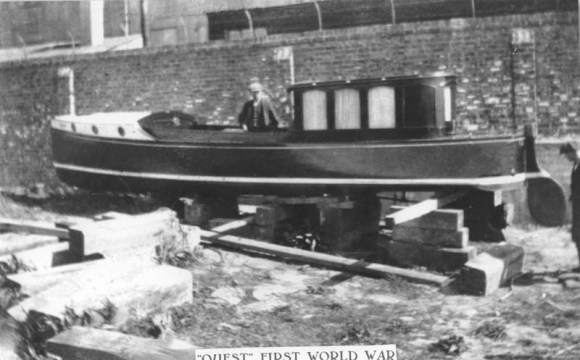
One of those on the Admiralty headquarters’ staff at Grangemouth was Edward Davies. Late in 1917 he became acting scoutmaster of the local troop, the 15th Stirlingshire. Due to military requirements, the troop had lost the use of the YMCA hall and Davies was able to use his influence to secure access to the Drill Hall. The troop thrived under his guidance and emerged stronger when he left after the end of the war.
On the official side Rear-Admiral Clinton Baker maintained diplomatic relations with the Town Council. In October 1918 he offered them the free use of a motor fire engine from the Docks in the event of a fire in the town, provided of course that it was not already in use at the time. The Council had been finding increasing difficulty in retaining the necessary horses in a state of readiness to use with their own appliance.
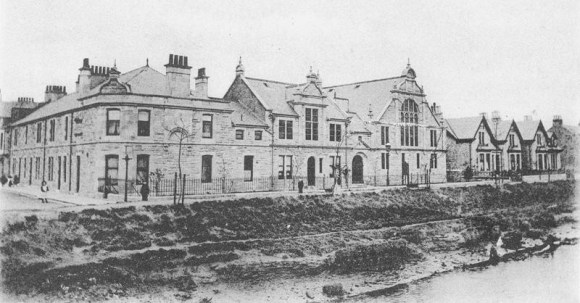
In February 1918 the YMCA Building in Abbots Road was reoccupied by the military and rooms in the Grierson Institute were converted for use by the YWCA. The following month WRNS started to appear in small numbers and “crocodiles” of these previously unseen Amazons were on the streets. In fact, the WRNS at Grangemouth acted as telegraph operators, confidential clerks, ledger clerks, domestic workers and motor drivers. In all 38 girls were stationed there, 14 of whom lived in the neighbourhood and stayed at home. These latter were attached to the “Immobile Branch” and their hours of work were fixed by their parents. Only those girls living in the hostel were asked to undertake night duties. Mrs Macrae was the commandant in charge of the WRNS hostel. It was inspected by a party of ladies from Falkirk charged with the responsibility of signing up further female recruits for the armed forces. They reported that the building had been extensively altered and there were few signs of its previous use – tinted glass windows and an oak roof being the most evident. The main hall had been divided into two almost equal sized living rooms for general use. Up the sides of these were cubicles, each with a single bed. All partitions were of oak. The inner of the two main rooms served as a mess room with the kitchen at the rear, above which was a small pantry. A piano and an assortment of games were placed in the mess room. The upper floor had been divided into further cubicles.
The Marines and WRNS cut quite a dash in the town and lifted spirits. People had been worn down by the drudgery of the war and the rationing. Normal civil life appeared to have been suspended and so it was with relish that a reporter wrote for the 18th May edition of the Falkirk Herald:
“A church wedding is a sufficiently rare spectacle in these parts to excite considerable remark, and on Tuesday morning the greatest interest was occasioned by the wedding in St Mary’s (Episcopal) Church of Miss Edith Alice Ivens to Mr Tom Derges, Admiral Clinton Baker’s steward. Rev. Robert Newell officiated at the marriage ceremony, the church being filled with spectators, the Admiral’s staff from Ramesses House being present, and a contingent of the WRNS. Mr Warren, the second steward, acted as groomsman, and the bride was given away by Admiral Clinton baker CB…
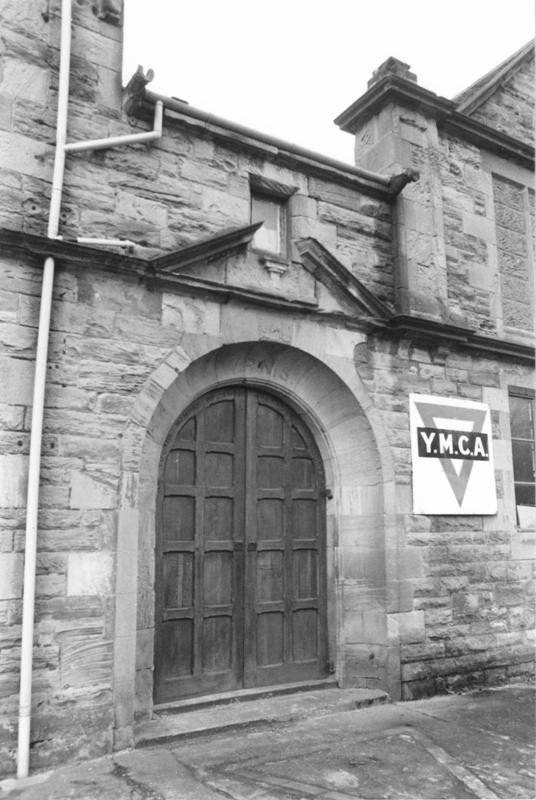
The married pair passed to their carriage through an arch of bayonets held aloft by Marines and WRNS… the wedding party went directly from the church to Ramesses House, where cake and wine was served, the bride and groom departing for their honeymoon immediately afterwards. The horses were taken from the shafts, and the WRNS and their Naval comrades pulled the carriage at a spanking rate up the steep incline of Station Road…”
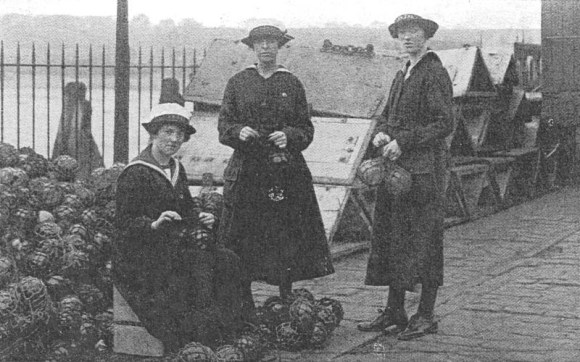
to the station.
The presence of the mining depot was good for local retailers still smarting from the withdrawal of the Territorials. Local services too benefited. The Grangemouth Laundry now employed 80 women, as it was doing the uniforms for Rosyth as well. Wages were unusually high at the mining depot at 30s a week plus overtime, which could make as much as £2 in total.
Despite their earlier correspondence to the Town Council, the Admiralty was so short of manpower that it did take on people from the general locality. Thomas Ferguson, for example, an ex-superintendent of police in Stirling, was chief warder from June until his death in October. In May 1918 the Labour Exchange at Perth sent an 80-year old man to Grangemouth to do Admiralty work at the Docks. He was so frail that within days of his arrival he had to be taken by ambulance and given a bed in the town’s workhouse. The Town Council were irate and accused other local authorities of dumping such problem “lodgers” on them. The Grangemouth Military Tribunal was in a complaining mood too. For four years they had been charged with hearing exemption cases for men called to the Forces and had sent many skilled men to France. They considered the mining depot to be over-manned and were annoyed that men were being taken from military duty to work there. Not only that, but the excessive wages at the Depot were inflating wages in the area and causing labour problems in the town. Property owners in Grangemouth certainly had cause for complaint. To house this large workforce the Admiralty, in March 1918, started to take over any empty premises in the town, of which there were many lodging houses due to the exodus of dock workers at the beginning of the war. No compensation was paid to the landowners, as it was said they were suffering no financial loss having had no income from the properties at the time.
Even with this accommodation men still had to be billeted in neighbouring towns and villages. From 1st January 1918, until well into 1918 the Caledonian Company, at the instance of the Admiralty, ran workmen’s trains between Grahamston, Grangemouth and the mining depot for the conveyance of the workpeople. At one time four trains were run daily in each direction. Special platforms were erected in or near to the docks for the accommodation of the passengers. (The Caledonian Railway Appendix for May 1915 had already contained instructions for “Working trains between Grangemouth No.1 Box and Passenger Platform, Grange Dock”.) There was an accident at the railway platform at the dock entry when a load of workers from the Mining Depot arrived one midday. A discharged soldier, Andrew Hamilton residing in Falkirk, tried to alight while the train was still in motion and was caught between two of the carriages. He was dragged for a few yards and suffered from shock. For those walking to work the open water remained a danger. Harold Odell, a 21 year old Englishman from Reading, drowned in the canal. He had worked at the Mining Depot and went missing from his lodgings in Lumley Street in the middle of November.
Men from the Marine Labour Corps worked in the Dockyard and the Docks as well as in the mining depot. They were also involved with the improvements to the Admiralty’s oil fuel storage and distribution systems at the port, which were considered vital for the Fleet. Ships from the Royal Fleet Auxiliary took the fuel oil from Grangemouth to naval ships in the Forth and to the Rosyth installation. The numbers of ships involved increased as the war progressed and the Fleet made greater use of the Forth. Oil tankers became a common sight in the port. The following RFA visited Grangemouth at this time:
Attendant (584t), Barkol (320t), Burma (1090t), Creosol (654t), Distol (571t), Ferrol 583t), Prestol (993t), Scotol (565t), Servitor (565t), Sprucol (583t), Teakol (583t), Thermol (1018t), Unio (1117t)
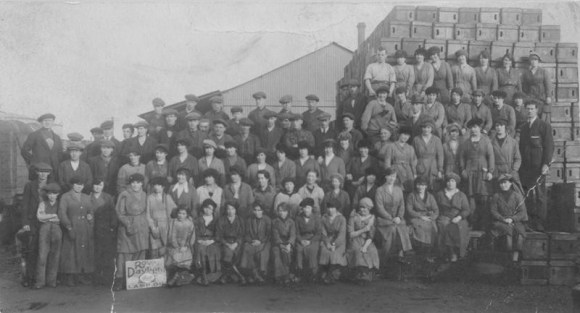
The Anglo-American Oil Company had built Scotland’s first bulk oil storage tanks at Grangemouth in 1906/7 after the opening of the Grange Dock and already employed over a hundred people there. Shortly afterwards Ross Creosote and Fuel Oils Ltd erected a storage depot there and in 1909 the British Petroleum Company had lain down tanks of 100,000 tons capacity. At the beginning of the war the Admiralty took over the British Petroleum Company’s oil installation in Grange Dock. Throughout the war, small oil tankers belonging to the Anglo-American Oil Company made the hazardous sailing from Thames Haven refinery to Grangemouth with lamp oil and motor spirit. These included the Tioga (345t), Oneida (332t), Luffwell (129t) and Osceola (161t). Aviation fuel was also needed for the seaplanes based in the Forth. One land-based plane had to make an emergency landing in May 1915 at Overton Farm due to shortage of fuel. The pilot eventually managed to get some aviation fuel, for after 1 ¾ hours, during which time a large crowd had gathered, he took off again. (24 years later this became part of Grangemouth airfield.)
Larger oil tankers of the Anglo-American Oil Company, such as the Ottawa (2074t), Cuyahoga (2738t), Luckawana (2412t) and Twance (2000t), made their way around the shores of Britain to deliver oil from America. The waters around Britain’s east coast were particularly dangerous and it was essential to limit voyages there. Two strategies were therefore evolved in tandem to solve this problem. The first involved discharging fuel from the large ocean-going tankers to smaller coastal tankers in the Orkneys. The smaller vessels then completed the hazardous journey down through the North Sea to Grangemouth. The ships commissioned for this task were from the merchant navy and included such ships as the Rhio (1505t), Fernhill (1457t), Cundall (1146t), Elmtree (1333t) and the Banchory (1317t). Some of these had to be fitted out for this task. One tanker, carrying 4,000 tons of oil, was torpedoed off the Aberdeenshire coast and sank, stern first, in just 17 minutes. The fishermen on the shore heard the massive explosion and set out at once in motor boats to the rescue. Of the 40 crew only four were found alive. Another tanker making this journey was badly damaged by a torpedo, but managed to limp into Grangemouth. Unknown to the officers her oil tanks were leaking and after a time part of the dock was covered with a thick scum of oil. A sailor on a neighbouring ship, unaware of any danger, lit his cigarette and threw the lighted match into the water. The oil was at once set on fire and in a short time the flames shot up into the air. Steps were taken straight away to subdue the flames, for there was a danger of them reaching the sheds were the mines were stored. The flames, and the event, were subdued, so it was several years before the public were allowed to hear of it.
The second strategy was to have the oil discharged on the banks of the Clyde and conveyed across central Scotland to Grangemouth. The Admiralty converted a fleet of boats in use on the Forth and Clyde Canal into oil-tank vessels. Large oil tankers from overseas began to go up the Clyde as far as Bowling at the western terminus of the Canal. Here the tankers lay in the outer harbour and the oil was pumped directly into the improvised oil-tank vessels, which lay at the west end of the inner basin. When full, the vessels were towed by steam lighters along the thirty-five miles of canal from Bowling to Grangemouth Docks. There the oil was pumped out of the boats into the tanks of the British Petroleum Oil Company, and was subsequently sent out to the Fleet as required. To facilitate the passage of the boats through the canal, the locks and bridges between Bowling and Grangemouth were double-manned from 9th April 1918 to 31st January 1919.
Under these arrangements there was conveyed by boat from the Clyde to Grangemouth Docks a total of 137,514 tons of oil. So much importance, however, was attached to the provision of fuel oil for the Fleet that the Admiralty decided, early in 1918, to lay an oil-pipe from Old Kilpatrick, east of Bowling, to Grangemouth Docks in order that the oil, pumped along this pipe for the entire distance, could be obtained in greater volume and less time.
Begun on 9th March 1918, the work was carried out by the British and the United States Governments in combination (Appendix 14). Britain was responsible for the excavation, the main contractor being Casey and Daragh. While the United States provided a Naval Pipe-line Unit for the laying of the pipes. These were eight inches in diameter. The pipeline was carried along the towing-path of the canal until it had been brought within a mile and a half of Grangemouth.
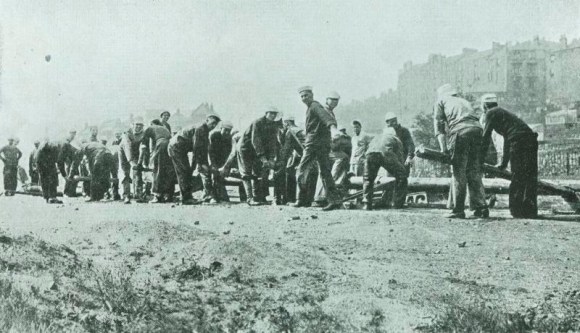
There it was diverted to the bank of the Grange Burn, whence it continued along the Caledonian Company’s dock property to the Admiralty Oil Installation at the new powerhouse, Grange Dock. Pumping stations were provided at either end of the line, and two intermediate stations were also arranged. At Grangemouth the steam for working the pumps was generated in the Caledonian Company’s hydraulic powerhouse. From the Admiralty Installation the oil was pumped, as required, into oil-tank vessels moored alongside, and so conveyed direct to the Fleet.
Large storage tanks were being built at the Admiralty Installation and the work was well advanced on the 6th September, when a fatal accident occurred. One of the workmen fell 25ft from his ladder. Peter Hill, aged 34 years from West Bromwich, was a discharged soldier who had volunteered to do war work. He had already undertaken similar work in Leeds. On the day in question the two sectioned iron ladder was lent against one of the oil tanks under construction. It was not lashed to the tank and the two halves were only jointed at the centre by a bolt through either upright. Hill had been at the top when his work mate, Spiers, climbed onto the lower section. The ladder folded with the upper half being thrown away from the tank and with it Hill. An inquiry held in October found no one culpable.
The difficulties in the way of constructing the pipeline will be better understood if the fact is mentioned that the summit level of the Forth and Clyde Canal is 158ft 6in above ordnance datum. The pipe, following the towing-path, had to be taken to this summit level before it could be brought down again to the level of the Grangemouth Docks. In the circumstances it was not found possible to begin the pumping until 1st November 1918, or ten days before the signing of the Armistice. Yet the line proved its practical value all the same, the amount of fuel oil pumped through it between the date mentioned and the end of April 1919 being about 220,000 tons. If we add to this figure the quantity carried by the oil-tank canal boats, the total weight of fuel oil conveyed from the Clyde to the Forth was no less than 357,514 tons. (See Appendix 14 for more details.)
The importance of the Admiralty base at Grangemouth, and its proximity to the main wireless relay station, meant that it was one of the first towns in Scotland to receive confirmation of the Armistice. At 9am on Monday 11th November Rear-Admiral S Clinton Baker received a short wireless signal that read, Admiralty to all ships:
“Armistice signed. Hostilities are suspended forthwith.”
The Rear-Admiral immediately informed Provost Jackson, though it was almost half an hour before he was able to pass the news on to Falkirk’s Provost. The sunrise that Monday morning had been extremely beautiful, coming as it did after the storm and rain of the weekend. Light fleecy clouds were tinged with crimson and the tranquillity of the weather seemed to bring hope and strength to a troubled world.
Grangemouth was not to remain tranquil.
“At nine o’clock the news reached Grangemouth and at 9.35 the Co-operative Soap Work workers’ siren, followed by those of other works, announced the glad tidings. The provost’s simple announcement at the dockyard, “Men, we have won the war”, was the signal for a terrific and joyful clamour and the throwing down of tools.
The workers from the mills were out and off home at shortest notice to don their holiday clothes, and Charing Cross presented a scene worthy of the great historic occasion. A group of lads and lasses from the Mining Depot joined hands in a wild “jing-a-ring”, bands of youths with explosives in old tins added deafening reports to the general clamour, rockets flared, and fog signals laid along the railway line made a series of shattering explosions. Drapers and general shops were besieged for flags, which were soon waving from every point of vantage – the small fist of the infant in the perambulator clutched one, and every school child contrived to be as much of a blaze of colour as possible. Soldiers climbed the various flagpoles and affixed the colours, and from office and dwelling-house windows and across the streets bannerets and pennons were suspended, while every horse, vehicle, and motor car added their quota of colour. An enterprising lad climbed the electric lamp at the centre of the Cross and affixed a string of sausages, which were promptly taken to represent all that was undesirable in the Teutonic disposition, and battered down with howls of derision and much laughter. A band appeared with miraculous promptitude, and paraded the streets, displaying a board with humorous and facetious remarks on “Der tag”.
Twenty minutes before eleven the church bells commenced to ring, and did not stop till the war had ended. All day the streets were flooded with sunshine and congested with holiday-making crowds, older people boisterously congratulating each other and younger ones delirious with delight, shouting and singing and forming processions, rendered quite irresponsible by the universal feeling of joy. Khaki, the kilt, and various navy blue uniforms were very conspicuous amid the general rejoicings, and uppermost in every mind was the pressing thought of those who had brought that day to pass, who had by death and wounds and every kind of suffering paid the unreckonable cost and brought the greatest military victory of the world. On all sides could be heard, mingling with congratulatory remarks, tributes of homage to the Port’s dead heroes.”
For the rest of the day Navy bands played in the streets. In the evening the Navy ships in the port and those on the Forth cleaved the still air with the piercing sound of their sirens, while their searchlights criss-crossed the night sky.
After over four horrific years the war was over. It had been just two days short of four years since the Docks were closed, but it was not possible to dismantle the apparatus of war overnight and the peace still had to be policed. One of the most urgent jobs was to clear the mines, including those so recently laid from Grangemouth in the North Sea. Throughout November and December liberty men, soldiers and sailors released from the armed forces, arrived at Grangemouth, completing the first leg of the journey home and to civilian life. Others, from the Grand Fleet, were just on leave for Christmas and the New Year. They were brought to Grangemouth by tugs, where special trains collected them from the Docks. These men returned in the new year and detrained at the dock side.
| DATE | No. of TRAINS | No. of OFFICERS AND MEN |
|---|---|---|
| 6 Dec 1918 | 6 | 3,479 |
| 17 Dec 1918 | 5 | 2,589 |
| 20 Dec 1918 | 1 | 266 |
| 30 Dec 1918 | 8 | 4,094 |
| 10 Jan 1919 | 7 | 3,655 |
The German High Seas Fleet surrendered at Rosyth on 21st November. This was an awesome sight and staff at the mining depot and WRNS from Grangemouth took it in turns to take an excursion up the Forth to see for themselves the massive warships. Tuesday 26th November saw Provost Jackson and officials from the burghs of Grangemouth, Falkirk, Stirling, Bridge of Allan, Denny and Kilsyth set sail on the steamer Forth, courtesy of Admiral Beatty. Near the Forth Bridge they gazed in awe at the British vessels in company with American and French ships. Beyond the bridge they caught a brief glimpse of the German fleet as it headed off into a mist for captivity at Scapa Flow.
Provost Jackson was also active in getting the Q-ship Fresh Hope to visit Grangemouth for the public to inspect in the week of 25th January 1919. There was a charge of 1s for adults and 6d for children. The turnout was so poor that he dropped his attempt to have one of the surrendered U-boats call by. When people were asked why they had not been interested in visiting the ship it was discovered they had already seen it – when it was being fitted out in “secret.”
Upon the cessation of hostilities there were immediate demands from Grangemouth Town Council and local ship owners to have the port opened again. The Admiralty was sympathetic, but had to proceed slowly. A few ships were allowed into the Docks at the discretion of the Navy, but it was Christmas Day 1918 before the facilities were opened to regular traffic. Amongst the restrictions retained were that each vessel had to arrive during the hours of daylight, declare its cargo and point of origin and to submit to any searches that were required by the Military Authorities.
Members of the Marine Labour Corps returned home and were replaced by returning dockers. In March 1919 Rear-Admiral Clinton Baker and his staff left, leaving just a handful of WRNS and a caretaker staff at the mining stores. In the immediate post-war boom tonnage figures for the Docks soared and in 1923 a record of 4.2 million tons passed through the port – a figure not exceeded for 40 years.
The boom was propelled by imports and trading conditions remained poor for manufactured goods moving south. Competition from railways had made serious inroads to coastal trade during the war and local ship owners had to scale down their operations. When peace returned J T Salvesen & Co had only the 24 year old Vina left. Although the company bought the seized 1,525 ton German steamer Brook and renamed her Duva in August 1920, it never regained its position in the Baltic trade. Thomas Cowan found that the French vineyards had been devastated and the wine trade depressed. With charters harder to get his ship the Koolga was laid up in Leith at the end of the war and he decided to sell his vessels and the business.
The Carron Line was in a better position. Being part of a large well-established company it could sustain losses for a number of years until it was able to reach profitability again. It was going to be an uphill struggle. The only remaining ship, Carron, was still under requisition. The Company had to hire ships at high charges to continue the Leith to London service. The City of London cost £2,500 for the three months from June to August 1918. The return of Carron was delayed, first by the war in Russia and then by mechanical difficulties. In any case, she was a passenger/cargo ship and the company had already reached a decision not to resume the passenger service. The Highlander was chartered until the end of January 1920 and sailings from Grangemouth were resumed, but the answer to the erratic supply of vessels was for the company to acquire second hand shipping of its own. In March 1920 Princess Beatrice was purchased and renamed Avon and in May the Cloch became the Grange. Trade on the route slowly picked up and the end of 1922 saw a small profit.
J T Salvesen & Co, the Rankine Line and the Leith, Hull & Hamburg Co each had a fleet of lighters carrying traffic along the Forth & Clyde Canal from Grangemouth to Glasgow. With the effective closure of the canal to through traffic many of these were sold and redeployed. In the four years of war the railways took over most of the east/west transport of goods and the canal never recovered from its wartime suspension. The Carron Company had retained many of its lighters for collecting and delivering coal and pig iron along the canal and for transporting bunkers from its mines at Carronshore to the steamers at Grangemouth. As rail services improved and coal hoists were provided at the Docks, the use of lighters ceased and the last of the fleet was sold in 1928. Carron Lighter No.10, which had done such sterling work in the war, was sold in August 1920.
Many of Britain’s coastal ships had been sunk and so there was a short boom in the shipbuilding industry. This class of vessel, in the 2,000 ton bracket, was a speciality of the Grangemouth yard. However, coastal shipping had also suffered at the hands of the railways and fewer of these vessels were built than had been anticipated. Instead, the British merchant fleet shrank as a proportion of the world fleet. In May 1918 the Dockyard Company had split and the Greenock yard went its own way. The Greenock & Grangemouth Dockyard Company reverted back to its old name of the Grangemouth Dockyard Company, based on the yard at Grangemouth. It attempted to rationalise from its wartime footing, when certain practices had been employed, to a peacetime industry in an attempt to compete successfully for replacement orders. With labour unrest the transition was far from easy and in February 1919 echoes of the war were reproduced:
“On Monday morning a number of soldiers arrived in the town and were posted at various points near the docks. They were fully armed, with bayonets fixed, and no person was allowed to proceed to the docks unless they had a pass. On Tuesday a representative from the Strike Committee, Glasgow, addressed a large meeting of the shipyard workers in the Town Hall. The proceedings were of a lively nature, and on a vote being taken it was decided by a majority to continue the strike. On Thursday morning, however, a change took place, when the platers, engineers and labourers resumed their work, and on Friday a start was made by other tradesmen.” (Grangemouth Advertiser 8.2.1919).
In December 1920 the Dockyard Company took up its lease of the Middle Dry Dock from the Caledonian Railway Company. This and the Carron Dry Dock were to be its greatest assets in the following decade as the depression set in and ship owners turned to repairing rather than replacing their ships.
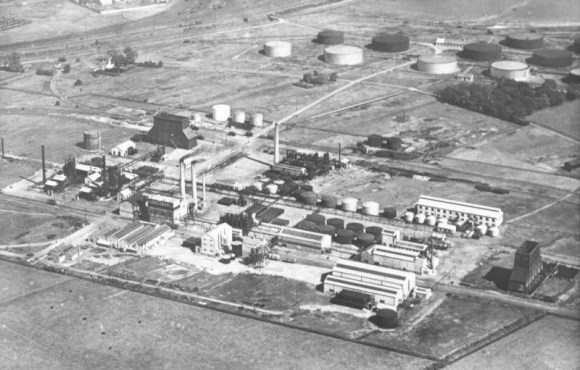
Outwardly then, it appeared as though Grangemouth has suffered economically from its wartime role. Yet these closures and retrenchments were signs of a general depression in trade throughout Europe and in fact the town was probably in a better shape than it might otherwise have been. Profits from the war were ploughed back into the infrastructure and these helped take the town’s businesses through the years of slow trade. One thing that the war had done was to emphasise the strategic location of the port in handling large quantities of oil and in 1923 a huge expansion of this industry took place, shaping the town’s destiny for a century to come.

Bibliography
| Admiralty | 1920 | Minelaying Bases at Grangemouth, Dalmore and Glen-Albyn. |
| Admiralty | 1920 | Admiralty Oil-fuel Pipe-line from the Clyde to the Firth |
| Auten, H. | 1919 | “Q” Boat Adventures. The Exploits of the Famous Mystery Ships by a “Q” Boat commander. |
| Bailey, G.B. | 1994 | ‘Battle Monuments and War Memorials’, Calatria 6, 1-60 |
| Brodie, I. | 1976 | Steamers of the Forth |
| Campbell, G. | 1928 | My Mystery Ships. |
| Campbell, G. | 1932 | Number Thirteen |
| Cowie, J.S. | 1949 | Mines, Minelayers and Minelaying. |
| Dickson, J. | 1994 | Heroes Departed. Falkirk District during the First World War. |
| Flanagan, J.A. | 1919 | Wholesale Co-operation in Scotland. |
| Girvin, B & Cosens, M. | 1919 | The Log of HMS Gunner. |
| Grangemouth Roll of Honour | 1914-1919 | 1919 brought to my attention by the staff of Grangemouth Library |
| Gray, E.A. | 1972 | The Killing Time: the German U-Boats 1914-1918. |
| Group Committee | 1959 | 15th Stirlingshire Boy Scout Group: centenary brochure. |
| Halpern, P.G. | 1994 | A Naval History of World War I. |
| HMSO | 1988 | British Vessels Lost at Sea 1914-18 and 1939-45. |
| Hutton, G | 2002 | Scotland’s Millennium Canals. The Survival and revival of the Forth & Clyde and Union Canals. |
| Isherwood, J.H. | 1972 | “Union Liner “Wahine” of 1913”, in Sea Breezes, 46, 371-374. |
| Keble Chatterton | 192? | Q-ships and their Story. |
| McKenzie, S.P. | 1995 | The Home Guard. |
| Miller, J. | 2000 | Scapa. Britain’s Famous Wartime Naval Base. |
| Murphy, J. | 2000 | Old Grangemouth. |
| Pratt, E.A | 1921 | British Railways and the Great War: Organisation, Efforts, Difficulties and Achievements. |
| Ritchie, CIA. | 1985 | Q-Ships. |
| Somner, G.H. | 1959 | “Buchan & Hogg, Grangemouth”, in Marine News, Dec 1959, 273. |
| Somner, G.H. | 1962 | “Shield SS Co and Kerse SS Co”, in Marine News, Nov 1962, 278-280. |
| Somner, G.H. | 1967 | “Gillespie & Nichol, Grangemouth”, in Marine News, March 1967, 82-84. |
| Somner, G.H. | 1974 | “James Rankine & Son, Grangemouth”, in Marine News, Dec 1974, 477-481. |
| Somner, G.H. | 2000 | The Carron Company, in British Shipping Fleets, ed Fenton, R & Clarkson, J, 162-188. |
| Tindall, N. | 1989 | Caledonian Railway Public and Working Timetables and Special Notices 1918”, True Line, 27. |
| PERIODICALS AND ARCHIVES | ||
| Falkirk Herald | ||
| Grangemouth Advertiser. | ||
| Grangemouth Harbour & Wet Dock – Return of vessels. A3.06. |
N.B.:
This is not intended to be a social study of the impact of the war on the general populous of the town. Nor have I attempted to assess the effect of food shortages, lighting restrictions, material and cultural deprivations, and so on.
Acknowledgements:
The author would like to thank Brian Lavery of the National Maritime Museum and Jim Summers of Falkirk for sparking his interest in the role of the port of Grangemouth in the First World War. Brian, an expert on the Naval role of Scotland in the war, was able to produce two technical Histories of problems dealt with by the Admiralty, which would otherwise have remained unknown. Jim, the railway specialist, found the detailed article by E Pratt concerning the railways and dock imports and exports. Once the main research had been undertaken, the encouragement of the individuals in the Grangemouth Heritage Trust provided the necessary impetus to see the project to a conclusion. Graeme Somner was kind enough to undertake the arduous task of checking a draft of this article, but errors remain my own responsibility.
For permission to reproduce photographs I am indebted to the Grangemouth Heritage Trust, the Imperial War Museum, Falkirk Museum, the Scottish Fisheries Museum, the Mitchell Library and the Falkirk Local History Society.
G.B Bailey, 2025
Appendices
Appendix 1: War prizes brought into Grangemouth.
Appendix 2a: Vessels that were laid up in Grangemouth at the beginning of the war for conversion to minesweepers, etc.
Appendix 2b: Details of the drifters (provided by the Scottish Fisheries Museum)
Appendix 3: Trade at Grangemouth Docks (tonnage)
Appendix 4: Civilian ship movements at Grangemouth after 13th November 1914.
Appendix 5: Drownings at the dock (those buried in Grandsable cemetery are noted)
Appendix 7a: Ships belonging to Grangemouth companies or agents sunk by enemy action during the war.
Appendix 7b: Vessels registered at Grangemouth at the beginning of the war,
Appendix 8: Ships built by the Greenock & Grangemouth Dockyard Co and sunk or attacked in the First World War.
Appendix 9: List of ships built by the Greenock & Grangemouth Dockyard Co at Grangemouth 1914-1919.
Appendix 10: Q-ship movements at Grangemouth.
Appendix 11: Q-ships based at Granton.
Appendix 12: Seaward movements of minelayers at Grangemouth.
Appendix 13: Steam lighters used to carry ammunition, mines & stores.
Appendix 14: “Admiralty Oil-fuel Pipe-line from the Clyde to the Firth”.
Appendix 15: “Minelaying Bases at Grangemouth, Dalmore and Glen-Albyn”.
 Falkirk Local History Society