
SMR 243 / NS 9664 7584
The Edinburgh to Glasgow Union Canal was a contour canal and required the use of large aqueducts to cross the deep valleys of the Water of Leith, the River Almond and the River Avon. The aqueducts were modelled on Telford’s aqueduct at Chirk on the Ellesmere Canal, and Telford’s advice was sought. That canal was for narrow gauge boats whereas the Union Canal was to be for vessels up to 12ft 6ins in beam and so the design required some strengthening. Telford was not convinced that stone arches were necessary in conjunction with the iron trough, but Baird decided to use both. In December 1818 it was reported that “from various causes” the Avon and Slateford aqueducts were likely to be a “very ruinous concern.” The following June, Baird submitted new plans for the Almond Aqueduct changing it from a single arch approached by long embankments to a five-arch bridge constructed in the same way as the other two. Work on the Avon Aqueduct continued day and night during the summer of 1819 and was more or less completed that September. In March 1820 it was reported that all three aqueducts were being built in an “unusually substantial and improved manner” on the “united advice” of Baird and Telford to make them more secure. By August 1821 these improvements had added an extra £20,917 to the costs.
“EDINBURGH AND GLASGOW UNION CANAL. To Contractors. Notice is hereby given, that the — necessary Plans, Sections, and Specifications of the Lot for 13 miles of the CANAL, from Almond River to Avon River, in suitable lots, together with those of the mason work of the Aqueduct over the Water of Leith and valley at Slateford, and of the great Aqueduct over the Avon River, are ready for the Inspection of intending Contractors, at the Company’s Office, 429 High Street, Edinburgh, on the 3rd of March next; and offers addressed to the Committee of management will be received from that time till the 31st day March 1818.”
(Caledonian Mercury 2 March 1818, 1)
Bores were taken of the valley floor to ascertain the depth of the rock for foundation purposes. Unfortunately too few were made to accurately ascertain the rise and fall of the rock, which proved generally to be at a deeper depth than anticipated, and this led to additional costs.
The contract for the masonry work on the aqueducts had been awarded to the partnership of Craven, Whitaker and Nowell of Edinburgh. Samuel Whitaker died on 16 June 1821 after falling from the roof of the stage-coach returning to Edinburgh from one of the sites. The castings for the iron troughs of those aqueducts were supplied by Anderson’s Leith Walk Foundry (Purves 2000) – a local source being preferred. This turned out to be fortunate as the specification provided for the Avon Aqueduct was short a few plates and these had to be summoned up at short notice (for a detailed specification of the cast iron work see Purves 2000, 28). An idea of the scale of the castings can be found in a description of Slateford Aqueduct just before it was completed:
“The cast-iron frame over the arches through which the canal is to pass is nearly completed, and (not yet inclosed by masonry) resembles the hull of a vessel of extraordinary length. The sides are formed of large concave cast-iron plates, and the flooring, or bed, is composed of the same material; these are bolted together, and the seams caulked. On walking through this iron passage, an extraordinary sensation is excited, and the mind is imperceptibly led to the contemplation of the astonishing improvements of the present age…”
(Caledonian Mercury 24 June 1820, 3).
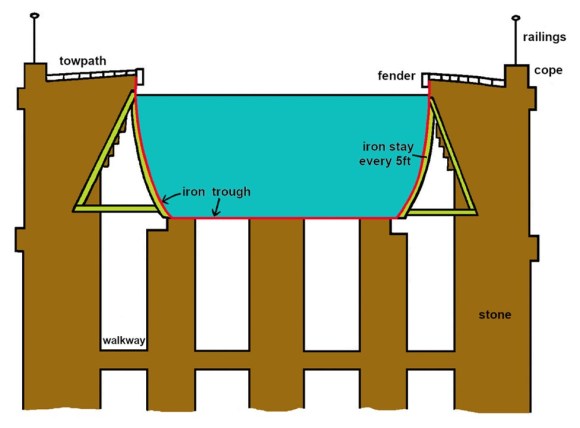
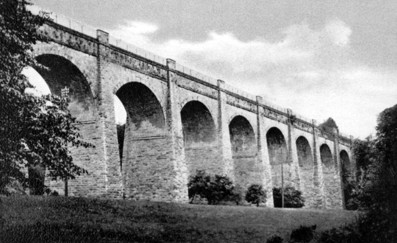
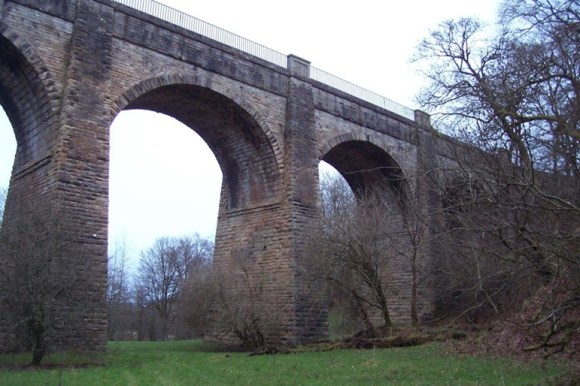
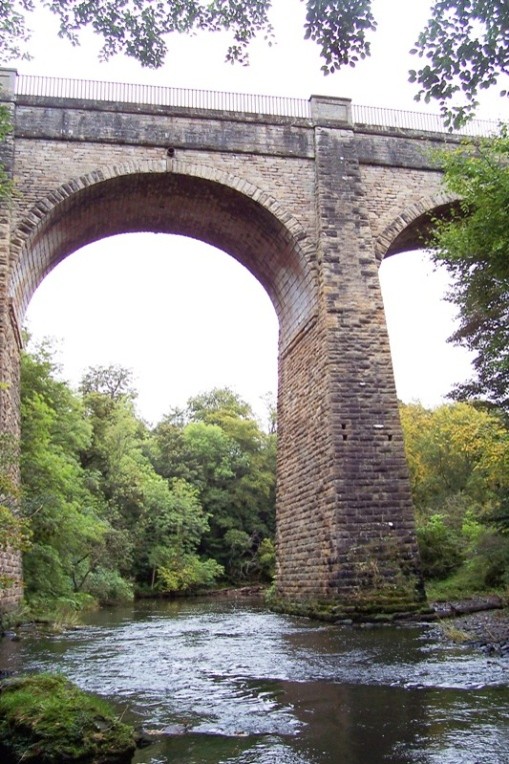
The finished aqueduct over the Avon was the longest and tallest aqueduct in Scotland, and the second longest in Britain (after the Pontcysyllte Aqueduct in Wales). Including the splayed-out ends where the narrower waterway of the aqueduct expands to the normal breadth of the canal, the structure measures just over 270yds in length by 23ft 8ins in breadth and stands 86ft above the water-level of the river. The aqueduct proper, within the splayed ends, is supported by twelve segmental arches of 50ft span, which spring 50ft above the water level and rise 26ft 6ins above the springing-line. The piers which are hollow and braced within, taper slightly on all faces; basal measurements taken of the fifth pier from the west end at ground level – i.e. about 10ft above the water at the foot of the fourth pier – gave a breadth of 37ft 8 in and a thickness of 12ft 7in. Flat, tapering buttresses carry on the lines of the piers, upwards across the face of the superstructure, which shows one string-course above the arches and another at the wall-head. The tops of the buttresses rise 5ft 6in above the wall-head, and the spaces between them are filled with heavy iron balustrades having uprights of X-section. The masonry is in block-in-course, rock-faced at quoins, voussoirs and string-courses. The upper surface carries, along its outer edges, stone bases 12in thick for the balustrades and, inside these on each side, stone-paved tow-paths 4ft wide.
The waterway consists of an iron trough which measures 13ft in width, exclusive of the wooden fenders with which it is provided, and 6ft in depth. Access to the interior of the superstructure, under the trough, is obtained through a small doorway 3ft high by 2ft 6in wide, which is situated in the north face just west of the westernmost pier (description based upon that of the RCAHMS 1963).
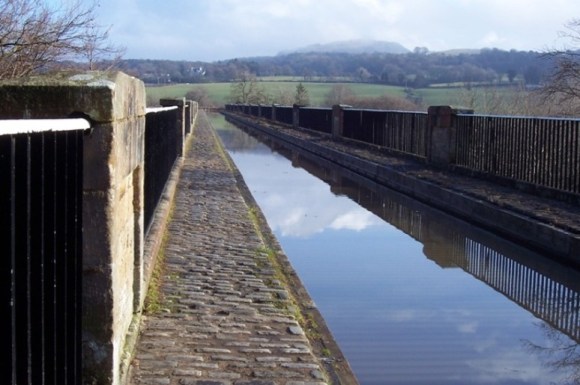
“On the 16th January the first boat passed along the aqueduct bridge over the river Avon, on the line of the Union Canal betwixt Edinburgh and lock 16, on the Forth and Clyde Canal. The beautiful scenery, the cheers of the crowd who were present, the appearance of the vast and elegant structure itself, all combined to make the spectacle very imposing”
(Aberdeen Press & Journal 31 January 1821, 2)
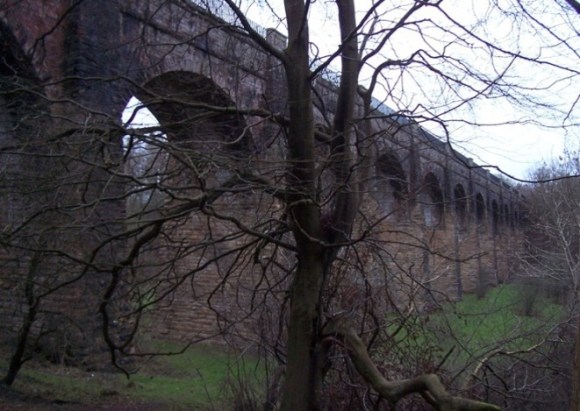
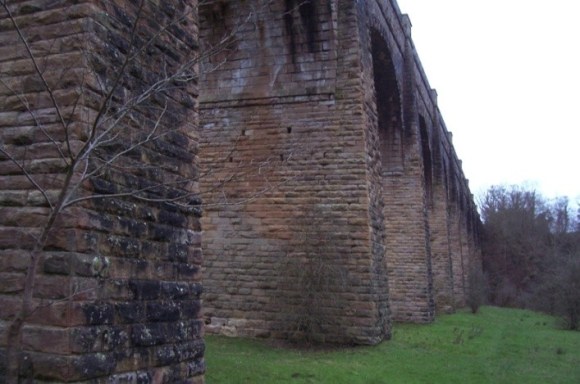
A companion guide for travellers from Edinburgh on the canal produced in 1823 was effervescent about the structure:
“beyond the 23d mile, looking down to the right, they have a front view of the Avon aqueduct; they will see with admiration and surprise, the lofty arches, and the vast extent of this stupendous structure, which stretches from bank to bank, across the woody glen of the Avon. This noble edifice, which, for magnificence, is scarcely equalled in Europe, consists of twelve arches, is nearly 900 feet in length, and 85 in height. When from the top of this bridge they look down upon the stream beneath, with the cottages, trees and corn-fields, they are struck with their diminished appearance, and, as Shakespeare says of the cliffs of Dover, “their heads turn giddy with the sight.””
(Aitken 1823, 17)
James Horne, who lived at Vellore, used to play in the area as a child. In 1973 he took a reporter to the west end of the aqueduct and pointed out a strongly locked wooden door. In his boyhood he had climbed up to it and found himself inside the aqueduct, with the iron bed of the canal as the ceiling and a perilous stone grid as the floor.
“Below that grid you could fall, in places, ninety feet into the foundations of the huge piers. It was a scary place, with bats in the black dark, yet a local worthy, Jimmy Gillies, who preferred to sleep rough and to make a hedgehog stew when he was hungry, would sometimes spend a night of two in a bed in the dark innards of the bridge!”
(Scots Magazine 1 September 1973, 11).
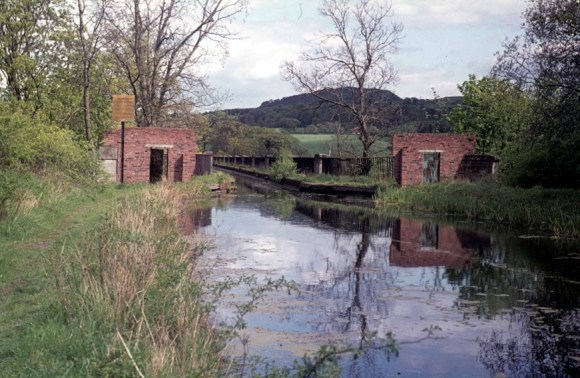
In August 1965 the Union Canal was declared a remainder waterway and closed to traffic. The infrastructure was left intact, though brick walls closed off the two ends of the Avon Aqueduct to bar pedestrians. The reporter who had spoken to James Horne visited:
“Theoretically, the towpath over this, and the Almond aqueduct, is blocked. In fact, the heavy steel doors in the brick curtain wall have been sprung open. I crossed, my tiny creeping shadow on top of the long shadow of the aqueduct keeping me company.”
These walls were subsequently removed and over the years the canal was restored and the aqueduct forms part of the John Muir Way.
Bibliography
| Aitken, J. | 1823 | A Companion for Canal Passengers betwixt Edinburgh and Glasgow (1981 reprint). |
| Fleming, G. (ed) | 2000 | The Millennium Link: The Rehabilitation of the Forth & Clyde and Union Canals. |
| Paxton, R. & Shipway, J. | 2007 | Civil Engineering Heritage: Scottish Lowlands and Borders. p.175-176. |
| Purves, S | 2000 | ‘Aqueduct construction in the canal age – a case study,’ in Fleming, G. (ed), 23-31. |
| RCAHMS | 1963 | Stirlingshire: An Inventory of Ancient Monuments. (Quoted below) |
RCAHMS, 1963 Stirlingshire: An Inventory of Ancient Monuments.
“Avon Aqueduct. The Avon Aqueduct carries the Union Canal (No. 553) across the valley of the Avon some 600 yds. NNE. of Muiravonside House. It is a dignified and interesting structure (Pl.228) , built between 1818 and 1822, but a view of it is difficult to obtain as the valley is here steep-sided, sinuous and partly wooded. Including the splayed-out ends where the narrower waterway of the aqueduct expands to the normal breadth of the canal, the structure measures just over 270 yds. in length by 23 ft. 8in. in breadth and stands 86 ft. above the observed water-level of the river. The aqueduct proper, within the splayed ends, is supported by twelve segmental arches of 50-ft. span, which spring 50 ft. above the water level and rise 25 ft. above the springing-line. the piers which are hollow, taper slightly on all faces; basal measurements taken of the fifth pier from the W. end at ground level – i.e. about 10 ft. above the water at the foot of the fourth pier – gave a breadth of 37ft. 8 in. and a thickness of 12 ft. 7in. Flat, tapering buttresses carry on the lines of the piers, upwards across the face of the superstructure, which shows one string-course above the arches and another at the wall-head. The tops of the buttresses rise 5ft. 6in. above the wall-head, and the spaces between them are filled with heavy iron balustrades having uprights of X section. The masonry is in block-in-course, rock-faced at quoins, voussoirs and string-courses. the upper surface carries, along its outer edges, stone bases 12 in. thick for the balustrades and, inside these, stone-paved tow-paths 4 ft. wide. The waterway consists of an iron trough, such as was first used by Telford for the Pont Cysyllte aqueduct on the Ellesmere Canal¹; this trough measures 13 ft. in width, exclusive of the wooden fenders with which it is provided, and 6ft. in depth in so far as its silted bottom permitted accurate measurement. Access to the interior of the superstructure, under the trough, is obtained through a small doorway 3 ft. high by 2 ft. 6in. wide, which is situated in the N. face just W. of the westermost pier. 965758-968757 NS 97 NE (“Aqueduct”) 12 June 1953″ [p415-6.]
NEWSPAPERS
- Caledonian Mercury 2 March 1818, 1:
EDINBURGH AND GLASGOW UNION CANAL. To Contractors. Notice is hereby given, that the — necessary Plans, Sections, and Specifications of the — for 13 miles of the CANAL, from Almond River to Avon River, in suitable lots, together with those of the mason work of the Aqueduct over the Water of Leith and valley at Slateford, and of the great Aqueduct over the Avon River, are ready for the Inspection of intending Contractors, at the Company’s Office, 429 High Street, Edinburgh, on the 3rd of March next; and offers addressed to the Committee of management will be received from that time till the 31st day March 1818. - Caledonian Mercury,16 September 1819, 3:
The most rapid progress continues to be made on the Union Canal. An aqueduct bridge has been completed in the neighbourhood of Linlithgow; and the first arch of the aqueduct bridge at Slateford, is finished. - Caledonian Mercury, 24 June 1820, 3:
The aqueduct bridge at Slateford, near this city, is in a forward state, and at this time presents a very remarkable appearance. The cast-iron frame over the arches through which the canal is to pass is nearly completed, and (not yet inclosed by masonry) resembles the hull of a vessel of extraordinary length. The sides are formed of large concave cast-iron plates, and the flooring, or bed, is composed of the same material; these are bolted together, and the seams caulked. On walking through this iron passage, an extraordinary sensation is excited, and the mind is imperceptibly led to the contemplation of the astonishing improvements of the present age… - Aberdeen Press & Journal, 31 January 1821, 2:
On the 16th January the first boat passed along the aqueduct bridge over the river Avon, on the line of the Union Canal betwixt Edinburgh and lock 16, on the Forth and Clyde Canal. The beautiful scenery, the cheers of the crowd who were present, the appearance of the vast and elegant structure itself, all combined to make the spectacle very imposing. The dimensions of the bridge are from 96 to 106 feet in height from the foundation to the top of the parapet, the arches (12 in number) are 50 feet span each, the arch across 26 feet 6 inches, and the whole length of the building, with its wings. 880 feet. - Caledonian Mercury, 20 October 1821, 1:
To be Let… The FREESTONE QUARRY on the Farm of East mains of Broxburn. This quarry has been worked the last two years to build some of the Aqueduct bridges on the line of the Union Canal, from which it is only distant about 200 yards, The quality of the stone is a fine white and yellow liver rock, fit for every purpose required for building, and about 27 feet thick, requiring only about seven feet of tirring.

