SMR 233 / NS 8589 8190
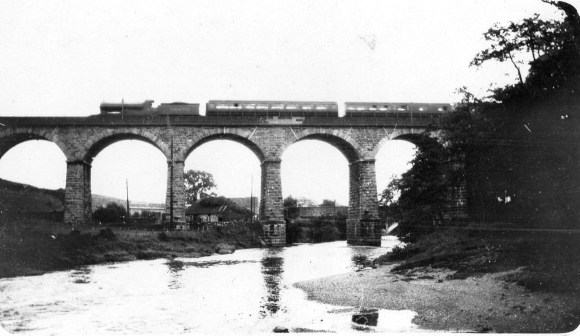
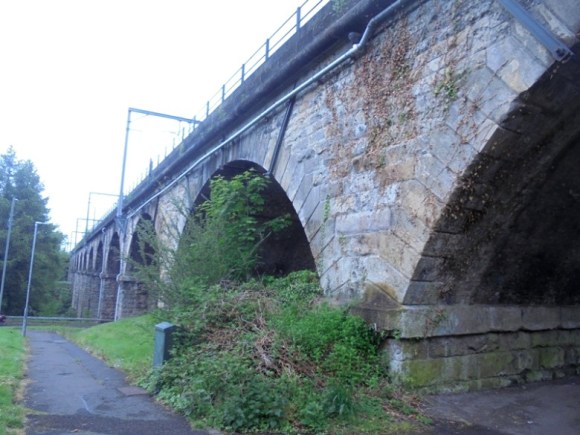
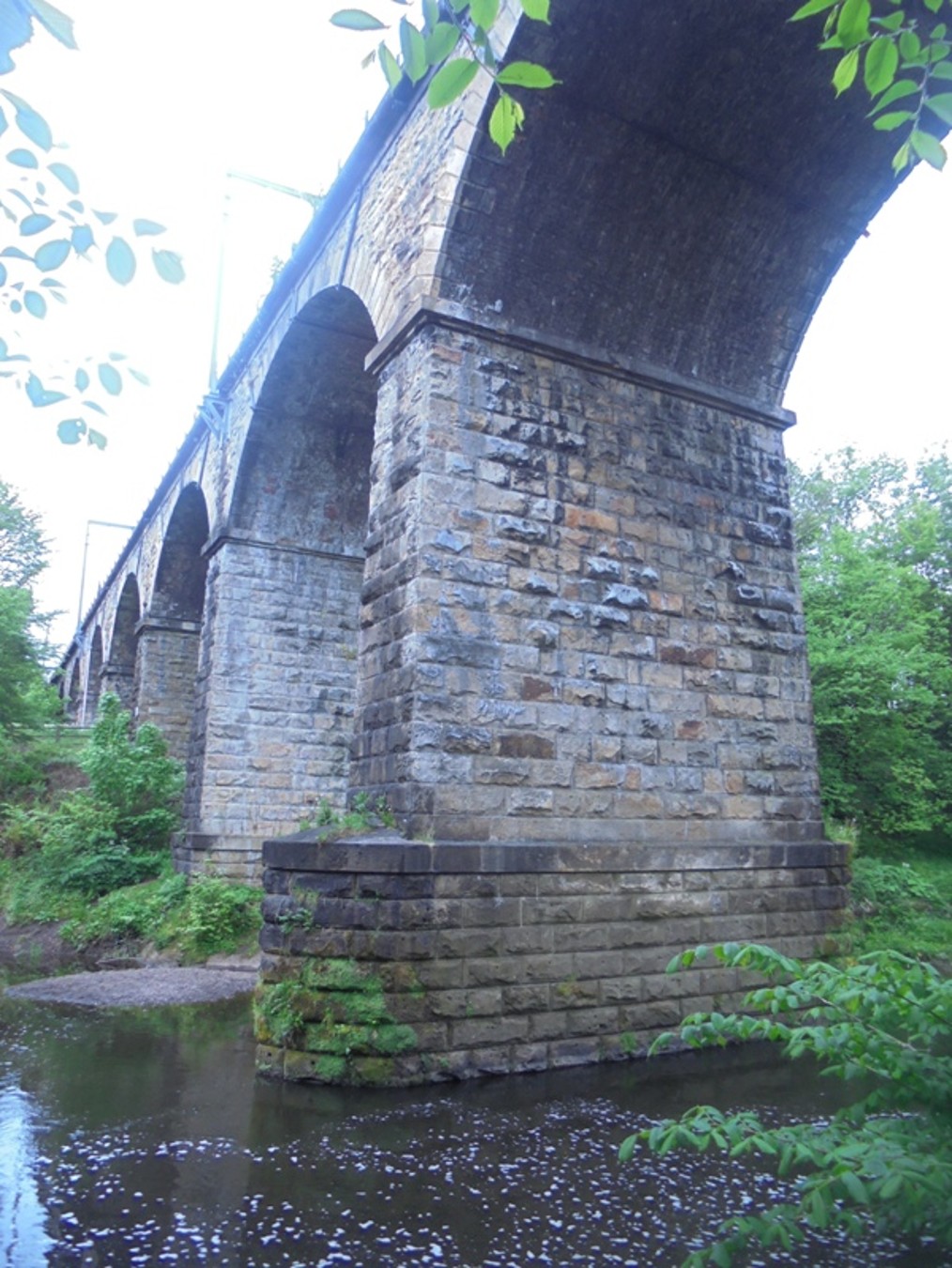
The Larbert Viaduct straggles the valley of the River Carron along with the Stirling Road to its north and Lochlands Road and Lochlands Loan to its south. It is 212m in length and 8.2m wide, and ranges in height from 4.58m to 17.5m, with the greatest height being over the river. Work on its construction began early in 1846 and the memorial stone can be seen on the north side of the second landward pier on the north bank, it reads:
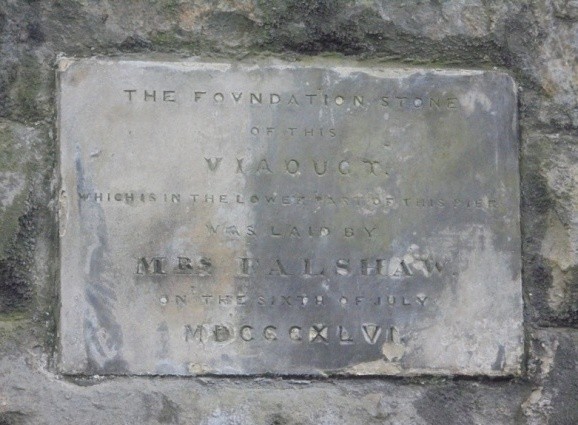
“THE FOUNDATION STONE/ OF THIS/ VIADUCT/ WHICH IS THE LOWER PART OF THIS PIER/ WAS LAID BY MRS FALSHAW/ ON THE SIXTH OF JULY/ MDCCCXLVI”.
In September 1846 it was reported that the piers were proceeding rapidly, and that there was a large store of material prepared on the ground. By March 1847 all the piers and abutments were ready for the arches and the centres had been prepared; and by the end of August 1847 all 14 arches had been completed.
A Government inspection of the southern portion of the Scottish Central Railway took place on the 17 January 1848 and the line was opened from Stirling to the southern end with the Edinburgh and Glasgow Railway on 1 March 1848. In 1865 the Scottish Central Railway amalgamated with the Caledonian Railway and the Scottish Central Railway was wound up.
On 29 April 1867 a goods train left Perth at half-past five in the afternoon. It was composed of three engines, fifty-two wagons and two vans – one of the vans being, as usual, placed in front, and the other next to the end of the train. In the rear van were the conductor of the train, H. Cartwright; the guard, David Easson; and a shepherd named James Lawrie. The trucks were filled with live stock and dead meat for the Edinburgh markets, the live stock forming the latter half of the train. It was due at Edinburgh about 9.30pm. The train proceeded safely on the journey till it reached Larbert, travelling at the rate of twenty-five miles an hour. At about half-past eight, when about the middle of Larbert Viaduct, the train suddenly parted in the middle. The engine, with about twenty wagons attached, proceeded on its way; the foremost wagon of the latter part of the train left the metals, tore up the road for a short distance, and was then precipitated over the bridge, dragging the whole of the 26 wagons following along with it. The terrible concussion, together with the jostling and wrenching which occurred, produced quite an illumination, and the parties in charge of the fore part of the train at first believed that some of the trucks had caught fire. The gleams of light produced were said to resemble those to be seen in a smithy when red hot iron is being hammered on an anvil. The noise which the crash produced was heard a considerable distance off, and excited the wildest alarm in the community at Larbert. The guard leapt from the brake-van and was badly hurt, losing one of his ears, but the other two occupants were hurled over with it. At the point where the guard’s van went over, the height from the ground was a little more than twenty feet and the van turned right over and was almost completely smashed to pieces, but amazingly the occupants sustained comparatively little injury. The conductor of the train received a slight wound on the head, and a heavy stone from the bridge fell on his breast, bruising him rather severely. The shepherd had been sleeping when the accident occurred, and with the severe shaking he got he was rendered for a time insensible. When consciousness returned, he found his faithful dog, which had escaped unhurt, sitting beside him licking his face. In the fading twilight the scene which presented itself to the men on recovering themselves was one of devastation. Some twenty-five wagons lay piled in a heap in the bottom of the stream, smashed and broken to pieces. Many of the cattle had been drowned, or were drowning in the water, others had been crushed to death by the falling wagons, while many more were severely wounded and were sending forth the most agonising cries. The rails had been torn up for several yards, and almost the entire parapet of the viaduct had been thrown down. At the extreme north end of the viaduct several huge copestones had been precipitated from their places into the adjoining field, while farther south a kink was made in the parapet, and then nearly 100 yards were completely removed. At the south end of the bridge many of the cope stones were also taken away by trucks at the hinder part of the first division of the train.
Cartwright, who seems to have been the least injured, proceeded, as soon as he could extricate himself from the debris, along the line, to give information of the accident, and prevent any trains approaching the spot running into danger. One of these was the passenger train from the north in connection with the London express, which was detained nearly three hours by the accident, arriving in Edinburgh at half-past twelve instead of 9.40pm. Cartwright was able to travel on this train to Edinburgh. However, he was not the first to report the accident. Information of the catastrophe was first brought to Larbert Station by D. McFarlane, a driver on a North British Railway train which crossed the viaduct going northwards just a few seconds before the accident happened. He met the goods train approaching the bridge, and after he had gone a little way he heard a noise and upon turning round saw the wagons leaping over the side of it into the valley underneath. Mr Baillie, the station-master at Larbert, immediately telegraphed to Stirling for assistance, and despatched a pilot-engine from the south side of the bridge to Greenhill to stop the traffic from the south. No communication could be sent in that direction by telegraph, the wires having been torn and destroyed for three-quarters of a mile.
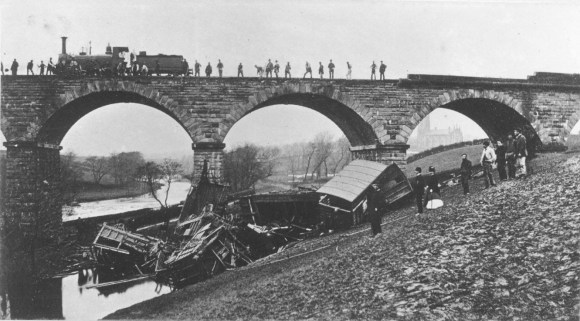
The precipitated trucks formed three piles – one in the bed of the River Carron, the second in the haugh between the lade and the river; and the third, by far the largest, into the lade. Into the river Carron fell three dressed-meat vans, being the first of the precipitated portion of the train. One of them was entirely submerged; of another, all that was visible was one of the buffers and a wheel; and a third, resting on the top of the first, was half submerged. The contents of these vans had been consigned by butchers in Aberdeen to the London market. The second pile, on the haugh, consisted of five trucks filled with sheep, heaped on each other, the last of the series resting against the steep embankment of the lade. These trucks were quite smashed, and many of the poor sheep were absolutely flattened, and heads nearly dissevered might be seen peeping out between the bars. The third pile, consisting of eighteen carriages, actually dammed up the lade, and rose to almost half the height of the archway.
News of the disaster spread rapidly, and hundreds of people from the surrounding districts were employed in extricating the cattle and sheep from the ruin. Many laboured through the night and were drenched by the rain and the river water in which they waded. Nearly 40 men worked on the pile of wagons in the lade, labouring to reduce its appalling dimensions.
“Truck after truck was broken into, and the cattle were extricated dead or alive. Those that were still in life were slaughtered even where they lay. This was necessary at once to put them out of pain, for many of them were evidently suffering from half-suffocation, if not from cold or bodily injury, and also to economise the carcase, if possible, by immediate bleeding. Sometimes the beasts were extricated in a half-slaughtered state, and by no very gentle means; but in the great majority of cases death had already proved an opiate to pain. One sheep was taken out from the pile alive, and apparently quite well”
(Falkirk Herald 2 May 1867, 4).
The total number of sheep taken out alive was fully 300, the number of cattle seven. Over 200 dead sheep were found, and considerable numbers were carried down the water. Several dead cattle were also discovered, two of which had their horns broken off at the root.
The live sheep were trucked at Larbert for Edinburgh, many of them lame and severely shaken. Those in the train consigned to Mr Murray, Edinburgh, and Swan and Co, Edinburgh, were handed over to them, while those for other parties were also given over to Swan and Murray conjointly for disposal for the railway company. Mr Tod, the representative of Murray and the Messrs Swan had been early at the scene of the accident, looking after the stock which they knew had been forwarded to them by the train for sale in the Edinburgh market. Some fifty dead sheep, after being skinned, were said to have been buried in an adjoining field, though cheap meat was apparently abundant in the local shops over the following week. While the crowd was thus engaged, the strength of the railway officials was directed to the removal of the carriages which were obstructing the line, so as to permit the resumption of traffic. This was accomplished at 10.50pm, when the delayed mail train for the south left Larbert Station.
Over the next few days the disaster attracted thousands of onlookers to witness the scene. From an early hour in the following morning till late in the evening the inhabitants of the surrounding districts went in a continuous stream, and from the passing trains crowds of faces were to be seen anxiously and apprehensively viewing the huge accumulation of ruin in the valley underneath. The cause of the disaster was attributed to the snapping of an axle of a wagon belonging to the Great North of Scotland Railway.
The parapets were repaired and the viaduct served without any further incidents. During the Second World War Home Guard platoon sections from Camelon and Larbert out on night foot-patrols would meet in the centre of the viaduct to pass on the word that all was well. The line was electrified in 2016.