
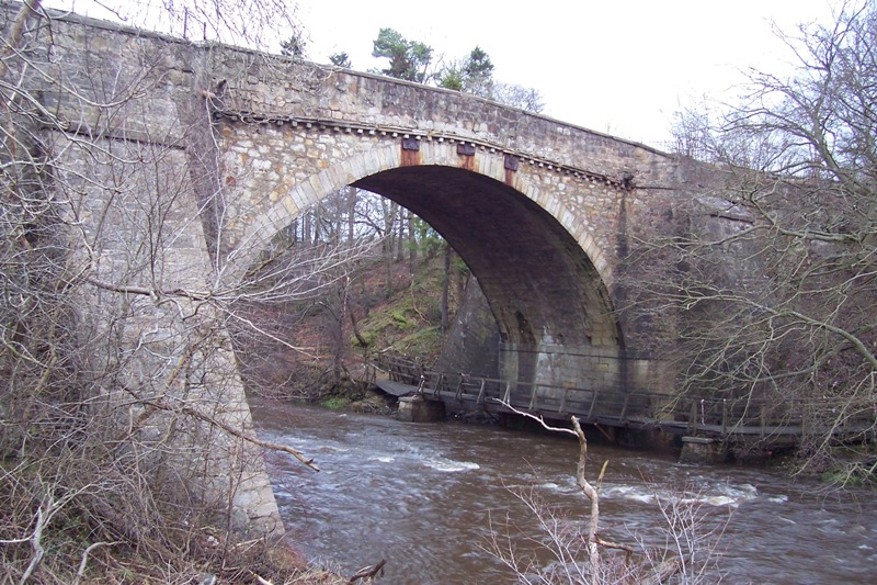
SMR 245 / NS 9545 7357
Before the building of Torphichen Bridge in the period 1810-1817 the River Avon was crossed by a series of fords which required the traveller to descend into the valley floor and ascend the opposite slope. Roy’s map of 1755 indicates that at that time the main crossing was near Torphichen Mill, though both Grassom and Forrest in 1817/18 also show that that the ford at Carribber was important.
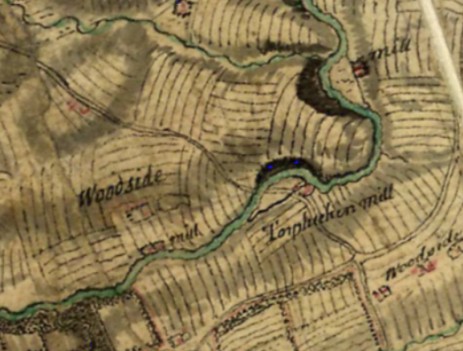
The late 18th century saw the construction of a series of important cross-country turnpike roads. That planned in the 1790s from near Torphichen to Stirling by way of Grangemouth and Airth was one of the most ambitious. At its south end it would join the new Linlithgow to Lanark turnpike. This required a bridge over the River Avon and the road trustees were not daunted by the scale of the project. It was intended to reduce the amount of uphill haulage required by the horse-drawn vehicles by providing a high-level bridge over the river reached through a deep road cutting on the north side and a prominent embankment on the south. Even then there was a carefully graded climb of around 100ft to either side. The site of the new bridge was to be about 50m west of the ford.
At the same time as they applied to Parliament for the requisite powers, the turnpike trust for the two counties investigated the engineering challenges and sought to estimate the costs. A design for the bridge near Torphichen Mill was produced and contactors were invited to provide quotes:
“To CONTRACTORS, Person willing to Contract for making and upholding the branch road leading to Linlithgow, from the new line of road between Bathgate and Airdrie, being about three miles in length, or any part of it, and for buildings a bridge at Torphichen Mill, are requested to give in their proposals to Alexander Dallas, clerk to the trustees upon the said road, No. 36 Queen’s Street, Edinburgh, on or before 28th December next.
The line of the foresaid road is staked out by the Surveyor; and as to farther particulars,”
(Caledonian Mercury 29 November 1792, 1)
The sum of £5,000 was to be raised for this purpose and the main subscribers were listed as :
- George Murray Lord Fincastle
- Sir Thomas Dundas of Kerse Baronet
- Lawrence Dundas Esq Younger of Kerse
- Sir Michael Bruce of Stenhouse Baronet
- William Bruce Esq Younger of Stenhouse
- Sir Alexander Levingstone of Westquarter Baronet
- Joseph Williamson of Polmont
- Henry Johnstoone of Meadowbank
- Thomas Livingstone of Parkhall
- Walter Ferrier of Dalderse
- William Glin of Dalderse
- John Ogilvie of Gairdoch
- Major General Thomas Dundas of Fingask
- Colonel John Callendar of Westertoun
- John Alexander Higgins of Newk
- James Bruce of Powfowls
- James Graham of Airth
- Michael Stewart Nicholson of Carnock
- Alexander Charles Maitland of Kersey
- John Francis Erskine of Marr
- Rev Cunninghame of Throsk
- Major General Ralph Abercrombie of Bandeath
- William Murray of Touchadam
- Sir George Dunbar of Mockrum Baronet
- John Strachan of Woodside
- Joseph Stainton
(Airth Papers MS 10891, dated 1794.)
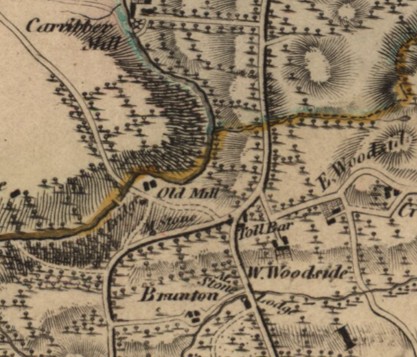
The work inevitably took longer than anticipated. The single arch was 60ft in span and of a considerable height. It took years to build and it was late 1819 before the approach roads were formed:
“From the exertions making by the noblemen and gentlemen in Stirlingshire and Linlithgowshire, the approach to the fine arch over the Avon, at Torphichen mill, is in a state of great forwardness. This work cannot fail to be of the utmost importance in facilitating the transit of lime from the several extensive works in the neighbourhood to the parishes of Muiravonside, Polmont, Slamannan, and Falkirk, the circuitous carriage of which has been long attended with much inconvenience and expence. The Earl of Hopetoun has, with his usual liberality, added L.20 to his former handsome subscription, and Lord Dundas has spent L.50 towards defraying the expences of this important undertaking.”
(Caledonian Mercury 9 October 1819, 4).
Some of the promised subscriptions of twenty years earlier had lapsed and a new round of fundraising was required. William Forbes of Callendar House was asked for money:
“I recollect that Mrs Forbes mentioned to me Mr Warden’s application for a Subscription towards the expense of Constructing Torphichen Bridge – but Mr Forbes’s interest in this work appeared to be so triffling, that I think it was agreed not to subscribe unless the Solicitation should be Renewed – No subscription was therefore paid.”
“The Draft for the Subscription to Torphichen Bridge will be paid when presented.”([Forbes Papers 1093/3: 8 July 1820])
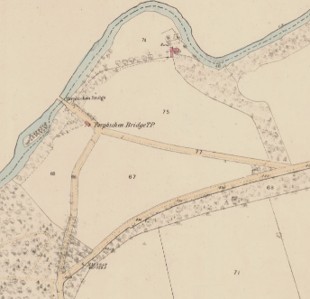
The bridge was overhauled in 1930, when it was given a concrete collar over the arch. To gain access to the underside of the arch ,wooden scaffolding was erected but when this gave way due to the force of the water in the river, a 21-wear old bricklayer, William Smith, was thrown into the river and drowned. Another workman, William Fleming, succeeded in grasping hold of a ladder which was hung over the top of the bridge, and pulled himself to safety.
In the late 1980s a wooden walkway was placed under the northern end of the bridge to take the Avon Valley Trail.
Tolls were collected at a tollhouse located on the southern end of the bridge in order to pay for its maintenance. In May 1858 David Walker, toll- Keeper there, was convicted of selling spirits without a license and sentenced to pay a fine of £7, or suffer six week’ imprisonment. Such behaviour was common at tollhouses.
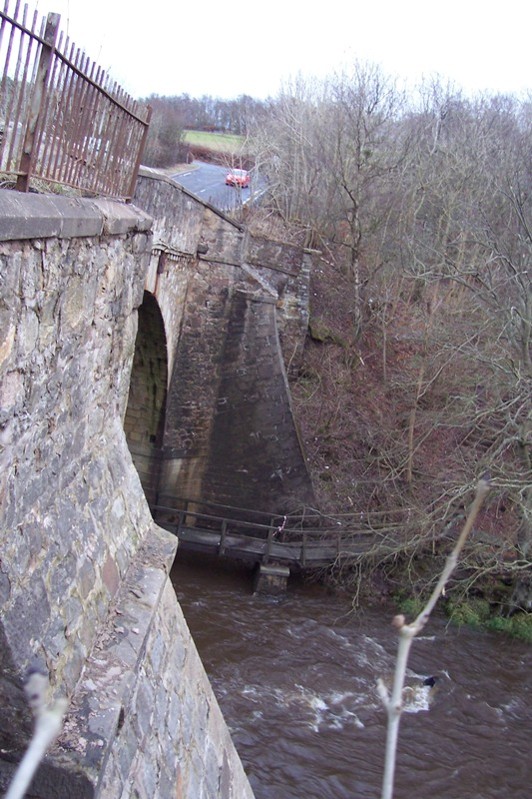
A new and much improved A801 was constructed in the 1970s from the Lathallan roundabout on the M9 to the Bowhouse roundabout at the junction of the B825. Further south, a new link route was also constructed from the M8 to the Westfield roundabout at the junction with the B8047 and A706. A northern spur with an embankment was led off that roundabout in anticipation an even higher level concrete and steel bridge across the Avon about 200m to the west of Torphichen Bridge. Budget cut backs delayed the implementation of this part of the scheme, and over the subsequent period it has become known as “The Missing Link.” The existing crossing of the Avon Gorge is a black spot for accidents and the parapets have needed repair on numerous occasions. One of the more infamous incidents was in October 1992 when a diesel tanker from Grangemouth which had just traversed the narrow bridge hit a cattle truck and burst into flames resulting in eleven cattle being burnt to death.
Bibliography
AIRTH PAPERS
[10891]
(1-18) 1794. An Act for making and repairing several roads leading across the County of Stirling.
“at or near Torphichen Bridge, Northwards by or near Parkend or Mumrells, to join the Road leading to the Harbour of the Great Canal at Grangemouth, and from thence by Bridges to be built over the Canal and River Carron at or near Carron Shore, or the Ford near Kerse, passing towards the Harbours of Airth and Dunmore Park, to join the Roads leading from Higgins’ Newk and Kersey Ferry to join the present Turnpike Road at or near Saint Ninians, leading to Glasgow by Denny and Cumbernauld, … through the parishes of Muiravonside, Polmont, Falkirk, Bothkennar, Airth, Saint Ninians, and Larbert”.
Existing roads in bad repair and cannot be maintained by present system. £5,000 to be raised for this purpose by:
- George Murray Lord Fincastle
- Sir Thomas Dundas of Kerse, Baronet
- Lawrence Dundas Esq Younger of Kerse
- Sir Michael Bruce of Stenhouse, Baronet
- William Bruce Esq Younger of Stenhouse
- Sir Alexander Levingstone of Westquarter Baronet
- Joseph Williamson of Polmont
- Henry Johnstoone of Meadowbank
- Thomas Livingstone of Parkhall
- Walter Ferrier of Dalderse
- William Glin of Dalderse
- John Ogilvie of Gairdoch
- Major General Thomas Dundas of Fingask
- Colonel John Callendar of Westertoun
- John Alexander Higgins of Newk
- James Bruce of Powfowls
- James Graham of Airth
- Michael Stewart Nicholson of Carnock
- Alexander Charles Maitland of Kersey
- John Francis Erskine of Marr
- Rev Cunninghame of Throsk
- Major General Ralph Abercrombie of Bandeath
- William Murray of Touchadam
- Sir George Dunbar of Mockrum Baronet
- John Strachan of Woodside
- Joseph Stainton
FORBES PAPERS
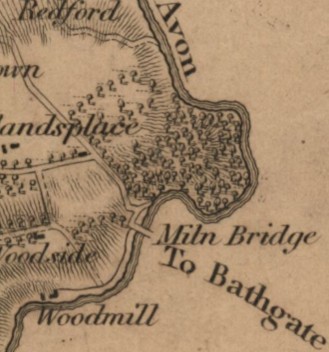
“an Act of Parliament was obtained several years ago, for making a Turnpike road across the Country, from the New Bridge on Avon water, near Torphichen Miln (which communicates with all the South Country) north to Kersie and Higgin’s Neuck Ferries upon Forth, having a branch to the County Town of Stirling, a line of road most useful for every part of that quarter” [Forbes papers 1998/4; 22 march 1804]
“– I recollect that Mrs Forbes mentioned to me Mr Warden’s application for a Subscription towards the expense of Constructing Torphichen Bridge – but Mr Forbes’s interest in this work appeared to be so triffling, that I think it was agreed not to subscribe unless the Solicitation should be Renewed – No subscription was therefore paid.” [Forbes Papers 1093/3: 8 July 1820] “The Draft for the Subscription to Torphichen Bridge will be paid when presented.”
NEWSPAPERS
- Caledonian Mercury, 29 November 1792, 1:
To CONTRACTORS, Person willing to Contract for making and upholding the branch road leading to Linlithgow, from the new line of road between Bathgate and Airdrie, being about three miles in length, or any part of it, and for buildings a bridge at Torphichen Mill, are requested to give in their proposals to Alexander Dallas, clerk to the trustees upon the said road, No. 36 Queen’s Street, Edinburgh, on or before 28th December next.- The line of the foresaid road is staked out by the Surveyor; and as to farther particulars…
- Caledonian Mercury, 14 September 1793, 1:
New Lines of Turnpike Roads. …to enable the Trustees to make and keep in repair a road across the County, leading from the Lanark and Linlithgowshire new Turnpike Road, at or near Torphichen Bridge northwards, by or near Parkend or Mumrells, to join the road leading to the harbour of the great Canal at Grangemouth, and from thence by a bridge over Carron, at or near Carron Shore, or the ford near Kerse… - Caledonian Mercury, 27 March 1794, 1: A CONTRACTOR WANTED to build a bridge over the Rover Avon, near Torphichen Mill, Linlithgowshire. The plan is with Mr Dallas, No. 36, Queen Street, Edinburgh. The dimensions of this bridge are considerable, and worth the attention of the craft. Materials are near to the work. The lowest offer will be preferred, on finding caution to build and uphold the Bridge for six years…
- Caledonian Mercury, 9 October 1819, 4: From the exertions making by the noblemen and gentlemen in Stirlingshire and Linlithgowshire, the approach to the fine arch over the Avon, at Torphichen mill, is in a state of great forwardness. This work cannot fail to be of the utmost importance in facilitating the transit of lime from the several extensive works in the neighbourhood to the parishes of Muiravonside, Polmont, Slamannan, and Falkirk, the circuitous carriage of which has been long attended with much inconvenience and expence. The Earl of Hopetoun has, with his usual liberality, added L.20 to his former handsome subscription, and Lord Dundas has spent L.50 towards defraying the expences of this important undertaking.
- Falkirk Herald, 27 May 1858, 3:
Selling without a License.—David Walker, toll-Keeper Torphichen Bridge, was, at the instance of Mr Colquhoun, chief constable, tried for selling spirits out a license. The accused was convicted and sentenced to pay a fine of £7, or suffer six week’ imprisonment. - The Scotsman, 19 September 1930, 10:
A bricklayer, William Smith (21), residing at 16 Edinburgh Road, Bathgate, lost his life yesterday in a drowning accident while executing repair work on the arch of Torphichen Bridge over the Rover Avon. Smith and another workman, William Fleming (19), of Sunnybank Terrace, Bathgate, were employed on the scaffolding under the arch of the bridge.- Owing to the pressure of water on the wooden supports, the scaffolding gave way without warning and precipitated Smith into the water along with the wooden wreckage of the scaffolding.
- Fleming succeeded in grasping hold of a ladder which was hung over the top of the bridge, and pulled himself to safety. Smith was carried down the river for about three-quarters of a mile. His fellow-workmen ran along the opposite bank, and saw him clutch a branch from an overhanging tree. James Fleming, a foreman (56), Stewart Terrace, Bathgate, entered the water to effect a rescue, but the strong current prevented him from doing so. The body was recovered last night, entangled in the roots of a tree growing in the river near Carriber Mill dam.
- Scotsman, 12 October 1992, 4:
Torphichen Bridge had been the scene of an accident in which 11 cattle were burned to death. A diesel tanker from Grangemouth had just traversed the narrow bridge when it exploded after an accident with a cattle truck… - Linlithgow Gazette, 9 July 1999, 1:
The Missing Link from the Westfield roundabout in West Lothian to the Bowhouse roundabout in Falkirk. At peak rush hour, 1,100 vehicles have been recorded as using this route across the narrow Torphichen Bridge.” The bridge, which straddles the boundary between West Lothian and Falkirk Councils, is barely wide enough to allow cars…

