
Frequently Asked Questions
– And Their Answers
Here, you will find a number of questions that people often ask about aspects of Falkirk’s history. These will be added to over time.
Ask us a question and it might find its way onto this page.
What is the story of the Hills of Dunipace?
Where was the Wallace (1298) Battle fought?
Where were the Falkirk Trysts Held?
Why are Falkirk people called “Bairns”?
 Falkirk Local History Society
19 replies on “FAQs”
Hello, just bought a print of Copper Bottom’s retreat or a View of Carron Works, with a handwritten inscription under saying William Forbes Esq d. 1815. (He is my many times great grandfather). Do you know where this would have appeared originally – you have a coloured print of it in your article on William Forbes. Grateful for any further info on it. Many thanks.
LikeLiked by 1 person
It is published in “A Series of Original Portraits and Character Etchings” by John Kay, reprinted by Birlinn. There is a more detailed article (Falkirk and the Militia ‘Riots’ of 1797) in vol. 30 (2013) of our journal, “Calatria” and there are reference copies of “Calatria” in the Falkirk Library. https://www.falkirkcommunitytrust.org/learning/libraries/
We can send you a copy of the article if you can email me at flhs.secretary@yahoo.co.uk and give me your address.
LikeLike
I was looking at John Horne (1826-1911) of Ceres in Fife. He is shown as the Parochial Schoolmaster in Slamannan in the 1861 to 1901 Censuses and resident in the Schoolhouse there. However, I note that the school at Blinkbonnie (Bank Street) was opened in the September of 1876. Research shows that Robert Main was the Parochial Schoolmaster from 1810 until his death in 1858 when, presumably, John Horn became teacher there. William Cowan also appears to have been teacher there – having gained his MA at Glasgow Uni. in 1808 – but mioved to East Kilbride as Parochial Schoolmaster.
The question is – Where, pre 1876, was the original Parish School, and Schoolhouse?
LikeLike
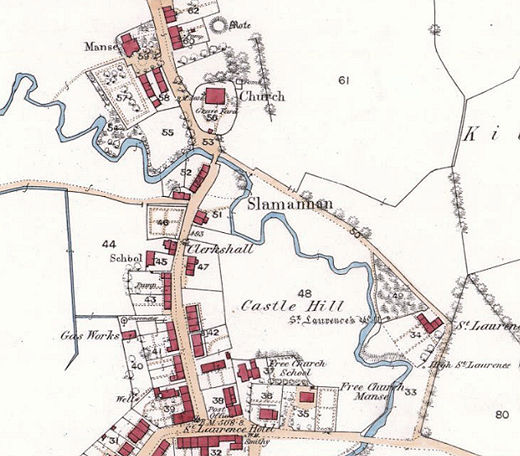
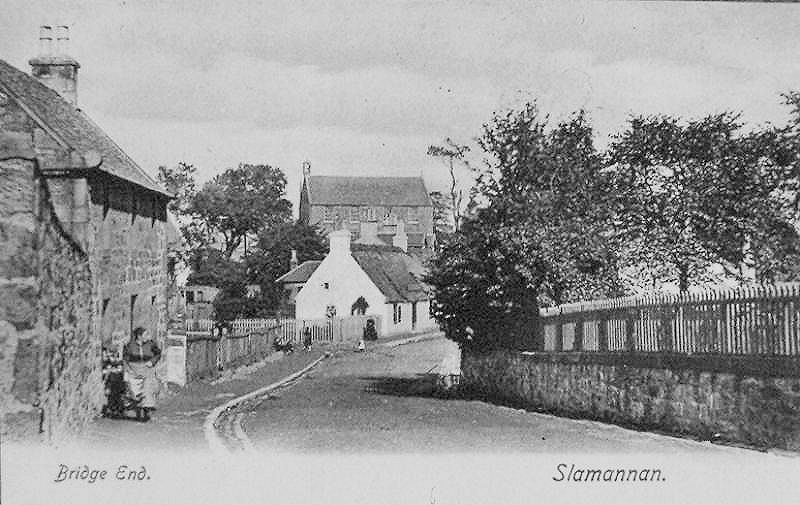
In his book about Slamannan the Rev Waugh wrote that in 1849 the Heritors renovated the Slate House near the Parish Church which had been used as a school for the schoolmaster’s house. They acquired an adjacent feu and built a school on it which continued in use until the School Board was formed and the present Public School was constructed in 1876. The headmaster at the time of the move was Robert Horne and his staff consisted of a lady teacher, an assistant and three pupil teachers. The number of pupils on the roll was 220. By September the following year two male teachers were added to the staff. Robert Horne retired in 1903.
I have not seen any photographs of the old school, but we have posted higher up this page a map and a photo titled “Bridge End”. The Slate House property called Clerkshall is the building on the left with the roll-moulded skewputs (now demolished).
LikeLike
In 1931-33 Reston Mather (Northern Mining Company Ltd ) from Provanhall house in Glasgow owned the first talc mine in Skye. The talc was then transported to a grinding plant at Seabegs Mill, Bonnybridge. Seabegs Mill produced talc, French chalk and soapstone. Is there any record of where the grinding plant was or information on when the Northern Mining Company used it
LikeLike
Hello, Katrina. We have an article on this website about the Bonny Mill, which seems to have been the name used for this mill locally: https://falkirklocalhistory.club/around-the-area/buildings/watermills/baronial-mills/bonny-mill/
and there are maps quoted in the article to show the location. We have asked around but there does not seem to be any information to hand about talc being ground there. Our speculation (although we have no evidence to confirm) is that the talc would have been transported from Skye by sea via the steam puffer boats that travelled the route frequently and would use the Forth & Clyde canal to call at the mill at Bonnybridge, which was beside the canal. There is an article on this website about the Forth & Clyde Canal:
I hope this helps.
LikeLike
Hi
Thanks for this. Yes the talc was transferred via a puffer, which sank carrying the talc down
LikeLike
hello does anyone know if there are records of employees at nobles explosive factory?
LikeLike
As far as we know there is no list of names of Nobel employees. You could try the National Records of Scotland as a place to start. You may have read Geoff Bailey’s article on this website about the Nobel’s Westquarter Works and seen that production moved from Westquarter to Ardeer. All the records are likely to have gone to Ardeer. We might assume that when the Ardeer factory closed, the records could have passed to ICI.
If you are successful in tracking down the records, then it is highly likely that the only staff names that will be recorded can be expected to be either of those in high positions of authority or else those who were in some kind of trouble.
LikeLike
I found a Falkirk cannon in Vohemar, Madagascar.
But it’s marked 12 Pounder. https://commons.wikimedia.org/wiki/File:12-pounder-Falkirk_in_Vohemar.jpg
LikeLike
Thank you very much for this information. We are updating our list on the website. It will be from Falkirk Iron Company rather than Carron. So it will be added under that section on the website
LikeLike
I am intrigued by the comment in the Millfield House article that “D.O. Hill arranged for photographs of the occasion” when the volunteer corps visited the house in September 1861. I am aware of family photos taken in May that year by Alexander McGlashon and Octavius Hill but have never found photos of this military corps. Are you able to point me in the direction of where these photos can be found.
LikeLike
We only know about the photographs because it was mentioned in the Falkirk Herald of 6 September 1860.
LikeLike
Thank you for your speedy reply. I have now accessed this edition of the Falkirk Herald and on the face of it this refers to an unrecorded photographic involvement by Octavius Hill. The photographic artist referred to would almost certainly have been Alexander McGlashon. The Millfield photos that I am familiar with were by Hill and McGlashon and were taken on May Day 1861. Thanks again, Alex.
LikeLike
I am coming to Scotland in June and hope to visit places related to my GG Grandparents, who lived in Falkirk. I have death certificates that list place of burial as “relief church” or “East UP churchyard or just “died” without reference to a cemetery. I read the article here about thoses churches, and it seems the stones were removed? Also, their names (McClay, John, Elizabeth, George and Mary died mid 1800s) are not in the listings in that article. They were “in the parish of Falkirk” according to their marriage records. Is there somewhere else I could look? They were poor miners.
Thank you for any help you can give!
Rebecca Lynch
LikeLike
As you may have seen from our Churches section, the Falkirk Parish included many denominations and it can be a little confusing. The Relief Church was the West Church on Tanner’s Brae, but it joined with the Erskine Church in Silver Row and they became the West and East United Presbyterian Churches. The East UP Churchyard is the one on Silver Row that was taken away when the first Callendar shopping centre was built in the 1960s
The record that we produced for ‘Calatria’ was based upon the inscriptions on gravestones which were recorded at the time of removal. However, many people would not have had a stone, or appeared on a stone that the family possessed. Especially if they were poor miners.
LikeLike
Thank you so much for taking the time to answer! Since I cannot visit their graves, I wonder what I could visit related to them. If their marriage record says they were “of this parish” (John McClay– baptised 1777 in Killearn– and Elizabeth Jamieson married 1819 in Falkirk Parish Church), and their parents were of the same parish, is there a building still standing today which they would have worshipped in?
I believe that Elizabeth’s father was a landowner in Falkirk, John Jamieson.
Any help you can give is mightitly appreciated!
RFL
LikeLike
Dear Falkirk History Society,
I am writing to inquire about your public contact information. I am a producer of a documentary and I am interested to learn what you have on Robert Dollar. Please let me know if its possible for us to directly communicate, your help is greatly appreciated.
Sincerely,
KC
LikeLike
Our Chairman, Ian Scott is the Falkirk man who knowns most about Robert Dollar – he even visited his house in the USA. And he wrote our website article on him. https://falkirklocalhistory.club/people/robert-dollar/
Jerry Bell, one of the followers of our Facebook page, has shared his collection of matchbox labels featuring the Dollar Shipping Line https://falkirklocalhistory.club/around-the-area/coasts/the-dollar-line/
Oddly enough, the wikipedia entry for Robert Dollar is quite good and covers most things. And there are the two volumes of his memoirs – copies of which may be found in Callendar House and Falkirk Library. https://collections.falkirk.gov.uk/explore
Geoff Bailey, our Archaeologist, has only touched upon some of his Falkirk exploits – such as the gift of Dollar Park and the Peking Lions, https://falkirklocalhistory.club/around-the-area/recreation/dollar-park-4/
the First Battle of Falkirk memorial fountain in Victoria Park,
the peal of bells for Falkirk Parish Church, https://falkirklocalhistory.club/people/james-g-callander/alterations-to-belfy/
and his visits to his home town.
Geoff says that he’d be happy to look up more of the Falkirk material if that would help but we cannot publish his private email address on here. You can contact him through me, Falkirk Local History Society Secretary : flhssecretary@yahoo.co.uk
From the visual aspect – as well as the monuments mentioned above, Falkirk Museum has photographs of his visits.
https://www.falkirkleisureandculture.org/learning/archives/
LikeLike