
SMR 104 / NT 013 814
Windmill Craig provided a prominent landmark on this part of the south coast of the Firth of Forth, similar in many ways to Chapel Hill at Blackness. It is not surprising that both attracted early burials. The full extent of the burial ground at Bridgeness is not known and possible cists have been conjectured near the Run on the south side of Philpingstone Road (reminiscences of the digging of Anderson shelters in the Second World War, though not reported at the time).
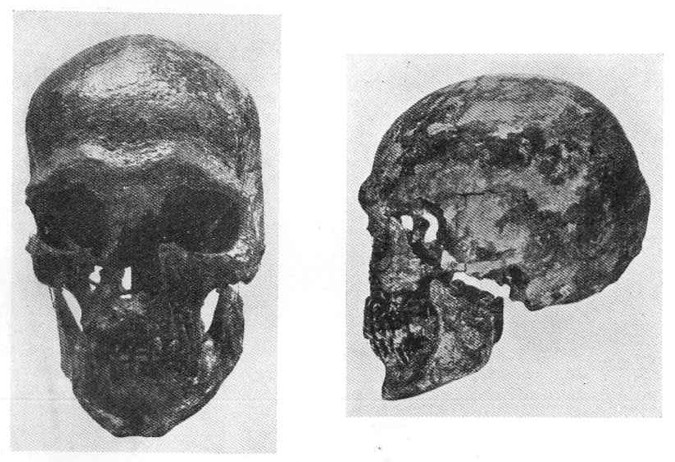
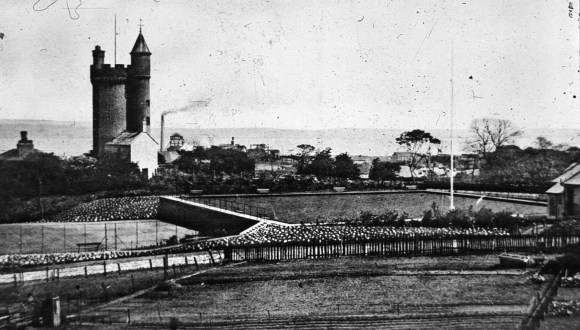
- A short cist was found in 1896 on the north side of what is now a bowling green. It contained a crouched adult male inhumation accompanied by a Food Vessel.
Turner 1917, 171-255; Callander 1924.
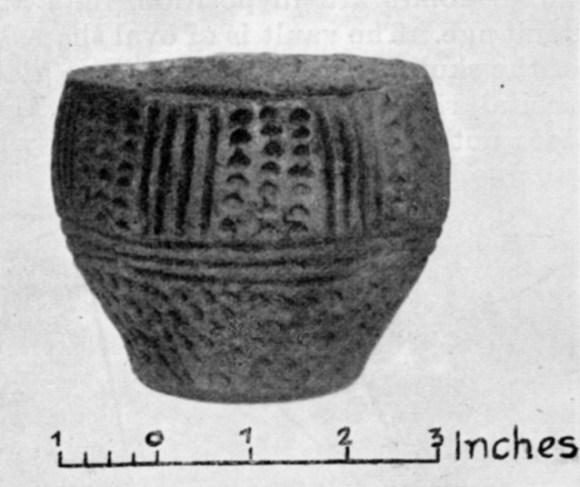
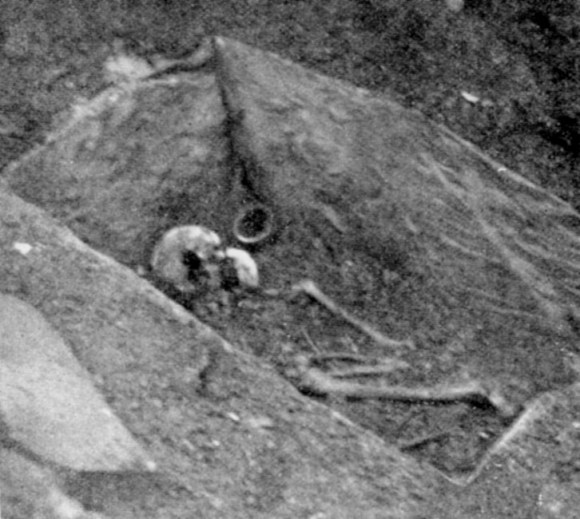
- Two more cists were found in November 1923 during the construction work for the bowling green as part of the Miners’ Welfare scheme.
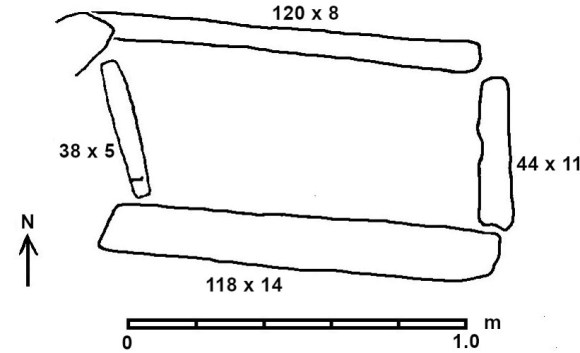
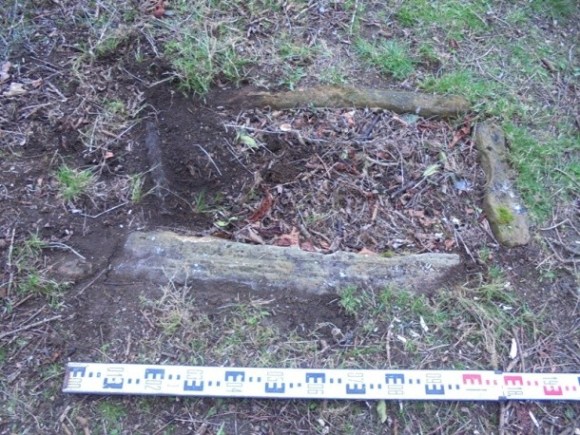
The first one was only 0.76 m long and was found to be full of soil with no sign of any human remains. The second was discovered c15m SSW of that of 1896. It was formed of four thin slabs of sandstone set on edge in a rough rectangle and sunk into the natural gravel. It measured from 1.19 m to 1.08 m by 0.65 m to 0.72 m internally and was 0.46 m deep.
The ends had been inserted between the sides, which projected about 0.10 m to the west, but were flush at the east end. The tops of the edge stones were almost level and had been covered by a long thin slab on the north side and by two short ones on the south. The openings between these were closed off with smaller slabs. Inside were the crouched inhumations of an adult male probably in his early thirties and a child of about five or six years old. Beside them was a Food Vessel (NMAS no EE 113). The bones and vessel were placed in the National Museum of Scotland (Callander 1924; Cadell 1925, 293).
The area of the bowling green belonged to H.M. Cadell of Grange and it would seem that he had the stones of the second of these cists removed and reconstructed in the ground just to the east of his house in Kinningars Park where they can still be seen (NT 0152 8139).
- About 20yds downhill, ie north, from where the Bridgeness Tablet was found a stone coffin was reputedly disturbed and reported during the excavation of a sewer in 1937 (West Lothian Courier 2 April 1937, 5). However, the location is inappropriate as this would have been more or less on the ancient coastline and the depth is said to have been 7ft or so. The three bones said to have been in the cist were putatively identified as deer or cattle bones by the National Museum. A Roman armchair voussoir was recovered from the same pile of stones, along with another square dressed stone. It would seem therefore that the workmen had hit a Roman wharf for shipping on the Forth.
References
| Bailey, G.B. | 1996 | Graveyards of Falkirk District: Part 1, Introduction; Calatria No. 9 P.2,3,24 |
| Cadell, H.M. | 1925 | The Rocks of West Lothian. (Quoted below *) |
| Callander, James G. | A short cist containing a Food-Vessel and human remains at Bridgeness, West Lothian. Proc Soc Antiq Scot | |
| Roy, T. | 1915 | Soc Edin 51 : 187, 189, 203, 206. |
| Turner | 1956 | 1917, 187-206 Cat. Bathgate Rotary Club Exhib., 1. small pot and fragments of human skull in grave on 25′ raised beach. |
- The Rocks of West Lothian.; H M Cadell; 1925
“At Bridgeness… a rude unhewn coffin of sandstone slabs was discovered in 1896 in which lay the skeleton of a man doubled up with an urn of half burnt clay beside it. These relics belong to the Bronze Age that succeeded the Neolithic period. The skull was almost perfect and contained a set of excellent but much worn teeth. Sir William Turner, F.R.S., to whom I presented the relics for the Edinburgh University Anatomical Museum, described and figured the Bridgeness skull in a monograph on the “Craniology of the People of Scotland,” published in the Transactions of the Royal Society of Edinburgh, in 1915 (Vol. li, pp.189 and 206). The accompanying figure taken from this notable treatise, shows the character of the cranium of this ancient inhabitant… Another and better stone coffin was found in Bridgeness in 1923, a few yards from the former, while levelling the ground for the new bowling-green in connection with the miners’ welfare scheme for the local collieries. A small cist was first discovered about 2 1/2 ft in length, full of soil and without any remains, but a few days afterwards, in the gravel bed where these interments had taken place, a flat stone was reached after a covering of 3ft of soil had been removed, which was not resting on solid ground, but gave out a hollow sound when struck. I summoned Mr J Graham Callander, F.S.A., Keeper of the Scottish Antiquarian Museum, and we lifted the lid on 22nd November, and inside the coffin, which was quite free of soil, we beheld a skeleton with a small urn near the skull, all in remarkably good preservation, and part of the skull of a child close to that of the adult (1). Mr Callander said this was about the most complete skeleton he had ever soon in a cist. We made photographs of this poor Caledonian, and his dry bones and cogie were then removed to the Museum at the same time as Mr Howard Carter was similarly desecrating Tutankhamen’s tomb in Egypt. The teeth were good but much worn, but an anatomist who happened to see them noticed a small hole in one which showed that this old residenter though in the prime of life had probably known what toothache was some 3200 years ago.
(1) The expert who examined the bones found that the man had been a good-sized individual, 5ft 7in in height, and about thirty years old. The child was about six. Mr Callander described these relics in a paper on “A Short Cist containing a Food Vessel and Human Remains at Bridgeness, West Lothian, with a Report on the Skeletal Remains by Prof. Thomas H Bryce, M.D., F.R.S.,” Proc. Soc. Antiquaries Scot, vol. x., Fifth Series, 1923-4, pp. 286-294.” [p.293]
NEWSPAPERS
- Linlithgowshire Gazette, 2 November 1923, 2:
“ANTIQUARIAN FIND AT BRIDGENESS —During excavations on the site the bowling green in connection with the Bridgeness Miners Welfare Scheme, workmen came upon s stone coffin, which is said to belong to the Roman period, and what lends credence to this belief is the fact that the eastern termination of Antonine’s Wall is close by. Mr Cadell is preserving the relic, which still lies on the ground. The district, from the first to last, has borne convincing evidence of the Roman occupation.” - The Scotsman, 23 November 1923, 5:
“ANCIENT STONE COFFIN DUG UP NEAR BO’NESS. A stone coffin containing a skeleton with the skull almost complete, and a small accompanying urn , were found near Bridgeness Tower, a little to the east of Bo ‘ ness, yesterday. The cist was opened by Mr J. Graham Callander, assistant secretary of the Society of Antiquaries, Edinburgh, in the presence of Mr H. M. Cadell, proprietor of The Grange, on which estate the discovery was made. The discovery was made during excavations near to the terminus of the Roman Wall. A few weeks ago a stone coffin was found in the same locality, but more importance is attached to yesterday’s discovery, as the coffin and contents are believed to belong to the Bronze Age.” - Daily Record, 15 April 1924, 5:
“BO’NESS SKELETONS. Mr J Graham Callander, Director of the Museum, described an early Bronze Age grave discovered behind Bridgeness Tower, near Bo’ness. The grave which was a typical short cist of the period measured 3 feet 11 inches in length and contained the remains of the skeleton of a man in the early thirties, placed in a crouching position, and also the fragments of a skeleton of a child about five or six years old.- Behind the skull, in the north-west corner of the grave, was a very small perfect example of an urn of the food-vessel type, standing on its base.
- This was the third short cist to be discovered on the plateau, the two others like the one described having each contained a food-vessel and human remains.”
- Falkirk Herald, 19 April 1924:
“BO’NESS. EARLY BRONZE AGE GRAVE. – Mr. J. Graham Callander, Director of the National Museum of Antiquities, at a meeting of the Society of Antiquaries of Scotland, described an early Bronze Age grave discovered on the small plateau behind Bridgeness Tower, at Bo’ness. The grave, which was a typical short cist of the period, measured 3 ft. 11 in. in length, and contained the remains of the skeleton of a man in the early thirties, placed in a crouching position, and also the fragments of a skeleton of a child about five or six years old.” - Aberdeen Press & Journal, 2 December 1924, 8:
Scottish Antiquaries “additions were made to the Bronze Age collections by Mr Cadell of Grange, who presented two food-vessel urns, found at Bridgeness;” - Edinburgh Evening News,31 March 1937, 9:
“Stone Coffin Find at Bo’ness. A coffin of roughly-hewn stone has been unearthed during sewer digging operations at the eastern extremity of the Antonine Wall at Bridgeness, Bo’ness. Burgh workmen came upon the coffin while digging in soft sand about 10 feet below the existing road level, and a number of stones were lifted before it was discovered that two had undoubtedly been shaped, one having the appearance of a headstone. There was no lettering on the stone, but two partly fossilised bones, believed to be human were discovered.- Mr Wm Beattie, Burgh Surveyor, communicated with officials of the Scottish Museum of Aniquaries, Edinburgh, and an inspection is to be made by experts. While the coffin may not be of the period of the Roman occupation, it is certainly hundreds of years old. There are no records of any burual ground at this part of Bo’ness.
- The exact spot of the find is some 20 yards downhill from the site where the Roman tablet was discovered last century.”
- Linlithgowshire Gazette, 2 April 1937, 3:
“Bo’ness Stone Coffin Mystery. A stone coffin of roughly-hewn sandstone blocks was unearthed during digging operations at the site of the eastern terminus of the Antonine Wall at Bridgeness, Bo’ness, on Tuesday afternoon. Workmen, employed by Bo’ness Town Council were digging a ditch at Harbour Road to lay a sewer when a number of stone slabs were encountered in soft sand about seven feet below the present road level. The attention of Mr William Beattie, burgh surveyor, was directed to one of the stones, which was T shaped and had the appearance of being a headstone.- Further digging brought out of the ditch more stones set in such a way as to suggest a coffin, and the Scottish national Museum of Antiquaries, was informed of the find.
- The coffin, which was really a rough arrangement of slabs, faced in an eastward of north-eastward direction. Within it were discovered three bones shrivelled up and fragile, believed to be from a human frame. Mr Arthur J Edwards, assistant keeper of the Museum of Antiquaries, made a detailed investigation of the site on Wednesday afternoon, but expressed himself as being unable to tell which period the coffin belonged to.
- In an interview with a Linlithgowshire Gazette reporter he said “the headstone has certainly been carved and moulded by man, but unfortunately there is no lettering nor marking to denote its significance. It is neatly carved with sides niches at the bases. Another stone, cut squarely, might have formed the other end of the coffin, but it too has not any lettering or markings. Two of the fragments of bone found in the coffin, as I was informed, do not necessarily appear to be human remains, and may be of a deer, ox, or horse. I intend to examine them further on return to Edinburgh. The record, I might add, is not very satisfactory, and, failing fresh discoveries, it might very well remain a mystery.”
- The coffin was unearthed about thirty yards further downhill from the site of the famous Roman tablet… The work of laying the sewer pipe was continued after mr Edwards’ visit was concluded, and no further discoveries were made,… In the neighbourhood of Harbour Road the remains of old boats have been found from time to time deep in the soil, and what was taken to be another cist was brought to light when the foundations of the Bowling green of the Bridgeness Club were being dug a number of years ago.”
- Falkirk Herald, 1 May 1937, 11: The curious headstone recently unearthed near an ancient cist at Harbour Road, Bridgeness, has been identified as being from a Roma building or part of the Antonine Wall which had its eastern’ terminus at Bridgeness. The stone, which is roughly T-shaped, was examined by Mr Arthur Edwards, assistant curator at the Museum of Antiquities, Edinburgh, who expressed the view that it had not any direct connection with the cist or stone coffin found in the sand eight feet below road level at Harbour Road. He is of the opinion that it was chiselled in the time of the Roman occupation, and that probably it was part of some building erected at that time.”

