
SMR 1294 / NS 9627 7614
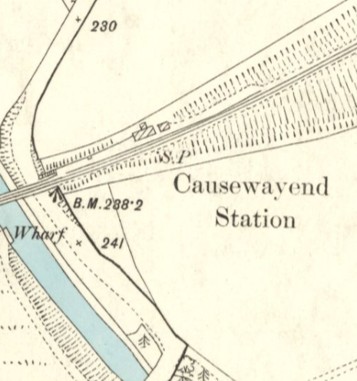
The name “Causewayend Station” is a little confusing. It often refers to the eastern terminus of the Slamannan Railway at the basin on the Union Canal at Causewayend in Muiravonside parish. This was in fact a transhipment point for goods between the railway and the canal. It was designed to handle minerals in bulk and largely functioned in that way. However, from the beginning, it was realised that it provided the most convenient connection between Edinburgh and Glasgow and also had to deal with passengers. For them a separate siding was created on the south side of the basin.
The opening of the Edinburgh and Glasgow Railway in 1842 created a faster and more direct passage between the two cities and passenger usage at Causewayend fell to negligible levels. The Bo’ness extension to the Slamannan Railway eastward from the canal basin at Causewayend was constructed in 1851 and so passengers could then proceed on to Bo’ness, and eventually a connection was also made with the Edinburgh and Glasgow Railway. When put up for sale or to let, large houses in the area continued to emphasise their proximity to Causewayend Station. Despite being intended only for minerals, and not having appropriate sheds, the station at Causewayend did handle some general goods and was much in demand by local estate owners and farmers. A well-known legal dispute between the mighty North British Railway and a local farmer and seedsman in 1859 ended up finding the Railway Company responsible for keeping goods, in this case ryegrass seeds, in the same kind of condition as the Company had received them. It set an important precedent for all such transactions.
It may have been the result of this case that prompted the North British railway Company to establish a new station on the east side of the Union Canal (and hence why Causewayend Station does not appear on the 1860 Ordnance Survey map). Over the years the large smelting ironworks at Almond were opened in 1855 producing pig iron, and around 1865 the Linlithgow Foundry moved to the location, specialising in architectural ironwork. The area was now a hub of industry and local housing could not keep up with demand. The location of the new station shows that it was intended for passengers rather than for goods. The site lay on the north side of the railway embankment to the east of the Union Canal and the Whitecross Road. At this point the railway was a single track. Pedestrian access was from the roadside by means of steps on the north side of the bridge/viaduct over the canal.
Almond Foundry closed in 1881 and the Linlithgow Foundry in 1912, causing the station to close shortly thereafter. The site has been cleared away and all that can be seen is the railway embankment.
Bibliography
NEWSPAPERS
Falkirk Herald, 6 May 1852, 1:
Sale of wood at Muiravonside… belonging to Charles Stirling… The Wood is lying along the side of the Avenue leading to the Mansion-House. Muiravonside is near to Causewayend Station on the Slamanan Railway.
Falkirk Herald, 6 January 1853, 1:
Compston House to let… The House is about three miles distant from the Linlithgow and Polmont Stations of the Edinburgh and Glasgow Railway, and less than a quarter of a mile from the Causewayend Station of the Monklands Railway. The House will be Let on moderate terms.
Falkirk Herald, 9 June 1859, 3:
John Swan, seedsman, Bo’ness, sued the Monkland Railways Company in the Sheriff Court of Stirlingshire for the price of a quantity of ryegrass seed which had been damaged whilst in their custody. The seed had been delivered at the Causewayend station, about nine o’clock on a Saturday morning, for transmission to Bo’ness. A goods train passed along the line about twelve o’clock, an another at two o’clock; but the seed was not despatched until the evening, reaching its destination about eight o’clock. There being no delivery of goods at that hour, the bags containing the seed remained in the truck till Monday morning, when delivery was tendered to the consignee, who refused to receive it, on the ground that it had been seriously injured from having been drenched with rain. It appeared from the evidence led, that the seed was delivered at Causewayend in good condition – that rain came in upon the day in question about one o’clock – that it continued wet the whole day, and that the bags were exposed to the weather until they reached Bo’ness, where they were covered with a tarpaulin, the tendency of which, necessarily, was rather to aggravate than prevent injury. Besides a number of pleas depending on specialities, the railway company set up the following defences, which, it is thought, possess a general interest:- They pled, first, that the Causewayend Station was intended and was used for mineral traffic, and not for general goods, and that they were not liable for damage resulting from the absence of sheds, tarpaulins, or other protection for perishable articles; second, that the stationmaster had received orders from his superiors not to receive goods except upon 24 hours’ prior notice, so as to enable him to provide trucks and coverings, and that such notice had not been given in this instance; third, that the stationmaster had declined to take in the goods in question on Saturday morning, and, that even although he had received them, the company would not have been liable for an act performed by their servant, not only without their sanction, but against express instructions; fourth, that they had come under no obligation to dispatch the goods at a particular hour, or by a specified train – that the transmission ion the evening of the day of reception was “due transmission,” and that they were not liable for injury from exposure to weather in the interim; fifth, that the consignee was not entitled to reject the goods and claim the price as damage, but was bound to receive them and claim damages as such. Mr Sheriff Robertson refuted the whole of these defences, as well as those urged upon the score of alleged specialities in fact, and found the railway company liable in the price of the seed, which was held in this case to be the measure of the damages; and Mr Sheriff Moir, upon this interlocutor being brought under his review in an elaborate written pleading prepared by counsel, affirmed the judgement of his Substitute.
The Scotsman, 21 September 1875, 5:
Yesterday morning, shortly before 10 o ‘ clock, Mr William Mowat, shipping agent for the Jawcraig Colliery Company, was fatally injured at the Causewayend Station, on the North British Railway. The unfortunate man had gone between two of a train of waggons, and on these being backed, he was caught by the buffers about the chest, sustain injuries from which he shortly afterwards expired. The deceased, who was about seventy years of age, was highly respected, and had been nearly thirty years at the Canal basin, Causewayend.
Falkirk Herald, 8 May 1897, 5:
John Bryson, labourer, Causewayend, Muiravonside parish, was charged with having, on 23rd April, on the N.B. Railway at Causewayend Station, Muiravonside parish, stolen 56 lbs. of coal. Accused admitted the charge, and was dismissed from the bar with an admonition…

