
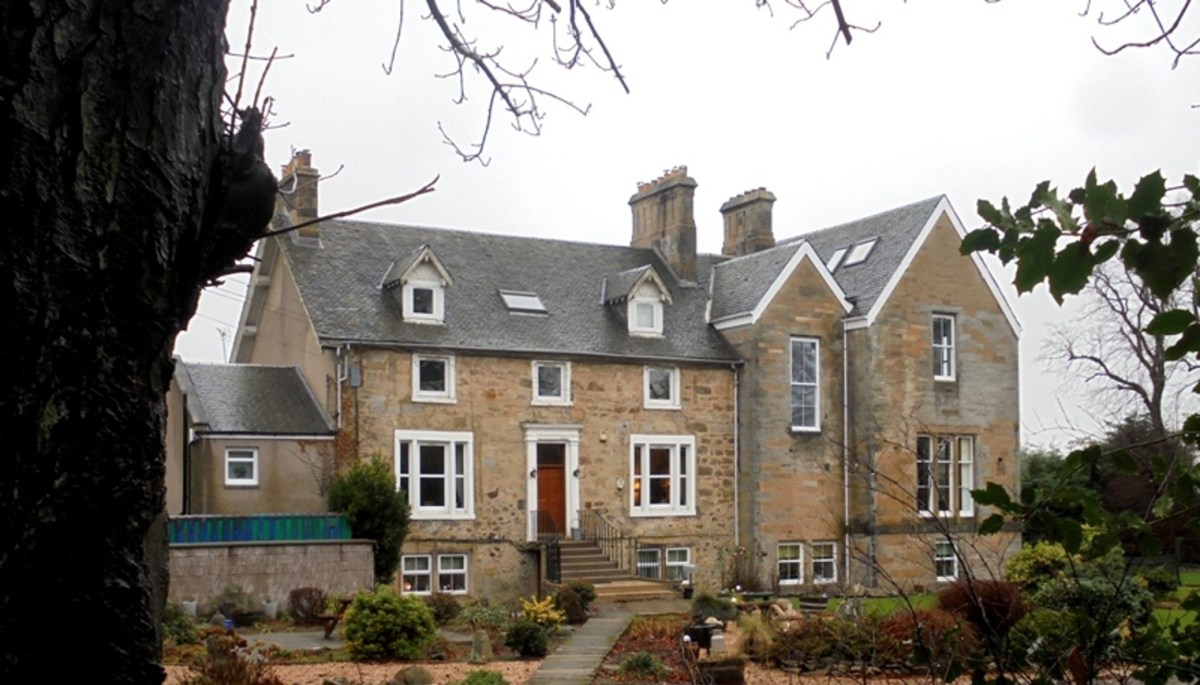
SMR 1260 / NS 9473 7560
| Sir William Ross (1636) | ||
| c1740 | Walter Gibson | c1788 |
| c1788 | Walter Gibson (son) | 1800 |
| 1800 | ?? | 1813 |
| 1813 | Thomas Andrew (purchase) | 1817 |
| 1817 | William Wilsone (purchase) | c1820 |
| c1820 | Charlotte Wilsone (widow) | 1829 |
| 1829 | Katherine Wilsone (daughter) | 1850 |
| 1850 | Lilias Wilsone (sister) | 1862 |
| 1863 | William Stirling (purchase) | 1865 |
| 1865 | Col. William Stirling (purchase) | 1900 |
| 1900 | Mary Katherine Stirling (widow) | 1915 |
| 1915 | Lt-Col. William G.H. Stirling (son) | 1917 |
| 1917 | John McDonald (purchase) | 1939 |
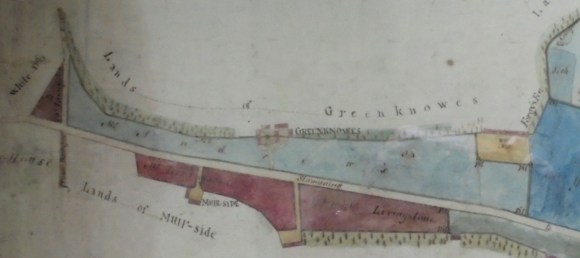
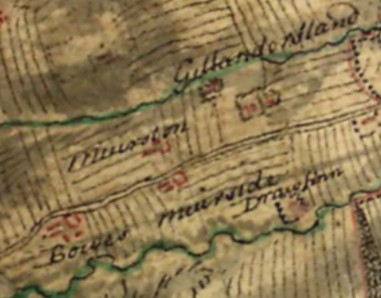
The name Tarduf refers to a topographical feature – a black promontory – which was part of the commonty of Haining (Reid 2009, 75. Adjacent to it were the lands of Bowhouse, also known as Gillandersland (Gilleislandis in 1459), a pendicle of Manuel-Foulis. These were feued separately at an early date but in 1727 became part of Muiravonside estate. The western part of Gillandersland was called Over Gillander’s Land or Muirside and in the eighteenth century included Lochhead and Kendieshill. Some time at the turn of the century the name changed to Greenknowes. This has essentially the same meaning as Tarduf, being hills on the green or common grazing ground. The House stood at the southern limit of the lands associated with it, adjacent to the moor. The dwelling at Greenknowes may have been of a more substantial nature than most in this area. Roy’s map of 1755 shows a building called Muirston at this location and in 1636 Sir William Ross of Mureston is mentioned. He had been the husband of Dame Margaret Forrester, daughter of Sir James Forrester of Torwoodhead (Reid Notes).
The house was rebuilt in an even more substantial style in c1790 by Walter Gibson, a surgeon based in Leith. Walter Gibson inherited the estate from his father of the same name. He died in July 1800 and in February the following year his son, also of the same name, put the lands and mansion house up for sale. Details of the house were given in the newspaper advert:
“To be sold by public roup, within the Royal Exchange Coffeehouse, Edinburgh, on Wednesday the 25th day of March next, at two o’clock afternoon, the LANDS of GREENKNOW, or MUIRSIDE, in the parish of Muiravonside, within three miles of Linlithgow, and five of Falkirk, in the immediate neighbourhood of coal, and within four miles of extensive lime works.
These lands are inclosed and subdivided, and extend to upwards of 80 acres, all arable, besides about 8 acres in belts of planting, which having been formed upwards of twenty years ago, afford at present both ornament and shelter.
There is an excellent Mansion-house on the estate, and also substantial Offices. The mansion-house which was built within these ten or twelve years, and cost nearly 1000 L. consists of kitchen, hall, laundry, and servants room on the ground floor; a good dining-room, and two bed-chambers on the principal flat; on the third are four bed-chambers, and above is a large garret, which, at a small expence, may be converted into several apartments.
A purchaser may enter immediately into possession of the mansion-house, garden, and about five acres of grass, and to the remainder of the lands (which are let for two years as pasturage) at the term of Martinmas 1802…. Also the LANDS of STANDRIDGE… Walter Gibson, at the mansion-house, will show the lands, and point out the boundaries.
(Caledonian Mercury 28 February 1801, 4).
A few months later the House was put up to let along with the well-stocked fruit garden. This garden lay close by to the south-east of the house and was surrounded with an 8ft tall stone wall. Just who the new owner was has not been ascertained, but it was on the market again, with less land, in April 1813. By that time the garret had been turned into sleeping apartments for servants.
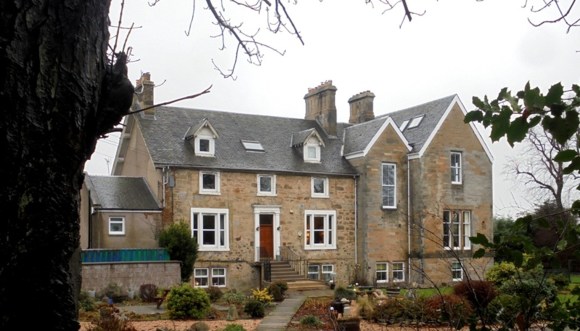
The advert at this time usefully confirms that the lowest floor was “sunk.” This was a common device, placing the service rooms such as the kitchen partly out of view on the main façade and raising the prominence of the public rooms by a slight elevation and a short flight of stairs to the front door.
“LAND FOR SALE THE LANDS of GREENKNOW, HOUSE, OFFICES, &c. containing 29 acres, 1 rood, and 19 falls, Scotch measure, situated in the parish of Muiravonside, and county of Stirling. Distant about 20 miles from Edinburgh, 4 from Linlithgow, and 5 from Falkirk. The ground is all inclosed and subdivided into six inclosures, the whole being surrounded with belts of wood of a considerable age, which afford both shelter and ornament to the property.
The lands are all in pasture grass, and let until Christmas next. The mansion house is substantial, commodious, and fit for the accommodation of a large family; the sunk storey contains kitchen, washing room, servants room, and other apartments. The first floor, dining, and drawing-rooms, and two bed-rooms. The second floor, four bed-rooms, closet, &c. And the attic storey, sleeping apartments for servants. The offices suitable to the property. A large garden inclosed by a stone wall, eight feet high, stocked with fruit trees. The public burdens are very trifling. The house, garden, and offices may be entered to immediately.
To be sold by public roup, in the Royal Exchange Coffeehouse, on Wednesday the 12th day of May 1813, at two o’clock afternoon; proposed upset price, L.2000 Sterling…”
(Caledonian Mercury 17 April 1813, 4).
The new owner was Thomas Andrew, who had a large property portfolio and a large brewery in Linlithgow. It was during his short time at Greenknowes that the common muir was divided up amongst the main landowners of the barony. Andrew was given a narrow strip of land from the muir between the Greenknowes House and the new turnpike road from Linlithgow to Avonbridge, and this is shown on a plan now in Falkirk Library (Plan of the Division of Tarduff-Muir, 1814). This shows a house orientated west/east with a courtyard to the south and a range of buildings on either side of the yard.
Thomas Andrew fell into debt and his estate was sequestered and put up for sale, including:
“II – All and whole the FARM and LANDS of GILLANDERSLAND and CABERTON, lying in the parish of Muiravonside, and county of Stirling, consisting of 70 acres, or thereby, as lately possessed by Mr Andrew, situate within four miles of the towns of Falkirk and Linlithgow. A threshing machine of six horse power was erected upon these lands within these two years.
III – All and whole the LANDS of GREENKNOW, lying contiguous to the Lands of Gillandersland, consisting of thirty acres, or thereby, upon which there is an excellent Mansion-house of three stories, with coach house, stables, garden, and every other convenience. These lands, as well as the lands of Gillandersland and Caberton, are in the best condition, and are intersected with thriving belts of planting; and they will be sold together, or separately, as intending purchasers may incline.
… Note – the Mansion house of GREENKNOW, before referred to, with the offices and garden, are to be let for the season; and a tenant can be accommodated with any quantity of grass he may require.”
(Caledonian Mercury 14 June 1817, 4).
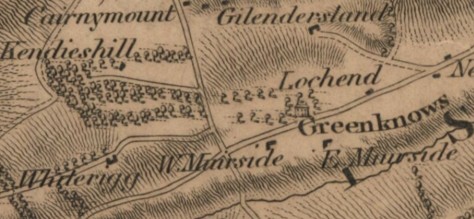
Grassom, in 1817, recognised Greenknows as a mansion and depicts it thus on his map of Stirlingshire.
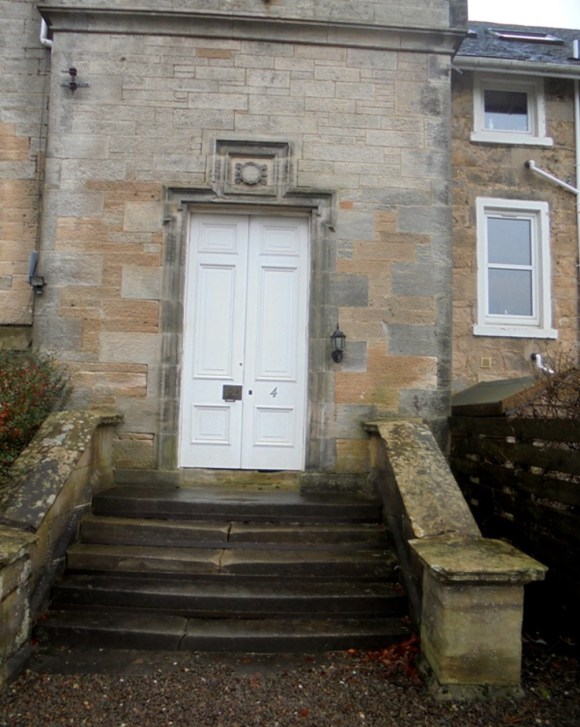
The mansion was constructed of random sandstone rubble and was three storeys in height. The lower floor was slightly sunk and possessed small two-light windows; those on the first floor were large, three-light, with monolithic mullions as befitted the principal rooms; and those on the second floor were small and square. They were disposed vertically one above the other to give a pleasing and symmetrical façade, with the doorway in the centre reached by a short flight of stairs.
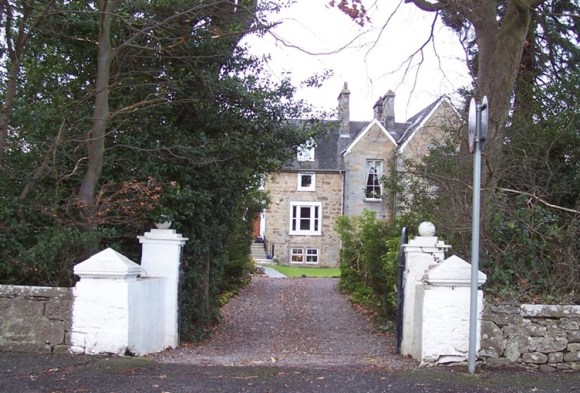
The new owner was William Wilsone (sometime spelled Wilson), a merchant in Edinburgh, and Thomas Duncan was appointed as the estate factor. William did not live long after his purchase and his widow, Charlotte, died 26 April 1829 aged 83 years. Their son, Archibald John Wilson, took over. When Archibald Wilsone and his wife died their daughter, Katherine, inherited. She was well known in the area for her charitable work and died 23 November 1850 aged 74 years, to be followed at Tarduf by her sister, Lilias Wilson.
Lilias died 14 January 1862, aged eighty-four years (the family tomb is at Muiravonside Churchyard, Number 101 on the published Inventory, Bailey 1997), followed just a month later by her factor. Her furniture and possessions were sold, including upwards of 300 volumes of books – standard works in theology, history, biography, philosophy, science, & c. The Household items included eight carpets, as well as a variety of fire grates and the kitchen range (a full list was printed in the Falkirk Herald of 20 February 1862. Katherine Wilsone’s trustees arranged for the sale of the estate which now extended to 151 acres, including 16 acres of :
“embellishing Pine and Hardwood trees”
(Edinburgh Evening Courant 12 July 1862, 4).
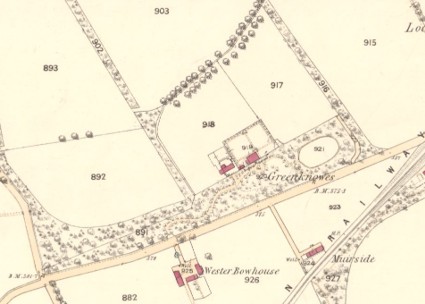
The 1863 edition Ordnance Survey map shows Greenknowes set within the south side of a rectangular garden with the new coachhouse to the west. The drive from the public road to the south ran through the shelter belt following a sinuous course to give the illusion of large grounds. The House and estate were bought by William Stirling of 179 West George Street, Glasgow. He immediately set about extending the House by constructing a large north/south wing onto its eastern side. This was made of blonde ashlar sandstone and presented a large gable with a large three-light window on the first floor to either end. Projecting bays, containing the staircase and north entrance, terminating in secondary gables joined the new wing to the old house. The east façade also contained a bay with a gable, to the north of which was a section with a two-storey canted bay window with dormer windows above. William Stirling immediately changed the name of the estate and mansion-house to Tarduf.
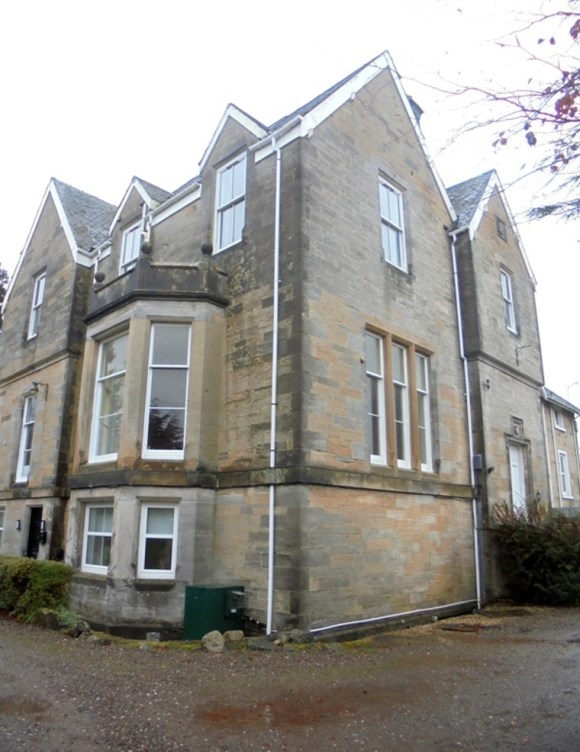
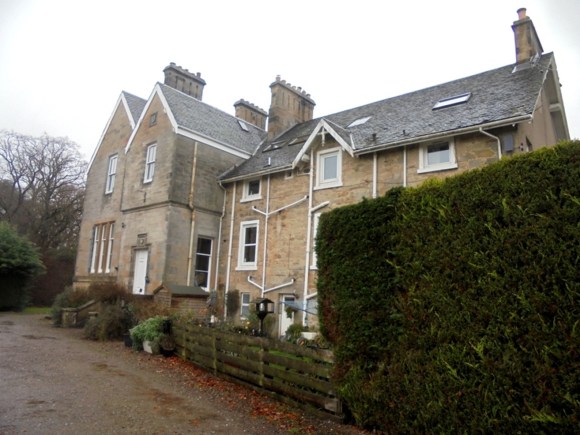
The work on the extension of the house had not been completed when William Stirling moved to Queensferry. It again went up for sale and was bought by a relative, Colonel William Stirling, for £8,500. It now contained a dining room, a drawing room, library, seven bed rooms, four dressing rooms, and ample servants’ accommodation. Colonel Stirling had been a West Indian merchant and made sufficient money to retire from business and acquire Greenknowes, where he took up residence. His rank came from his service in the volunteer movement in one of the Glasgow regiments. He belonged to an old, influential, and well-known Stirlingshire family, all the branches of which have taken a keen interest in public and county affairs.
In the case of Colonel William Stirling of Tarduf, he was a Justice of the Peace for Stirlingshire, and one of the County Justices of the Falkirk Burgh Confirming Committee. When the Roads and bridges Act was adopted in 1880, he was appointed the chairman of the Eastern or Falkirk District Roads Committee, and he continued to hold that office till the Local Government Act came into force in 1900. He was elected to the Eastern District Committee of the Stirling County Council by one of the divisions of the Muiravonside parish, and he was subsequently returned to represent his parish at that Board. He was also a member of the Standing Joint Committee and the Commissioners of Supply for the County. For many years he was chairman of the Stirling District Lunacy Board. While he was closely identified with county matters, he took a very deep interest in his own neighbourhood, and for a good many years he was the chairman of the Muiravonside School Board and the Parochial Board. He was also instrumental in setting up the Scottish Society.
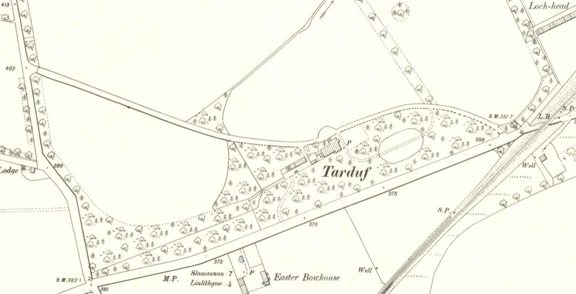
It was during his occupancy that the finishing touches were put to change the orientation of the house towards the north. A new access road was led off to the north-west to meet the Maddiston road a little to the north of Craigend Lodge. The walled garden to the north of the house was dispensed with and a carriage turning circle put in its place. The carriageway continued eastwards to meet the Linlithgow road next to the Slamannan Railway.
Miss Elizabeth Stirling of Tarduf went out to China in the 1880s to help with missionary work. When she came back she brought with her specimens of Chinese work. These included a Chinese child’s cape, a pair of Chinese lady’s shoes, an opium pipe, and part a Chinese bride’s dress. She made these available for exhibitions in the area. There was a great curiosity for information about China and before long she was on the talk circuit, showing lantern slides and relating her experiences. Quite a few of those involved in the China Inland Mission visited Tarduf House. In October 1894, for example, a Missionary Monday was held in the drawing-room, when Mr and Mrs Graham Brown, from Kansuh, North-West China, and Mr Montague Beauchamp, B.A., Sichuan, West China, gave accounts of their work.
The Stirling family had properties elsewhere and often spent the summer visiting them and relatives. Tarduf was therefore let in the summer months. Colonel Stirling of Tarduf died on 28 August 1900 at Sutherland House, Stirling, aged 76. He was survived by a widow and grown up family of three sons and four daughters. One of the sons, Captain William Stirling, was then in India, another, Lieutenant James David Stirling, was in China, and the third was a chartered accountant in London.
While rounding up a gang of raiders on the Bannu border (North West Frontier), Captain James David Stirling, DSO, of the 57th (Wildes) Rifles (Frontier Force) was killed. He had led an active military career, entering the army in 1894 at the age of 21 years. In 1895 he served with the Chitral Relief Force, under Sir Robert Low, with the 2d Battalion King’s Own Scottish Borderers, including the capture of the Malakand Pass, the passage of the Swat River, and the engagement at Panjorka. He received the medal and clasp. He was promoted to lieutenant in 1897. He was in China in 1900-2, and was mentioned in despatched, receiving the D.S.O. and medal. In 1903 he attained the rank of Captain, and was present at the fighting in the Bazar Valley in 1908, for which he received the medal with clasp. The last regiment of the line to which he was attached was the King’s Own Scottish Borderers.
Tarduf House was owned and run by Mary Katherine Stirling, widow of William Stirling, until she died on 28 July 1915, in her 82nd year. The House, which had been let seasonally was now offered to let for two years, furnished or unfurnished. After less than a year, however, Lieut-Colonel William G.H. Stirling decided to move to Edinburgh and sell Tarduf, the upset price being set at £2,500:
STIRLINGSHIRIE, DESIRABLE RESIDENCE AND SMALL ESTATE for sale, the ESTATE of TARDUF, in the Eastern District of Stirlingshire, extending to 75 ½ Acres or thereby, about 5 miles from Linlithgow and 2 miles from Polmont and Manuel Stations.
The Mansion House, contains 4 public rooms, 8 bedrooms, and 2 dressing rooms, with servants’ rooms and other accommodation. Stable, coach-house or garage, and other offices. Good walled garden. The LANDS surround the House, and consist of GRASS PARKS let yearly…”
(Glasgow Herald 8 March 1916, 4).
It even appeared in Country Life on 26 May 1917 (see illus):
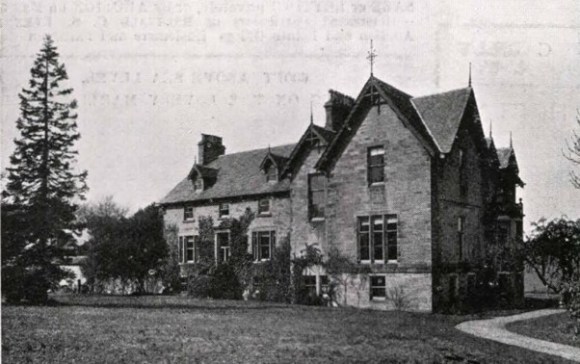
The furniture was sold off and in July 1917, after keen bidding, the house and estate sold for £3,000 to John McDonald, who has just returned from the Empire. He had been in India for a number of years where he operated extensive tea plantations at Gairkaata and Arcuttipore. In this connection he was the inventor of an efficient patent for the drying of tea, the machine becoming generally used on most plantations. His journey home from India had taken place during the First World War, and he had to make a difficult passage through Russia. He and his family threw themselves into community work, serving on numerous committees, opening events such as fairs, and making charitable donations. He, like many landowners of the period, took to keeping Highland cattle.
Extensive’ damage was done to panelling at Tarduf House in September 1933 as a result of an outbreak of fire. Falkirk Fire brigade were summoned, and were successful in subduing the fire before the entire house became involved. John McDonald died at Tarduf on 25 June 1939. The House was once again on the market. It now had central heating and came with gardens and policies extending to over 5 acres; 10 acres of woodland and 50 acres of grass parks (Falkirk Herald 15 July 1939, 2). It was not a good time to sell a large mansion and the empty premises were requisitioned for use by the Polish army. A brick building was erected to the south-east of the house. In November
1944 the Linlithgow Gazette announced that “a local gentleman has purchased Tarduf Mansion… his intention is to turn it into a first-class roadhouse, with golf course attached. The latter may not mature for some time as we understand five years of the lease of the land have still to run.” (3 November 1944, 4).
The roadhouse never happened. Instead, the House was converted into six flats with the families of
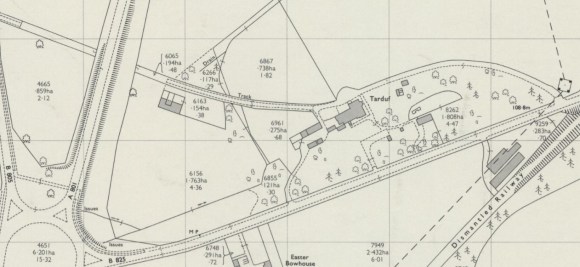
Jones, Hanlon, Sharpe, and Moir, living there. Here is a typical advert for one of these flats when it came up for resale in 1959: “TARDUF, POLMONT. House on two floors, part of mansion-house, consisting of 2 public rooms, 2 bed rooms, kitchenette, and bathroom; modern and electric light and power; garage and ground suitable for pigs and poultry. Low assessment, no feu-duty.” (The Scotsman 4 June 1959, 16). The construction of a new line for the A801 with a large roundabout at Bowhouse in the late 1960s changed the setting of the House to the west, but there are still rolling fields of pasture to the north with an uninterrupted view of Gillandersland Farm. In 1985 the coachhouse was made into a separate residence, and this was considerably upgraded in 2002 by the proprietors of Dunne Building and Civil Engineering.
Bibliography
| Bailey, G.B. | 1997 | ‘The Graveyards of Falkirk District: Part 3. Muiravonside,’ Calatria 11, 1-62. |
| Jaques, R. | 2001 | Falkirk and District, an Illustrated Architectural Guide. TARDUF HOUSE, mid/late 19th century. Large two-and-a-half storey mansion, at end of small curving drive and among estate trees and rhododendrons, comprising west wing in rubble with banded windows and bay window to gable, projecting east wing having three-light windows to gable at first floor, possibly David Bryce additions to an earlier house. On site of Greenknowes, former home of Walter Gibson, laird of Greenknowes, 1717-1800. [p104] |
| Leask, D | 2017 | A Historic Tour of the Parish of Muiravonside. |
| Reid, J | 1994 | ‘The Feudal Land Divisions of Muiravonside Parish: the Principal Subdivisions,’ Calatria 7, 21-85. |
| Reid, J | 2009 | The Place Names of Falkirk and East Stirlingshire. |
NEWSPAPERS
Scots Magazine 1 August 1800, 68: Deaths. At Leith, Walter Gibson, of Greenknow, Esq, late surgeon in Leith, who practised there upwards of 61 years.
Caledonian Mercury 28 February 1801, 4: To be sold by public roup, within the Royal Exchange Coffeehouse, Edinburgh, on Wednesday the 25th day of March next, at two o’clock afternoon, the LANDS of GREENKNOW, or MUIRSIDE, in the parish of Muiravonside, within three miles of Linlithgow, and five of Falkirk, in the immediate neighbourhood of coal, and within four miles of extensive lime works.
These lands are inclosed and subdivided, and extend to upwards of 80 acres, all arable, besides about 8 acres in belts of planting, which having been formed upwards of twenty years ago, afford at present both ornament and shelter.
There is an excellent Mansion-house on the estate, and also substantial Offices. The mansion-house which was built within these ten or twelve years, and cost nearly 1000 L. consists of kitchen, hall, laundry, and servants room on the ground floor; a good dining-room, and two bed-chambers on the principal flat; on the third are four bed-chambers, and above is a large garret, which, at a small expence, may be converted into several apartments.
A purchaser may enter immediately into possession of the mansion-house, garden, and about five acres of grass, and to the remainder of the lands (which are let for two years as pasturage) at the term of Martinmas 1802…. Also the LANDS of STANDRIDGE… Walter Gibson, at the mansion-house, will show the lands, and point out the boundaries.
CM 2 May 1801, 1: FURNISHED HOUSE & GARDEN TO LET. To be Let for such time as may be agreed to, GREENKNOW HOUSE, Furnished, with a Garden well stocked with Fruit, lying in the parish of Muiravonside, about three miles to the westward of Linlithgow. A Park containing about five acres of pasture will also be let, if the tenant chuses…
CM 17 April 1813, 4: LAND FOR SALE, THE LANDS of GREENKNOW, HOUSE, OFFICES, &c. containing 29 acres, 1 rood, and 19 falls, Scotch measure, situated in the parish of Muiravonside, and county of Stirling. Distant about 20 miles from Edinburgh, 4 from Linlithgow, and 5 from Falkirk. The ground is all inclosed and subdivided into six inclosures, the whole being surrounded with belts of wood of a considerable age, which afford both shelter and ornament to the property.
The lands are all in pasture grass, and let until Christmas next. The mansion house is substantial, commodious, and fit for the accommodation of a large family; the sunk storey contains kitchen, washing room, servants room, and other apartments. The first floor, dining, and drawing-rooms, and two bed-rooms. The second floor, four bed-rooms, closet, &c. And the attic storey, sleeping apartments for servants. The offices suitable to the property. A large garden inclosed by a stone wall, eight feet high, stocked with fruit trees. The public burdens are very trifling. The house, garden, and offices may be entered to immediately.
To be sold by public roup, in the Royal Exchange Coffeehouse, on Wednesday the 12th day of May 1813, at two o’clock afternoon; proposed upset price, L.2000 Sterling…
CM 14 June 1817, 4: Part of the sequestered estate of Mr Thomas Andrew, of Gillandersland, brewer in Linlithgow…
II – All and whole the FARM and LANDS of GILLANDERSLAND and CABERTON, lying in the parish of Muiravonside, and county of Stirling, consisting of 70 acres, or thereby, as lately possessed by Mr Andrew, situate within four miles of the towns of Falkirk and Linlithgow. A threshing machine of six horse power was erected upon these lands within these two years.
III – All and whole the LANDS of GREENKNOW, lying contiguous to the Lands of Gillandersland, consisting of thirty acres, or thereby, upon which there is an excellent Mansion-house of three stories, with coach house, stables, garden, and every other convenience. These lands, as well as the lands of Gillandersland and Caberton, are in the best condition, and are intersected with thriving belts of planting; and they will be sold together, or separately, as intending purchasers may incline.
… Note – the Mansion house of GREENKNOW, before referred to, with the offices and garden, are to be let for the season; and a tenant can be accommodated with any quantity of grass he may require.
1827 Archibald Wilson, Greenknowe, Stirlingshire.
SO 18 April 1844, 1: FARM TO LET. THE FARM of GREENKNOWES, in the parish of Muiravonside, containing about 90 Acres Scotch measure, or thereby, presently occupied by Wm. Johnstone… Thomas Duncan, at Greenknowes, will point out the boundaries…
SO 5 December 1850 4: Died— At Greenknowe, Stirlingshire, on the ultimo, Miss Wilson of Greenknowe.
Glasgow Courier 23 January 1862, 3: At Greenknowe, Stirlingshire, on the 14th inst., Miss Wilsone of Greenknowe, aged eighty-four years.
FH 20 February 1862, 4: …27th January, 1862. Neilson’s Sales. DINING-ROOM, DRAWING ROOM, PARLOUR, BEDCHAMBER FURNITURE, AT THE MANSION-HOUSE or GREENKNOWE, On SATURDAY, FEBRUARY. JAMES NEILSON begs most respectfully announce that will Sell Public Roup, at the Mansion-House of GREENKNOWE… which belonged to the late Miss Wilson… upwards of 300 volumes of books – standard works in theology, history, biography, philosophy, science, & c… 8 carpets, grates, kitchen range, etc
SO 3 April 1862 1: Duncan. – Suddenly, at Whiterigg, Mr Thomas Duncan, Lochhead, Muiravonside, aged 64 years, factor to the late Miss Wilson, Greenknowes.
Edinburgh Evening Courant 12 July 1862, 4: …To be sold by public roup, within the Red Lion Hotel, Falkirk, on Thursday the 21st August 1862, at Two o’clock Afternoon, The beautiful small estate of GREENKNOWE. which belonged to the late Miss Katherine Wilsone, situated in the Parish of Muiravonside, and County of Stirling, four … the property is bounded on the west and south by the public roads leading to Falkirk and Linlithgow, and extends to 151 acres or thereby of true bearing alluvial soil, including 16 acres of embellishing Pine and hardwood trees.
The mansion-house of Greenknowe is delightfully situated on the south side of the Property, and is surrounded by ORNAMENTAL PLANTATION, OLD TREES, and LAWN GRASS, and consists of dining-room, drawing-room, library, five bed-rooms, kitchen, scullery, butler’s pantry, laundry, and servants; apartments; with stables, coach-house and offices attached; also, garden with fruit-tree walls, &c.
The farm of Gillandersland on the estate, possessed by Mr William Cuthill, an enterprising tenant, has been mostly drained, and is capable of bearing all kinds of cereal crops, and is subdivided, and surrounded by belts of ornamental wood. There is also an excellent farm-steading, with every necessary accommodation for carrying on the farm.
The gross yearly rental of the property, including the Mansion-house, and some feu-duties which are payable to the estate, is £238…
FH 3 September 1863 1: The farm of GILLANDSERLAND… consisting of 100 Imperial acres or thereby, the whole of which is arable… The boundaries will be pointed out by James Ryrie, Tarduf House; and offers will be received, and other information given, by William Stirling, 179 West George Street, Glasgow.
1864 – Wm Stirling of Tarduf.
Glasgow Herald 26 February 1864, 5; At Tarduf, Stirlingshire, on the 23d instant, the wife of William Stirling, Esq.; a daughter.
Glasgow Herald 24 February 1865, 3: To be sold, by public roup,… The very Desirable ESTATE of TARDUF in the Parish of Muiravonside, and County of Stirling. This property consists of the Lands of Greenknowe, Over and Nether Gillandersland, Cairneymount, and others, all lying contiguous. It is situated about four miles west from Linlithgow, and two and a half miles from Polmont Station of the Edinburgh and Glasgow, at which Station trains from Edinburgh and Glasgow stop almost every hour of the day.
The Property extends to 163.453 acres, of which the greater portion is arable, the remainder being either under Plantation or occupied with Houses and Roads, and three small feus.
The Mansion House has been recently greatly extended, but is not yet finished. It contains dining room, drawing room, library, seven bed rooms, four dressing rooms, ample servants’ accommodation, and all the necessary conveniences for a large family. There are a three-stalled stable, double coach house, harness room, and other offices, all in good order.
The rental is about £370, and the public and parochial burdens are about £20 per annum. The tern of entry will be at Whitsunday 1865. The Property will be shown by James Ryrie, overseer at Tarduf…
Glasgow Morning Journal 6 April 1865, 2: The Estate of Tarduf realised the upset price of £8500.
FH 5 October 1865, 4: Wm Stirling of Tarduf deleted from the electoral register. [living at Queensferry]
SO 8 February 1866, 4: Stirling.—At Tarduf, Stirlingshire, on the 31st ult., Sylvia Anne, youngest daughter of Wm. Stirling, Esq
EEC 28 May 1866, 4: At Tarduf, Stirlingshire, on the 26th instant, the wife of William Stirling, Esq., of daughter.
FH 24 January 1867, 3: Muiravonside Club members of this club for a handsome pair of curling stones with silver mounted handles, presented by William Stirling, Esq. of Tarduf.
Glasgow Herald 1 September 1868, 3: At Tarduf, on the 30th ult., the wife of William Stirling, Esq,; a daughter.
Colonel Stirling
FH 10 September 1868, 1: To let, the dwelling-house of Gillandersland Farm… the House is in good order, has two flats, and consists six apartments. There is a good Garden. A Stable, Byre, and Grass can be had if required. —Apply at Tarduf House.
FH 18 December 1873, 5: At Tarduf, on 11th inst., the wife of William Stirling, Esq., of twin sons.
1887 – Sir Charles Stirling, Tarduf
FH 9 March 1892, 6: Miss Elizabeth Stirling of Tarduf, who went out to China a abort time ago along with Dr and Mrs Wilson,
FH 6 October 1894, 7: MUIRAVOSIDE Missionary Monday a drawing-room meeting was held at Tarduf, when Mr and Mrs Graham Brown, from Kansuh, North-West, China, and Mr Montague Beauchamp, B.A., Sichuan, West China, all of the China Inland Mission, gave most interesting accounts of their work…
Glasgow Herald 10 June 1895, 4: 1 STIRLINGSHIRE. – The Mansion House of Tarduf To Let for summer months: accommodation for a large family; good gardens and tennis lawn; within easy distance of Polmont, Manuel, and Bowhouse Stations.-Apply Tarduf, Linlithgow.
FH 20 July 1895, 5: A Marriage has been arranged, and will shortly take place, between Captain Stirling, Madras Lancers, younger of Tarduf, and Mary Louisa, eldest daughter of W. S. Spens and the Honourable Mrs Spens.
Linlithgow Gazette 8 May 1897, 5: Amongst the exhibits lent by Miss Stirling. Tarduf, were specimens of Chinese work. Chinese child’s cape, pair of Chinese lady’s shoes, opium pipe. part a Chinese bride’s dress …
FH 24 March 1900, 7: STANDBURN. PUBLIC HOUSE – The profits from this house are considerable, and at a meeting recently held in Mr. Stirling’s, Tarduf, at which were present representatives from Messrs James Nimmo and Co., local Justices, and other gentlemen, it was decided to expend the profits in the following manner: in the building of a large hall for Standburn, in the purchase of an ambulance waggon, and the securing of a burse for Standburn.
FH 29 August 1900, 4: the death of Colonel Stirling of Tarduf, Muiravonside, took place at Sutherland House, Stirling, yesterday. Colonel Stirling, who was over 70 years of age [76], has been in a delicate state of health for some four or five years past.. he belonged to an old, influential, and well-known Stirlingshire family, all the branches of which have taken a keen interest in public and county affairs. He was in his early years a West Indian merchant, but many years ago he retired from business, and took up his residence at Tarduf. While he was closely identified with county matters, he took a very deep interest in all that concerned his own neighbourhood, and for a good many years he was the chairman of the Muiravonside School Board and Parochial Board. He was likewise a Justice of the Peace for Stirlingshire, and was one of the County Justices who composed the Falkirk Burgh Confirming Committee. When the Roads and bridges Act was adopted in 1880, he was appointed the chairman of the Eastern or Falkirk District Roads Committee, and he continued to hold that office till the Local Government Act came into force in 1900. He was elected to the Eastern District Committee of the Stirling County Council by one of the divisions of the Muiravonside parish, and he was subsequently returned to represent his parish at that Board. He was also a member of the Standing Joint Committee and the Commissioners of Supply for the County. For many years he was chairman of the Stirling District Lunacy Board. He rose to the rank of Colonel in the volunteer movement in one of the Glasgow regiments…
FH 1 September 1900, 6; …He purchased the mansion-house and lands of Greenknowes there from the trustees of the proprietrix, the late Miss Wilson of Greenknowes. He changed the name of the estate and mansion-house to Tarduf, and during his occupancy of the house he considerably enlarged it… Colonel Stirling is survived by a widow and grown up family of three sons and four daughters… one of the sons, Captain William Stirling, is presently in India, another, Lieutenant Stirling, has been called to China, and the third is a chartered accountant in London.
GH 3 October 1900, 3: For winter or year, the Mansion House of Tarduf; ample accommodation; easy distance from Polmont, Manuel, and Bowhouse Stations- Apply agents Macindoe & Lauder, Fraser & Steele.
FH 8 December 1900, 5: Wm Stirling of Tarduf personal estate of £8993.
FH 14 December 1901, 7: Lieutenant James David Stirling of Tarduf has been made a Companion of the Distinguished Service Order for bravery in the late operations in China.
Capt then Major WH Stirling of Tarduf, Indian Army.
Glasgow Herald 8 October 1900, 3: For winter or year, the Mansion House of Tarduf; ample accommodation; easy distance from Polmont, Manuel, and Bowhouse Stations- Apply agents, Macindoe & Lauder; or Walker, Fraser & Steele.
FH 12 March 1910, 4: At TARDUF, The Property Mrs Stirling, GRASS PARKS, Well Fenced and Watered
Dundee Evening Telegraph 14 March 1910, 1: While rounding up a gang of raiders on the Bannu border (North West Frontier), Captain James David Stirling, DSO, of the 57th (Wildes) Rifles (Frontier Force) was killed.
Captain Stirling was a son of the late Mr Wm Stirling of Tarduf, Stirlingshire, he was born in 1873. Entering the army in 1894, he was promoted to be Lieutenant in 1897. In 1895 he served with the Chitral Relief Force, under Sir Robert Low, with the 2d Battalion King’s Own Scottish Borderers, including the capture of the Malakand Pass, the passage of the Swat River, and the engagement at Panjorka. He received the medal and clasp. He was in China in 1900-2, and was mentioned in despatched, besides receiving the D.S.O. and medal. In 1903 he attained the rank of Captain, and was present at the fighting in the Bazar Valley in 1908, for which he received the medal with clasp. The last regiment of the line to which he was attached was the King’s Own Scottish Borderers.
The Scotsman 29 July 1915, 12: At Tarduf , Polmont , on the 28th Inst Mary Katherine Stirling, widow of William Stirling, of Tarduf, in her 82nd year.
The Scotsman 23 October 1915, 3: STIRLINGSHIRE. – TARDUF HOUSE, 2 miles south of Manuel Station; 4 Public Rooms, 8 Bedrooms; Garage, Garden, &c; to let furnished or unfurnished for two years or a shorter period…
Glasgow Herald 8 March 1916, 4: STIRLINGSHIRIE, DESIRABLE RESIDENCE AND SMALL ESTATE for sale, the ESTATE of TARDUF, in the Eastern District of Stirlingshire, extending to 75 ½ Acres or thereby, about 5 miles from Linlithgow and 2 miles from Polmont and Manuel Stations.
The Mansion House, contains 4 public rooms, 8 bedrooms, and 2 dressing rooms, with servants’ rooms and other accommodation. Stable, coach-house or garage, and other offices. Good walled garden. The LANDS surround the House, and consist of GRASS PARKS let yearly…
Country Life 26 May 1917, 21: By direction of Lieut-Colonel W.G.H. Stirling, Stirlingshire, about four miles from Linlithgow and two miles from Polmont and Manuel Stations, on the North British Ry. from Edinburgh to Glasgow; Bowhouse Station on a branch line is about ten minute’s walk from the House.
The Estate of TARDUF, comprising a well-built residence with four reception rooms, fifteen bedrooms and bathrooms; well-established gardens and policies, lodge, cottages and farm buildings, woodlands and grassland, in all about 75 acres. To be offered by Auction on the Premises (immediately preceding the sale of the furniture) in July next, unless previously sold…
FH 23 June 1917, 2: At Tarduf Sale of the residue of furnishings belonging to Lieut-Col, Stirling, who is leaving the district. List…
FH 4 July 1917 2: SALE OF TARDUF ESTATE.-The estate of Tarduf was exposed to public roup within the mansion-house on Tuesday, at the upset price of £2500. Competition was keen, and the bidding rose to £3000, at which figure the estate was purchased by Mr John M’Donald, who has just returned to this country from India.
The Scotsman 18 September 1933 7: Extensive’ damage was done to panelling at Tarduf House, Maddiston, near Polmont, the residence of Mr John M’Donald, a retired tea planter, as a result of an outbreak of fire which occurred on Saturday. Falkirk Fire brigade were summoned, and were successful in subduing the fire before the entire house became involved.
The Scotsman 27 June 1939, 18: On 25th June 1939 . JOHN MCDONALD, of Tarduf, Polmont. Stirlingshire. formerly of Gairkhata and Arcuttipore, India. Service on Wednesday at Tarduf at 2 o’clock; and at Muiravonside Churchyard at 2.30.
FH 1 July 1939, 9: TEA PLANTER’S DEATH The Late Mr John M’Donald of Tarduf. The death took place at his residence, Tarduf. Polmont, on Sunday, of Mr John M’Donald, who, since he came to the district twenty years ago, had become widely known and greatly respected. A north-country Scot, he was for a long number of years in India, where he operated extensive tea plantations at Gairkaata and Arcuttipore. In this connection he was the onventor of a highly efficient patent for the drying of tea, the machine becoming and still being very generally used wherever there are tea plantations. Mr M’Donald returned home from India to this country during the period of the Great War, and had to make a difficult journey through Russia, suffering not a little hardship on the way.
In 1917 he purchased Tarduf and, with Mrs M’Donald and the members of his family, settled in residence there, From that time he revealed a keen and practical interest in all that pertained to the welfare of the people in Muiravonside Parish…
FH 15 July 1939, 2: TARDUF ESTATE, situated about 4 miles from Linlithgow and 2 miles from Polmont Station. The Mansionhouse —surrounded by Shrubberies and Parks – contains entrance hall, 4 public, 9 bedrooms, 2 dressing-rooms, 2 bathrooms, servants’ hall, sitting room, 3 servants’ bedrooms, kitchen and usual offices; central heating. Lodge, stabling (3), garage, small byre. The gardens and policies extend over 5 acres; woodlands 10 acres; grass parks 50 acres. Gross assessed rental £153 10s. Mineral rent (subject to Coal Act) £50. Ground burdens £9 10s…
22 July 1939: At Tarduf, Polmont, Stirling, en 25th June, 1939, John M‘Donald, tea planter, second son of the late Mr and Mrs D. M‘Donald
SO 5 September 1939, 5: STIRLINGSHIRE WILLS Inventories of estates lodged with the sheriff-clerk at Stirling include the following:— John M‘Donald. late of Tarduf. Polmont (net movable estate, £5468 6s Id).
LG 3 November 1944, 4: We understand a local gentleman has purchased Tarduf Mansion at the corner of the Avonbridge-Maddiston roads and that his intention is to turn it into a first-class roadhouse, with golf course attached. The latter may not mature for some time as we understand five years of the lease of the land have still to run.
The Scotsman 29 December 1947, 1: Jones, Tarduf House, Polmont.
FH 15 October 1949, 2: E Hanlon, Tarduf House, Polmont.
Scotsman 6 January 1951, 10: SHARPE – suddenly, at Tarduf House, POLMONT, on 4 January 1951 DONALD MCLAURIN SHARPE, husband of Margaret Grant and second son of the late Mr & Mrs J Sharpe, Elmbank, Oban…
FH 28 July 1951, 1: Mrs James Moir, Tarduf
The Scotsman 4 June 1959, 16: TARDUF, POLMONT. House on two floors, part of mansion-house, consisting of 2 public rooms, 2 bed rooms, kitchenette, and bathroom; modern and electric light and power; garage and ground suitable for pigs and poultry. Low assessment, no feu-duty.
WLC 2 October 1959, 15: House on first and second flats, part of Tarduf House, Polmont: 6 rooms, kitchen and bathroom; rent £28: upset price £59
The Scotsman 7 January 1961, 20: STIRLINGSHIRE MADDISTON, by FALRIRK. Property consisting of westmost ground floor flat at Tarduf House. containing livingroom. 2 bedrooms. kitchenette, bathroom and pantries, fi.” 2 acres or thereby: substantial outbuildings suitable for pigs and poultry…
2002 – Mrs Johanna Dunne, Dunne Building and Civil Engineering, Tarduf Stables, Maddiston

