
SMR 1252 / NS 9134 7848
| c1862 | Mr Alexander | 1866 |
| 1866 | James Anderson Snell = Jessie Waddington | 1877 |
| 1878 | David Mathie Peebles | 1901 |
| 1902 | Steven |
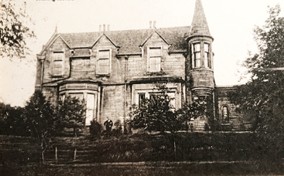
Thomas Fenton Livingstone saw off a rival claim to the estate of Westquarter in 1861 and soon afterwards started feuing off parts of the ground. Around 1862 he sold 6.5 acres from his part of Overton to a Mr Alexander who then constructed a mansion house there; in 1870 land to the south of Overton, on the south side of the Edinburgh to Glasgow Railway, was feued off for a sulphuric acid works and eventually became Nobel’s Explosive Works. Unfortunately I have not been able to ascertain who Mr Alexander was. The new house occupied a hilltop position to the north-west of the farmstead of Overton, thus obtaining excellent views across the Forth to the north. The site was part of the Lands of Redding and so the dwelling was called Redding House. At that time Redding was an ancient place name for a large tract of land but had become closely associated with the village. Given that the village was described at the time of the building of the house as
“A populous colliers’ village situated in the centre of a very productive coal district. It contains a population of near six hundred, the greater number of whom are chiefly employed at the coal works in the neighbourhood. It also contains a school, post office and two public houses. The houses, with a few exceptions, are one storey, thatched and in bad repair”
(OSNB),
it was an odd choice for the name of the mansion.
The new house was substantial and clearly the new proprietor had access to huge financial resources. He was probably helped by the fact that when the Scottish Midland Junction Railway was built in 1848 a seam of good quality blonde sandstone was found in the cutting a little to the north of the house and this was exploited for the next thirty or so years for building purposes.
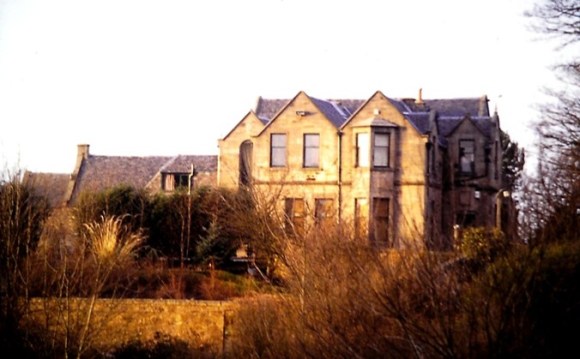
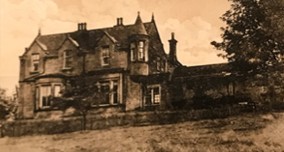
To the north a walled terrace allowed the house to sit astride the ridge. This face was typical weak Scottish baronial in style with a corbelled turret with a candle snuff conical roof attached to the west corner. Three dormer windows broke through the eaves of the main block and on the ground floor was a canted and a square bay window
Due to a serries of neatly articulated intakes the south façade was not as long as its counterpart. It had two gabled bays. That on the west had two windows on each of the two floors, but they were deliberately arranged asymmetrically. That on the east had a two-storey triangular bay window down its centre. This may be compared with the triangular oriel windows at Carriden House (or the much later windows on the Cinema de Luxe in Denny).
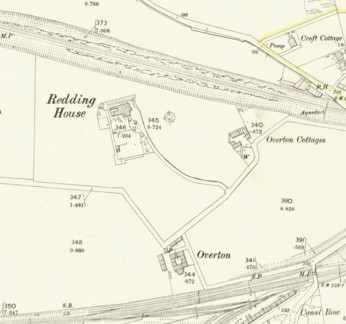
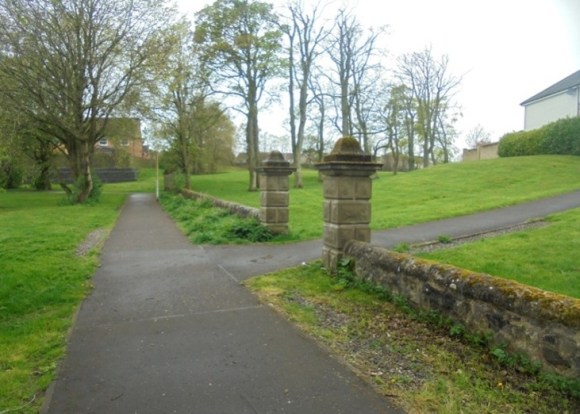
To the west of the two-storey residence was a single-storey service wing and to its south was a large walled garden which was well stocked with fruit trees. The approach road swept in from the south-east from gate piers on the Overton Road and trees were planted along the perimeter to soften the landscape.
Despite the care taken in planning the property, the proprietor decided to sell it just a few years later and in 1866 the following advertisement appeared which gives a good idea of the size of the house:
“Redding House, near Polmont, containing dining room, drawing room, parlour, library, four bedrooms, with two large dressing rooms; besides kitchen, butler’s pantry, scullery, bath-room, servants’ bedrooms, wash-house, & c., together with six acres and a half of ground. The house is in first-rate order, having been recently built by the proprietor for his own occupation, and is situated within a mile of Polmont Railway Station. For further particulars apply to John Smith and Wilson, writers, Falkirk”
(Falkirk Herald 7 April 1866).
It was bought by James Anderson Snell, iron merchant, who had been in residence in Toravon House near Maddiston. He did not spend all of his time in this part of the world and so the house was occasionally put up for rent for limited periods. In 1868 the rooms were described as “Dining Boom, Drawing Room, Library, and Breakfast Room. Four large bed rooms, with two dressing rooms, and ample servants’ accommodation.” More land was added to the curtilege and the rental advert for 1873 provides additional details:
“TO SELL OR LET, FURNISHED. For such term as may be agreed on. REDDING HOUSE and GROUNDS, extending to about 12 Acres or thereby, situated about a mite west of Polmont Station, on the Edinburgh and Glasgow Railway.
The House, which is on rising ground, commands one of the finest views in Scotland. It is built with all the modern improvements, and has throughout an abundant supply of water, hot and cold. It is handsomely furnished, and contains large dining and drawing rooms, parlour, and five bed rooms, also day and night nurseries, bath room, butler’s pantry, and large cellarage, etc. There is a coach house and stables, also a good walled garden, having a southern exposure, and about ten acres of Land for grazing may be had if desired…”
(North British Daily Mail 10 February 1873, 8).
Snell was based in Glasgow, with branches and companies elsewhere, including London. However, he overstretched himself and was declared bankrupt and his assets sequestered in October 1877. In January 1878 the mansion and land were offered for sale at the upset price of £2,000. John Parker, accountant, was appointed as the executor to the estate and the following May the household furniture and plenishing of Redding House was sold by public auction to raise money for the creditors. The list of material provides an interesting insight into the appearance of the interior of the house at that time:
“In Dining-Room – mahogany pedestal sideboard, filled back; mahogany telescope dining table, 12 feet; chiffonier, leaf-holder, suite of 10 vase-back chairs, 2 easy chairs, and roll-back sofa in haircloth; mahogany fire screen, sewed-work centre; set damask curtains and gilt window pole, carpet, hearth rug and skin matt, fender, fire-irons, copper scuttle, ornaments, &c.
In Drawing-Room – rosewood suits, upholstered in rich figured crepe and slips of 6 small chairs, easy chair, ladies’ chair, one-end couch and divas sofa, set curtains for two windows (to match) and gilt poles, 2 gilt occasional chairs, upholstered in rich crimson flowered silk; handsome gilt pier mirror, with marble console table; rosewood circular table, on pillar and claw; rosewood fire screen, sewed work centre; rosewood Canterbury, rosewood cottage pianoforte. 6 7/8 octaves, by Collard & Collard, registered keyboard and truss legs; rosewood piano stool, walnut 3-tier whatnot, walnut card table, walnut envelope case, mantelpiece mirror in gilt frame, circular table, with marble top, beautifully inlaid; Japanned coal vase, set 4 steel fire-irons, pair crystal lustres, 2 pairs Dresden figures under shades, pair Parian marble figures under shades, & c & c.
Library in light oak – harmonium by Alexandre, 11 stops; circular table on pillar and claw, suit of 6 small chairs, easy chair and sofa in green morocco, dwarf open bookcase, 6ft 6 x 3ft 9; terrestrial globe on high stand, 2 stucco busts on circular pedestals, pair Indian China vases, fender and fire irons, brass mounted coal vase, carpet and hearth rug, damask curtains and gilt window poles; also, a small and select library of about 250 volumes books.
Bed-room, in light oak, comprising French bedstead with green repp curtains, 2-door wardrobe, double basin stand and ware, toilet table and dressing glass, chamber stand, night stool, towel rail, 2 chairs in repp, curtains, muslin curtains, straw and hair mattresses, feather bolster and pillows, blankets, & c.
Bed-room in dark oak, comprising 2-door wardrobe, double basin stand with marble top and gilt ware, toilet table and dressing glass, chamber stand, night stool, 3 carved chairs, cane seated; iron and brass Duchess bedstead with chints curtains, straw and 2 hair mattresses, feather bolster and 3 pillows, 2 pair blankets, &c; sofa in crimson damask, 3 sets damask window curtains and gilt cornices, fender, fire irons, and coal depot, carpet and rug, & c.
Bed-room, in rich dark mahogany, comprising tester bedstead and damask curtains, 4-door wardrobe, double basin stand, marble top; very handsome hand-painted toilet ware, toilet table and dressing glass, chamber stand, night stool, bedette, 2 chairs in damask, towel rail, carpet, rug, and skin mat, 4-leaved fire screen, straw and hair mattresses, feather bolster and 4 pillows, 2 pair blankets, &c.
The nursery and furniture of other bedrooms includes birch French bedstead, 2 birch baic stands and ware, 2 chests birch drawers, birch toilet table and dressing-glass, birch chamber stand, marble top; birch towel rail, 2 birch chairs in repp, bedroom chairs, towel rails, iron and other bedsteads, painted wardrobe, carpets, rugs, sets damask and muslin curtains, fenders, fire-irons, coal depots, hair and straw mattresses, blankets, &c.
In hall and upper landings – oak hall table with hat pegs, oak hall table, oak circular hall table, carved oak hat stand, oak dinner waggon, 3 cases stuffed birds, 7 oak hall chairs, 11 skin mats, 6 deer skins, wheel barometer in oak case, Fitzroy barometer in oak case, Indian gong on circular oak stand, large japanned coal vase, Brussels stair and landing carpet and 25 brass rods, 2 iron chairs, 2 life-size statuary figures on square pedestals, 5 statuary busts on circular pedestals, 4 stucco groups, 3 magnificent deer heads and antlers, 10 deer’s and goats’ heads, oilcloth, hall lamp for oil, &c.
Fine proof engravings, &c. include “Wellington Banquet,” in rich gilt frame, “Shoeing Forge,” “Milking Time,” “Presentation in the Temple,” in gilt frame, “Christ among the doctors” from Holman Hunt’s Picture, “The Secret of England’s Greatness,” “Queen Elizabeth and the Doctors,” “Cromwell refusing the Crown,” “Fight for the Standard,” “The Combat,” set of three cartoons from “Vanity Fair.” Oleographs, prints, &c.
Kitchen, laundry, and pantry – 3 tables, 3 chairs, sets 6 dish covers, brass pan and winter, roasting jack and screen, set steps, sundry crockery and cooking utensils, patent mangle by John Findlay 36in rollers; 2 sets winter dykes, set of fine cut and engraved crystal, dinner ware, & c.
Miscellanea – 4 washing tubs, milk dishes, 3 garden seats, garden roller, garden tools, wheelbarrow, and sundry effects…”
(North British Daily Mail 30 April 1878, 7).
Redding House was bought by David Mathie Peebles who had been the Bank of Scotland agent in Falkirk from around 1870. He was a quiet man and whilst his wife took part in the social life of the area, attending fetes and the like, he stayed out of public life apart from becoming a director of the Falkirk Certified Industrial School in 1892. Unlike his predecessor he did not cultivate the land at Redding House for oats and ryegrass, and instead let it out as pasture for sheep. He died at Redding House on 18 May 1901.
Redding House was soon put up for sale and this took some time to find a buyer. It was let to William Watson who in 1903 moved to his town house and sold off his surplus furniture and greenhouse plants at Redding. The new owner of Redding House was Alexander William Steven, ironfounder. In 1914 he became chairman of McDowell, Steven & Co Ltd, Laurieston Iron Works, and in 1918 was appointed as a Justice of the Peace for the County. He and his wife were very active amongst the community – crowning the Redding Fair queens, opening fetes and bazaars, and the like. Mr Steven was associated with the local Scouting Association. During the First World War he was elected as commandant of Polmont & District Volunteer Training Corps. Towards the end of that war one of his gardeners was called up for military service. He appealed because agricultural workers were usually exempt. He had been ten years in that employment and was paid a wage of £1 7s 6d per week, with coal and house. It was said that he assisted in the cultivation of a field six acres in extent – the field had previously been in grass, but had been put in oats and potatoes (again) especially for the war. About a fortnight before the tribunal hearing he had secured work in Nobel’s Explosive Works, and then did his gardening work in his spare time. He had four children and was 45 years of age. It made little difference and he was told to join up within one month (Falkirk Herald 20 July 1918, 3).
By 1929 A.W. Steven had moved to Polmont Bank and Redding House had been put on the market:
“STIRLINGSHIRE. Polmont. Desirable Residence for Sale. For Sale by Private Bargain. Redding House, Polmont, with Grounds extending to about 11½ Acres The House, which is in excellent order, contains 3 Public Rooms, 5 bedrooms, (1 with dressing room), 2 bathrooms, and ample kitchen and servants’ accommodation. Central heating and acetylene gas installation. The offices consist of a gardener’s cottage and a garage (heated).
The garden is well stocked and productive, with hot-house. There is a good tennis lawn.
The House is situated about 1 ¼ miles from Polmont Station.
There are also 5 cottages, which, with the grazing on the policies, yield a rent of £48 16s 6d. Casualties charged…”
( Scotsman 11 July 1925, 3).
During 1928 and 1929 Redding House was occupied by Mr and Mrs Sangster. By this time it was getting harder to find tenants for large houses and in 1931 Redding House was offered for sale at the throw-away upset price of a mere £500!
“For sale by public roup within the FACULTY HALL, ST. GEORGE’S PLACE, GLASGOW, on WEDNESDAY. 4th MARCH, 1931, at 2 p.m. (unless previously sold privately). REDDING HOUSE, POLMONT. This COUNTRY HOUSE stands in nicely-timbered Grounds of between 11 and 12 Acres. Fine views of the Ochils, Stirling Castle, etc. Contains large entrance hall, 3 public, 5 bedrooms, dressing-room, 2 servants’ rooms, and complete office, central heating. Acetylene gas.
Commodious garage (heated). Large fruit and vegetable gardens. Tennis lawn.
Excellent soil, and the ground is highly suitable for poultry farming, market gardens, or similar purpose.
6 small cottages and grass park yield about £46 per annum.
Assessed rent of house, £75. Feu duty, £84 16s 6d.
To ensure a sale, the subjects will be offered at the throw-away upset price of £500…”
(Falkirk Herald 14 February 1931, 2).
Alexander Ernest Thomson snapped it up – though he presumably had to pay ore that the upset price. He was the son of Mr and Mrs A. W. Thomson, “Stratbendrick,” Falkirk, and had served with the Durham Light Infantry in the First World War. As Second Lieutenenat he had been wounded in 1918 and spent some time in a Canadian hospital in France. Perhaps it is not surprising that after the war he took a leading role in the local Toc H.
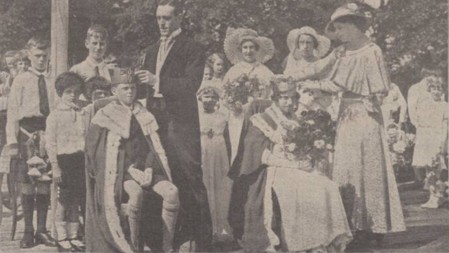
He was a prominent businessman and a director of Mackinlay and Thomson, Ltd, ladies’ and children’s outfitters, Vicar Street and Princes Street, Falkirk. He eventually became president of the Falkirk Burgh Merchants Association. He and his wife were extremely active amongst the local community. Mrs Thomson was the only daughter of Mr and Mrs D. McIntosh, St Fillans, Grange Terrace, Bo’ness. Each year they gave permission for a platform to erected in a park at the Overton estate for the crowning ceremony of the Redding Gala which was normally attended by a crowd of three thousand or so spectators.
The Second World War saw the Thomsons at their best. At the time of greatest need they stepped forward. Ernest Thomson became a captain in the local Home Guard and was chairman of the Redding and Westquarter Mobile Canteen Committee. At the very beginning of the war Elizabeth Thomson gathered together a small work party of local ladies to form a Comforts Work Party to knit socks, gloves, and other garments for local men and women serving in the armed forces. Redding House became the headquarters of the group where the garments were assembled and despatched to men serving in Egypt, India, Singapore, Palestine, and the B.E.F. and Home Forces. In September 1940 the Redding and Westquarter War Comforts Association, based at Redding House, was registered under the War Charities Act of 1940. Both Thomsons were heavily involved in other war charities.
Alexander Ernest Thomson died on a visit to London on 21August 1949, aged just 51 years. Redding House and 11 acres of land were quickly bought by Falkirk Council which was eager to have the resources to implement the new Children’s Act. In the winter of 1950 council workmen undertook repairs and alterations to the house, discovering a water clock of 1650 in the cellar (now in Falkirk Museum). Over the year Falkirk Council spent £6,061 on purchasing and adapting the building for use as a Children’s Home. Typical of council property, it became the target for a theft of lead in 1951 when 5 ½ cwt was stolen from the roof by two local men. Miss McIntosh was appointed as the first Children’s Officer and Miss Allan as the residing matron of the Redding House Children’s Home which opened late in 1951. The Home was intended to help in caring for children not yet ready for adoption or boarding-out and provided accommodation for up to 20 residents. The new Home was well supported by the generosity of local groups who donated food, toys, clothes and other items. The children were often taken to watch entertaining performances of various kinds.
One of the residents was destined to be a week old baby found on a doorstep in Garden Terrace, Falkirk, in March 1961. He became named Andrew Kirk after Falkirk. In 1974 Redding House was described as “an all-purpose local authority home with accommodation for 20 children aged 0-17 years” (Scotsman 14 August 1974, 17). It was about to change its role to one of reception and assessment of children coming into the authority’s care, and to take more problematic children as a long stay unit to accommodate both sexes. With local government reorganisation the Home was transferred to Central Regional Council. By August 1984 it housed eight 14 to 16-year old disturbed children, some of whom had just rioted and smashed furniture and broken over 30 windows. Police and a senior social worker were called in. A series of incidents of bad behaviour followed.
The Children’s Home at Redding House was closed in April 1986. Central Regional Council Social Work Department insisted that it was closed because it was surplus to requirements, and not because of discipline problems, even though it had recruited six additional staff just a year before. The following year it was put up for sale as suitable for conversion into flats. In April 1991 Don Jack was granted a relaxation of building regulations to construct a separating floor inside the property for that purpose.
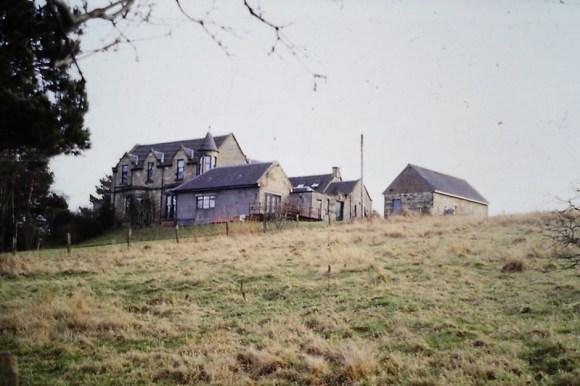
In the event it was taken over by Stuart Robertson of the Ideas company and extensively restored over a two-year period, retaining many of the original features. The gardens have been landscaped in a modern style to harmonise with the setting.
Bibliography
NEWSPAPERS
Falkirk Herald, 27 February 1864, 3: Mrs Alexander, Redding House.
Falkirk Herald, 7 April 1866;
“Redding House, near Polmont, containing dining room, drawing room, parlour, library, four bedrooms, with two large dressing rooms; besides kitchen, butler’s pantry, scullery, bath-room, servants’ bedrooms, wash-house, & c., together with six acres and a half of ground. The house is in first-rate order, having been recently built by the proprietor for his own occupation, and is situated within a mile of Polmont Railway Station. For further particulars apply to John Smith and Wilson, writers, Falkirk.”
Falkirk Herald, 2 March 1868, 7:
VILLA RESIDENCE NEAR POLMONT – TO BE LET, UNFURNISHED. REDDING HOUSE, near Polmont, with Garden and Grounds attached, to be Let, for such period as may be agreed on, Entry immediately or at Whitsunday next.
The House contains Dining Boom, Drawing Room, Library, and Breakfast Room. Four large bed rooms, with two dressing rooms, and ample servants’ accommodation. It stands on rising ground, about a mile west of Polmont Station, and commands beautiful views of the Forth, the Grampians, and the Ochils…
Falkirk Herald, 29 July 1869, 4:
OATS, AT REDDING HOUSE, on WEDNESDAY, 4TH AUGUST. JAMES NEILSON will Sell by Public Roup, on WEDNESDAY the 4th-August, 1869, on the POLICY GROUNDS at REDDING HOUSE, belonging to James Anderson Snell, Esq., 7 ACRES of SPLENDID OATS…
Glasgow Herald, 7 June 1870, 5:
At Redding House, Stirlingshire, on the 5th inst., Mrs James Anderson Snell; a daughter.
Falkirk Herald, 3 February 1872, 3:
At Redding House, Stirlingshire, on the 31st ult., John Whitehead Snell.
North British Daily Mail, 10 February 1873, 8:
TO SELL OR LET, FURNISHED. For such term as may be agreed on. REDDING HOUSE and GROUNDS, extending to about 12 Acres or thereby, situated about a mite west of Polmont Station, on the Edinburgh and Glasgow Railway.
The House, which is on rising ground, commands one of the finest views in Scotland. It is built with all the modern improvements, and has throughout an abundant supply of water, hot and cold. It is handsomely furnished, and contains large dining and drawing rooms, parlour, and five bed rooms, also day and night nurseries, bath room, butler’s pantry, and large cellarage, etc. There is a coach house and stables, also a good walled garden, having a southern exposure, and about ten acres of Land for grazing may be had if desired…
North British Daily Mail, 6 December 1875, 4:
At Redding House, Stirlingshire, on the 2d inst., Mrs Snell, of a son.
Paisley Daily Express, 6 October 1877, 3:
James Anderson Snell & Company, metal brokers and commission agents in Glasgow, and James Anderson Snell, metal broker and commission agent there, the only known partner that company, and also a partner of the now dissolved firms of Snell, Stuart & Company, and James Anderson Snell & Company, sometime carrying on business as merchants and commission agents in Glasgow, and of Stuart Snell & Company, sometime carrying on business as merchants and commission agents in London, as partner foresaid, and as an individual – sequestration of bankrupt…
Falkirk Herald, 26 January 1878, 1:
MANSION HOUSE near Polmont, Upset Price, £2000.
To be sold by Public Roup, within the Faculty Hall, Glasgow, on WEDNESDAY the 13th day of February, 1878, at Two o’clock p.m., REDDING HOUSE and GROUNDS, situated about a mile from Polmont Station on the North British Railway. The House, which commands magnificent views, is Modern and Substantial. It contains 3 public rooms and 5 bedrooms (two having large dressing rooms), with Kitchen, scullery, butler’s pantry, store-room, bath-room with hot and cold water, two servant’s rooms, and other conveniences. There are also within the grounds a two-stalled stable and coach-house, and a good walled garden in full bearing. Near the offices there are several small cottages, at present let at a rental of about £20.
The grounds extend to about 12 acres, part of which can be let in grass. Feu-duty, £84 16s 6d…
North British Daily Mail, 30 April 1878, 7:
At Auction Halls, 61 Renfield Street, on Tuesday 7th May, at TWELVE O’CLOCK. PUBLIC SALE of THE VALUABLE MODERN HOUSEHOLD FURNITURE and PLENISHING OF REDDING MANSION-HOUSE, POLMONT. (Removed and sold by instruction of John Parker, Esq, Accountant, 58 West Regent Street).
Duncan KEITH & BUCHANAN will sell, by public Auction, as above, including
In Dining-Room – mahogany pedestal sideboard, filled back; mahogany telescope dining table, 12 feet; chiffonier, leaf-holder, suite of 10 vase-back chairs, 2 easy chairs, and roll-back sofa in haircloth; mahogany fire screen, sewed-work centre; set damask curtains and gilt window pole, carpet, hearth rug and skin matt, fender, fire-irons, copper scuttle, ornaments, &c.
In Drawing-Room – rosewood suits, upholstered in rich figured crepe and slips of 6 small chairs, easy chair, ladies’ chair, one-end couch and divas sofa, set curtains for two windows (to match) and gilt poles, 2 gilt occasional chairs, upholstered in rich crimson flowered silk; handsome gilt pier mirror, with marble console table; rosewood circular table, on pillar and claw; rosewood fire screen, sewed work centre; rosewood Canterbury, rosewood cottage pianoforte. 6 7/8 octaves, by Collard & Collard, registered keyboard and truss legs; rosewood piano stool, walnut 3-tier whatnot, walnut card table, walnut envelope case, mantelpiece mirror in gilt frame, circular table, with marble top, beautifully inlaid; Japanned coal vase, set 4 steel fire-irons, pair crystal lustres, 2 pairs Dresden figures under shades, pair Parian marble figures under shades, & c & c.
Library in light oak – harmonium by Alexandre, 11 stops; circular table on pillar and claw, suit of 6 small chairs, easy chair and sofa in green morocco, dwarf open bookcase, 6ft 6 x 3ft 9; terrestrial globe on high stand, 2 stucco busts on circular pedestals, pair Indian China vases, fender and fire irons, brass mounted coal vase, carpet and hearth rug, damask curtains and gilt window poles; also, a small and select library of about 250 volumes books.
Bed-room, in light oak, comprising French bedstead with green repp curtains, 2-door wardrobe, double basin stand and ware, toilet table and dressing glass, chamber stand, night stool, towel rail, 2 chairs in repp, curtains, muslin curtains, straw and hair mattresses, feather bolster and pillows, blankets, & c.
Bed-room in dark oak, comprising 2-door wardrobe, double basin stand with marble top and gilt ware, toilet table and dressing glass, chamber stand, night stool, 3 carved chairs, cane seated; iron and brass Duchess bedstead with chints curtains, straw and 2 hair mattresses, feather bolster and 3 pillows, 2 pair blankets, &c; sofa in crimson damask, 3 sets damask window curtains and gilt cornices, fender, fire irons, and coal depot, carpet and rug, & c.
Bed-room, in rich dark mahogany, comprising tester bedstead and damask curtains, 4-door wardrobe, double basin stand, marble top; very handsome hand-painted toilet ware, toilet table and dressing glass, chamber stand, night stool, bedette, 2 chairs in damask, towel rail, carpet, rug, and skin mat, 4-leaved fire screen, straw and hair mattresses, feather bolster and 4 pillows, 2 pair blankets, &c.
The nursery and furniture of other bedrooms includes birch French bedstead, 2 birch baic stands and ware, 2 chests birch drawers, birch toilet table and dressing-glass, birch chamber stand, marble top; birch towel rail, 2 birch chairs in repp, bedroom chairs, towel rails, iron and other bedsteads, painted wardrobe, carpets, rugs, sets damask and muslin curtains, fenders, fire-irons, coal depots, hair and straw mattresses, blankets, &c.
In hall and upper landings – oak hall table with hat pegs, oak hall table, oak circular hall table, carved oak hat stand, oak dinner waggon, 3 cases stuffed birds, 7 oak hall chairs, 11 skin mats, 6 deer skins, wheel barometer in oak case, Fitzroy barometer in oak case, Indian gong on circular oak stand, large japanned coal vase, Brussels stair and landing carpet and 25 brass rods, 2 iron chairs, 2 life-size statuary figures on square pedestals, 5 statuary busts on circular pedestals, 4 stucco groups, 3 magnificent deer heads and antlers, 10 deer’s and goats’ heads, oilcloth, hall lamp for oil, &c.
Fine proof engravings, &c. include “Wellington Banquet,” in rich gilt frame, “Shoeing Forge,” “Milking Time,” “Presentation in the Temple,” in gilt frame, “Christ among the doctors” from Holman Hunt’s Picture, “The Secret of England’s Greatness,” “Queen Elizabeth and the Doctors,” “Cromwell refusing the Crown,” “Fight for the Standard,” “The Combat,” set of three cartoons from “Vanity Fair.” Oleographs, prints, &c.
Kitchen, laundry, and pantry – 3 tables, 3 chairs, sets 6 dish covers, brass pan and winter, roasting jack and screen, set steps, sundry crockery and cooking utensils, patent mangle by John Findlay 36in rollers; 2 sets winter dykes, set of fine cut and engraved crystal, dinner ware, & c.
Miscellanea – 4 washing tubs, milk dishes, 3 garden seats, garden roller, garden tools, wheelbarrow, and sundry effects…
Falkirk Herald, 1 August 1878, 1:
STIRLINGSHIRE. To Let, Unfurnished, immediately, for such period as may be agreed on, REDDING HOUSE, Polmont, distant about a mile and half from Polmont Station, and two and a half miles from Falkirk, containing 3 Public rooms, 5 bedrooms, 2 dressing-rooms, bathroom, with hot and cold water, and ample servants’ accommodation. There is a coachhouse and stable.
The house is in a healthy situation, commands a magnificent view, and is on good order.
The garden has a southern exposure, and is well stocked with fruit trees.
Mr George Bartholomew, joiner, Redding, will show the House…
Falkirk Herald, 9 March 1895, 1:
At Redding House, on the 1st inst. Andrew, eldest son of D. M. Peebles.
Falkirk Herald, 22 May 1901, 4:
We regret to record the death of Mr D. M. Peebles, formerly agent of the Bank of Scotland, Falkirk, which took place at his residence, Redding House, Redding, on Saturday. The deceased gentleman, who had reached an advanced age, had been in failing health for some time. A native of Fifeshire, Mr Peebles early in life entered the service of the Bank of Scotland. About forty years ago he held the position of accountant on one of the principal offices of the bank in Glasgow, when he was appointed to succeed Mr Macfarlane as agent of the bank in Falkirk. He held that appointment until two years ago, when the state of his health compelled him to resign. He was a shrewd businessman, and attended very closely to the interests of the bank. …
Falkirk Herald, 19 Oct 1901;
“Desirable residence for sale. For sale, privately, with immediate entry, that desirable property, near Polmont Station, known as Redding House, containing 3 public and 5 bedrooms (2 with dressing-rooms), bathroom, kitchen etc, etc,: also land adjoining House extending to about 12 acres, and small cottages thereon, yielding rental of £37.
Falkirk Herald, 18 Jan 1902;
“That eligible residence known as Redding House, with garden, ornamental grounds and land. The House, which is a substantial modern building, contains 3 public rooms, 5 bedrooms (2 with dressing rooms), bathroom, kitchen 2 servants’ rooms, etc, etc and cold water. The land extends to about 12 acres, and along with several small houses thereon yields a rental of £37.
Scotsman, 11 June 1902, 3:
STIRLINGSHIRE – TO let, summer months, or longer, country house, large sitting-room, 4 bedrooms, (2 double-bedded), kitchen, scullery, and good stable: 7 miles from Stirling; good roads, good fishing, splendid hill air, every freedom; moderate rent…
Falkirk Herald, 26 September 1903, 4:
SALE of surplus household furniture AND GREENHOUSE PLANTS, at REDDING HOUSE, near Polmont or FALKIRK, on SATURDAY, THE 3rd OCTOBER. James NEILSON & SONS, Auctioneers, have been favoured with instructions from William Watson, Esquire of Redding House (who has removed to his town residence) to Sell by public roup… list
Falkirk Herald, 23 January 1904, 1:
GRAZING to LET from now till Christmas, at REDDING HOUSE, extending to 9 Acres or thereby. Particulars may be had at the House. — Sealed Offers to be sent to Wm. Watson,,
June 1905 – Mrs Steven, Redding house
Mr Alexander William Steven
Chairman of local Scouting Association
1915 – elected commandant of Polmont & District Volunteer training Corps.
1918 become JP.
Chairman of McDowell, Steven & Co Ltd, Laurieston Iron Works.
Falkirk Herald, 20 July 1918, 3:
An appeal was lodged against the decision of the Local Tribunal by the National Service Representative in the case of a gardener employed at Redding House. The man affected resisted this on the ground that he assisted in the cultivation of a field six acres in extent. He had been ten years in his present employment, and was paid a wage of £1 7s 6d per week, with coal and house… the field had previously been in grass, but was now in oats and potatoes. About a fortnight ago the man had secured work in Nobel’s Explosive Works, and now did his gardening work in his spare time. He had four children and was 45 years of age. He had been a Volunteer.
The man was told to join up in one month.
Scotsman, 11 July 1925, 3:
STIRLINGSHIRE . Polmont. Desirable Residence For Sale. For Sale by Private Bargain. Redding House, Polmont, with Grounds extending to about 11½ Acres The House, which is in excellent order, contains 3 Public Rooms, 5 bedrooms, (1 with dressing room), 2 bathrooms, and ample kitchen and servants’ accommodation. Central heating and acetylene gas installation. The offices consist of a gardener’s cottage and a garage (heated).
The garden is well stocked and productive, with hot-house. There is a good tennis lawn.
The House is situated about 1 ¼ miles from Polmont Station.
There are also 5 cottages, which, with the grazing on the policies, yield a rent of £48 16s 6d. Casualties charged…
Falkirk Herald, 27 October 1928, 7: Mrs Sangster, Redding House.
Falkirk Herald, 14 February 1931, 2:
For sale by public roup within the FACULTY HALL, ST. GEORGE’S PLACE, GLASGOW, on WEDNESDAY. 4th MARCH, 1931, at 2 p.m. (unless previously sold privately). REDDING HOUSE, POLMONT. This COUNTRY HOUSE stands in nicely-timbered Grounds of between 11 and 12 Acres. Fine views of the Ochils, Stirling Castle, etc. Contains large entrance hall, 3 public, 5 bedrooms, dressing-room, 2 servants’ rooms, and complete office, central heating. Acetylene gas.
Commodious garage (heated). Large fruit and vegetable gardens. Tennis lawn.
Excellent soil, and the ground is highly suitable for poultry farming, market gardens, or similar purpose.
6 small cottages and grass park yield about £46 per annum.
Assessed rent of house, £75. Feu duty, £84 16s 6d.
To ensure a sale, the subjects will be offered at the throw-away upset price of £500….
Falkirk Herald, 6 June 1931, 2:
Experienced Housemaid Wanted. — Apply Mrs A. Ernest Thomson, Redding House.
Falkirk Herald, 5 July 1933, 12:
platform erected in a park at the Overton estate of Mr. Ernest Thomson, Redding House. The ceremony was witnessed by a crowd of three thousand spectators drawn from the East Stirlingshire district.
Falkirk Herald, 2 December 1939, 5:
This week a representative the “Falkirk Herald paid a visit to Redding House, the headquarters the Redding and Westquarter War Comforts Association, and watched the work in progress in connection with the assembling and despatch of the first consignment of parcels to the local men serving in H.M. Forces. Parcels have been sent to men serving in Egypt, India, Singapore, and Palestine, and a large consignment is being prepared for men serving in the B.E.F. and Home Forces.
The progress which the association has made in the short space of seven weeks is truly noteworthy. The venture was started early in October by Mrs Thomson of Redding House, who gathered together a small work party of local ladies…
Bo’ness Journal, 8 December 1939, 6:
other Comforts Work Parties we note a very active band of workers which has been organised by Mrs A. Ernest Thomson, of Redding House, Falkirk. Mrs Thomson is the only daughter of Mr and Mrs D. McIntosh, St Fillans, Grange Terrace, Bo’ness Six weeks ago … knit comforts…
Falkirk Herald, 21 September 1940, 1:
War Charities Act, 1940. Notice is hereby given, that it is proposed to apply to the County Council of the County of Stirling for the registration under the above mentioned Act of “Redding and Westquarter War Comforts Association,” the objects of which are as follows: To receive donations or subscriptions in money or in kind for the purpose of providing Comforts for local men serving in His Majesty Forces; and the administrative centre of which is situated at Redding House, Falkirk…
Falkirk Herald, 27 August 1949, 5:
His numerous friends in Falkirk and district will learn with regret of the death of Mr Alexander Ernest Thomson, of Redding House, Polmont. Mr Thomson was on a visit to London when he was taken suddenly ill on Thursday last week and died on Sunday morning [21st]. Fifty-one years of age, Mr Thomson was a son of the late Mr A.W. Thomson, Falkirk and of Mrs Thomson, Strathendrick, Major’s Loan, Falkirk. Deceased was a director of Messrs Mackinlay and Thomson, Ltd, ladies’ and children’s outfitters, Vicar Street and Princes Street, Falkirk, where he was exceedingly well known.
Mr Thomson took an active interest in the business and social affairs of the town, he was a past president if the Falkirk Burgh Merchants’ Association, and was a founder member of the Rotary Club of Falkirk. Locally, he took a leading part in the Toc H. movement. An officer in the Durham Light Infantry during the Great War of 1914-18, he was badly wounded, and in the recent war he was an officer in the Polmont contingent of the Home Guard.
Mr Thomson is survived by his wife, and by his mother.
Falkirk Herald, 2 August 1950, 1:
general expansion in particular by the purchase of equipment and subsequent maintenance of the new Children’s Home at Redding House, together with a substantial increase in costs at Windsor Hospital, which, incidentally, on patient day figures still cannot…
Falkirk Herald, 16 December 1950, 5:
INTERESTING FIND AT REDDING. Workmen expose 260 years old clock. Workmen carrying out renovations at Redding House, Polmont, near Falkirk, made an interesting discovery in the cellar. There they found a curious clock which has since been identified as a clepsydra, or water clock.
The clock bears the inscription “W. Bentley, Anno Domini 1650, Winchester.” It has only an hour hand which is operated by a pulley arrangement when the water level in a tank below sinks, the water escaping through a small tap into another tank lower down.
The face and tanks of the clock are made of brass, with a backing of wood. The engraving and carving are delicate and are obviously the work of a master craftsman. On one tank there is engraved the Royal coast-of-arms, and on the other a windmill is depicted. The engraver seems to have had some Dutch influence in his work for the wood is carved in a design of tulips.
The clock is at present in the office of Mr A.J.M. Currell, Falkirk, Burgh Architect. It is in good working order, and keeps reasonably accurate time. When it has been properly cleaned and polished it will be housed in the museum at Dollar Park, Falkirk.
The water clock was the chronometer of the Greeks and Romans…
Falkirk Herald, 6 June 1951, 6:
ANOTHER LEAD THEFT Stolen from roof of Redding House. TWO MEN CONVICTED. Two labourers who appeared in custody at Falkirk Sheriff Court on Tuesday, admitted stealing 5 ½ cwts. of lead from the roof of Redding House, Redding, the property of Falkirk Town Council…
Falkirk Herald, 25 July 1951, 1:
Falkirk Council to borrow £6000 for the purchase and adaptation of Redding House.
[£6,061 spent for the Children’s Home]
Falkirk Herald, 27 October 1951, 8:
The speaker at a meeting of the Erskine Church, Falkirk, Women’s Guild, on Tuesday evening was Miss M’Intosh, Falkirk’s recently appointed Children’s officer, whose subject was “Deprived Children.” She spoke of the changes brought about by the Children’s Act, based on the recommendations of the Clyde Report. Everything related to the care and welfare of these children was now the responsibility of a Children’s Committee whose executive was the Children’s Officer. This was not simply administration, but had greatly improved conditions for the children. Miss M’Intosh spoke of the Children’s Home shortly to be opened at Redding House, and how it would help in caring for children not yet ready for adoption or boarding-out. Many questions were asked about choice and supervision of foster-parents, and other details of the work…
Falkirk Herald, 4 April 1953, 9:
Miss Allan matron of Redding House Children’s Home.
Falkirk Herald, 9 May 1953, 7:
—the first step after a visit to the home was to admit the child to a children’s home. In Falkirk’s case, the home was Redding House. Miss M’Intosh said that the ideal home was large enough to accommodate 18 children. The staff should possess some nursing experience and some experience in the care of children. Above all, they should be fond of children. The home itself, although it should not be lavishly furnished, should give the impression of a homely atmosphere…
Falkirk Herald, 28 November 1953, 7:
REDDING HOUSE MATRON.—Falkirk Town Council have appointed Miss Dorothy Bardason, 82 Oaklands Road. Hanwell, London, as matron at Redding House. She will commence her duties on 16th December.
Daily Record, 14 March 1961, 5:
. baby found on a doorstep in garden Terrace, Falkirk… a pink flannel sheet and a part of an Ayrshire blanket hand-stitched along one hem. The baby is now being cared for at Redding House, Falkirk Corporation’s Home Matron Mary Macleod said: “He cannot be a week old” The baby has not been given a name and Matron Macleod said “He is still just THE baby.” [Later named Andrew Kirk].
Scotsman, 14 August 1974, 17:
Redding House is a present an all-purpose local authority home with accommodation for 20 children aged 0-17 years. However, with further developments by Falkirk Town Council in the field of Residential Care, Redding House will shortly be changing its role to one of reception and assessment of children coming into the authority’s care.
1. Qualified Assistant Matron (resident)…
Daily Record, 16 January 1976, 3:
councillor has asked for the taxi trips to be axed The children are in the Central Region Social Work Department home at Redding House Polmont Stirlingshire But they are going to school more than 10 miles away at Alloa in Clackmannanshire The round trips…
Scotsman, 3 December 1980, 19:
…cooperation and support: Redding House is an eighteen bedded, long stay unit to accommodate both sexes in a semi-rural setting situated three miles from Falkirk. : The Social Work Department is keen to develop the facilities of Redding House to provide high standards…
Daily Record, 11 August 1984, 5:
The home houses eight 14 to 16-year old disturbed children, some of whom rioted and smashed furniture and over 30 windows. Police and a senior social worker were called in.
Falkirk Herald, 3 January 1986, 1:
…caught by police and arrested they defaced the walls of Maddiston Police Office with slogans. The gang, all staying at Redding House Children’s Home, Redding, appeared from custody at Falkirk Sheriff Court on Monday on a total of six charges. The ringleader…
Falkirk Herald, 14 March 1986, 1:
BLAZE AT HOME. Fire broke out in a children’s home on Wednesday evening. Redding House, was evacuated when the fire alarm went off just before 6.30 p.m. Firemen from Falkirk fought the blaze which was confined to curtains in the games room. The cause of…
Falkirk Herald, 5 September 1986, 6:
Redding House children’s home was closed because it was surplus to requirements, and not because of discipline problems, Central Regional Council insisted this week. The home which catered for up to a dozen young people with special emotional problems, was closed in April – exactly one year after te Council recruited six additional staff at a cost of around £50,000 a year.
Police were called on several occasions to disturbances at Redding House… we thought we would need the facilities at Redding House, but it soon became clear that we were not admitting as many young people as anticipated. That was why it was closed. “Certainly there were management problems at Redding House, but it was not closed because …
Falkirk Herald, 20 February 1987, 11:
A FORMER children’s home is up for sale. Redding House would be suitable for conversion into flats, say the owners Central Regional Council. The villa set in 11 acres of ground has nine bedrooms and three public rooms. The Region’s social work department …
Falkirk Herald, 18 April 1991, 10:
The former children’s home at Redding is to be turned into offices and flats. Permission has been granted by Falkirk District Council’s Building Control Sub- Committee to relax building regulations on Redding House. The applicant is Mr Don Jack of 20 Erskine Hill, Polmont. He has been granted permission to construct a separating floor inside the property.

