
SMR 252 / NS 9488 7672
| 1806 | Major Duncan Drummond = Helen Orr (purchase) | 1813 |
| 1813 | Helen Orr (widow) | c1823 |
| c1823 | Hugh Pearson = Helen Littlejohn (purchase) | 1838 |
| 1843 | John Urquhart = Elizabeth Grubb (purchase) | 1857 |
| 1857 | John Grubb Urquhart = Jessie Kincaid (son) | 1890 |
| 1890 | Jessie Urquhart (widow) | 1900 |
| 1901 | William Brown = Henrietta Watson (purchase) | 1922 |
| 1922 | Henrietta Brown (widow) | 1944 |
| 1944 | Richard Brown | |
| 1996 | Mr & Mrs J.G. Henderson | |
| 2004 | Keith & Carole Harkness | 2013 |
| 2013 | Jeffrey Davidson |
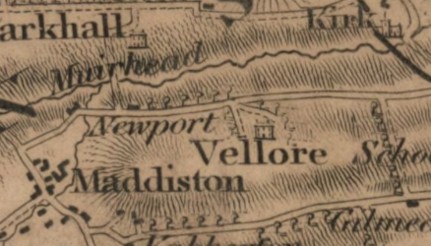
The estate of Vellore was created in the early nineteenth century. Major Duncan Drummond returned from India with sufficient funds to feu about 40 acres of the lands of Gilmeadowland – named in 1813 as
“that Park or inclosure on which the new Houses of Gilmeadowland are situated with the houses themselves, part of the said lands on the west side of the said park, and that other part commonly called Burnlee”
(Reid Notes; AOS 7455).
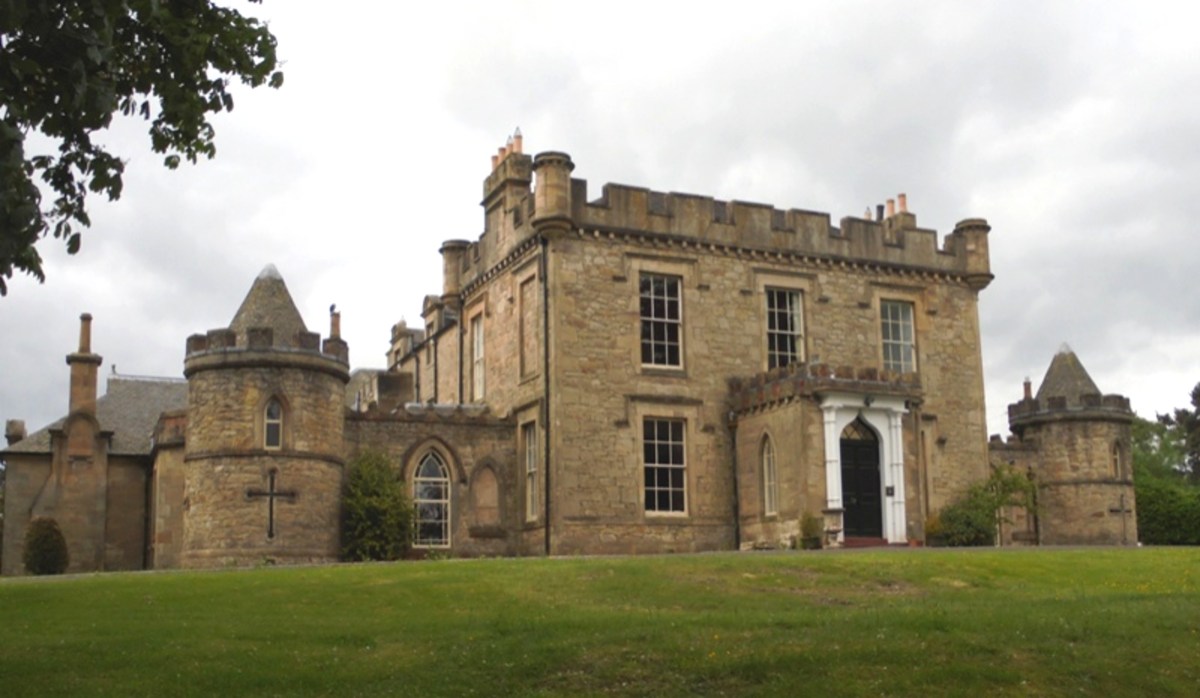
Major Duncan Drummond of the Scotch Brigade had been with the British army at Fort Vellore in India when it was besieged by Hyder Ali in 1780. The siege lasted for just over two years and on his acquisition of that part of Gilmeadowland he set about remodelling the farmhouse to create a stylised replica of the fort with its round corner towers. It is said that this included a parade ground (now gone). He quickly named his new holdings “Vellore.”
Vellore house is set on a slight hill with the principal façade facing north towards the main road from Maddiston to Muiravonside Kirk. This façade is symmetrical, in the medieval castle style, with a tall central battlemented two-storey block flanked by recessed single-storey links leading to squat two-storey round towers having conical caps. It might thus be described as a small-scale version of a pavilioned Palladian layout in the emergent Gothic style. The traditional date for the building of the “castle” was said to be 1807 which fits well into the known timeline and tastes.
The three-bay main block has large hood-moulded rectangular windows with backset margins containing 12-pane sash and case glazing. A similar window occurs in the ground floor re-entrant to either side. The two windows on the first floor on the west side are blank, as is the northernmost one on the east side. The walls are of random rubble with a dressed plinth course, a string course at the level of the ground floor window sills and backset quoins. These once highlighted a render picked out with lines to depict ashlar masonry, as still occurs above the wall head. The whole block is topped by a crenellated parapet with large squared merlons capped with a plain cornice, set on a dentilled corbel. There are diminutive polished ashlar bartizans at each of the four corners, with moulded corbels and curved dentilled eaves. In the centre of the east and west walls the merlon is expanded to form a large chimney stack with hood-moulded panelled sides carrying four smaller merlons each supporting a chimney can. These features hide the shallow piended slated roof. A crenallated single-storey porch projecting from the central bay may be an early 19th century addition, its ornate doorpiece having been formerly flush with the main wall.
The doorpiece has an ogee arch containing a traceried fanlight under a pedimented cornice, framed on either side by three-cluster column shafts. It interrupts the dentilled cornice. The side walls of the porch each contain a single pointed arched window. These walls are of ashlar and have the same plinth course and sill band as the main block. The slated roof is in the form of a shallow pyramid and is now topped by a crown finial of lead.
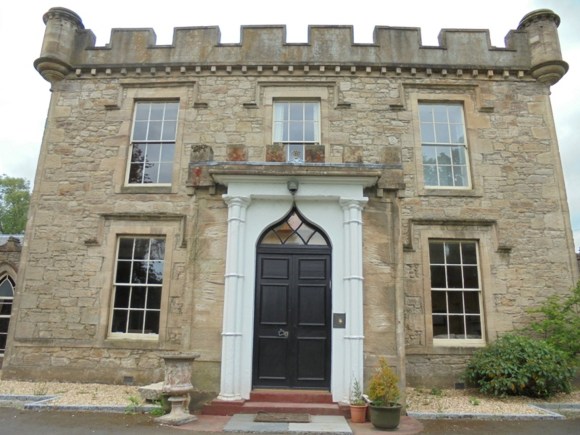
The single storey links contain three symmetrically disposed pointed-arched windows, the centre one being larger than the others and possessing a hood-mould. It also has margined glazing, whereas the other two are blank. A scalloped crenalleted wallhead of dressed masonry hides the low piended slated roof. The terminal towers are of random rubble with dressed margins, including a rounded plinth course, plain string or sill course and moulded corbel to the battlements. The ground floors are dominated by large glazed crosslets loops facing north and west or east. Directly above these are small pointed arched windows.
Major Drummond may be the same officer who helped Sir Walter Scott with the search for the Scottish crown jewels in Edinburgh Castle. He did not have long to enjoy his new estate, as in 1813 his widow, Helen Orr, took possession. She moved to Edinburgh and the house was rented out, subsequently being put up for sale:
“Villa for sale. To be sold by private bargain, the HOUSE and GROUNDS of VELLORE, in Stirlingshire. The Lands lie within two miles of Linlithgow and five of Falkirk, extending to about fifty acres, completely inclosed and surrounded by a belt of thriving planting, from twenty to thirty years old. The house is new, and the public rooms handsome.
The view is most commanding, comprehending no less than seven counties, the Frith of Forth, Linlithgow Palace, &c. which renders it a most desirable place of residence, and the property will be greatly increased in value by the Union Canal, which runs within a few hundred yards of it. Particulars may be learned by making application at 56 George Street, or at Vellore.
(Caledonian Mercury 15 August 1818, 3).
It appears that the house did not sell. Mrs Drummond died on 12 November 1818 and it was probably only when the lease of the house was coming to an end in June 1822 that the house was again put on the market with James Orr, a relative of Mrs Drummond, as one of the contacts. Major Bogle was the sitting tenant.
“RESIDENCE IN STIRLINGSHIIRE. To be SOLD by private bargain, THE HOUSE and LANDS of VELLORE, in the Parish of Muiravonside, 19 miles from Edinburgh, 3 from Linlithgow, and 5 from Falkirk. The House is modern, commodious, and substantial, and the public rooms, which are spacious, command one of the finest and most extensive views in Scotland. There are also a suitable coach-house, stable, and other offices, and a good kitchen garden.
…The Lands extend to 52 English acres, are subdivided into 5 inclosures, and are well sheltered, and ornamented by numerous stripes and clumps of planting. They are all presently occupied as grass parks, and are out of lease, so that a purchaser can have immediate possession. The Union Canal passes within less than half a mile of the property, on which elegant passage boats ply four times a day between Edinburgh and Glasgow, thus affording daily communication by the most pleasant conveyance, and at a very easy rate.
Major Bogle, who occupies the House, will give directions for shewing the property, and to him, or Mr James Orr, 100 South bridge; or Mr John Brown, Fountain Bridge; or Messrs Donaldson & Ramsay, W.S., 73 George Street, application may be made for farther information.”
(Caledonian Mercury 29 June 1822, 1).
This time it did sell and the new owner was Hugh Pearson of Myrecairnie, son of William Pearson of Kippenross, Stirlingshire. He had been a commander in the Royal Navy and saw service with Nelson before retiring from active service in 1815. It had been a lucrative time to be in the navy with plenty of prize money going around. Hugh Pearson and his wife, Helen Littlejohn, lived at Vellore and raised their family there. Indeed, the births of some of their children, and of friends’ children, are recorded at the house; as is the death of Lieutenant James Rattray of the 4th Regiment N.I. on 31 July 1831. The family burial plot lies on the south-west side of Muiravonside Parish Church:
52. Wall. 1.80 x 0.84 m. TO THE MEMORY OF/ HUGH PEARSON ESQR/ OF MYRECAIRNIE/ COMMANDER ROYAL NAVY/ WHO DIED AT VELLORE/ IN THIS PARISH THE 19th/ OF NOVEMBER 1838/ AND OF HIS TWO DAUGHTERS/ WHO BOTH DIED AT VELLORE/ MARGARET ANNE PEARSON/ ON THE 28th AUGUST 1836/ AGED 10 AND MARY PEARSON/ THE 31st JANUARY 1835/ AGED 4/ ERECTED/ BY HIS AFFECTIONATE/ WIDOW AND FAMILY.
53. Wall. 1.50 x 0.63 m. (a) In Memory of/ HELEN LITTLEJOHN/ RELICT OF/ HUGH PEARSON/ COMMANDER R.N./ WHO DIED IN EDINBURGH/ 18th JANUARY 1869./ AGED 72./ ALSO OF/ HUGH PEARSON/ THEIR SON/ LIEUT. R.N./ WHO DIED IN AUSTRALIA/ 17th JUNE 1856,/ AGED 27./ ALSO OF/ JANE CAMPBELL PEARSON/ THEIR SECOND DAUGHTER,/ WHO DIED IN EDINBURGH/ 1st MAY 1902,/ AND IS INTERRED HERE.
It would have been during the Pearson’s time that a three-storey jamb or wing with a hipped roof was added to the south of the main block, aligned north/south. This was attached to the eastern part of the main block and was originally relatively plain with backset margins and a southern gable having a plain skew. Despite the difference in the number of floors, the extension was almost the same height as the main block and one of the merlons was given a pointed top to accommodate the ridge. A narrow porch-like return of the same height covered the central doorway of that block, providing a new entrance.
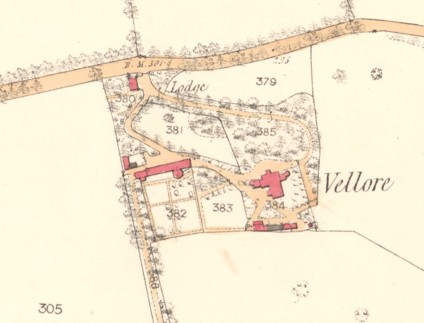
The house was acquired in 1843 by John Urquhart senior, whose son John Grubb Urquhart married Jessie Kincaid of Bowhouse in 1847. JG Urquhart inherited the estate in 1857 and soon became an important figure in the local community. He was often seen at agricultural shows winning prizes for his farm stock. He was a Justice of the Peace and faithfully attended the sittings of the Licensing Courts. He was a Commissioner of Supply and Income Tax Commissioner. He also served on the School Board of the Parish of Muiravonside when the Education Act first came into operation. He was a prominent member of the Parish Church of Muiravonside, and spent a large sum of money in improving the Session-house, and in providing the church with suitable utensils. He was a sponsor of clubs and church groups. At his own expense he constructed a pond in front of the house near the road in 1867 and founded the Vellore Curling Club, and shortly afterwards the Vellore Bowling Club for which he converted the front lawn into a green. In 1869 he was made an ensign of the 1st Linlithgowshire Rifle Volunteers and subsequently entertained its members at the house where they performed drills, bringing back the military air. During his ownership it was referred to as “Vellore Castle.” A firing range near the house could be used for distances up to 400yds (afterwards this was known as the Target Field). He went on to achieve the rank of captain.
As well as staging several meetings of the Torphichen Rifle Volunteers, the house and its grounds played host to other groups. The Muiravonside Games were held here annually from 1866 onwards. Several church groups were also given the use of the grounds for annual excursions from Linlithgow, Maddiston and the surrounding area, sometimes arriving by canal barge.
JG Urquhart also owned the 27-acre farm of Craigs at Brightons near Polmont. This proved to be a good source of income, not so much because it was rented to tenant farmers, but because the urban expansion of the time meant that it could be feued out periodically to members of the upper middle classes in half acre plots. An unusual legal case was brought before the Court of Session in November 1886 between the marriage contract trustees of John Grubb Urquhart of Vellore on the one part, and Mr Urquhart and his wife on the other. They had now reached the age of 60 years and, there being no children of the marriage, and so it was decided that Mr Urquhart was entitled to have the trust terminated, and the whole of the property disposed of by that deed conveyed to him absolutely. John Urquhart died in June 1890.
Falkirk Herald, 2 June 1900, 7: His widow, Jessie Urquhart, continues at Vellore until her death there on 26 May 1900. She had taken a keen interest in the social life of the area and was acknowledged as the patroness of the curling club. As the couple had no children the will of John G. Urquhart now came into play. To the Kirk-Session and heritors of the parish he left the sum of £2,000 for the erection of a new church, and also two acres of ground, free of feu-duty for ever, for the purpose of forming a suitable burying ground for the parish. The church was eventually built at Cairneymount.
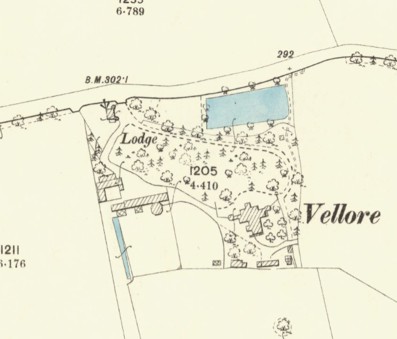
In February 1901 the usual sale of a large quantity of furniture was held (see Falkirk Herald 27 February 1901, 4, for details). The house was bought by William Brown, a Glasgow banker. His wife, Henrietta, was a daughter of Sir John Watson of Earnock, the first baronet. When their furniture was being moved from The Knowe, Milton of Campsie, to Vellore, on a heavily laden van drawn by three horses, the horses panicked in Falkirk town centre and the driver was killed (Falkirk Herald 25 May 1901, 4).
The south wing was further extended by the Falkirk architect James Strang in 1905/6 for the Browns when a two-storey accommodation block was placed across its southern end, extending a little beyond it to the east. It has snecked rubble walls in a pinkish sandstone and a piended slated roof, aligned W/E. The upper floor window surrounds stand slightly proud of the wallhead and are capped with corniced round-headed pediments. Those on the east side contain the inscriptions “WB” and “1906”. As further improvements followed this design was incorporated into the existing dormers of the early 19th century wing. 1905 also saw the construction of a recreation or billiard room behind the western tower, linked to it by a short corridor. A tall square chimney stack near its north-west corner bears the inscription “19 WB & HB 05” on its splayed moulded foot. Two large windows to the south have the round-headed pediments, again inscribed; that on the west bearing two monograms – “WB HB”, the other the date “1905”.Again the roof is piended and it stands as a semi-separate structure.
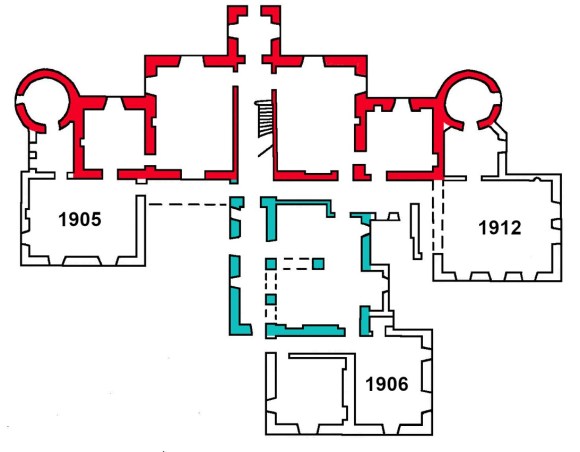
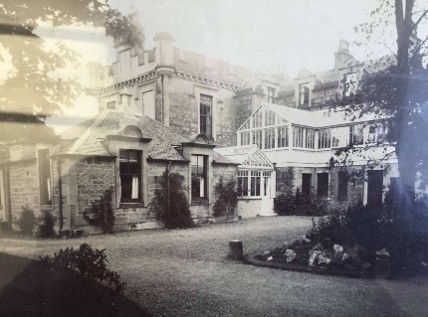
In 1912 this was balanced by another pavilion or smoking room in a similar position behind the eastern tower (but slightly protruding to the east). It too has two large windows, this time with plain round-headed pediments. The roof has gabled hips. The tall chimney on the north wall protrudes from it and is heavily moulded. The link to the tower is by an angled crenelated wall, bearing a blank shield. A similar wallhead is found in the re-entrant angle between the 1906 extension and the south wing, where a small rectangular extension was inserted to improve lighting to the kitchen.
This was achieved by the use of double windows. Finally, a substantial lean-to structure was added to the west side of the south wing. It had a stone lower storey below a conservatory, which extended westward along the south side of the original block. The conservatory storey has now been lost and the lower floor greatly modified.
To the south of the house the existing outbuildings which followed the west/east boundary were demolished and replaced by substantial north/south stone structures; the western one having a heavily moulded door surround and the date 1909. The Browns were closely related to the Salvesens and in 1902 a telephone link was made between Vellore and Toravon, requiring seven telegraph poles alongside the road – now known as Vellore Road.
The Browns continued the tradition of playing a lead role in the community, allowing the grounds to be used on special occasions by various groups. Horticultural shows were promoted. William Brown gifted a baptismal font to the refurbished parish church, and Mrs Brown two communion cups, an organ, and a fine clock. Bonfires were in vogue for celebrating national events and in July 1902 the Coronation date of Edward VII was commemorated by such a bonfire at Vellore which was well attended by the public. Mrs Brown set fire to the pile amid loud cheers. Two pipers discoursed excellent music, and dancing was engaged in till 12 o’clock. Refreshments were provided by Mr Brown. Another bonfire with fireworks for the Jubilee of of George V in May 1935 also attracted large crowds, as did one just two years later in May 1937 on the Coronation Night of George VI.
William Brown died in 1922 and Henrietta carried on performing at public ceremonies until her death in 1944. Lieutenant Richard Mackenzie Watson Brown followed in his parents’ footsteps and became particularly interested in observing details of the weather, reporting his records to the Falkirk Herald.
Richard Brown was a stockbroker in Glasgow, while the other son, William Adrian Watson Brown, went into agriculture and took on the nearby Parkhall Farm.
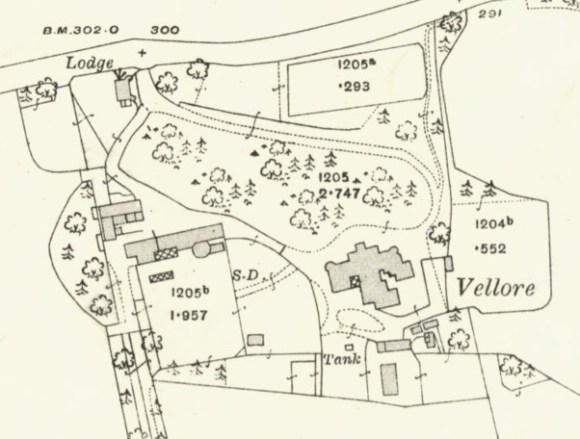
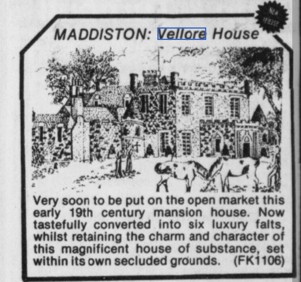
After standing empty for some time the house was converted into six “luxury” flats in 1987. However, just two years later it was announced that Drummohr Investments Ltd were to covert them into a nursing home. This did not succeed and so in 1995 the South Wing was put on sale for £52,500 with a note that it was :
“In need of refurbishment,” though “the property offers an opportunity to own part of a category B listed mansionhouse in country setting”
(Falkirk Herald 16 March 1995, 28).
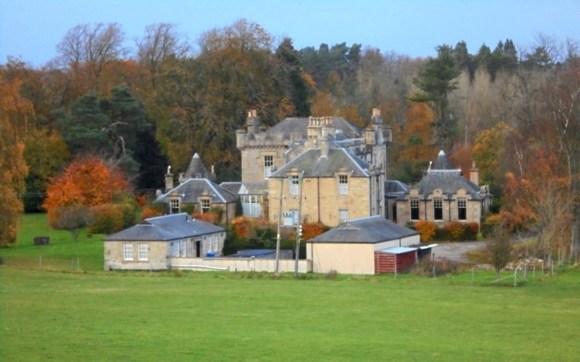
It was, in fact, the southern side of the house which was to receive the greatest attention over the following two decades. The house fell into the hands of a succession of considerate owners who kept the main façade as it was and tidied up that on the south as well as landscaping the grounds.
Bibliography
| Leask, D. | 2017 | A Historic Tour of the Parish of Muiravonside. pp.170-172. |
| RCHMS | National Monuments Record for Scotland; John Sinclair House 16 Bernard Terrace Edinburgh Three phases of building: mid 18th, late 18th and early 20th centuries. Most prominent now is circa 1790s gothick/castle style villa, with symmetrical north-facing entrance front, with rectangular-plan 2 storey, 3-bay main block at centre, and straight links terminated to either side by 2-stage circular turrets. This 1790s building was added as a new front to an earlier, mid 18th century 2-storey, 3-bay symmetrical gabled house, with slated pitched roof and corniced end stacks, orientated in opposite way (entrance to east or west) remodelled and heightened subsequently, during circa 1905 period of alterations and additions, and now largely concealed, both by 1790s building to north, and by Edwardian (1905 dated) and modern additions to south and to either side. | |
| Richard Jaques (Architect) | Active 2000/2001 | Falkirk and District: an Illustrated Guide; (RIAS/Rutland Press) VELLORE, from mid-18th century, (?) James Gillespie Graham Quixotic Gothic villa, predominantly 1790d, rectangular plan, two storey, three bay, symmetrical, with battlements, turrets, matching porch and drum tower with pepper-pot roof; 19th century interiors survive. Named after a massacre in the Indian Mutiny, 1857. [p.104] |
| Archives; Falkirk Museums; Callendar House | Dean of Guild Records – Recreation room added 1905 (a867/red/1905/15), and new smoking room, kitchen windows, etc, for William Brown in 1912 (a867/red/1912/12/1). |
NEWSPAPERS
- Caledonian Mercury, 15 August 1818, 3:
Villa for sale. To be sold by private bargain, the HOUSE and GROUNDS of VELLORE, in Stirlingshire. The Lands lie within two miles of Linlithgow and five of Falkirk, extending to about fifty acres, completely inclosed and surrounded by a belt of thriving planting, from twenty to thirty years old. The house is new, and the public rooms handsome.- The view is most commanding, comprehending no less than seven counties, the Frith of Forth, Linlithgow Palace, &c. which renders it a most desirable place of residence, and the property will be greatly increased in value by the Union Canal, which runs within a few hundred yards of it. Particulars may be learned by making application at 56 George Street, or at Vellore.
- Scots Magazine, 1 December 1818, 100:
Deaths 12 Nov. At Edinburgh, Mrs Major Drummond of Vellore, Stirlingshire. - Caledonian Mercury, 29 June 1822, 1:
RESIDENCE IN STIRLINGSHIIRE. To be SOLD by private bargain, THE HOUSE and LANDS of VELLORE, in the Parish of Muiravonside, 19 miles from Edinburgh, 3 from Linlithgow, and 5 from Falkirk. The House is modern, commodious, and substantial, and the public rooms, which are spacious, command one of the finest and most extensive views in Scotland. There are also a suitable coach-house, stable, and other offices, and a good kitchen garden.- …The Lands extend to 52 English acres, are subdivided into 5 inclosures, and are well sheltered, and ornamented by numerous stripes and clumps of planting. They are all presently occupied as grass parks, and are out of lease, so that a purchaser can have immediate possession. The Union Canal passes within less than half a mile of the property, on which elegant passage boats ply four times a day between Edinburgh and Glasgow, thus affording daily communication by the most pleasant conveyance, and at a very easy rate.
- Major Bogle, who occupies the House, will give directions for shewing the property, and to him, or Mr James Orr, 100 South bridge; or Mr John Brown, Fountain Bridge; or Messrs Donaldson & Ramsay, W.S., 73 George Street, application may be made for farther information.
- Caledonian Mercury, 3 May 1830, 3:
At Vellore on he 5th ultimo, Mrs Pearson of Myrecairnie, of a daughter. - Caledonian Mercury, 19 December 1831, 3:
At Vellore, on 31st July last, Lieut. JAMES RATTRAY, 4th regt. N. I. eldest son of Robert Rattray, W.S. - Caledonian Mercury, 7 April 1834, 3:
At Vellore, on the 24th October the Lady of A.F. Bruce Esq, civil service, of a son. - Caledonian Mercury, 18 October 1847, 3:
At Bowhouse, Stirlingshire, on the 15th current, JOHN GRUBB URQUHART, Esq. younger of Vellore, to JESSIE, youngest daughter of Alexander Kincaid, Esq. of Bowhouse. - Falkirk Herald, 8 June 1848, 1:
To Mill wrights and others. Wanted, a THRASHING-MILL, of from 3 to 4 horse power. Parties having such to dispose of may hear of a purchaser by applying, by letter, stating lowest price, to J,G,U,, Vellore, by Linlithgow. - Caledonian Mercury, 6 December 1860, 1:
WANTED MARRIED MAN as GROOM and GARDENER.—Address, by letter, to Vellore, by Linlithgow. - Caledonian Mercury, 14 November 1861, 1:
Small compact farm to let… the Lands of CRAIGS… extends to upwards of 27 acres imperial measure… application to the Proprietor, at Vellore Castle, by Linlithgow ; and offers will be received by him, by John Gair, Writer, Falkirk, till the 25th instant, when the Farm will be Let. Vellore Castle, 8th Nov., 1861. - Falkirk Herald, 28 June 1866, 1:
Muiravonside Games to take place on the grounds of Vellore games presented JG Urquhart of Vellore Castle with a handsome cane bearing the inscription: “A token of respect to J.G. Urquhart, Esq. of Vellore, from the committee of the Muiravonside Games.” It is the workmanship of Thomas Middlemas, watch maker, Falkirk. - Again July 1867 and 1868, 1869, 1870, 1871.
- Falkirk Herald, 24 January 1867, 3:
Vellore Club.On Thursday last the Vellore Club met on the new pond, kindly placed at their disposal, to compete for the elegant silver medal presented to them by their patroness, Mrs Urquhart, of Vellore, it was played for at points, and being their first attempt, all the members of this Club – which has only been formed a few weeks – were present…… - Falkirk Herald, 29 April 1869, 4:
We believe that John G. Urquhart, Esq., of Vellore Castle, has been appointed, and will shortly be gazetted, ensign of the 1st Linlithgowshire Rifle Volunteers, in the place of John Glen, resigned. - Falkirk Herald, 15 July 1869, 5:
A friendly match between two rinks of the Linlithgow Bowling Club and two rinks of the Muiravonside Club took place upon the green of the latter, at Vellore Castle, on Thursday night. The weather was not favourable, showers falling during the game, rendering the grass very wet and heavy going… - Falkirk Herald, 24 July 1869, 2:
1st Linlithgowshire Rifle Volunteers. J.G. Urquhart, Esq. of Vellore Castle, recently appointed ensign in this corps, having signified a wish to entertain them at Vellore, the company, under command of their officers, proceeded there on Thursday evening. On arriving on the grounds—the men being each furnished with ten rounds of blank ammunition – a variety of manoeuvres in light infantry drill, were gone through. On the close of the drill, the company were formed up, and a few remarks were addressed by Colonel Stirling of the 5th Lanarkshire (Glasgow) Rifle Volunteers, in the course of which he complimented Capt. Dawson, the commanding officer, on the smart appearance of the men, also on the steady and very creditable manner in which they executed the various evolutions they were ordered to perform. Immediately thereafter the company marched to the lawn in front of the castle, were a substantial refreshment awaited them… the officers and non-commissioned officers were at the same time handsomely provided for in the dining-room… - Falkirk Herald, 15 December 1870, 5:
The Volunteers.—The annual competition of the 3d Linlithgow Rifle Volunteers took place on the range on Friday last, when a large number of prizes were given. Amongst these was a handsome silver cup, presented by the late Thomas Allan Bell of Abbotshaugh, to be annually shot for; and on this occasion it was gained by Lieut. Alexander, who also took Captain Urquhart’s challenge cup with the highest aggregate score of the day… - Falkirk Herald, 16 March 1871, 5:
Deaths. At Vellore, Stirlingshire, on the 15th inst., Elizabeth Grubb, relict of John Urquhart, Esq. of Vellore… - Falkirk Herald, 24 August 1871, 3:
…a private No. 1 Company (Linlithgow) and equal number from No. 3 Company (Torphichen), took place on Saturday last on the Vellore range. The distances fired at were 200 and 400 yards—10 rounds at each. The following were the scores: - Falkirk Herald,12 October 1871, 1:
Eligible Feuing Ground close to Polmont Station. The LANDS of CRAIGS, in the parish of Polmont, and County of Stirling, situate on the ridge at Brightons Hill. The situation commands one of the finest views in Scotland, embracing the picturesque country from Inchkeith on the east to Ben Ledi on the west.- The feus will be let off at a moderate rate, in acre and half-acre lots, to suit feuars. There is abundance of rock on the ground, close to the surface, suitable for building. For further particulars apply to the Proprietor, Vellore Castle.
- Falkirk Herald, 6 September 1873, 2:
Muiravonside Flower and Vegetable Society’s Show. The second annual exhibition and competition this society took place on Friday in the grounds of Vellore Castle, which were thrown open for the occasion by Captain Urquhart. The weather was propitious, and the arrangements… [and 1876] - Falkirk Herald, 13 April 1878, 2:
Mary Mitchelson or Duncan, wife of the coachman lately at Vellore Castle. - Falkirk Herald, 27 November 1886, 2:
Court of Session – a case presented by the marriage contract trustees of John Grubb Urquhart of Vellore on the one part, and Mr Urquhart and his wife on the other, and the question was whether Mr and Mrs Urquhart being now 60 years of age and there being no children of the marriage, Mr Urquhart was entitled to have the trust under the marriage contract terminated, and the whole of the property disposed of by that deed conveyed to him absolutely, in respect that there was no prospect of any issue. After discussion, their lordships held that Mr Urquhart was entitled to have the trust terminated… - Falkirk Herald, 11 June 1887, 5:
A deputation from the Vellore Curling Club recently waited on J. G. Urquhart, Esq., the president of the club, at his beautiful residence of Vellore Castle, and presented him with a handsome hot water kettle and stand, as a token of the respect in which he is held by the members of the club. - Falkirk Herald, 14 June 1890, 4:
…the death of Mr J.G. Urquhart took place at Vellore yesterday. Mr Urquhart had been in ill-health… He was the only son of John Urquhart, Edinburgh, who purchased the estate of Vellore in 1843. Mr Urquhart was born in Edinburgh , and came to Vellore along with his father. In 1847 he married Jessie Kincaid, fourth daughter of Alexander Kincaid of Bowhouse near Grangemouth. Mr Urquhart succeeded to Vellore and to valuable properties in Edinburgh on the death of his father, which occurred on 19th January 1857. Nearly all his life Mr Urquhart identified himself with numerous public movements and associations, and was an excellent friend of the working classes of Muiravonside district. For a considerable time he acted as captain of the Torphichen Company of Volunteers. He was also a Justice of the peace, and, when in good health, was seldom absent from the Licensing Courts. He was a Commissioner of Supply and Income Tax Commissioner. He also served on the School Board of the parish of Muiravonside when the Education Act first came into operation. He was a prominent member of the Parish Church of Muiravonside, and spent a large sum of money in improving the Session-house, and in providing the church with suitable utensils. He also took a keen interest in athletics. In front of his residence was a bowling green and curling pond, to which the residenters were always made welcome. In the games Mr Urquhart took a lively interest, and he drew around him a large circle of friends. In politics, Mr Urquhart was a Conservative, and was a hard worker for his party. He was 66 years of age. There was no family from the marriage. His wife survived him. - Falkirk Herald, 9 August 1890, 5:
the late Captain Urquhart of Vellore had bequeathed the handsome sum of to be applied towards the purposes of the restoration and the embellishment of the church… - Falkirk Herald, 2 June 1900, 7:
Mrs Urquhart died at Vellore on 26 May. - Falkirk Herald, 20 June 1900, 4:
Under the will of the late John G. Urquhart of Vellore, Linlithgow, the parish of Muiravonside is to benefit considerably. To the Kirk-Session and heritors of the parish, the sum of £2000 is to be handed over for the erection of a new church, and also two acres of ground, free of feu-duty for ever, for the purpose of forming a suitable burying ground for the parish…. - 1900: Major Kincaid Smith of Vellore.
- Falkirk Herald, 27 February 1901, 4:
SELL, BY AUCTION, on TUESDAY FIRST, 5th MARCH, at VELLORE MANSION-HOUSE, LIN LITHGOWSHIRE, THE FURNISHINGS of the MANSION-HOUSE. BROUGHAM, HARNESS, STABLE and GARDEN IMPLEMENTS, and … long list - Falkirk Herald, 25 May 1901, 4:
…a heavy laden van, drawn by three horses, and belonging to Messrs Wylie & Lochhead, contractors, Glasgow, was conveying furniture from The Knowe, Milton of Campsie, to Vellore House, Maddiston… - Falkirk Herald, 5 July 1902, 5:
MUIRAVONSIDE, The bonfire erected at Vellore to celebrate Coronation was lit on Monday evening, and was attended by a considerable number of the people of the district. Mr Brown referred briefly… Mrs Brown set fire to the pile amid loud cheers. Two pipers discoursed excellent music, and dancing was engaged in till 12 o’clock. Refreshments were provided by Mr Brown… - Falkirk Herald, 13 September 1902, 6:
TELEPHONE EXTENSION. The Telephone Company having arranged to connect Toravon and Vellore Houses with a telephone service, it was agreed (so far as the Council could do so) to grant them permission to erect seven poles at the side of the road at Maddiston village on the usual conditions. - Falkirk Herald, 15 November 1902, 6:
The church, which is to be erected by means of funds left by the late Mrs. Urquhart of Vellore, will be situated at Cairneymount, Maddiston Brae, alongside the main road, about three miles from Muiravonside Parish Church - Falkirk Herald, 3 October 1903, 5:
The Heritors arranged for the repair of Muiravonside parish Church. During the work the services were held in the Templars; Hall, Maddiston. The interior of the church has been repainted by Mr Graham, painter, Falkirk, whilst a number of box seats have been taken out, and the ordinary kind put in. The memorial window to the late Rev. Mr Keith has also been altered, four new panels being added. The congregation have contributed spontaneously toward the repairs, a new communion table being subscribed for by them. Mr Brown. Vellore, has gifted to the congregation a handsome baptismal font. The choir seats have also been re-arranged. The services were conducted in the church on Sabbath last. - Falkirk Herald, 5 November 1904, 1:
GOVERNESS Wanted immediately, 2 hours, forenoon, 2 girls. First Lessons; Musical preferred. — Apply Mrs Brown, Vellore, Polmont, - Falkirk Herald, 15 September 1906, 6:
THE VALUATION of VELLORE HOUSE AND LANDS. William Brown of Vellore, Muiravonside, appealed against an assessment of £l00 for Vellore Mansion House, and £47 for the land. Mr Barr said that that was the rent which Mr Brown paid when he rented the property before becoming proprietor. - Falkirk Herald, 1 July 1911, 8:
Coronation Gala Day – The children attending the Muiravonside and Maddiston Schools were entertained on Coronation Day at Vellore in a field kindly granted Mr Wm. Brown. About 1.30 nearly 450 children had reached the entrance to Vellore House accompanied by their teachers. The procession headed by three pipers in full costume, marched in front of Vellore House, and before entering the field, Mrs Brown presented them all with a new penny… - Falkirk Herald, 27 April 1912, 3:
Muiravonside parish Church. A fine double-manual Trayser harmonium has just been presented to the congregation by Mrs Brown of Vellore for use in the services of the church. The organ hitherto in use having become completely worn out, the gift of the new instrument is highly appreciated. - Falkirk Herald, 16 September 1922, 2:
WANTED. Cook, Tablemaid, and Housemaid, beginning October. —Apply Mrs Brown, Vellore, near Maddiston. - Falkirk Herald, 3 March 1923, 8:
DEATH OLD RESIDENTER.—There Passed away on Monday morning a well-known and highly respected resident in the person of John Haldane, Vellore Castle Gatehouse, Maddiston. He had attained the ripe age of 84 years, and although not entirely confined to bed had been in … - Falkirk Herald, 12 September 1931, 8:
GARDEN PARTY AT VELLORE.—On Thursday afternoon Mrs Brown, Vellore, entertained the members of the Muiravonside and Standburn Churches woman’s Guild to a garden party … - Falkirk Herald, 4 May 1935, 11:
In connection with the Jubilee celebrations… to give the children treat and in the afternoon to hold sports. Mrs Brown, Vellore is arranging for a bonfire and firework display in the Target Field, which adjoins the Vellore estate. - Falkirk Herald, 11 May 1935, 5:
BONFIRE AND FIREWORKS AT VELLORE Mrs Brown of Vellore had a bonfire and firework display in the target field on the Vellore estate on Jubilee night. The bonfire and firework display was open to the public and large crowds took advantage of the kindness … - Falkirk Herald, 15 May 1937, 12:
BONFIRE AT VELLORE On Coronation Night a bonfire was lit in a field adjoining Vellore. Mrs Brown lit the fire at 10.30 p.m., and Mr Adrian and Mr Richard Brown gave a fine display of fireworks. Large crowds from the district attended the display. - Lieut RMW Brown
- Falkirk Herald, 8 January 1944, 5:
By the death on New Year’s Day of Mrs Henrietta Watson Brown at her residence, Vellore, Polmont, the eastern district of Stirlingshire and the Polmont and Muiravonside areas in particular have lost one of the best known and most highly esteemed residents. Mrs Brown was a lady who interested herself actively in the religious and social welfare of the district and both she and her late husband gave liberally f their means to help the sick and suffering as well as to promote good causes.- Mrs Brown was a native of Glasgow, was 81 years of age, She was a daughter of the late Sir John Watson of Earnock, the first baronet, who was a coalmaster at Hamilton. Her husband. Mr Wm. Watson of Vellore, who died in February, 1922, was a banker in Glasgow. Mr and Mrs Brown came to reside at Vellore in 1901, and from the very first they both interested themselves in a most practical way in the work of Muiravonside parish Church, which benefitted considerably from their gifts. These included two communion cups, the organ, and a fine clock. In memory of her husband Mrs Brown gave two vases for the communion table… Polmont Domestic Mission…
- Mrs Brown is survived by two sons and three married daughters. The eldest son is Richard Mackenzie Watson Brown, stockbroker, Glasgow, while the other son is William Adrian Watson Brown, farmer, Parkhall, Polmont.
- Falkirk Herald, 21 September 1989, 3:
Nursing home SIX flats in Maddiston are to be converted into a nursing home at Vellore House, Vellore Road, Maddiston, for Drummohr Investments Lid. - Falkirk Herald, 16 March 1995, 28:
MADDISTON South Wing Vellore House OFFERS OVER £52,500 In need of refurbishment, the property offers an opportunity to own part of a category B listed mansionhouse in country setting. Further details from subscribers or telephone (01324) 717524. PETERKIN ..
- Falkirk Herald, 29 February 1996, 25:
PUBLICITY FOR AN APPLICATION AFFECTING THE SETTING OF A LISTED BUILDING Vellore Coach House Internal Alterations and Vellore Road Installation of Velux Maddiston for Ms G. Moverley… - Falkirk Herald, 15 August 1996, 10:
internal alterations and demolition of extensions at Vellore House, Maddiston, for Mr and Mrs J.G. Henderson - Scotsman, 14 June 2012:
“…Parts of it date from the early 1700s, when it was built as a farmhouse on the lands of Muiravonside, by Alexander MacLeod, aide de camp of Bonnie prince Charlie. But it took on its impressive looks in the 1780s under the ownership of a Major Duncan of the Scotch Brigade, on his return from service in India. Having survived being besieged in Fort Vellore for two years by Hyder Ali, Major Duncan returned home and set about modelling the farmhouse to create a replica of Fort Vellore, and even included a parade ground and the Indian way of dividing fields with mounds of earth topped with trees. Current owners, Keith and Carole Harkness, who bought it eight years ago, say you can still see the mounds in the surrounding fields which the Major used for rifle practice when he wasn’t drilling his troops, although the parade ground is, sadly, gone… After his tenure, Vellore House passed into the Urquhart family, who donated the land on which Cairneymount Church was built. Between 1905 and 1909, William and Helen Brown extended the house, added wings to the west and east, adding wings to the west and east and more bedrooms to the south. These wings have softened the effect of what must have been a very solid fort-like house, and the pepperpot turrets and arched windows have added a touch of romanticism, while creating the beautiful symmetry of the front of the house. Inside, this Victorian/Edwardian style has resulted in light-filled rooms perfect for entertaining and quite a few quirks. Carole says: “One of the turrets houses a curved library on the ground floor and a spiral staircase up to a reading room on the first floor, which is really a peaceful place to retire…”

