
SMR 1276
Polmont Junction Sawmills
SMR 1345 / NS 9293 7817
The Junction Sawmills were erected on a 3-acre green field site adjacent to the Union Canal just to the west of Polmont Station in 1885 by Dow & Co and fitted out with the latest machinery. This included a rack bench, about 60ft long, with iron top and reversing gear; a 30in log and deal frame, with 82 saws; an 18in ditto, with 52 saws; a circular saw bench with Casson’s Patent Feed; a moulding and flooring machine, with irons; a band saw, with folding top and saws – made by McDowall & Son, Johnstone, who were the leading manufacturers of such equipment. There were also bogies and bogie rails, circular and cross-cut saws, files, chains, a saw teething machine, and so on. The rails connected with a siding of the mainline railway.
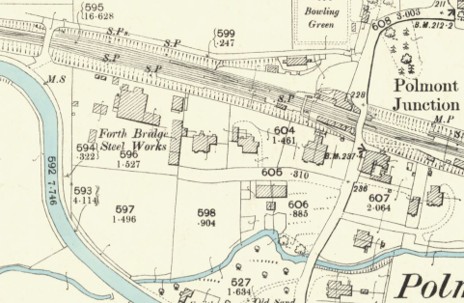
Just three years later the works was put up for sale.
In the late 1870s Charles Walter Robinson of Polmont had become a partner in the firm running the Avon Steel Works beside the River Avon in Muiravonside parish. The works had been temporarily closed and re-opened in 1878 making “All kinds of steel supplies at the most reasonable rates” (Scotsman 19 June 1878, 1) and steel bars for Charlier shoes for horses. In 1889 CW Robertson and Company purchased the saw-mill of Dow and Company at Polmont with the initial intention of establishing an auxiliary factory there. Steam power was now taking over from water power and in December that year a self-acting steam hammer of 20-30cwt was purchased. Before long the new works was known as the Forth Bridge Steel Works and the Avon Steel Works was leased to John Alexander and soon closed.
C.W. Robinson had connections with Sheffield where his father established the Royds Foundry at Attercliffe. Alexander Yeats Jones was Robinson’s business partner at the new works. The Polmont firm soon gained a high reputation and was on the Admiralty List of contractors. It specialised in tool steel, self-hardening steels and large shear blades, and even supplied a lot of these to Sheffield firms. The Forth Bridge Steel Works employed skilled men from throughout central Scotland, including turners, moulders, dressers, hammer tilters, blacksmiths, an engine-keeper and so on. It was physically hard work and could be dangerous. It was for this reason that many of the work force were hired through contractors – though that practice too could be dangerous. In September 1908 John Taylor was given notice and he and his men were laid off. Smith Coleman took his place. Taylor’s men met at the railway bridge and threatened their replacements with violence, saying that they would burn the works down. Sure enough, a few days later a tool house at the works, made of timber with a corrugated iron roof, burnt down and a paraffin can was found next to it. The damage was estimated at £20 and was covered by insurance, but it was serious enough to be investigated by the police. David Hutton, one of the redundant steel dressers was accused of the act and taken to court. Despite overwhelming evidence that one of the sacked men had committed the crime, a not proven verdict was returned on Hutton. Then Coleman, who was only 24 years of age, disappeared in a strange manner, and the following day police were informed and discovered his jacket, torn and spotted with blood, lying at the side of the Union Canal immediately adjoining the steel works. Along with the jacket was a crow-bar. These facts pointed to foul play, and the next day again men were engaged dragging the canal in the vicinity. The suspicion of foul play was strengthened by a statement from his landlady that the missing man had received a letter threatening him with violence. These circumstances were relayed to the public in newspapers across Britain. A bloodhound was brought in and picked up the trail. The Londonderry Standard reported that the trail led to another point on the canal where Coleman’s body was found and that it was then believed to be a case of suicide. It was wrong. Other papers reported that the bloodhound had led the police back to one of the furnaces at the works and that the body may have been disposed of that way. Eventually, however, the police found Coleman alive and living in Hamilton. He had taken the train from Polmont Station and found work there under the assumed name of Colin Smith. His mind, apparently, had been deranged – or was it?
Inside the works accidents happened. On 26 April 1895 George Dick, engine-keeper, was oiling the machinery while it was in motion when his clothes got caught by the pulley wheel. He was dragged between it and the shafting and so severely crushed and injured that death ensued before the machinery could be stopped (Falkirk Herald 27 April 1895, 8).
According to initial reports in February 1900 a young man named John McCallum, belonging to Govan,
“was in the act of lifting a large pot of boiling steel metal from one place to another. His clothes were wet, and a drop of water from his clothes fell into the pot containing the boiling metal, with the result that the metal exploded with a terrific report, and severely scalded M’Callum. The unfortunate man was conveyed to one of the offices, where he was examined by Drs Lawrie and Wyse, who ordered his removal to Glasgow Royal Infirmary, whence he was conveyed. M’Callum’s burns were of a very painful nature, and necessitated his clothes being party cut off. His condition is considered critical”
(Falkirk Herald 17 February 1900, 5).
He survived and sued C.W. Robinson & Co in the Court of Session for £500 damages. According to this the explosion was caused by a pot of molten metal falling into a pool of water near the furnace at which he was working, which should not have been left there. The firm countered that McCallum had been careless (Edinburgh Evening News 16 October 1900, 2). Later in the court case it emerged that the tongs used were defective (Falkirk Herald 20 October 1900, 7).
Alexander Jones retired in 1899 and C.W. Robinson continued on his own. That same year William Sykes left to found the Airdrie Steel Company. That December damage of £1,000 was done at the Forth Bridge Steel Works by a storm. A recently erected building was totally wrecked, and all the workmen were temporarily thrown idle. In 1903 C.W. Robinson & Co. agreed to enter the new steel combine which was intended to consolidate production throughout Britain.
Although most of the workmen lived in and around Polmont Station, many still came in from the west. In 1904 we learn that Allan McNeil, moulder, lived at 15 Beardmore Terrace, Shettleston, Glasgow. As a foreman moulder over the Siemen’s moulding department at the Forth Bridge Steel Works he was paid a salary of £2 10s per week.
The firm was still employing John Taylor as its contractor for the dressing of castings. In 1907 he was contracted to dress at a contract price of 26s 6d per ton. The weights of the castings were entered in books kept for the purpose, and known as the dressing wages books. From the period from 1 January 1907 till 5 September 1908 the total weight of castings dressed by him, as show by the dressing wages books, amounted to 1608 tons 6cwts, entitling him to receive the sum of £2,131 0s 11d. Due to advances paid to him in order to keep his men employed he was over-paid by £85 0s 4d. The company tried unsuccessfully to claim the money back (Falkirk Herald 26 March 1910, 5).
The period leading up to the First Word War was one of recession in the steel trade and a number of firms closed as a result of the consolidation. In June 1913 C.W. Robinson put the steel foundry and forge up for sale as a going concern, but not immediately finding a buyer he granted a trust deed for the creditors. Work continued under the trustee, a chartered accountant called John Duncan. A short while afterwards the works, plant, and goodwill of the business, were bought from the trustees and the new owners continued to operate under the name of C.W. Robinson & Co, only to find that the goodwill did not include the name. Business had not been up to expectation and in July 1914 the works were again on sale:
“STEEL FOUNDRY for Sale. The BUSINESS of C. W. ROBINSON & COY., LIMITED, at FORTH BRIDGE STEEL WORKS, POLMONT STATION. The Works are equipped with a Siemens Open Hearth Furnace, having a capacity of 5½ tons per charge; also 12 crucible pot holes, 8 in operation, having a capacity of nearly 2½ tons per day.
A number of improvements have recently been completed, others are partially completed, and when finished the works will be well equipped for carrying on a steel casting business.
Apply M’Clelland, Ker & Co, C.A., 115 St Vincent Street, Glasgow.”
(The Scotsman 16 July 1914, 1).
No one was going to buy it as a going concern in the economic environment of the time and work at the Forth Bridge Steel Works came to a standstill. The buildings stood empty and without regular maintenance fell into a bad state of repair. The site was put on the market for redevelopment but there was no commercial appetite for building work in the area. Then, in 1928, Stirlingshire County Council bought the land and towards the end of that summer began the construction of 28 houses. More followed.
Bibliography
NEWSPAPERS
Falkirk Herald, 29 Aug 1888:
“To be sold by public roup, within Dowell’s rooms, 18 George Street, Edinburgh, on Wednesday… All and whole that piece of ground at Polmont Station, containing 3 acres and 16 99th square yards or thereby, with the sawmills erected thereon known as Junction Sawmills, steam engine, boiler, saw frames, steam crane, and other heritable machinery of the most approved description. The mills were erected three years ago by Messrs Dow & Co, sawmillers and timber merchants, by whom the same have been worked, and are connected with the North British Railway by a line of rails…”
Falkirk Herald, 6 Nov 1889:
“Thomas Binnie begs to intimate that he is instructed by Mr Archibald Paterson to sell by public auction, at Polmont Junction Saw Mills, Polmont Station, on Friday 15th November 1889, the whole of the extensive saw mill machinery, comprising 1 rack bench, about 60ft long, with iron top and reversing gear. 1 30-in log and deal frame, with 82 saws. 1 18-in ditto, with 52 saws. 1 circular saw bench with Casson’s Patent Feed. 1 moulding and flooring machine, with irons. 1 band saw, with folding top and saws. Bogies and bogie rails, circular and cross-cut saws, files, chains, fire and common bricks, 1 saw teething machine, anvil, and all the other small tools connected with the works; also, the office furniture, & c. The above machines are by Messrs M’Dowall & Son, Johnstone, and have all the latest improvements… Falkirk Auction Mart”
Falkirk Herald, 25 June 1892, 1:
TURNER.— Young Man Wanted to Turn and Bore Hutch Axles and Wheels.—Apply Forth Bridge Steel Works, Polmont Station.
Falkirk Herald, 2 July 1892, 1:
DRESSER Wanted for Steel Castings.—Apply Forth Bridge Steel Works, Polmont Station.
Falkirk Herald, 3 August 1892, 1:
WANTED, at once. Good Steady Jobbing Blacksmith.—Apply Forth Bridge Steel Works, Polmont Station.
West Lothian Courant, 19 May 1894, 5:
AN ENGINE DISPUTE. In the Small Debt Court at Linlithgow, yesterday Messrs C. M. Robinson & Co., Forth Bridge Steel Works, Polmont Station, sued Mr Brechin, wood merchant, Linlithgow, for £7 12s, the price of a quantity of barrow wheels. Defender lodged a contrar account, amounting to £5, for repairs on a portable engine belonging to the pursuers. The engine had been brought from Polmont Station to the yard of Mr Paterson, engineer, Linlithgow, for repairs. After these had been executed Messrs Robinson & Co gave Mr Paterson instructions to sell the engine. It was advertised for sale by Mr Paterson when Mr Brechin went to Mr Paterson and asked it on hire. After communicating with Mr Robinson, Mr Paterson gave the engine to Mr Brechin on hire at £1 per week – it to be returned to Mr Paterson’s yard when Mr Brechin was done with it; but instead of returning it he took it to his own yard, where he also had some repairs carried out on it by a Leith firm without getting pursuer’s sanction to do so. Mr Brechin pleaded that before taking the engine to his yard he bought it from Mr Robinson, but this Mr Robinson denied. The Sheriff held that no bargain had been made between pursuers and defender as to the sale of the engine, and he therefore gave decree for the sum sued for by the pursuers.
Falkirk Herald, 27 April 1895, 8:
Yesterday a fatal occurred the Forth Bridge Steel Works. It appears that George Dick, engine-keeper, had gone to oil the machinery while it was in motion. In doing so his clothes got caught by the pulley wheel. He was dragged between it and the shafting and so severely crushed and injured that death ensued before the machinery could be stopped. Deceased, who was much esteemed, was a very steady worker. He was aged about 47, and leaves a widow and ten of a family to mourn his loss.
Sheffield Daily Telegraph, 12 May 1896, 2:
WANTED, Tilter for Hammer; state wages expected. —Apply Forth Bridge Steel Works, Polmont Station. Scotland.
Edinburgh Evening News, 15 August 1898, 1:
DRESSERS. — Several steady men, at once, light steel castings.— Forth Bridge Steel Works, Polmont Station.
Edinburgh Evening News, 15 November 1898, 5:
This morning fire was discovered to have broken out in the oil store adjoining the office of the Forth Bridge Steel Works at Polmont Station, occupied by C. W. Robinson. The warehousemen immediately poured water on the flames, and disconnected the workshop from the office and stores by removing a wooden partition. The fire was subdued before the arrival of the Falkirk and Linlithgow Fire Brigade. The store and offices were gutted, and the damage, which is covered by insurance, is estimated at £200.
Falkirk Herald, 28 January 1899, 5:
The employees in the forge department of the Forth Bridge Steel Works, Polmont Station, met in a social capacity in the Railway Hotel, Falkirk, on Saturday night. Mr Robert Smith, in name of his fellow-workmen, presented Mr H. Johnstone, one of the employees, with a handsome meerschaum pipe as a token of respect and esteem on the occasion of his leaving for South Africa…
Falkirk Herald, 17 June 1899, 1:
NOTICE IS HEREBY GIVEN, That Mr ALEXANDER YEATS JONES has RETIRED from the Firm of C.W. ROBINSON & COMPANY, Steel Manufacturers, Forth Bridge Steel Works, Polmont, as at 30th May, of mutual consent of the Subscribers, the sole Partners thereof.
The Subscriber, C. W. Robinson, will continue to carry on the business, and is authorised to receive payment of all sums due to, and will pay all debts due by, the said Firm…
Edinburgh Evening News, 3 July 1899, 1:
DRESSER.—Foreman wanted for steel cast be steady; none other need apply.—Forth Bridge Steel Works, Station.
Falkirk Herald, 28 October 1899, 5:
Airdrie Steel Company… that the originators of the company are Mr H. Peden, of Eastrigg Colliery, Bathgate, and Mr Wm. Sykes, late of Forth Bridge Steel Works, Polmont Station. The works, which are got up on the most modern principle, and are equipped with all the most improved…
Falkirk Herald, 17 February 1900, 5:
On Tuesday forenoon a rather painful accident occurred at the Forth Bridge Steel Works. It appears that a young man named John M’Callum, belonging to Govan, was in the act of lifting a large pot boiling steel metal from one place to another. His clothes were wet, and a drop of water from his clothes fell into the pot containing the boiling metal, with the result that the metal exploded with a terrific report, and severely scalded McCallum. The unfortunate man was conveyed to one of the offices, where he was examined by Drs Lawrie and Wyse, who ordered his removal to Glasgow Royal Infirmary, whence he was conveyed. M’Callum’s burns were of a very painful nature, and necessitated his clothes being party cut off. His condition is considered critical.
Edinburgh Evening News, 16 October 1900, 2:
In the second division of the Court of Session today, issues were ordered in an action by John M’Callum, 44 Hamilton Street. Govan, against C, W. Robinson & Co., Forth Bridge Steel Works, Polmont, for £500 damages for injuries sustained in the defenders’ employment through an explosion caused by a pot of molten metal falling into a pool of water near the furnace at which the pursuer was working. Fault is alleged in respect that the defenders failed to have the water removed, while the defenders say that the accident was due to the pursuer’s own carelessness.
Falkirk Herald, 20 October 1900, 7:
In the Court of Session on Tuesday issues were ordered in action by John M’Callum, 44 Hamilton Street, Govan, C. W. Robinson & Co., Forth Bridge Steel Works, Polmont, in which the pursuer sues for £500. On 13th February, 1900, the pursuer was drawing a pot molten metal from a furnace in the defender’s works, when, on account, it is said, of a defective tongs, the pot fell, and he was burned about the legs by the contents. The defenders say that the pursuer was himself to blame for the accident…
North British Daily Mail, 22 December 1900, 5:
At the Forth Bridge Steel Works damage of £1000 was done by the storm, a new building recently erected by the firm being totally wrecked, and all the workmen thrown idle.
Falkirk Herald, 9 February 1901, 5:
A slight accident occurred at the Forth Bridge Steel Works yesterday fore- noon, whereby a labourer named Jardine had his leg broken through a “crossing” falling upon him. After being medically attended, the injured man was conveyed home.
Falkirk Herald, 10 January 1903, 5:
Messrs Robinson & Co. TO ENTER THE STEEL Combine. It is understood Messrs C. W. Robinson & Co, Forth Bridge Steel Works, Polmont Station, have agreed to enter the new steel combine.
Falkirk Herald, 8 August 1903, 1:
APPRENTICE Moulders. — One dozen Wanted at once. 2 or Years at Trade; every encouragement given.— Apply personally. Forth Bridge Steel Works. Polmont Station.
Falkirk Herald, 26 November 1904, 4:
Proof was partly held in the Falkirk Sheriff Court recently in an action at the instance of Allan M’Neil, moulder, 15 Beardmore Terrace, Shettleston, Glasgow, against Messrs C. W. Robinson & Coy., steel manufacturers, Forth Bridge Steel Works, for the sum of (1) £100 and (2) the sum of £42. The pursuer alleged that on or about 25th April, 1903, he was employed by the defenders as a foreman moulder over the Siemen’s moulding department at defender’s works at Polmont for the period of one year from and after the 4th May 1903 at a salary of £2 10s per week, and that the defenders, without cause or warning, dismissed him from their service on or about 12th December 1903. The defenders, in answer, alleged that the pursuer was justifiably dismissed owing to his incapacity and carelessness and inattention to his duties, and that a large number of castings turned out by him were defective and had to be broken up and remelted. The pursuer denied these averments in tot, and stated that if any bad castings were turned out it was owing to defective plant. The adjourned proof in the case should have been heard on Tuesday last, but we understand that, before the case was called, the parties and their agents met, when the defenders offered the sum of £37 10s in full settlement, which was accepted…
Falkirk Herald, 5 August 1905, 8:
On Tuesday afternoon a serious accident befell a man named Ernest Rees, residing at Main Street, Brightons, in the Forth Bridge Steel Work at Polmont Station. It would appear that Rees was engaged in drilling a hole in a plate of steel at a boring machine, when his left hand was drawn in and terribly lacerated. Rees was at once taken to the Falkirk Infirmary, where it was found necessary to amputate one of the fingers. It has now transpired, however, that his injuries are not likely to prove so serious as was at first anticipated.
Falkirk Herald, 16 September 1908, 4:
Before Sheriff Substitute Moffat, in Falkirk Sheriff Court on Monday, a steel-dresser, named Angus Cameron, residing at Brightons, Polmont Station, was judicially examined on a charge of having, on 7th September, wilfully set fire to a wooden building forming part of the Forth Bridge Steel Works, Polmont Station, occupied by Charles Walter Robertson, steel manufacturer. Application was made for bail by Mr W.A. Liddle, solicitor, Falkirk, and this was fixed at £15. In connection with the same case, another steel-dresser, named Duncan Hutton, also residing at Brightons, emitted a declaration before Hon, Sheriff-Substitute Watson on Tuesday afternoon…
Falkirk Herald, 14 October 1908, 6:
Court case.
- Duncan Hutton, steel dresser, Polmont Station.
- The tool house was a timber building with corrugated iron roof burnt down. £20. Insured.
- Contractors employed. First John Taylor (Angus Cameron, Robert Taylor, Duncan Hutton, Robert McNee, steel-dresser) who was given notice on 1 September, and replaced by Smith Coleman (24).
- Robert Smith engineman.
- Robert Scott, steel-dresser.
- William Wallace, steel-dresser.
Londonderry Standard, 13 November 1908, 3:
The efforts of the Falkirk police to elucidate the mystery of Smith Coleman, a contractor in the Forth Bridge Steel Works, Polmont, have been attended with success, due, it is believed, to the work of a bloodhound.
Coleman disappeared in a strange manner on Monday, and the police being informed on Tuesday they discovered his jacket, torn and spotted with what is supposed to be blood, lying at the side of the Union Canal immediately adjoining the steel works. Along with the jacket was a crow-bar.
These facts pointed to foul play, and on Wednesday men were engaged continually dragging the canal in the vicinity. The suspicion of foul play was strengthened by a statement that the missing man is said to have received a letter threatening him with violence.
On Wednesday afternoon the police enlisted the assistance of a bloodhound, and the animal followed a trail leading to the canal, where Coleman’s body was found. It is now believed that the case is one of suicide.
Falkirk Herald, 14 November 1908, 5: explanation…
Falkirk Herald, 26 March 1910, 5:
Proof was begun in the Sheriff Court on Thursday— before Sheriff Moffat – in an notion raised at the instance of C. W. Robinson and Company, Forth Bridge Steel Works, Polmont Station, against John Taylor, dresser. Polmont Station, in which pursuers sued defender for payment £85 0s 4d, which they averred was due to them by defender in respect of his having in error been overpaid by them in terms of a contract which he had with them. In their averments, the pursuers state that the defender contracted with them to dress all steel castings produced by them at a contract price of 26s 6d per ton. The weights of said castings were entered in books kept for the said purpose, and known as the dressing wages books..Upon the castings so dressed they state that advances were made to the defender upon the estimated weights before the dressing of same was finished. From the period from 1st January 1907 till 5th September 1908, when defender left their employment, the total weight of castings dressed by him, as show by the said dressing wages books, amounted to 1608 tons 6cwts odds, and that in terms of his contract he was entitled to receive therefore the sum of £2,131 0s 11d. They state, however, that they have recently discovered that during the period mentioned defender had received the sum of £2216 1s 3d, representing an over-payment of £85 0s 4d. They aver that said over payment arose through a mistake owing to a miscalculation of the amount really due to the defender, and in respect of certain advances not having been taken into account and retained from defender. They plead that having in error paid the sum sued for they are entitled to repayment. The defender, in answer, admits that he had a contract with pursuers from September 1905 until September 1908, and that from time to time he obtained advances from pursuer to enable him to settle with his workmen. He avers, however, that these advances were retained by the pursuers from the amount payable to him on the pay day next succeeding the day of advance. He further pleads that he is unaware of the system of bookkeeping adopted by the pursuers in regard to the castings dressed by him, and that he kept no records of the weight thereof, and relied entirely upon pursuers to keep him right in reference thereto. He states that pursuers’ practice was to hand him each week a note showing what he was entitled in respect of his contract, and avers that said books do not contain a full account of all the castings dressed by him, and that he has not been overpaid. He further avers that if any mistake was made in his payments it was entirely due to the gross carelessness and negligence of the pursuers, and not induced by any act of his. If such a mistake were made, and had been reported to him, it could have been rectified, and…
Edinburgh Evening News, 18 August 1910, 2:
C.W Robinson not entitled to the £85 claimed.
Falkirk Herald, 24 September 1910, 6:
The dressers employed at the Forth Bridge Steel Works have had a dispute with their employers regarding their wages. They appeared to think they were entitled to a penny per hour more than they were at present receiving. After being idle a week, however, the men resumed work on Tuesday last at a halfpenny per hour of an increase.
Falkirk Herald, 4 May 1912, 6:
Daniel M’Roberts, moulder at the Forth Bridge Steel Works, was badly burned the arm and foot on Saturday last. Whilst a ton of boiling metal was being poured into a mould it latterly got top heavy and spilled, part of the metal coming in contact with M’Roberts, who was working nearby. He was conveyed home, and attended to by Dr Lawrie, his injuries being not quite so bas a they were first thought to be.
Sheffield Daily Telegraph, 25 June 1913, 2:
Steel Foundry and Forge for Sale.
For immediate Sale privately as a going concern, the .business carried on by G. W. Robinson and Company, Forth Bridge Steel Works, Polmont Station, with the Works, Buildings, Machinery, Plant (fixed and moveable), Office Furniture, Fittings, stock in trade, patterns, scrap iron, etc, together with the ground on which the works are situated. The business is an old established one, and has a first-class connection.
The ground extends to about three acres, and adjoins the North British Railway. It is admirably situated for a work of this kind, and the buildings and plant are in fair order. There is no feu duty…
Falkirk Herald, 2 May 1914:
“C.W. ROBINSON AND CO., FORTH BRIDGE STEEL WORKS, POLMONT. All parties having claims against me, as Trustee, for goods supplied to these works after 22nd May, 1913, are requested to lodge these claims with me forthwith. John Duncan, Jr., C.A. Trustee. 226 St. Vincent Street, Glasgow, 28th April 1914.”
Falkirk Herald, 23 May 1914, 5:
Sheriff Moffat issued judgement on Wednesday refusing interim interdict to C. W. Robinson and Co., Ltd., Forth Bridge Steel Works, Polmont, against C. W. Robinson, Prospect House, Polmont. Pursuers asked that the defender be interdicted from carrying on business under the name C. W. Robinson and Co, and asked for interim interdict. The case for the pursuers is that the firm of C.W. Robinson and Co granted a trust deed for creditors, and pursuers bought from the trustee the works, plant, and goodwill of the business. They claim that with the goodwill went the right to use the firm’s name, and they complain that letters meant for them were being delivered to Mr Robinson, who was carrying on business under the name of C.W. Robinson and Co at his house. Defender disputed that the transfer of the goodwill carried with it the right to use the firm name, and challenged the title of the pursuers, stating that they had not paid the full price and did not held a converance. The Sheriff heard parties’ agents on…
The Scotsman, 16 July 1914, 1:
STEEL FOUNDRY for Sale. The BUSINESS of C. W. ROBINSON & COY., LIMITED, at FORTH BRIDGE STEEL WORKS, POLMONT STATION. The Works are equipped with a Siemens Open Hearth Furnace, having a capacity of 5½ tons per charge; also 12 crucible pot holes, 8 in operation, having a capacity of nearly 2½ tons per day.
A number of improvements have recently been completed, others are partially completed, and when finished the works will be well equipped for carrying on a steel casting business.
Apply M’Clelland, Ker & Co, C.A., 115 St Vincent Street, Glasgow.
Falkirk Herald, 25 August 1928, 5:
BUILDING OPERATIONS. A further scheme of 28 houses has now been commenced the County Council on the site of the old Forth Bridge Steel Works at Polmont Station. The site was first used about 40 years ago as a saw mill, which was later bought by Mr C. W. Robinson and started as a steel work. This was carried on successfully until just before the war, when trade was rather bad, and the work came to a standstill, Thereafter the works changed hands, but without success. The buildings got into a bad state of disrepair…
Sheffield Independent, 11 November 1933, 12:
In the first place, it should be explained that he is a veteran steel manufacturer, who formerly carried on business as C.W. Robinson and Co., Forth Bridge Steel Works, Polmont, near Glasgow. His firm was on the Admiralty List, as shown by the records, and specialised in tool steel, self-hardening steels and large shear blades. At one time he supplied a lot of these manufactures to Sheffield firms, and was associated in this way with the ex-firm of Askham Bros. His father was the late John Robinson, the founder of the Royds Foundry, Attercliffe, which in turn was carried on by James Robinson, the brother of C.W..

