
SMR 1686 / NS 885 750
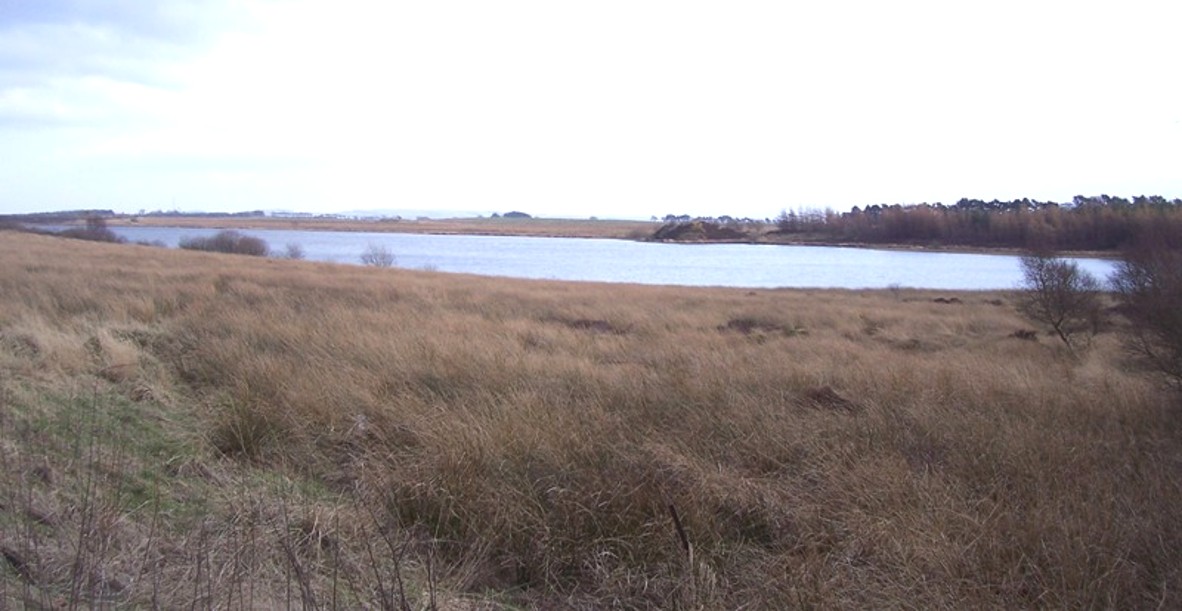
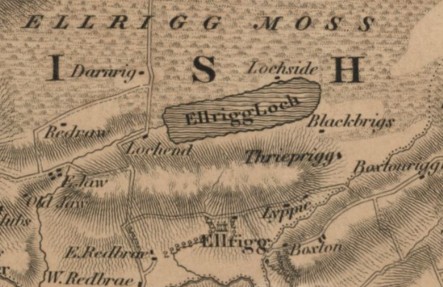
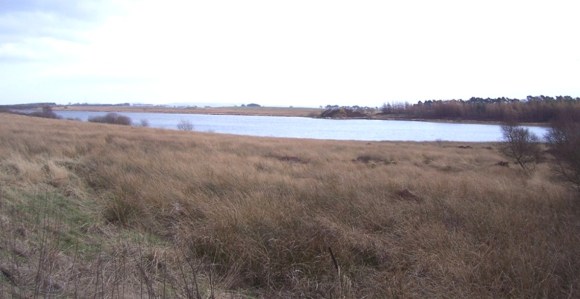
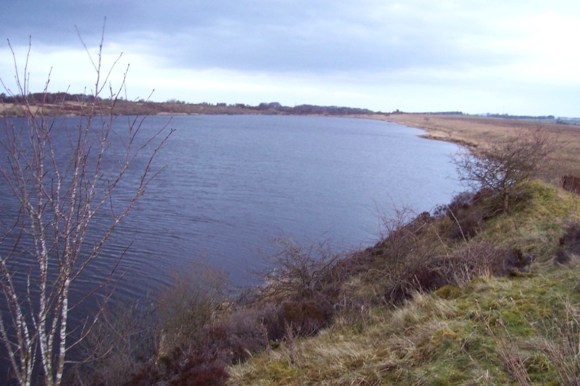
Ellrig Loch lies on the edge of Gardrum Moss between Shieldhill and Slamannan. It is a large natural body of brackish water, measuring 500m from west to east and 207m from north to south, thus occupying an area a little over 23 acres, though it was once almost twice that size. It sits in a small hollow and receives its waters from the mosses. The surplus water drains off to the south-west to make its way to the River Avon and the outflow has long been artificially modified to control the rate of flow and the depth of the water in the loch. It is known as the Mill Burn. The history of the loch is somewhat chequered and the loch might be described as a moveable feast. It was originally in the parish of Falkirk, but in 1725 it was placed within that of Slamannan. Then, in 1896 it disappeared, drained by the Redding Colliery Company, only to reappear again half a century later.
The loch must have been used as a source of food – birds and fish – from an early date. It lay within the baronies of Callendar and Abbotskerse. A 16th century rental book for Abbotskerse has Ellrig contributing two wild geese and two moorfowl as part of its payment (Reid 2010, 66). The loch probably served as a place for the recreational hunting of wild fowl and ducks by its lairds. The duck gun liberated by the Jacobites from Callendar House in 1745 was probably used here (Bailey 2025).
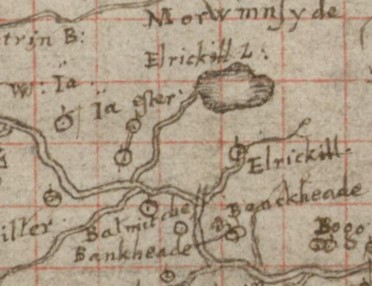
“Elrichill L.” appears on Timothy Pont’s map of c1570 next to the text “Morwmnsyde” parish because it was almost on the boundary between Falkirk and Muiravonside parishes. This liminal location, and the bleak and open nature of the landscape, made the nearby isolated hillock at Craigmad ideal for conventicles during the 17th century persecutions. The large body of water denied patrolling cavalry access to the site from that direction. Sibbald in 1707 calls it “Elach-Loch.”
Johnston of Kirkland in 1723 brings us closer to the modern spelling and provides useful comments:
“At Elridge is a large loch near two miles about, called Elridge Loch. I have not heard of any fishing in these lochs, but aboundance of wild and water foul.” The latter is confirmed by the parish minister in the 1790s: “There are some trouts in the water of Avon, and also in the 2 Black Lochs, and some perches and eels; but none, I believe, in the Ellridge Loch” (Macnair 1795).
The main importance of the loch was that from the medieval period its water provided the motive power for two baronial mills – that of the barony of Abbotskerse known as Ellrig Mill (SMR 1202), and that of the barony of Callendar known as Jaw Mill (SMR 507). The former was already in ruins in 1737. Jaw Mill was the larger of the two and by 1737 its miller maintained a dam or sluice at the west end of the loch “for the better securing the said Miln of Jaw with water from the said Loch“. This would have raised the level of the water and provided a better head of water at the mill.
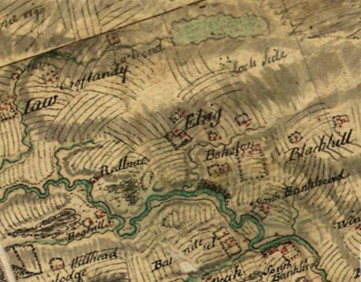
Jaw Mill closed in the early 19th century and around 1825 a distillery was erected on the site. It is said that the water from the loch was not conducive to the production of good whisky – though this may have been to do with them being muddied by mining operations. In any case, the distillery was short-lived and the buildings were converted into a brewery. This fared little better and machinery was inserted to allow it to function as a flax mill. All of these industries required copious supplies of water which the loch provided. Sometime around 1853 the buildings were converted for use as a corn and barley mill but these too eventually closed.
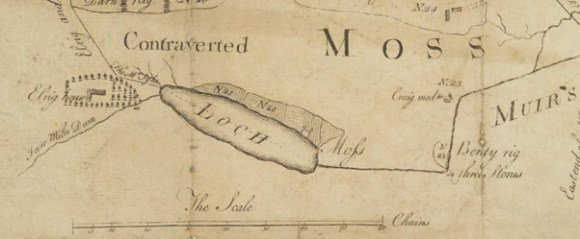
Curling became very popular in the middle of the 19th century and the relatively shallow waters of Ellrig Loch and its elevated location meant that it froze well. In 1844 we hear that :
“A district medal from the Royal Caledonian Club having been drawn to be played for between the Grahamston and Cobblebrae Curling Club and the Linlithgow Curling Club, these two clubs, according to previous agreement, met at Callander Pond on Saturday the 24th curt. On arriving there, however, the ice was found to be perfectly unsuitable. With all the proverbial keenness of curlers, the two clubs immediately set out for Ellrig Loch,
a distance of five miles, where most capital ice was found. A very keen contest took place, and after much scientific play on both sides, the Linlithgow Club were declared victors, and had the satisfaction of bringing with them the reward of their skill, the much prized medal”
(Caledonian Mercury 26 February 1844, 3).
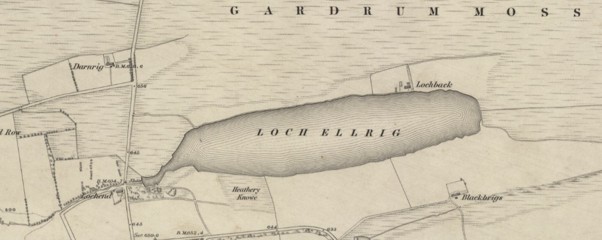
The Carron Company was interested in the minerals in the area and acquired Gardrum Moss. The Ordnance Survey Name Book of 1860 described Ellrig Loch as:
“A considerable large lake situate about 5 miles south from Falkirk. It is about 3/4 mile in length by 1/8 in width, and the centre of it forms the property boundary between the Carron Coy and Glenellrig estate. Property of the Carron Coy and…”
In1890 the loch was described as an ancient landmark,
“the one bright spot on the verge of a sullen landscape” (Falkirk Herald 19 April 1890, 5).
By then the coal beneath the moss, as well as to the southward in Glenellrig estate, had been worked for some time by the Redding Colliery Company, and the company wanted to work the coal under the loch. The strata under the loch were cracked and so there was the very real danger of the water flooding any coal workings. Consequently the Company decided to drain the loch. The consent of the proprietors having an interest in the water was obtained, and the outlet was deepened to allow the water out. By April that year the water was mostly gone and a drain was cut down the centre of the old loch to complete the process. The intention was, in course of time, to convert the area into arable land. That month a new pit was sunk at the south-west end of the former loch next to the Heathery Knowe and a light railway was run along the former south bank. Draining the loch put pay to a scheme being advocated by the County to obtain a water supply from it for the Blackbraes and Shieldhill areas.
Ellrig Loch was removed from the Ordnance Survey maps and replaced with symbols for marshland.
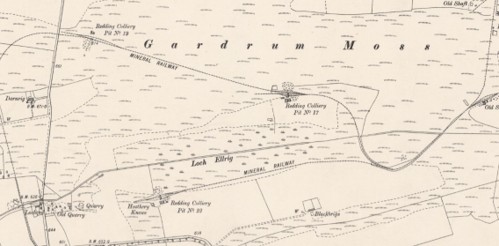
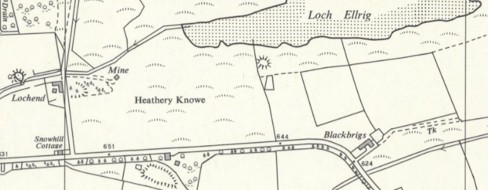
It was still absent in 1946. Then, in 1964, it reappeared. The coal was exhausted and the land was unfit for arable cultivation. The foundations of dry-stone dykes dipping their toes into the water are the only reminder of the futile attempt to reclaim the land. Shooting game still occurs occasionally.
Bibliography
| Bailey, G.B. | 2025 | Falkirk or Paradise! The Battle of Falkirk Muir 17 January 1746. (2nd ed). |
| MacFarlane, W. | 1906 | Geographical Collections Volume 1; Johnston of Kirkland. “At Elridge is a large loch near two miles about, called Elridge Loch. I have not heard of any fishing in these lochs, but aboundance of wild and water foul.” |
| Macnair, J. | 1795 | ‘Parish of Slamannan, or St Laurence,’ Old Statistical Account; County of Stirling. “There are also 3 lochs in this parish; one the north side of the annexation, called the Ellridge Loch, which supplies a corn mill with water, and falls into the water of Avon; the other two are upon the S.W. side of the old parish, called the little and the great Black Lochs; the one of which, namely the Little Black Loch, runs E., and the other, the great Black loch, which is about half a mile W. from the other, and lies upon the boundaries of this and the East Monkland parish, runs W. It hath lately been made a reservoir to the great canal between the Forth and Clyde, by the run of the water of Calder, by which it is carried into the Monkland canal, and from that, by a cut near Glasgow, conveyed into the large canal. There are some trouts in the water of Avon, and also in the 2 Black Lochs, and some perches and eels; but none, I believe, in the Ellridge Loch.” |
| Reid, J. | 2010 | ‘The Feudal Divisions of East Stirlingshire: Slamannan Parish,’ Calatria 26, 65-78. |
| Sibbald, R. and Modern | 1707 | History and Description of Stirlingshire, Ancient and Modern. “The Calander has a large Wood adjacent to it, with Walks cut through it, and Fish Ponds near the House, and Gardens, and large Inclosures to the East and West: a Cadet of the Family has Westquarter, a pleasant Seat with much Planting, a little to the East of Calander. Near to this are the seats of Kilblayn, Glen Halgen, Sheilhill, Langtown. The countrey which lyeth to the south though it be much Moore and part of it Moss, yet it enjoyeth by its rising situation, a wholesome Air, and very lately died a fewer there, call’d George Waddel, lived to a great age, of whom more particularly in the (p.55) next Chapter. There is much Coal in the rising ground, and tho it be more fit for Pasture, yet it wants not good Corn fields. The South side slopes gently towards the Water of Avon; there are severall Gentlemens Seats there, as Alridge, Dalquharne, and the Jaa’s, and to the East is Park hill, the Seat of a Gentleman of the Name of Livingston, where there is a Copice Wood. There are also the Seats of Balmitchel, Bankhead, Bogo, Rashihill, Bochastle, Langrig and Glentorie, Balmiller, Somerhouse, Mildridge, and there are in this Tract, Elach-Loch, Loch of Finlech, and the Blackloch, the Meikle and the less; Blackloch Seat, Aryloss, and Dykehead.” |
| NSA Slamannan | “There are two lochs in this parish, called the little and the great Black Lochs. The latter is the principal feeder of the reservoir formed on the lands of Auchingray, for supplying the Monkland Canal. There is another called the Ellrig Loch, lying to the north-east of the Annexation There are perch and eel found in all the lochs, and good sizeable trout in the Avon, many of which are annually destroyed, when the pools used for steeping lint are emptied into the Avon.” | |
| 3SA | 1961 | “There are two lochs, the Black Loch and Glenelrigg. On the latter there is excellent shooting.” |
NEWSPAPERS
Caledonian Mercury, 26 February 1844, 3:
A district medal from the Royal Caledonian Club having been drawn to be played for between the Grahamston and Cobblebrae Curling Club and the Linlithgow Curling Club, these two clubs, according to previous agreement, met at Callander Pond on Saturday the 24th curt. On arriving there, however, the ice was found to be perfectly unsuitable. With all the proverbial keenness of curlers, the two clubs immediately set out for Ellrig Loch, a distance of five miles, where most capital ice was found. A very keen contest took place, and after much scientific play on both sides, the Linlithgow Club were declared victors, and had the satisfaction of bringing with them the reward of their skill, the much prized medal.
Stirling Observer, 8 April 1847, 1:
The Mill’s are amply supplied with water from Loch Ellrig, and will either be Let along with the Farm or separately, as offerers may incline.
Falkirk Herald, 17 January 1861, 3:
Curling.—A match was played yesterday, on Ellrig Loch, between the Falkirk and Slamanan Clubs, 3 rinks aside. The ice at the outset was not in good condition, from the sleet and rain which fell in the morning, and was partially submerged. After a few hours’ play, Slamanan Club was declared winner by 37 shots.
Bridge of Allan Reporter, 19 November 1887, 2:
the curlers of the Middle Ward of Lanarkshire had challenged any county in Scotland, and that the curlers of Stirlingshire had taken up the challenge. The match was fixed for January 3ist, at Ellrig Loch, parish of Slamannan, but had to be put off owing to a Road meeting.
Falkirk Herald, 19 April 1890, 5:
the motive power for the Jaw Mill, and then flowed into the Avon. The coal beneath the moss as well as to the southward Glenellrig estate, has been worked for considerable time by Redding Colliery Company, and it is in consequence of the extension their Colliery operations to the southwards have removed an ancient landmark – Ellrigg Loch – which formed the one bright spot on the verge of a sullen landscape. This sheet of water occupied some fifty acres, surrounded on three sides by moss, and stretched from East to West between Gardrum and Darnrigg, its waters escaping at the western end by a small stream which provided the motive power for the Jaw Mill, and then flowed into the Avon. The coal beneath the moss as well as to the southward on Glenellrig estate, has been worked for a considerable time by Redding Colliery Company, and it is in consequence of the extension of their workings that it has been found necessary to drain the Loch. The consent of the proprietors having an interest in the water has been obtained, and the outlet having been deepened sufficiently, the process has now been all but completed. In course of time the area will be reclaimed for arable purposes…
Falkirk Herald, 18 June 1890, 2:
The Redding Colliery have been sinking and developing their coal-fields in the direction of Slamannan district, and for this purpose have very recently removed an old landmark, well known as the Ellrig’s loch.
Falkirk Herald, 9 May 1891, 4:
Redding Colliery Company have made considerable progress in sinking a new pit to work two seams of coal on the south side of the now drained Ellrig Loch, and an extension of their branch line to this place has been made.
Falkirk Herald, 17 October 1891, 6:
Water supply to Blackbraes – A number of years ago it was thought that a supply could have been obtained from Loch Ellrig. There is now, of course, no prospect of a supply being got from this quarter, as the Redding Company have drained off the water to work the mineral under it…
Falkirk Herald, 15 November 1913, 5:
The old Jaw Mill has passed through many vicissitudes in its 150 years’ history. Originally, it is said, it was a distillery, next it was used as a brewery, then as a flax mill, and afterwards as a grain mill. The draining off of the water in Gleneldrick Loch, however, stopped its further uses in this direction. As a farm house, up to its demolition by the underground workings of Easter jaw Colliery, it is better known to the younger generation.

