
SMR 530 / NS 819 775
Loch Green was a small natural loch occupying a slight hollow in the centre of what had been an extensive area of mossland which stretched from west to east. Lochgreen is first mentioned in 1664 (Reid 2009, 185). As Reid notes, this name refers to the meadow to the south of the loch, whilst Lochdrum refers to the ridge to the north. The proper name for the loch is not known and Loch Green was adopted long ago. In 1723 Johnston of Kirkland said that: “A mile South of Seabegs house is a loch called Lochgreen about half a mile in circumference.”
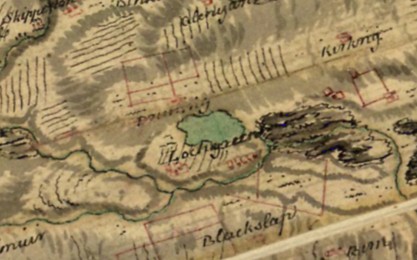
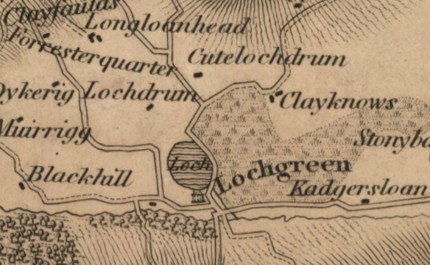
The public roads pass around the loch – that on the east following the earlier curve of its bank, whilst that on the west is a little distance away from it. A comparison of the shapes of the loch depicted on Roy’s map of 1755 and Grassom’s map of 1817 suggests that the loch had been reduced in size between those dates, with the greatest diminution being at the west end.
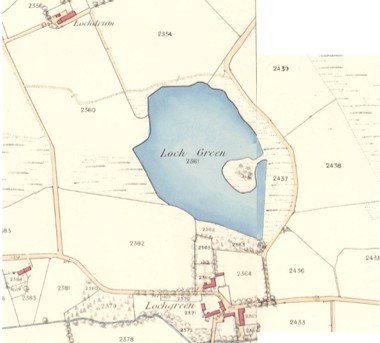
The Ordnance Survey Name Book in 1860 calls it “Loch Green” and describes it as “A fresh water lake of considerable extent with an island near the eastern bank, covered with fir wood. It is situate a few chains north of Loch Green Farm. Property of Mrs Dick, Edinburgh.”
The island had a slender causeway on its north-eastern side connecting it to the shore and may well have started life as a crannog (SMR 530). By the time of the 1896 Ordnance Survey map the loch had been drained and the area around the “island” is shown as moss. The island can still be seen with its clump of pine trees encompassed by a large circular setting of boulders.
Bibliography
NEWSPAPERS
- Stirling Observer, 16 May 1844, 4:
On Saturday last, William Fulton, Supervisor of Excise, Kirkintilloch, accompanied by Messrs Morris, Mackie, and M’Dougal, Officers of Excise, discovered an illicit distillery in full operation near Lochgreen, parish of Falkirk, and destroyed 145 gallons of wash, 90 gallons of low wines, one still (55 gallons content), ten casks, with other utensils, and carried off a copper still, head, and worm. On approaching near the place two men made their escape into a wood. - Falkirk Herald, 17 January 1856, 3:
Inland Revenue officers discovered a still, a still-head, a quantity of feints, and other material for making whisky, at a farmhouse about six miles to the south-west of Falkirk… It appears very evident from the proof led for the panel, that the still and materials for making spirits had been found by his son, partly in Castlecary Wood and partly on Lochgreen, where no doubt they had been uses for illicit distillation, but it appeared that they had not been made use of at the place where they were found by the officers. - Falkirk Herald, 24 October 1883, 2:
On the south side of Lochgreen there was gathering ground to the extent of 530 or 550 acres, and there was no gentleman but who would say that it was the… gravitational water supply to Falkirk. - Falkirk Herald, 25 September 1886, 2:
Mr Gale’s report: Your instructions directed my attention to the Loch Green district, which drains into the Skipperton Burn, a tributary to the Bonny Water, and I therefore carefully examined the ground, and had sections taken somewhat in detail. The loch itself os of no value as a reservoir, but the stream affords sites where two very good reservoirs could be constructed – one immediately below Lochgreen House and another lower down the stream, above Burnhouse, on the site of an old dam, the embankment of which is now in ruins. The dam at one time appears to have been used for regulating the supply of water to two mills lower down the stream, and although these mills are now disused, and the machinery removed, compensation water would have to be given to the stream to the usual amount, to satisfy the probable claims of these millowners…

