
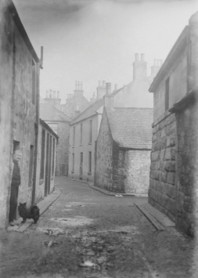
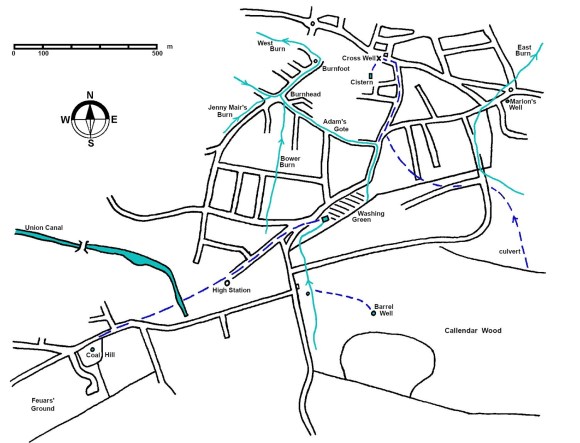
We hear little or nothing about Falkirk’s water supply before the great drought of 1681 because there was nothing unusual about it. Like many settlements in Scotland the inhabitants of the small town got most of their domestic water from streams. These were the West and East Burns located, as the names suggest, at either end of the long High Street and the Gote Burn or Adam’s Gote to the south along the line now occupied by Cochrane Avenue and Hodge Street. The name was also abbreviated to simply The Gote and it joined the West Burn in front of the Erskine Church. Here too it was met by Jenny Mair’s Burn which ran alongside Major’s Loan. The Gote was fed by another lost stream that originated from a spring called the Bower’s Well near the east end of Gartcows Road. It is now covered in and ran along the boundary between the properties in Neilson Street and Woodlands Crescent. The confluence of Adam’s Gote, Jenny Mair’s Burn and the West Burn was known as Burnhead and the road that led down from the High Street as the Burngait. This road would have been one of the main routes for the carriage of water. Gait here means road, but it is possible that the fortified entrance that arched over this road as part of the town’s defences and known as the Bantaskine Wynd Port was also called the Water Gate.
In the 1860s the already polluted streams at the west end of the town were made unpalatable by the sewage from the new Poorhouse being dumped into them. In hot weather the effluvia from the stagnant water which lay in the burn became a positive danger to the health of the inhabitants. Numerous complaints were made and so the Falkirk Commissioners instructed A. & W. Black, architects and engineers, to arrange for the covering in of the West Burn from Gartcows to William Dick’s Tannery, which was done in 1870. Within a decade the East Burn was also culverted.
As well as the streams, the inhabitants harvested water from the roofs of their buildings, storing it in large barrels. This system accounted for over half of the household usage. It continued until the end of the 19th century as it provided soft water suitable for washing, whereas that provided by the public wells was hard, apart from that at Marion’s Well.
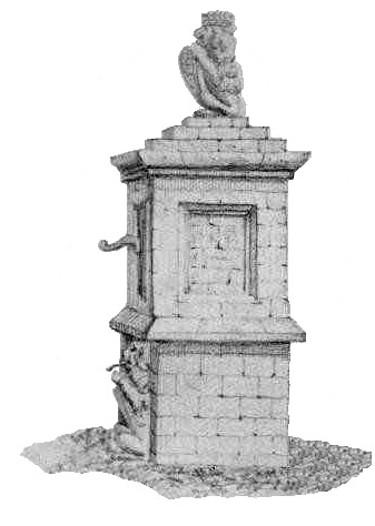
During the drought of 1681 the streams dried up and the people of the town suffered. There was little or no water for drinking, cooking or washing, except what came from a handful of wells such as Marion’s Well. Two years later Earl Alexander Livingstone of Callendar made provision for water to be led from a spring in his parks which had continued to flow in the dry spell. The water was led down the hill in wooden pipes made by drilling out the centres of tree trunks and joining them with iron collars. The water fed into an underground cistern in the High Street and a wellhead was placed over it to pump the water out by hand. As it was at the principal crossroads it became known as the Cross Well. Not wanting to spend money on its maintenance the Earl then set up a public body to do just that and gave it powers to raise a stent or tax within the burgh – this was, of course, the Stentmasters (the alternative spelling of Stintmasters is also correct).
The spring in west end of Callendar Wood was probably the Barrel Well at the foot of Hendry’s Hill. The name suggests that originally the water was gathered in a wooden barrel set into the ground before being piped into the town, subsequently being joined on the way by water from other springs. A well of the same name supplied the needs of much of Corbiehall and Grangepans at this time. The west end of Callendar Wood was extensively mined for coal in the first half of the 17th century and the water was almost certainly oozing out of them. We know that when the pits were temporarily abandoned in 1651, due to the Civil War which saw Cromwell’s troops occupy Callendar House, the pits flooded. An alternative is the feature a little to the south-east of the Glen Brae Lodge shown on the 1862 OS map. It lay beside a small burn which descended to Parkfoot and upon emerging from the Callendar policy passed through the town’s washing green. In 1837 the green was described as :
“A piece of land, extending to nearly two acres, at the foot of Callendar Wood, commonly called the washing green, which was has been used for time immemorial for the purpose of washing bleaching clothes, without any charge” (Reid 1993, 33).
It was already in the possession of the Stentmasters in 1807. In either case, the pipeline would have run downhill from the source along the east of the Glen Brae within the bounds of Callendar Estate and entered the town by the port on the Cow Wynd. From there it went to the High Street and to the Cross Well.
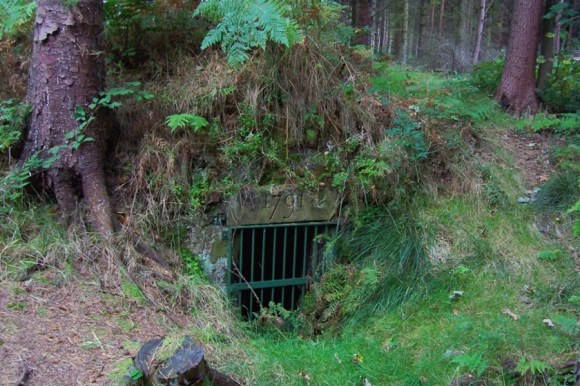
At first the water would have been fed directly to the cistern under the Cross Well but this would have resulted in an uneven flow and the pressure was probably rather high. It would seem that a tank was constructed somewhere around Parkfoot, probably at the washing green, to act as a reserve supply and to reduce the water pressure – much in the same way as later service reservoirs acted. This was called the Lower Fountain to distinguish it from the High Fountain at the Barrel Well. Access to the two fountains and the pipeline was required for cleaning and maintenance and this right was duly given by the Livingstones of Callendar.
Referring to this period some sources mention springs in plural and it is probable that other springs in Callendar Wood were tapped. A well-made stone culvert emerges from the wood and crosses what is now Kemper Avenue about 54m south of the estate wall heading in the direction of the Cow Wynd and may have also conveyed water to the town centre. It is notable that within the Park the culvert follows the contours instead of taking a direct route to the East Burn. Until 2003 it still carried a copious amount of water. A plan of the Home Farm in Callendar Wood also shows a “culvert carrying stream” joining this one (Falkirk Archives a1085.149).
As time went by the town’s demand for water increased and more springs were needed. In July 1777 the Stentmasters appointed :
“a committee to view the water that supplied Callendar House, and to report their opinion, whether or not there may be an overplus to serve the town of Falkirk; and also they recommend to the said committee, and each individual stintmaster, to view the whole water on the Muir of Falkirk, so that they may be able, against the next meeting, to give their opinion distinctly thereanent… The meeting appoint a publick advertisement to be given to any person choosing to give in proposals to the Baillie for bringing water into the town of Falkirk.”
This is an important statement and it is interesting to note that the source within the Callendar policies was the first priority, presumably because it would have been closest to the existing pipes. The Muir lay to the west of Callendar Wood and it appears that they were looking at similar pit water which was pouring out of the hill there. It was common land and so the water rights belonged to the feuars of the town. Shortly afterwards the Stentmasters ordered men “to red out the level above the Mutton-house in the muir” and in August Mr Robertson, coalmaster in Falkirk, and others, were desired to inspect the operations at the Mutton-house, and report their opinion as to the conveyance of the water to the town. The name Mutton-house is probably a derogatory term for the old abandoned pithead which had been surrounded by a circular wall to keep people out and which resembled a sheep fold. After various meetings on the subject during which the Stentmasters were clearly concerned about the costs, and also whether they had a right to the common water, consequently,
“the Stintmasters unanimously agreed that their preses shall draw up an advertisement, and order it through the town with the drum, advertising the heritors and inhabitants, that the stintmasters had dropt the idea of bringing in water to the town of Falkirk, ay and until the said heritors and inhabitants met amongst themselves and gave their sanction thereto. – Alexr Henderson.”
On hearing this the burgesses insisted that the Stentmasters should do all in their power to bring a proper supply of water into the town and with this mandate, in July 1778, they received estimates for conveying water from the new source. That of John Melvin, entitled
“Estimate of water in the Muir of Falkirk to carry to the cistern in the Wood Parke in a 2½ bor inch diameter in Scots fir” for £80, was accepted (Taylor 1949, 27).
For whatever reason, he failed to do so. His quote is useful as it tells us that the Lower Fountain was already in place and that it was in the Wood Park, i.e. the park by the wood, or Parkfoot. The pipes were still to be wooden.
The source of the water on the Muir became known as the High Fountain but its exact location is a matter of debate. Taylor places it opposite Parkfoot, which is rather further up the hill than we might expect and not strictly part of the Muir of Falkirk. In that location the pipe from it would not have been interrupted by the construction of the Union Canal, which we know that it was in 1822. When, in 1803, the pipes between the two fountains were replaced, the distance given was 860yds. This would place the High Fountain at the “Old Coal Hill” on the south side of the Slamannan Road immediately west of Princes Park. From there the pipeline would have followed the old road to the washing green. That road was interrupted by the arrival of the Union Canal, but the northern section of it still serves the High Station.
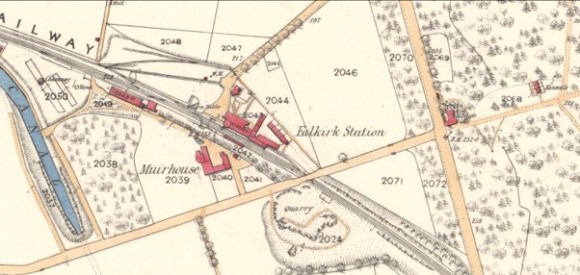
In 1786 the complaints of inadequate water were still numerous and the Stentmasters again ordered the Muir of Falkirk to be inspected. It would seem that a two-pronged approach was used. First of all, a better storage facility was required so that water would not be run off as waste when it was plentiful. The solution turned out to be simple and cost effective. The old abandoned coal wastes below what became Muirhouse Farm were extensive and could be utilised as a large subterranean reservoir. They lay on the route of the pipeline from the High Fountain to the Low Fountain. Secondly, the amount of water feeding into this underground reservoir could be supplemented by diverting underground water in the various sections of the pits towards it; this required the expertise of a collier familiar with the workings and William Ann Walker came to the assistance of the Stentmasters. The augmentation of the water supply in this way over the following decades was intermittent and episodic. The situation was neatly described by John Wilson in 1861:
“The basin from which the Town was formerly, but scantily, supplied with Water, is in the ancient coal waste in what is termed the cox-rod or soft coal. Its area is about 2 ½ acres of waste, and lies between the Union Canal and the Fountainhead, to which the Town’s pipes are laid. The basin is entirely surrounded on the south, west, and north by solid coal; on the east, however, the old waste continues, but the strata rises to a ridge under the railway station-house, and this ridge forms the east boundary of the basin; the strata then dips in the direction of Callendar Woods; in short, I may describe this basin, which contains 2 ½ acres, as being in form very much like a saucer. It was from this basin – (with an additional quantity conveyed by pipe from the splint coal waste on a higher level south of the Canal) – that the Town had its supply” (Falkirk Herald 11 July 1861, 1).
By 1791 the wooden pipes which conveyed the water to the town were found to be insufficient. Not only were they of too small in bore but the wood had decayed to such an extent that a large portion of the water was escaping. The Stentmasters ordered “their track” to be examined, for the purpose of replacing them with lead, but nothing was done till 1792, when they were again ordered to be examined. It would seem that more vacillation followed, for in 1793 a group of disaffected townsfolk tried to oust the Stentmasters from office, saying, amongst other things, that the old pipes should be replaced by ones of lead and cast iron at a cost of around £200 – a not inconsiderable sum. The result of their action was that the four quarters of the town gained representation on the committee of the Stentmasters.
The Cross Well was still the only public distribution point in the town and a keeper was appointed to look after it. At night it could be turned off so that the cistern below it had time to refill. In 1793 the Stentmasters
“taking it into their serious consideration, that it was very ill attended by Helen Dick particularly on Sabbath day, when the children of the place hurt the machinery, the meeting are unanimous that another person be appointed to attend the well.”
A man was appointed with the additional duties of attending to the water-pipes on the Muir of Falkirk, and ringing the Tolbooth bell every morning and evening, according to the common use and wont.
Still the old pipes had not been attended to. At the meeting of the Stentmasters on 23 November 1801 they took into
“consideration the present state of the wooden pipes in the muir, and find that they are in a ruinous state, and will in a very short time require to be renewed with new pipes. The meeting have therefore agreed for estimates to be given in for the whole expense of leaden and cast-iron pipes. They also agree that the whole of the inhabitants be called together and the estimates be laid before them for their approbation.”
They needed the public on side in order to agree to a large capital expenditure. At a general meeting of the inhabitants of the Town of Falkirk held on 9 August 1802 it was agreed to renew the pipes, construct a cistern or reservoir in the town, and to move the Cross Well from the south side of the High Street to the north side where it would be out of the way of through traffic.
The new cistern was to be raised slightly above the ground so that it would have sufficient water pressure to be used for fire-fighting. The Stentmasters accepted an offer made by John Rankine, merchant, to feu 25ft by 17ft of building ground at 20 shillings annual rent. It lay 90m to the west of Cow Wynd, more or less at the end of Bean Row. This ground had formerly been part of the garden of the Great Lodging of the Livingstones of Westquarter.
First, however, they dealt with the feeder pipes and on 15 February 1803
“the preses laid before the Meeting the following estimates for laying eight hundred and sixty yards of leaden pipes from the fountain head in the muir to the fountain head in the wood in consequence of previous advertisements in the Newspapers. Estimate from Mr Dalrymple, Ditto from Mr Douglas, Glasgow, Ditto from Marshall and Son, Edinburgh, and Ditto from Mr Dickson there, and the meeting having taken the same into consideration, they unanimously agree to accept of the offer made by Mr Dickson as being the cheapest, vizt. 8s 7d per yard and using lead pipes weighing 27 lb per yard. The meeting authorises the preses immediately to contract with Mr Dickson for having the pipes laid in terms of his letter”
and they then appointed a committee to see that the contract was properly executed. This was done and at their meeting in August 1803 the Stentmasters had to arrange payment. The way that they went about this shows the difficulties that they were operating under:
“the money must be raised by voluntary loan or discounting bills with the Falkirk Banks, they therefore agree that the Preses and Treasurer with one member of each of the trades shall grant their bills for such sums as may be necessary in the meantime to pay Mr Dickson who had come to Falkirk for that purpose, and that the stint be laid upon the Inhabitants for defraying the same and they fix Friday first at 10 o’clock for the Stentmasters to meet and lay on a Stint for such sum as to them shall seem proper.” They then discounted bills to the amount of £357 12s 6d.
This large sum also seems to have covered repairs to the lower Fountain and the extension of the pipes in the High Street to provide a public well at either end at the East and West Ports, and also to the old Back Row (Manor Street) on the north side of the town.
The amount of stint imposed upon the inhabitants was not based upon the rental, but was at the discretion of the Stentmasters according to the supposed ability to pay, and the quantity of water made use of. The amount to each individual in 1807 was put at from 1s 6d to £3. It was paid in respect of occupation and not by the landlord. The only exemption from stent was the inability to pay. For almost twenty years the total collected amounted only to about £200. Litigation about the Tolbooth and Steeple kept the Stentmasters from erecting the cistern till 1805, and the foundation was laid on 23 August that year. A brass plate was fixed to the south east corner of the building with the following inscription:
“Falkirk. 23rd August, 1805. Rex Geo. III. This house is built to contain the Water Cistern or Reservoir to serve the Inhabitants of Falkirk. under the direction of the Stentmasters, they being the Managers of the Town’s affairs.”
On its completion a board containing the following information was erected at the south end of the cistern:
“1805. This Cistern is 18 feet long 11 feet wide, and 9 feet deep, being 1782 cubic feet; containing 13,330 22-77th gallons wine measure each inch of depth 123 33-77th gallons. This first Cistern of Falkirk is erected under the direction of the managers of the Town’s affairs, denominated Stentmasters. ROBERT WALKER, Preses. JOHN RANKINE, Treasurer.”
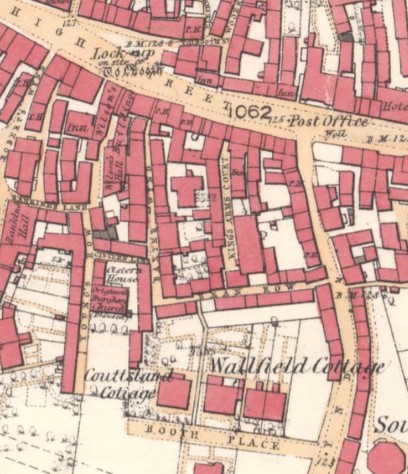

The Cistern House was a substantial rectangular two-storey building, measuring c25 x 17ft, that being the size of the feu. It was aligned north/south with a moulded crow-stepped gable to the north. The walls were of ashlar sandstone, with the ground floor battered and rusticated and separated from the upper storey by a plain projecting string course. A double flight of steps on the north gable led to a central first floor doorway, surmounted by a tympanum bearing the date 1825. At the apex of both gables were moulded twin-octagonal chimney stalks for ventilation. All in all, it was a handsome building which must have been a symbol of civic pride. The iron cistern within the building had a capacity of about 13,000 gallons. The rateable value remained at £1 until 1865 when it was raised to £10, and then reduced to £2 upon appeal.
Three of the leading local builders of that period offered to do the work, James Wyse for £115; Thomas Hastie for £128; William Hume, £149. The first-named being the lowest offerer, he was entrusted to build the cistern. On its completion early in 1826, something like £30 additional had to he paid Wyse for extra work. The opportunity seems to have been taken to renew some of the piping and adding wells so that in the end the sum expended reached a total of £270 or thereby, £67 odds being received for the lead removed from the old structure.

Over the decades that followed the construction of the new cistern a small yard or close that led from Blue Bell Court to Robert’s Wynd became known as the “Beetler’s Howff.” It was said that a countryman or lint beetler was “beetled” to death on a feeing fair evening. On a quiet night after 10 o’clock a peculiar sound could be heard coming from the close, which the superstitious portion of the community ascribed to the ghost of the murdered man. Groups of people used to collect in the evenings listening to the strange sound. It was later realised that the noise came from the water pipes. Water being scarce, and the cistern requiring time to refill, the water was turned off each evening at 10pm, first by Mr Ronald, and then for some thirty years by Alexander Downie. When the water was shut off at the cistern, and housewives drew water from wells at a lower level than the cistern, air filled the vacuum, producing the sound. The noise was most frequent in the vicinity of Robert’s Wynd and Blue Bell Close because they were situated at the highest levels where the water pipes were laid. In 1907 the close was officially renamed Galloway’s Close.
The pipe leading to the cistern was now of iron, but only 2½ inch in diameter. It was prone to the accretion of material on the inside due to the hard water and was easily clogged with vegetation and trapped creatures. As early as 1802 the Stentmasters had received estimates for new wells. From 1822 to 1845 their ledgers make mention of Marion’s Well, Meadow Well, King Well, Garrison Well, Kills Well, the well at the Bank, and the well at Gentels barn. Some of these were old springs which were cleaned up and augmented but most were new, fed from the pipes. By 1837 there were fourteen public wells situated in various parts of the town, with gas lamps at each. In addition to the growing number of wells the Stentmasters had allowed individuals since 1805 to make a connection to the water pipes to serve their own homes upon payment of £1 10s 6d, though these were still few in number.
There were some backward steps. In 1831 the water stopped running from the higher to the lower fountain. After considerable trouble and repeated cleaning, which proved of no avail, it was decided, with the agreement of the owners of the Union Canal, to examine the pipe there. When that section of the canal was drained and the pipe was lifted it was found to have a dozen pick holes in it. The damage was clearly deliberate and by someone who knew its location, but just who the malicious individual was, was never discovered.
The Edinburgh to Glasgow Railway opened in 1842 to much fanfare. It was obvious to all that it would bring an increase of trade and passengers to Falkirk. What was not evident was that the Railway Company was to sink a well at the station at Falkirk into the coal wastes below and tap into the town’s water supply and pump it up for use in its steam locomotives! Upon discovering the project, the Stentmasters made strenuous and vociferous representations to the Railway Company and to their local Member of Parliament who just happened to be William Forbes. At first the Company appeared to be indifferent but it soon became apparent to them that the whole population was in uproar. In fact, Forbes, when feuing the property, had specifically forbidden them from accessing the water. The Railway Company threatened to take proceedings to Parliament at great costs to the Stentmasters, but eventually had to climb down. The following letter to William Forbes gives a good idea of the exchange of letters and the details behind them.
“Falkirk 7thMay, 1844.
Sir,
At a late meeting of the Stintmasters of Falkirk a committee was appointed to take such measures as might be deemed advisable with the view of getting a clause introduced into the Edinburgh and Glasgow Railway company’s Bill now in Parliament to protect the Town’s water and more particularly to prepare a Petition to the House, was directed to be entrusted to your care, and is now enclosed.
You are aware that the supply of water used for the Town is exclusively derived from the old coal wastes situated in your property and lying near and to the west of the Falkirk station from whence it is carried in pipes to the cistern in the town and the public wells.
A few yards to the North of the Railway and in the neighbourhood of the Char Kilns, the Stentmasters have a cistern in the waste for the purpose of collecting the water previous to its transmission to Falkirk in pipes. Into the waste and in close proximity to the Fountain, the Railway Company about two years ago sunk a pit or shaft and from thence are raising by a pump a supply of water which otherwise would come to the Town. They are thus diminishing the quantity and injuring the quality of the water used by the inhabitants.
Before the Railway Company had got their operations completed the Stintmasters as representing the Town of Falkirk brought an Action of Interdict to prohibit them from taking away the water used for the supply of the Town. To this action the Railway Company answered that the Stintmasters had no corporate existence, and were not entitled to pursue any action in name of the office bearers, and that they were entitled to take water wherever they could find it even although their doing so should deprive the town of that article . The Sheriff has found that the Stintmasters are entitled to pursue the action, but the other parts of the case are not yet decided.
The Stintmasters conceive it to be a great hardship that they should even be obliged to resort to legal proceedings in order to defend their right to the water, of which the inhabitants have been for centuries in possession, against the intrusion of the Railway Company who certainly ought to take possession of no property whatever belonging to any individual without remuneration, much less to deprive a community of nearly 7000 individuals of an article essential to comfortable existence.
The Railway Company, moreover, have it entirely in their power to secure a supply of water from other sources. They could procure a supply from Mr. Russel at Bantaskine or other quarters in the neighbourhood at an expense which to them would be trifling, but they prefer to seize upon the property of the Town in the manner described, a mode of procedure which certainly the legislature would never sanction.
It is a fact which admits of no dispute, and is we believe well known to you that the inhabitants of the Town of Falkirk have for at least upwards of 100 years been in possession of the water in the wastes, and that from this source the town has been supplied. That their right to use it has always been vested in the town and the Stentmasters, and that no private individual or Company can or ought to interfere therewith, and we hesitate not to think that the Parliament would give no sanction or authority to any private Company whatever thus wantonly and summarily to seize upon a stream of water which is the only resource of a community comprising about 7000 individuals or confer powers upon the Company which would enable them to lay claim to this most invaluable kind of property, while any other possession is so sedulously protected.
If a clause such as that noted in the prayer of the Petition could be introduced into the Railway Company Bill, the object of the Steintmasters and the town of Falkirk would be gained.
Any information which may be necessary we shall be happy to supply.
We have the honour to be
Sir,
Your very respectful servant,
Geo. Lightbody. Preses of Stentmasters
P Muirhouse Treasurer.
Rob Henderson Clerk”
(Forbes Papers 1293/12)
It is from this time that the Falkirk Herald took to campaigning to improve the water supply by publishing letters on the subject. It was for this reason that James Russel, solicitor, wrote to William Forbes on 24 July 1850
“As I mentioned to you in my last I considered then, as I now do, that there is no good ground for complaint against your Mineral Tenants, & far less against you as to the Towns water; but I am aware there is a loud outcry on the subject at this time, as there generally is about this season of the year, when the water gets scarce, which it generally does nowabouts, & this year the outcry is augmented by an article which lately appeared in a small periodical which we have called the Falkirk Herald which is very generally circulated over the Town – The water question is one not well understood generally like all other underground matters and as you are aware I am somewhat at home on such subjects I propose to endeavour to enlighten the natives by a Letter on the subject in the Herald” (Forbes Papers 1341/4).
The situation with regard to the water supply to the burgh as it lay in September 1849 is nicely summed up in this extract from the Falkirk Herald of the 13th of that month:
“from actual measurement made upon the 8th of the present month, the quantity was found to be no more than 364 gallons per hour, or 8736, but say 9000 per day, and taking the population at 6000, the supply is found to amount to no more than 1½ gallons per day per head! It is as remarkable as true, that a community should continue thus stinted in the first necessary of life, when sources of abundant supply are within easy reach at a moderate cost. The water which runs to waste from the coal workings of Mr Wilson, South Bantaskine, could, it is estimated, be led in a pipe to the existing public cistern in the town, for the small sum of £80 or £100. The water is not only abundant in quantity, but it has, we are enabled to state, been scientifically tested, and has turned out to be most excellent in quality, – free from the mixture of lime and iron found in the town’s water, and having no acidulous properties calculated to act deleteriously upon lead. The present cistern is objectionable for its being erected on the level of Falkirk, although the fountain from which it is supplied is at an elevation above the town of no less than 60 feet, a height sufficient, were the power preserved, to carry the water to the top of the highest house. In resorting to the waste water from Mr Wilson’s workings, the lack of sufficient elevation would be a disadvantage, but the abundance and excellence of the supply would outlay the cost, and it is an important consideration that this source could be made available with a few days.”
As well as the problems with gathering the water and transmitting it to the town there were faults with the pipes within private premises. In 1850 the following notice was printed:
“NOTICE. Information having been made to the Stintmasters that several parties who have private service-pipes are in the habit of permitting an undue WASTE OF WATER therefrom, NOTICE is hereby given to those persons who have such pipes, that a STRICT ECONOMY in the use of the Water is required of them, and that, in the event of any improper waste being allowed after this intimation, the Stintmasters have employed a person to detect such offences, and immediately to cut off the supply of Water.
Any person found washing Bakers’ Scuffles, Tripe, or other articles, a the Public Wells, will be punished.” (Falkirk Herald 11 April 1850, 3)
An interesting letter to the Falkirk Herald appeared in the edition of 3 February 1853. It stated that the iron pipes from the Muir to the town were too small and corroded. Larger pipes of clay would improve this. The improvement in the manufacture of clay pipes had developed by leaps and bounds in the previous two decades now making these very efficient and comparatively cheap. What is really interesting in the letter is that its author suggested that
“the old waste in the muir might be converted into a reservoir of ample dimensions, to supersede entirely the cistern in the town, and from the level which would be attained by direct and unbroken connection with the source of supply, the water could be carried to the top flat of every tenement in the Burgh.”
He was referring to the newly created wastes to the west of those already utilised by the town and the story of these will be found in Part 2. Here it is simply necessary to state that the cistern in the town was thus made redundant and eventually the upper floors of the taller buildings were also supplied with water.
Despite its earlier dispute with the Stentmasters of Falkirk, the proprietors of the Edinburgh and Glasgow Railway Company were soon at loggerheads with the Falkirk authorities again. In 1858, and again in 1862, creosote from its sleeper works at the High Station soaked into the ground and permeated the water supply (see Coast – Imports: wooden railway sleepers Exports: creosote Falkirk Water Supply post 1860).
The 1859 Falkirk Police and Improvement Act saw the responsibilities for the water supply transferred from the Stentmasters to the Police Commissioners of Falkirk and their property was also handed over. So too was the Stentmasters’ debt of a little over £1,600. After one and three quarters of a century the Stentmasters’ corporate existence came to an end. The Act extended the burgh limits to encompass Grahamston and Bainsford, thus enlarging the area to be supplied with water and the taxable population. Grahamston and Bainsford were only to be supplied if the majority of householders there above the rental of £4 agreed. A large number of private wells there meant that it was some time before piped water was delivered. At the time the existing supply to the town was only about 3 gallons per head. Works proposed under the Bill were estimated to cost £525 and were to extend this to 13 gallons per head. They were designed by Alexander Black, civil engineer, Falkirk.
A transcript of the proceedings of the 1859 Bill in Parliament includes the following extracts:
- No Private Wells
- That it [the water] requires to be guarded. The Coal is being wrought in the place where the water is found. The Miners sometimes pollute it. It comes occasionally to the town the colour of porter or nearly so.
- That at these times it takes several hours before the (mud) subsides.
- That there is no alternative but to use it. There are no private wells in the town.
- Water Supply
- That the water is frequently scarce. It is not laid on during the night. It is frequently only to be got at two or three of the most favourably situated wells.
- That at times the scarcity has been so great that the water of the Union Canal has been used for domestic (& culinary) purposes. Water is in summer occasionally sold from barrels brought into the town.
- 12. Water Closets
- That there are only a very few water closets in the town. Not more than a dozen at the most.
- That these are chiefly supplied from rain water collected on the roofs of the Houses where they are situated. The others are generally dry.
So, as it entered the era of government by the Police Commissioners of Falkirk, the town was negotiating with William Forbes of Callendar and John Wilson of South Bantaskine for additional water from the underground workings to the south-west. The new provost, Thomas Kier was about to negotiate with the Railway Company for water from the Union Canal. Things were getting bigger and future developments will be found in Part 2 – the supply post 1860.
In the meantime, it just remains here to draw a line under the final days of the water tank in Cistern Lane. A major part of the problem with its use was the small diameter of the pipes from the Lower Fountain to the cistern in the town. The 2-ins pipes were replaced by one of 6-ins in 1861 and this solved it. The pipes were supplied by John Shaw & Co and cost £216 15s 3d. By 1867 the cistern was not necessary and so when soft water was made available from the Union Canal the cistern was used as a metre for the water supplied by the Railway Company who owned the canal. Its capacity had been reduced to 8,000 gallons.
By 1895 the water cistern was no longer in use and the Town Commissioners discussed demolishing it to reuse the stone in a wall in Kerse Lane. The resulting saving would, however, have been trifling and when Bailie Rennie visited the old cistern-house he was astonished to find that it was a well-built handsome building and ought to be retained. After some thought it was decided to convert it into a public convenience which was needed for that part of the town. The Commissioners had previously had difficulty in placing the conventional iron water closets on the town-centre streets due to objections from the public and the building provided a satisfactory solution to the problem. By removing the outside stair, it was also possible to widen the road and this was done the following year. The iron tank was removed and a flush-out closet and combination urinal installed. The building was eventually demolished around 1930 when the sensibilities of the town’s councillors to historic landmarks and architecture had been diminished and the site now lies within the car park to the east of the Howgate Centre.
Sites and Monuments Record
| Cross Well | SMR 432 | NS 8880 7991 |
| Marion’s Well | SMR 682 | NS 8926 7976 |
| Cistern, Cistern Lane | SMR 998 | NS 8879 7982 |
| Barrel Well | SMR 1452 | NS 8879 7897 |
Bibliography
| Bailey, G.B. | 2015 | ‘The Cross Well,’ Calatria 32, 89-98. |
| Keir, R. | 1827 | “History of Falkirk” in The Falkirk Monthly Magazine. |
| Love, J. | 1928 | Highways, Byeways and Biggins of Falkirk. |
| Reid, J | 1993 | ‘The Stentmasters of Falkirk,’ Calatria 5, 25-50. |
| Taylor, R.S | 1950 | ‘Falkirk’s Fight for Water,’ Proc. Falkirk Archaeol. & Nat. His. Soc. 4, 25-40. |
| Some of the Stentmasters papers are in Falkirk Archives, see for example a66 and a812. | ||
| The FLHS Website also has articles on Public Wells and Fountains by G.B.Bailey. |
Appendix 1
Renunciation of the Town’s Servitude and Right of Access to Callendar Park, 1818.
At Edinburgh the fifth day of May one Thousand eight hundred and eighteen years. In presence of the Lords of Council and Session Compeared Mr Thomas Thomson Advocate Procurator for the Inhabitants of Falkirk and gave in the Renunciation underwritten desiring the same might be Registered in their Lordships Books Conform to Law which desire the said Lords found reasonable and ordained the same to be done accordingly whereof the tenor follows. Know all Men by these presents That we Robert Clark Merchant in Falkirk, William Meikel Merchant there, William Pender Merchant there, John Johnston Shoemaker there, Archibald MacIntyre Shoemaker there, William Hume Mason there, Michael Muir Wright there, John Culling Wright there, David Arnot Smith there, John Young Smith there, James Meikel Baker there, William Durham Gardner there, John Greenhorn Weaver there, John Nicol Weaver there, John Ramsay Taylor there, James Robertson Taylor there, Walter Bain Stoking maker there and John Corkendale Stocking maker there, present stent Masters of the Burgh of Falkirk, James Walker Merchant in Falkirk, Thomas Duncanson Merchant there, Thomas Johnston Stationer there and William Leishman Tin Smith there, being a Committee named and appointed by the Inhabitants of the said Burgh of Falkirk at a general meeting held upon the twenty eighth day of October last one Thousand eight hundred and seventeen called by Tuck of Drum for the express purpose of taking into consideration a proposal made in behalf of the Burgh and whole Inhabitants thereof to the Trustees of the late William Forbes of Callendar Esquire relative to the removal of the water pipes for the supply of water to the said Burgh from their present line of direction and carrying them by a less circuitous road or direction from the reservoir to the Town, and having power in terms of our said appointment to the effect underwritten, Considering that at present the said Water pipes pass through the Western extremity of the Park surrounding the Mansion house of Callendar, and that the Inhabitants of the said Burgh claim a servitude and right of access to the said Park for the purpose of enabling them to clean and repair the said pipes. That it was sometime ago resolved upon at a meeting of the Inhabitants of the said Burgh that these water pipes should be removed or carried to another situation without the said Park where they could be continued in a more straight and less circuitous direction, and by which means a greater and more certain supply of Water would be obtained and secured to the Town, and in pursuance of this resolution we proposed to the Trustees of the said deceased William Forbes Esquire that the Burgh of Falkirk should relinquish and give up the aforesaid claim of servitude and right of access to Callendar Park, on condition of their making payment of the Sum of Forty Pounds Sterling to assist the Town in defraying the expence of removing these water pipes from Callendar Park and relaying the same in a situation better calculated to insure to the Town a constant supply of water, to which proposal the said Trustees having a great regard to the comfort and advantage of the Inhabitants of the Town of Falkirk did agree to accede. And now seeing that Mrs Agnes Chalmers or Forbes Widow of the said deceased William Forbes Esquire, David Forbes Esquire Merchant in London and James Allan Maconochie Esquire Advocate Trustees acting under the Trust Disposition and Deed of Settlement executed by the said deceased William Forbes Esquire bearing date that the seventeenth day of august Eighteen hundred and eleven and registered in the Books of Council and Session the twenty first day of July Eighteen hundred and fifteen and also Tutors and curators therein nominated and appointed by him to William Forbes Esquire now of Callendar his eldest son Proprietor of the said Park have in consideration of our renouncing the foresaid servitude and right of access to Callendar Park in manner underwritten made payment to us by the hands of James Thomson writer to the Signet their Cashier of the sum of Forty Pounds Sterling for the use and behoof of the Inhabitants of the said Burgh to be applied towards defraying the expence of removing the said pipes as before mentioned, of which sum of Forty Pounds Sterling we hereby grant the Receipt, renouncing All exceptions to the Contrary forever. Therefore we have renounced and discharged, as we do hereby in terms of the Powers vested in us by the said General Meeting of the Inhabitants of Falkirk for ourselves and as taking burden on us for the whole other Inhabitants of the said Burgh, renounce, discharge and impliciterupgive and overgiveto and in favour of the said William Forbes Esquire now of Callendar and his heirs and successors in that estate all right of servitude over and upon the said Park or Inclosure surrounding the Mansion house of Callendar and all right of access thereto for the purpose of cleaning or repairing the said Water pipes, or for any other purpose whatever which we or the other Inhabitants of the said Burgh, either individually or collectively or the Predecessors and authors of all or any of us had have or may any ways claim or pretend to in time coming, and we hereby for ourselves and other Inhabitants of the said Burgh as aforesaid declare the foresaid Park or Inclosure thereon which part of the said Water pipes presently passes belonging to the said William Forbes Esquire to be freed and disburdened of the foresaid claim of servitude and right of access thereto in all time coming as if the same had never been claimed or had never existed; which Renounciation above written we Bind and oblige ourselves and said Constituents and their and our respective heirs and Successors individually and jointly and severally to warrant to the said William Forbes and his foresaids heirs and Successors in the Estate, Lordship and Barony of Callendar at all hands and against all deadly as Law will. And we Consent to the Registration hereof in the Books of Council and Session or others competent therein to remain for preservation, and that all execution needful may pass upon a Decreet to be underponed hereto in common form and we consent also to the Registration hereof in the General or Particular Register of Sasines, Reversions & for publication and likeways in the Register of Interruptions, for which purposes we Constitute Mr Thomas Thomson Advocate our Procurators & in witness whereof these presents written upon stamped paper by John Galletly Clerk to James Thomson Writer to the Signet, are subscribed by us at Falkirk the eighteenth day of February in the year one Thousand eight hundred and eighteen before these witnesses Henry Aitken and James McGilchrist bothe apprentices to James Russell writer in Falkirk –
(Signed)
- Thos. Duncanson
- John Hamilton
- Willm. Hume
- James Walker
- Tho: Johnston
- Wm. Pender
- Walter Bain
- Archd. McIntyre
- John Nicol
- William Durham
- James Robertson
- John Ramsay
- John Greenhorn
- William Lieshman
- Robert Clark
- William Meikle
- John Young
- John Johnston
- John Cullen
- John Corkendal
- Michael Muir Junr.
- James Meikle
- David Arnot;
- Henry Aitken witness
- James McGilchrist witness.”
- (Forbes Papers 4035/1)

