
SMR 251 / NS 9675 7856
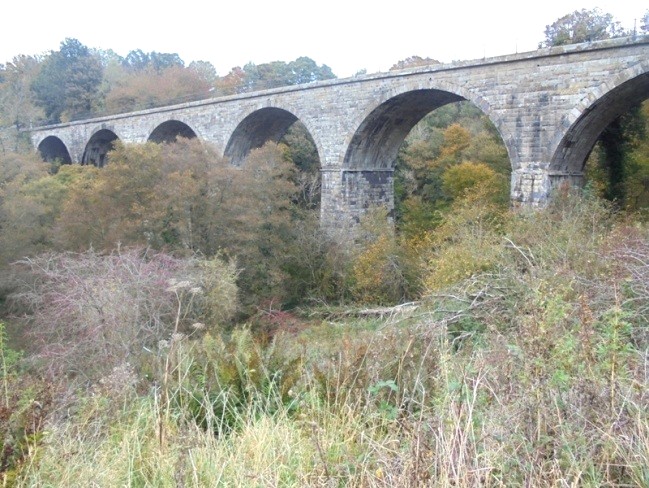
This railway viaduct crosses the River Avon on the Slamannan and Borrowstounness Railway and was constructed in 1847. The viaduct is 124m long and 7.6m wide. It has six segmental arches, each with a span of 4.6m rising 6.1m above the segmental-line. These are borne on tapering piers of rock-faced, block-in-course masonry with string-courses at the springing line,
the voussoirs being of droved ashlar with V-channelled joints. The river runs between the second and third piers from the north, which here are intaken at 1.8m and 3.35m above the river and have shallow rounded cut-waters on both the upstream and downstream sides. The remaining piers stand on the steep valley sides and do not have intakes. A cornice runs below the wallhead which supports an iron rail parapet. The height from the river to the road bed is approximately 24m.
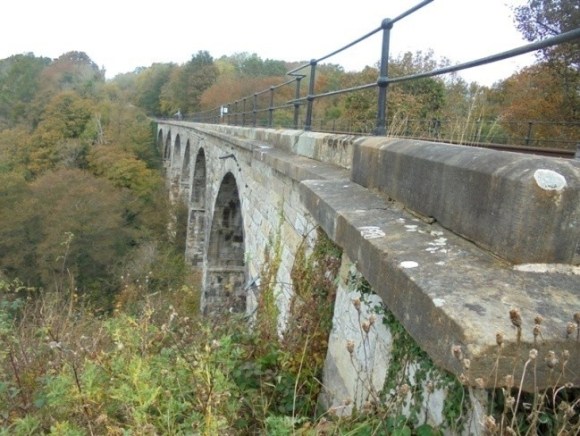
It now links the premises of the Scottish Railway Preservation Society at Bo’ness to the mainline at Manuel, and is maintained by that organisation.
Bibliography
| RCAHMS | 1963 | Stirlingshire: An Inventory of the Ancient Monuments. “Railway Viaduct, Avonbank. The viaduct that carries the branch line from Manuel junction to Bo’ness over the ravine of the River Avon, 300 yds. E. of Avonbank, deserves to be mentioned among the early railway constructions, as this branch was originally built as part of the Slamannan and Borrowstounness Joint Railway, authorised in 1846. The viaduct is about 135 yds. in length by 25 ft. in breadth, and consists (Pl. 229B) of six segmental arches with a span of 51 ft. and rising to 20 ft. above the springing line. The arches are borne on tapering piers of rock-faced, block-in-course masonry with string-courses at the springing-line, the voussoirs being of droved ashlar with V-channelled joints. Below the wall-head there runs a cornice, and the wall-head course supports an iron handrail. The river runs between the second and third piers from the N., 80 ft. below the level of the of the road-bed; these piers are intaken at 6 ft., and again at 11 ft., above the water, and have shallow rounded cut-waters both upstream and down stream. The other piers, which are founded on the steeply-sloping sides of the valley, show no intakes. The terminal arches abut on the range of the railway embankment. The left bank of the river, on the downstream side of the viaduct, is rivetted with stone blocks showing seatings for the chairs that evidently held the rails of the earliest line. (cf. No. 559). 967785 NS 97 NE 21 April 1956″ [p.414-5] |
NEWSPAPERS
- Scotsman, 29 November 1890, 7:
Yesterday a collision… occurred on the Bo’ness branch of the North British Railway near Manuel station… About three-quarters of a mile below the junction the line s carried over the Avon by a high viaduct – known as Todd’s Mill viaduct – fully a hundred and fifty yards in length, and at its highest pint about eighty feet from the bottom of the glen. The colliding trains were both special minerals, one from Bo’ness to Monkland made up of thirty-one empty wagons, and the other from Manuel junction to Bo’ness, with thirty-seven wagons of coal. It was at the south end of the viaduct that the accident took place a few minutes before four o’clock in the morning. It would appear that the drivers and firemen of both trains became aware of their danger in time to make an attempt to save themselves, for they leaped from the engines to the ground before the actual smash took place. They escaped without hurt, with the exception of the fireman from Bo’ness, John Birnie, who appears to have landed on the driver and rolled over and fell through the open rail of the viaduct sixty feet to the ground below…- The wagons ended up over the outside curve of the viaduct, and a 40 ton engine over the west side. [much more detail given]

