
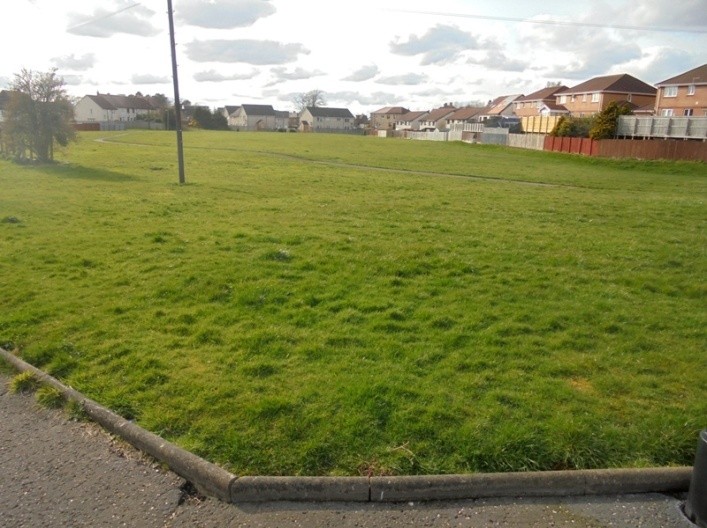
SMR 258/ NS 918 785
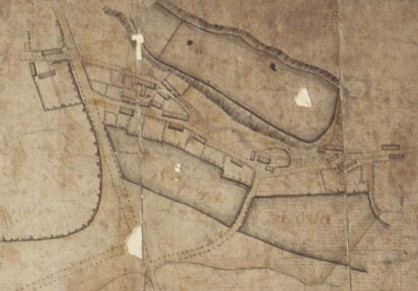
A glacial esker in the form of a large ridge of gravel runs along the northern front of Callendar Park and then heads south-eastward, passing through Redding to Polmont Station. It is cut by the Gallow Syke and the Westquarter Burn which drain the lands in their vicinity, but further east it is an impediment to free drainage and as a result several small natural lochs were created – North Redding Loch, South Redding Loch, and Loch Gairn.
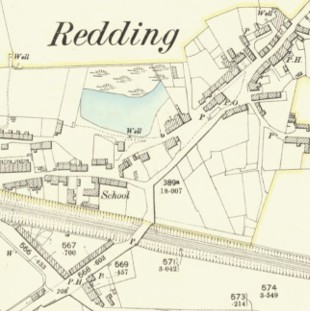
Redding Loch is first mentioned in 1668 when the Blackburn or Dempster Fauld was being delimited; it was bounded on the east by “the common loch callit the Reddine Loch” with the common muir of Reddingrig on the south (Reid 2009, 185). “Common” here seems to refer to its position in relation to that commonty and distinguished it from the other Redding Loch. In 1728 it is referred to as “the Common Loch called South Loch of Reddine.” The South Loch of Redding is also mentioned in 1715. It was fed from the south-west by the Gather Burn. It was too small to appear on the early maps of Pont (1570s), Roy (1755) and Grassom (1817), but is clearly depicted on the plan for the Division of Reddingrigmuir drawn up in 1772 (RHP 409), but strangely is omitted from another map drawn up for the same purpose in 1771 (RHP 3919. It was aligned with the south side of the esker in an almost west-east orientation, and was traversed near its centre by a road on the line of the current Main Street.
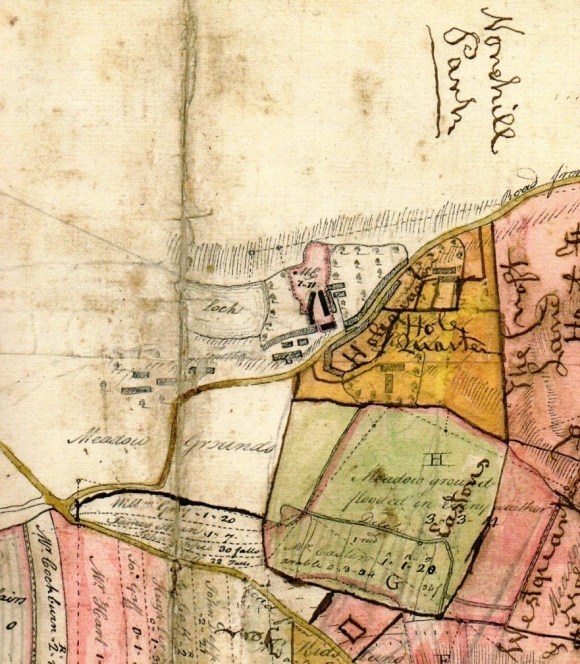
The North Loch of Redding also appears on the 1772 plan. It lay on the north side of the esker with the massive ridge of a None Hill to its north. At around 0.8 acre it was a little smaller than the South Loch, but was not divided in two like that one. Its main inlet was from the north-east and this sheet of water was from four to twelve feet deep. The village of Redding lay between the two lochs along the ridge formed by the esker (now School Road-Wholequarter Avenue).
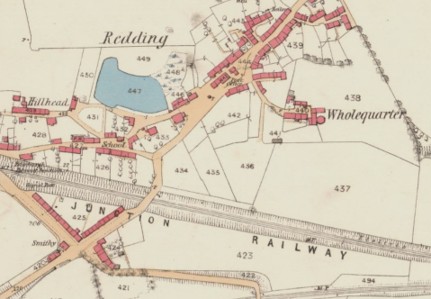
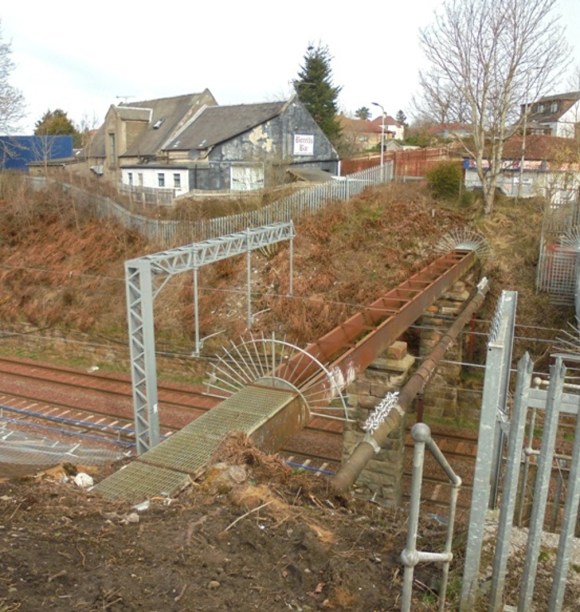
The South Loch appears to have been the shallower one and another plan, originally measured in 1760, but heavily amended at later dates, shows its location as “Meadow Grounds – flooded in rainy weather” (Falkirk Archives EN 1981). When Waverley Park was constructed in the late 1980s at the east end of the loch a large amount of dark blue-grey silty clay was encountered which suggests that this loch was naturally silting up. It must have been deliberately drained and would have provided a rich source of nutrients for the meadow grass which could be used for the cattle attending the nearby Trysts, bringing in a good income. The west-east hollow in which the South Loch lay was utilised in the late 1840s for a cutting of the Stirlingshire Midland Junction Railway. The Gather Burn was placed in an aqueduct suspended above the railway.
The lochs provided the village with water, though it was apt to be a little stagnant and was polluted by the activities of the villagers using the public washing green. This appears to have been located at the east end of the loch on the south-facing slope. As well as washing clothes, it was used for bleaching cloth. The linen sheets were coated with sour milk and then laid out in the sun to bleach. Once completed the sheets were rinsed in the waters of the loch.
The level of the loch depended upon the season and as a consequence its shape changed on each edition of the Ordnance Survey maps. The higher end at the east sometimes dried out. The loch’s elevated position above the village made it useful for flushing the drains. The Duke of Hamilton must have given permission for this usage, on the understanding that he was not obliged to maintain the water supply to his tenants.
In the winter months skating was indulged in from an early period. The shallower South Loch would have frozen first, but after it was drained the North Loch was frequented. Its depth made it dangerous and unsurprisingly one of the first newspaper notices of skating on it is in 1855 and refers to the death of two young boys who fell through the broken ice (Stirling Observer 20 December 1855, 3). The first record of the Polmont (later the Polmont and Westquarter) Curling Club playing a match on the loch was in 1856. In 1870 they competed within the club for a sucking pig. Competitive matches were held against other clubs such as Vellore or Zetland.
Considerable excitement was caused in Redding on the morning of Monday 13th January 1879 when the village drummer walked through the settlement beating his instrument and announcing that a public meeting of the inhabitants was to be held at 11am at the back of the Redding Loch to maintain their right of way to the public washing green and loch, which had been in the use of the inhabitants from time immemorial. A Mr Dunn has acquired from the Duke of Hamilton a lease of a house and garden adjoining the loch. During the absence of the curlers on the previous Saturday he had commenced to stake off a large portion of the loch with large branches of trees driven through the ice, and between Sunday and Monday morning cut up the washing green and conveyed it over the ice to the stakes, forming a wall on the top of the ice. Long before the appointed hour several hundreds of people gathered at the spot. The destruction of the green before their very eyes meant that the feeling of the villagers ran very high. The workmen were civilly told to desist, which was done. The crowd then fell on the obnoxious fence. Sledges and wheelbarrows and axes, with the assistance of over two hundred men, cleared the whole obstruction in a very short time, and curling was resumed over the place (Falkirk Herald 18 January 1879, 3). The 1896 Ordnance Survey map shows that the east end of the loch was indeed enclosed, though the water inlet was maintained. And a public path led from the main street up the hill along the east side of the new enclosure to the washing green.
In the 1870s Redding was formed into a special drainage district under the Local Authority of the Parish of Polmont. This would eventually provide an abundant supply of water to the village, but in 1879 it was still dependent upon the loch. Even so, it was not long before rumblings appeared to the effect that the loch was detrimental to the health of the populous. In 1884 the Polmont Parochial Board consulted A.P. Purvis, solicitor, Edinburgh, to get an opinion of counsel in connection with arrangements as to Redding Loch as it was required to flush the drainage system. The Parochial Board were concerned about the dumping of rubbish of all sorts in the loch meaning that it was becoming a health nuisance. It wanted the Duke of Hamilton’s factors to arrange for it to be cleaned. Understandably the Duke’s estate was not keen to clear up after the locals had sullied their own nest. Eventually a compromise was arranged on the basis of each side paying half the expense of cleaning out and putting the loch in order, and the Local Authority paying a nominal sum yearly for the use of the water to flush their drains (Falkirk Herald 4 May 1895, 6). A few years later the matter was devolved from the Parochial Board to the County Council which had taken over the special drainage scheme.
In 1895 the County’s medical officer reported that an outbreak of fever at Redding was not helped by the foul and unsatisfactory condition of Redding Loch. Intimation was sent to the Duke’s agents to have the loch cleaned out and the nuisance remedied. Their remedy would have been to drain and fill in the loch but the Council still required the water to flush its drains (Falkirk Herald 4 May 1895, 6). Three years later the boot was on the other foot and Mr Macaulay, factor to the Duke of Hamilton, wrote to the Eastern District of Stirling County Council calling the committee’s attention to the state of the Redding Loch. The sub-committee examined the loch. The new Millhall Reservoir had officially been opened on 27 December 1897 to serve Grangemouth and in 1904 Buckieburn Reservoir was due to enter service, meaning that they no longer required the water from Redding Loch. It instructed the sanitary inspector to have the loch cleaned and put in order, preparatory to terminating the agreement with the Duke of Hamilton’s trustees.
Fresh complaints about the foul nature of the loch arose in 1902 and the Duke’s factor was written to. Macaulay replied that he had found that no such nuisance existed there, but he proposed that as soon as the county water supply was introduced he would have the loch drained, enclosed, and planted with trees. The matter was batted backwards and forwards over the next ten years with each side saying that the other should stop people tipping the rubbish, or that the other side should clean it up. That situation might have gone on indefinitely if another problem had not arisen – the Council needed somewhere to dump its rubbish. Strangely, this proved to be the key to resolving the issue of the loch. In 1913 the sanitary inspector came to a provisional agreement with T.D. Wallace, chamberlain to the trustees of the Duke of Hamilton, for the Council to lease the loch as a rubbish tip for the district for a period of three years. After further discussion it was finally agreed that the lease would last as long as it took to fill the ground, and thereafter the Council would feu the ground at the same rate for the purpose of a recreation ground for the inhabitants of Redding in all time coming. The agreement was signed in 1914.
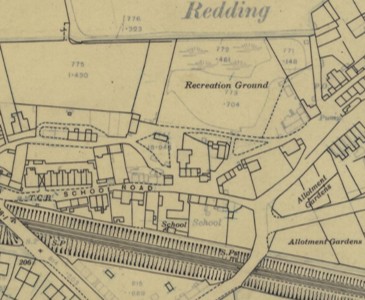
Official tipping began the following year. Ironically, the very people who had been illegally tipping their rubbish in the loch up to this point complained a few years later of the smell coming from the public coup. It was particularly bad in the summer of 1922 and so the medical officer inspected the loch. He was not going to pander to the local residents and stated that no epidemics had arisen through the committee’s operations at this coup, and, after considering the whole circumstances he was not able to certify that a nuisance existed under the Public Health (Scotland) Act. He further stated that it was not always possible to operate a coup without at the same time causing a certain amount of inconvenience, and that when the coup at Redding Loch was filled in and turned into a park it would provide a great improvement. It was June 1925 before the refuse tip was closed.
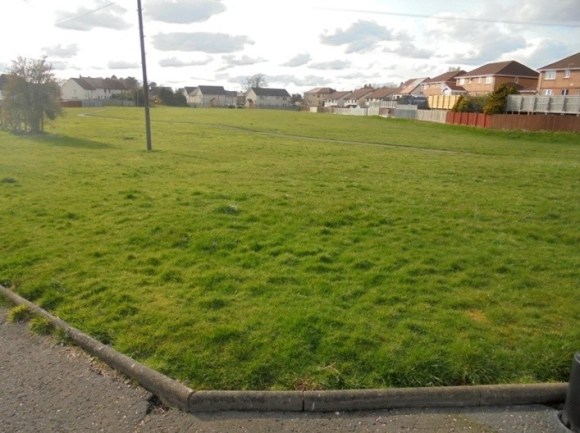
The surface of the coup was dressed with topsoil and the ground was taken over by the Grangemouth Parish Council. In co-operation with the Local Committee of Redding it laid out the ground for recreational purposes, and furnished it with swings and other necessary amusement appliances. This provided a full-size football pitch, and a children’s play area. The upkeep of the ground was borne by the Grangemouth Parish Council, and administered by the local committee. The opening ceremony of Redding Loch Park took place on 31 July 1929.
Bibliography
| Miller, T, | 1937 | ‘The Origin of the Falkirk Trysts.’ Proceedings of the Falkirk Archaeological & Nat. Hist. Soc., 1, 25-47. |
| Reid, J. | 1996 | ‘The Barony of Abbotskerse,’ Calatria 10, 39-52. |
| Reid, J. | 2009 | The Place Names of Falkirk and East Stirlingshire. |
| RHP 409 | 1772 | Plan of the Division of Reddingrigmuir (reproduced in Miller 1937.) |
NEWSPAPERS
- Stirling Observer, 20 December 1855, 3:
On Sunday [16th]afternoon, about three o’clock, while six boys were amusing themselves on the Redding Loch, a sheet of water from four to twelve feet deep, the ice broke, and three of them fell in. One of the three, named Henry Dougal, managed to spring out, but the other two, names Henry Walker and William Wardrope, sunk and did not again appear on the surface. In less than about ten minutes, by the praiseworthy exertions of John Myles, one of the bodies was recovered, but life was gone; the other body was got out about two hours afterwards. - Falkirk Herald, 4 December 1856, 3:
Polmont Curling Club have been enjoying their roaring play for some days past, and have had several excellent games on Redding Loch and other places. - Falkirk Herald, 29 January 1870, 3:
On Wednesday afternoon, two rinks of the Polmont and Westquarter Curling Club met upon Redding Loch to compete for a young roast sucking-pig. After three hours’ capital play during a well-contested game, the rink skipped by John Gaff, Redding, secured the prize… - Falkirk Herald, 16 January 1879, 3:
Westquarter and Polmont v Vellore.—The above clubs met on Redding Loch yesterday week hours. the result stood as follows… - Falkirk Herald, 18 January 1879, 3:
Considerable excitement was caused here on Monday [13th] morning last by the village drummer announcing that a public meeting of the inhabitants was to be held at the back of the Redding Loch to maintain their right of way to the public washing green and loch, which has been in the use of the inhabitants from time immemorial. It appears that a Mr Dunn has acquired from the Duke of Hamilton a lease of a house and garden adjoining the loch. During the absence of the curlers on Saturday he commenced to stake off a large portion of the loch with large branches of trees driven through the ice, and between Sunday and Monday morning cut up the washing green and conveyed it over the ice to the stakes, forming a wall on the top of the ice. The hour of meeting was 11 o’clock, but long before that time several hundreds of people had repaired to the spot, and as the destruction of the green was going on, the feeling of the villages ran very high. The workmen were civilly told to desist, which was done. The crowd then fell on the obnoxious fence. Sledges and wheelbarrows and axes, with the assistance of over two hundred men, cleared the whole obstruction in a very short time, and curling was resumed over the place. Redding was lately formed into a special drainage district, an eminent engineer being appointed to survey and carry out the scheme under the Local Authority of the parish of Polmont. The most of the drains are flushed with water from the Loch, and had this part of the loch been cut off, being the inlet to the whole, the drainage would have been rendered useless. - Falkirk Herald, 27 January 1881, 3:
Redding Loch. After a well contested game of three Westquarter and Polmont v Zetland. - Falkirk Herald, 14 January 1891, 6:
Redding Colliery and the Westquarter and Polmont Club met on the Redding Loch to compete for the cup a… - Falkirk Herald, 29 April 1891, 5:
It has often been asserted by some that the Redding Loch was detrimental to the health of the villagers. The following facts speak for themselves. ‘The twelve oldest people in the village are respectively Mrs Cockburn, 83; Mrs… - Falkirk Herald, 9 December 1891, 6:
Polmont parochial Board, account submitted from A.P. Purvis, solicitor, Edinburgh, for £7 12s 6d for outlays and opinion of counsel obtained in connection with arrangements as to Redding Loch in 1884. …should be paid by the County Council – the power and funds in this connection having been handed over to them. - Falkirk Herald, 6 February 1895, 4:
Westquarter and Polmont Curling Club. — The members of this club met in a friendly game between president and vice-president on Redding Loch. - Falkirk Herald, 4 May 1895, 6:
report from the medical officer was submitted calling attention to an outbreak of fever at Redding and to the foul and unsatisfactory condition of Redding Loch. This loch was claimed to be the property of the Duke of Hamilton, and intimation was thereupon ordered to be sent to the Duke’s agents to have the loch cleaned out and the nuisance remedied. This matter, like the allied one of drainage, gave occasion for a good deal of contention, and division, especially in view of a claim to use the water from the loch for flushing the drains. The correspondence between parties went on till in June 1884, when, on recommendation from the Board’s law agent, and after the chairman had got an opinion of counsel, a compromise was arranged on the basis of each side paying half the expense of cleaning out and putting the loch in order, and the Local Authority paying a nominal sum yearly for the use of the water to flush their drains…. - Falkirk Herald, 9 October 1895, 5:
Polmont Parish Council – A deputation, from the Westquarter and Polmont Curling Club appeared and stated a complaint that there was a likelihood of the Redding Loch being filled. They asked the Council to uses what power they had to prevent its being filled up. After discussion, in the course of which it was pointed out by several councillors that there were no great grounds for fear about the filling up of the loch, it was agreed to do nothing meantime… - Falkirk Herald, 30 January 1897, 3:
On Saturday last 20 members the Westquarter and Club met Redding Loch to compete for a, silver jug and two medals. The ice was in the finest condition, - Falkirk Herald, 15 October 1898, 3:
Eastern District of Stirling County Council – the clerk submitted a letter from Mr Macaulay, factor to the Duke of Hamilton, calling the committee’s attention to the state of the Redding Loch. The sub-committee, having examined the loch, which is of no service to the special district, resolved, in terms of the agreement between the Duke of Hamilton and the former Local Authority for Polmont parish, to instruct the sanitary inspector to have it cleaned, and put in order, preparatory to terminating the agreement, as at Whitsunday next. … - Falkirk Herald, 23 February 1901, 3:
members of the club met at Redding Loch in a friendly match - Falkirk Herald, 8 February 1902, 3:
WESTQUARTER AND POLMONT CURLING CLUB.—On Thursday, 30th ult., 22 members met on Redding Loch to compete for prizes in the annual points game. The ice was very dull. - Falkirk Herald, 13 September 1902, 6:
The Clerk submitted several minutes of meetings of the Public health Executive Committee. At the first of these, held on the 10th July, the sanitary inspector stated that he had received a complaint regarding the foul condition of Redding Loch. The medical officer was instructed to inspect the loch and to report to next meeting. At a meeting held on the 29th July the clerk read a report by the medical officer, dated 16th inst,, stating that the loch, in consequence of varying water level leaving a considerable extent of marshy ground, and it being made a dumping ground for rubbish and ashpit refuse, was a nuisance. After discussion, and it being understood that the loch belongs to the Duke of Hamilton, the clerk was instructed to write to James Macaulay, the Duke’s factor, calling his attention to the nuisance, and requesting him to have the same abated. At the subsequent meeting the Clerk read Mr Macaulay’s reply, stating that he had inspected the loch, and had found that no nuisance existed, nor that ashpit refuse was being deposited there, and that he proposed, as soon as the county water supply was introduced, to drain, enclose, and plant the loch. It was agreed to continue the matter… - Falkirk Herald, 13 April 1907, 2:
A minute of the Public Health Executive Sub-Committee bore that the clerk read a letter, dated 15th March, from Mr Macaulay, the Duke of Hamilton’s factor, referring to a meeting he had had on the ground along with the commissioner for the Duke of Hamilton’s trustees, the owners of Redding Loch, and the medical officer and the sanitary inspector, and stating that the commissioner is of opinion that the Duke’s trustees are not bound to drain or clean out the loch, and that the committee ought to exercise their powers and prevent those resident around the loch from putting refuse not only in, but round about, the loch. It was agreed that the clerk reply to Mr Macaulay that the loch being the property of the trustees, all that is asked is that the nuisance complained of be at once abated, and continued the matter… - Falkirk Herald, 12 April 1913, 8:
The sanitary inspector reported that the condition of Redding Loch had been under his consideration for some time past, and that he had met with Mr T.D. Wallace, chamberlain to the trustees of the Duke of Hamilton, and now submitted letter from him, specifying the conditions on which the trustees were prepared to let the loch as a rubbish tip for the district. After full consideration and discussion, the clerk was instructed to write to Mr Wallace as to whether the proprietors would be willing instead of leasing the loch for a period of three years, to allow the committee to have the use of same on the terms mentioned until the ground is filled up, with an option thereafter to feu the ground at same rate for the purpose of a recreation ground, and also during the period of the committee’s occupation to prevent other parties from building on or otherwise making use of same. - Falkirk Herald, 10 May 1913, 8:
further discussion on the conditions on which the trustees of the late Duke of Hamilton were prepared to let the loch to the sub-committee as a rubbish tip for the district, and generally for public health purposes until filled up, and thereafter to be kept as an open space for the inhabitants of Redding in all time coming… agreed. - Falkirk Herald, 14 November 1914, 7:
had now received the draft contract and agreement between the Duke Hamilton’s trustees and the committee regarding Redding Loch the terms which are the loch should be acquired and used rubbish tip for the district until filled up, and thereafter be kept … - Falkirk Herald, 22 July 1922, 5:
The medical officer reported that he had inspected the loch, and stated that no epidemics had arisen through the committees operations at his coup, and, also that after considering the whole circumstances he was not able to certify that a nuisance at present exists under the Public health (Scotland) Act. The medical officer further stated that it is not always possible to operate a coup without at the same time causing a certain amount of inconvenience. and that when the coup at Redding Loch is filled in it will provide great improvement. It was accordingly decided that the committee deny that a nuisance exists at Redding Loch, and the clerk wan instructed to pass the medical officer’s views to the Grangemouth Parish Council. - Falkirk Herald, 20 June 1925, 1:
CLOSING OF REDDING LOCH REDDING Notice is hereby given, that Redding Loch is no longer available s a Coup for Refuse, and on and after this date any person found depositing Refuse thereon will be proceeded against in terms of the Public Health (Scotland) Act, 1897…. - Falkirk Herald, 18 December 1926, 6:
The Landward Committee that the Redding Loch should be converted into public recreation ground, with pitch for football and swings erected, Mr Forrester moved that a sum be allocated towards the conversion of Redding Loch, and that the Committee ask the … - Falkirk Herald, 3 August 1929, 4:
The site on which the new playground is situated was formerly occupied by a large pool of stagnant water, known as Redding Loch, and which was latterly an eyesore to every one in the vicinity. Seven years ago the question arose regarding what should be done with it. At that time the County Council decided to drain off the water and to fill up the cavity with refuse. This work was completed recently, and the ground thus made available was taken over by the Grangemouth parish Council. In co-operation with the Local Committee of Redding, the Parish Council laid out the ground for recreational purposes, and furnished it with swings and other necessary amusement appliances. The area thus made available by this useful scheme is sufficient to provde a full size football pitch, in addition to allowing the smaller children ample space in which to enjoy themselves. While the upkeep of the ground will be borne by the Grangemouth Parish Councul, every assistance is to be given by a local committee, which will have charge of it and be responsible for its proper use. The opening ceremony took place on Wednesday 31 July.

