
SMR 603 / NS 9188 7710
Along the hill range overlooking Linlithgow there is a tradition that Wallace and his men observed the English army approaching Falkirk in July 1298. Nimmo, in 1777, is amongst the first to report such an example:
“upon the summit of a hill, a short mile south-east of Callander wood, a stone is erected, which is well known in that neighbourhood by the name of Wallace Stone, and a little to the east of it is a track of ground called Wallace ridge. Common tradition reports, that this stone is erected in the spot where Wallace stood during the battle”
(Nimmo 1777, 175).
At that time it was an isolated feature in the landscape and was part of Redding-rig Muir. The views from it are extensive. “Wallacerig” is first found in the records in 1562 (Reid, 134), though we cannot be certain which Wallace it refers to.
Nimmo provides a description of Wallace’s Stone –
“Upon the stone, which is about three feet in height, eighteen inches in breadth, and three in thickness, two double W’s, which as supposed to be the initials of William Wallace, are discernible; though, from the form of the letters, they do not appear to be so ancient as the age we are upon.”
This small size of the slab would have been typical of early memorials. Everyone in the area knew what the stone stood for and stories were handed down from generation to generation. It is often said that Wallace’s Stone at Wallacestone was the oldest monument to that national hero. Another stone at Broxburn, known as the Wallace stone, was erected on 15 October 1784 by the 11th Earl of Buchan. The Latin inscription reads: “M S/ GUL VALLAS. OCTOB XV/ MDCCLXXIV” and can be translated as “Sacred to the memory of William Wallace October 15th 1784”. It is said that William Wallace hunted on Drumshoreland Moor and from this spot observed the army of King Edward I who were camped at Temple Liston (Kirkliston) prior to the Battle of Falkirk in July 1298.
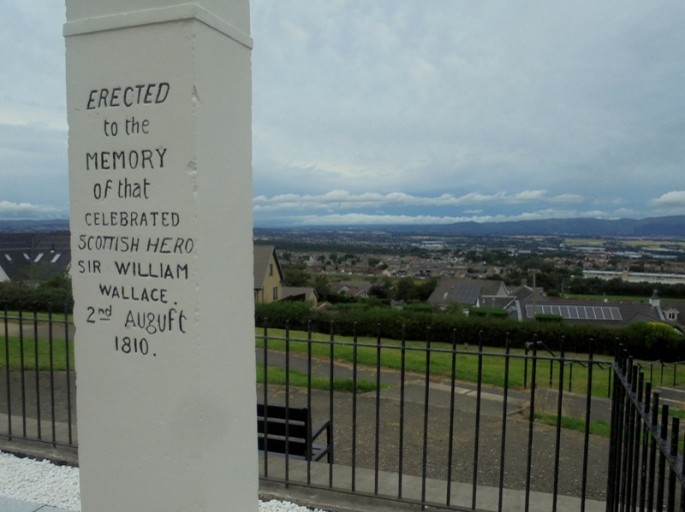
With the reawakening of nationalism at the beginning of the nineteenth century, corresponding with the growth of the population and the influx of labour, it was decided in 1810 to replace the stone at Wallacestone with a new one more in keeping with the spirit of the age.
It was still relatively plain by modern standards. A large block of stone was donated for the purpose by the proprietor of Brightons Quarry. The square column was 13ft tall with a finial on top. The capital is heavily moulded. On the south side are inscribed the words “ERECTED/ to the/ MEMORY/ of tha/t CELEBRATED/ SCOTTISH HERO/ SIR WILLIAM/ WALLACE./ 2nd Auguft/ 1810″. And on the north side “HIC STETIT/ iidie Augufie/ A.D.1298”. The finial has since been lost.
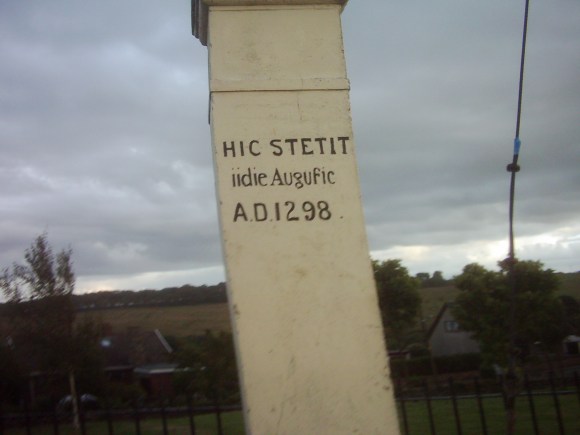
Most of the arrangements for the new monument were made by and at the expense of James Menzies who apparently preferred the date provided by the old Julian calendar (being 11 days different) for the battle. It was unveiled with considerable pomp and ceremony that summer. At the initial ceremony
“a great concourse of people, carrying Scots thistles in their hands, and accompanied by a drum and a pair of Highland bagpipes, proceeded to the place where the stone was to be erected. After its erection, the company, forming a circle around it, drank to the memory of the departed hero with the most enthusiastic rapture. The festivity of the day was concluded by dancing a variety of Caledonian reels”
(Caledonian Mercury 25 August 1810, 4).
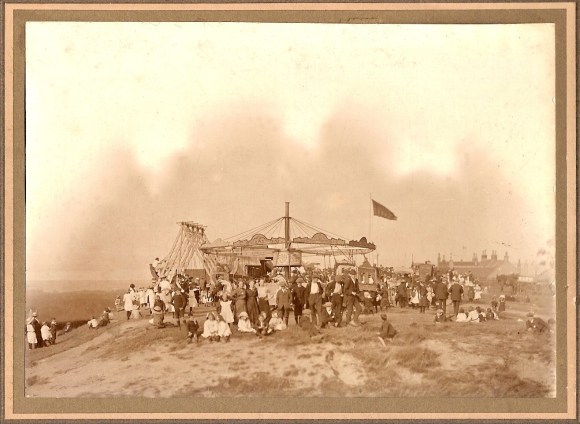
The site became the locus of an annual fair in celebration of Wallace.
The editor of the second edition of Nimmo’s book, in 1817, seems to have been unaware of the erection of the new memorial and still refers to the old one. It was the place and its associations rather than the stone which was honoured in the minds of the local people, as is made clear by Gillespie:
“A rather good story is told of the original slab, which stood a short distance to the west. Some local collier, as the legend goes, coolly took the block from its hallowed place, and made a hearthstone of it; but every night thereafter the bagpipes began to skirl, and created such a din that the whole neighbourhood became alarmed, fancying that an army was advancing. The result was the compunction of the collier, and the restoration of the slab to its former site.” It soon disappeared, chipped away by souvenir hunters
(Falkirk Herald 20 February 1851, 3; 3 January 1861, 3).
As well as the annual commemoration of Wallace and the Battle of Falkirk, the monument became a rallying point for outdoor political meetings.
This was particularly the case with regard to the local colliers and their campaign for representation. One of the earliest recorded examples of this was in September 1843 when the colliers of Glen End, Stone-rigg, and Reddington met at Wallace’s Stone. William Daniells delivered a lecture on the laws, organization, and objects of the Miners’ Association, and the meeting consequently passed a resolution in favour of the Association (Northern Star and Leeds General Advertiser 16 September 1843, 8). On 21 July 1863 the Grand Sir William Wallace Lodge of Free Colliers was instituted.
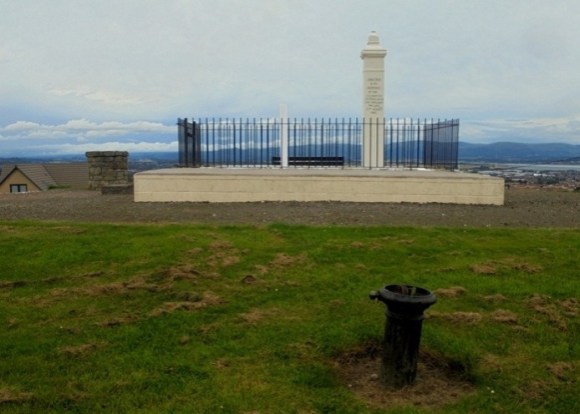
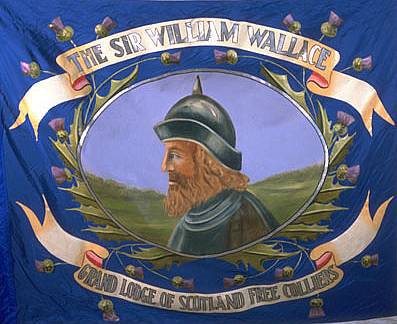
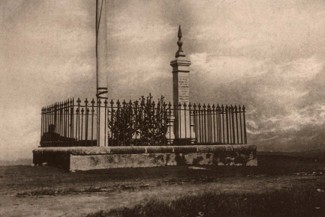
In 1888 an appeal was launched to raise money for a 60ft tall flagpole and an enclosing set of railings set upon a dwarf wall. The appeal was successful and they were ready in time for the annual demonstration on 2 August 1899 (Falkirk Herald 22 June 1889, 6). Almost immediately two park benches were gifted by ex-Bailie Mitchell of Grahamston Foundry. And in 1890 two of the balustrades from the old London Bridge, associated with the martyrdom of Wallace, were brought to the site by Mr Walker, a local civil engineer.
He had the contract for renewing the bridge and a number of the stones were transported by Carron Company’s sloops. Mitchell and Johnstone, who arranged the improvements, each received a piece of the original Wallace stone from John Sneddon, In its unprotected state it had fallen prey to enthusiastic admirers of the national hero, who chipped it up and carried it off piecemeal, until only a small portion fell to the share of local gentlemen interested in the matter (Falkirk Herald 16 August 1890, 5). In 1891 a proposal by Alex Easton to erect a bronze figure of Wallace came to nought. The two balusters have also since disappeared.
By 1932 Wallace’s Stone and its surroundings had become an eyesore and so were cleaned up voluntarily by some local men. The stone was whitewashed and the adjacent area was levelled and ashes spread over rubble paths (Falkirk Herald 8 July 1933, 7). Today the park is maintained by Falkirk Council.
Bibliography
| Bailey, G.B. | 1994 | ‘Battle Monuments and War Memorials,’ Calatria 6, 1-60. p.17 |
| Gillespie, R. | 1879 | Round About Falkirk (2nd ed) “At Wallace Ridge, a pillar ten feet high marks the spot occupied by the noble warrior and a portion of his troops the day previous to the arrival of the English from Linlithgow. On the north side of the stone is inscribed, “Hic stetit, 11 die Auguste, A.D. 1298;” while on that facing south, “Erected to the memory of that celebrated Scottish hero, Sir William Wallace, 3rd August, 1810.” A rather good story is told of the original slab, which stood a short distance to the west. Some local collier, as the legend goes, coolly took the block from its hallowed place, and made a hearthstone of it; but every night thereafter the bagpipes began to skirl, and created such a din that the whole neighbourhood became alarmed, fancying that an army was advancing. The result was the compunction of the collier, and the restoration of the slab to its former site.” [p.13] |
| Jaques, R. | 2001 | Falkirk and District, an Illustrated Architectural Guide. “WALLACESTONE MONUMENT, 1810. Simple square pillar in public park, with panoramic views over Falkirk, Grangemouth and beyond, bearing the inscription: “Erected to the memory of that celebrated Scottish hero Sir William Wallace.” [p101] |
| Nimmo, W. | 1777 | 1777 History of Stirlingshire “No monuments are to be seen near the field of battle; but, upon the summit of a hill, a short mile south-east of Callander wood, a stone is erected, which is well known in that neighbourhood by the name of Wallace Stone, and a little to the east of it is a track of ground called Wallace ridge. Common tradition reports, that this stone is erected in the spot where Wallace stood during the battle; having been so incensed by the opprobrious language he had received from Stewart, that he would not act in conjunction with him, and that his soldiers were posted on the tract called Wallace ridge. But, if this stone hath any reference to the actions of that hero, it is more probable that it was erected in the place where he had taken post before the battle; and, as it can be seen from Linlithgow, it is not unlikely, that it was the corps under his command which the English saw from that town. The spot where the stone is fixed, commands a full prospect of the field of battle, at the distance of two miles, and it appears, that the English halted to say mass very near the place where it stands. Upon the stone, which is about three feet in height, eighteen inches in breadth, and three in thickness, two double W’s, which was supposed to be the initials of William Wallace, are discernible; though, from the form of the letters, they do not appear to be so ancient as the age we are upon.” [p.175] |
| Nimmo, W. | 1817 | History of Stirlingshire (2nd ed) “No monuments are to be seen near the field of battle; but, upon the summit of a hill, a mile south-east of Callander wood, a stone is erected, well known in the neighbourhood by the name of Wallace’s Stone, and a little to the east, is a track of ground called Wallace’s Ridge. The stone is three feet high, eighteen inches broad, and three inches thick. Common tradition reports, that it is erected where Wallace, incensed by Stewart’s opprobrious language, had stood, an idle spectator of the battle; and that his soldiers were posted on the above-mentioned ridge. If this stone, however, have any reference to that hero, it was more probably erected where he had taken post before the battle; and, as the place can be seen from Linlithgow, we may reason that it was possibly the corps under his command which the English had thence descried. The stone commands a full prospect of the field of action, from the distance of two miles; and the English halted to say mass very near the spot. W W, supposed to be Wallace’s initials, are discernible upon the stone; but, indeed, do not appear sufficiently ancient for the age we are treating of.” [p.197-8] |
| RCAHMS | 1963 | Stirlingshire: An Inventory of the Ancient Monuments. According to Nimmo’s editor, the original “Wallace’s Stone” was a slab 3ft high, 18in wide and 3in thick; but the monument that now occupies the site is an ornamental stone pillar, erected in 1810 in honour of Sir William Wallace, and is of no archaeological interest. 918770 NS 97 NW 9 December 1952 [No. 52, p.67] |
| Thomson, D. | 1896 | Memories of Wallacestone, Polmont Parish, etc, [p.9-11] (quoted below) |
Memories of Wallacestone, Polmont Parish, etc. [p.9-11]
“Far back in History, tales are told
Of memories past and gone.
‘Twas here that Wallace stood to hold
Our rights at Wallacestone.

‘Tis here the memories we revere,
As year by year roll round;
With flags and banners raised, we cheer
Upom this sacred ground.

In eighteen hundred years and ten
They raised his memory here; (1)
And now they show they’re “Wallace” men
In each succeeding year. (2)

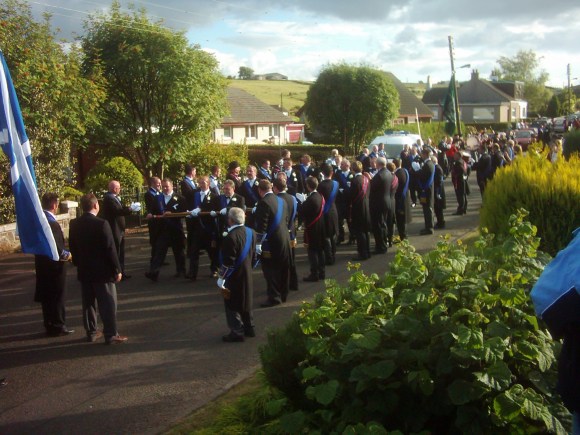
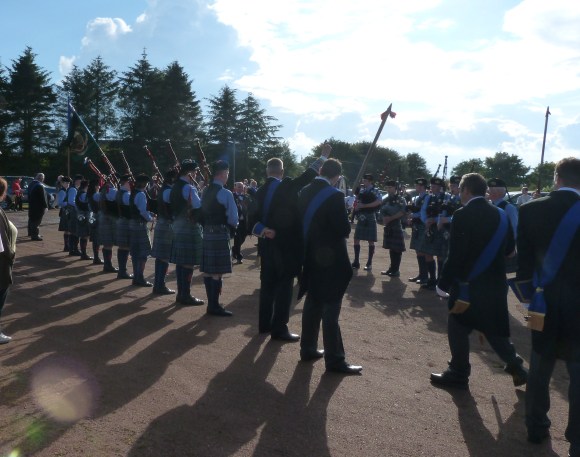
They march around our heights and tracks;
In full dress they appear,
With sword and spear and battle axe,
And other warlike gear.

They march in grand procession here
While bands of music play
Those Scottish airs which ever stir
The patriot heart this day.

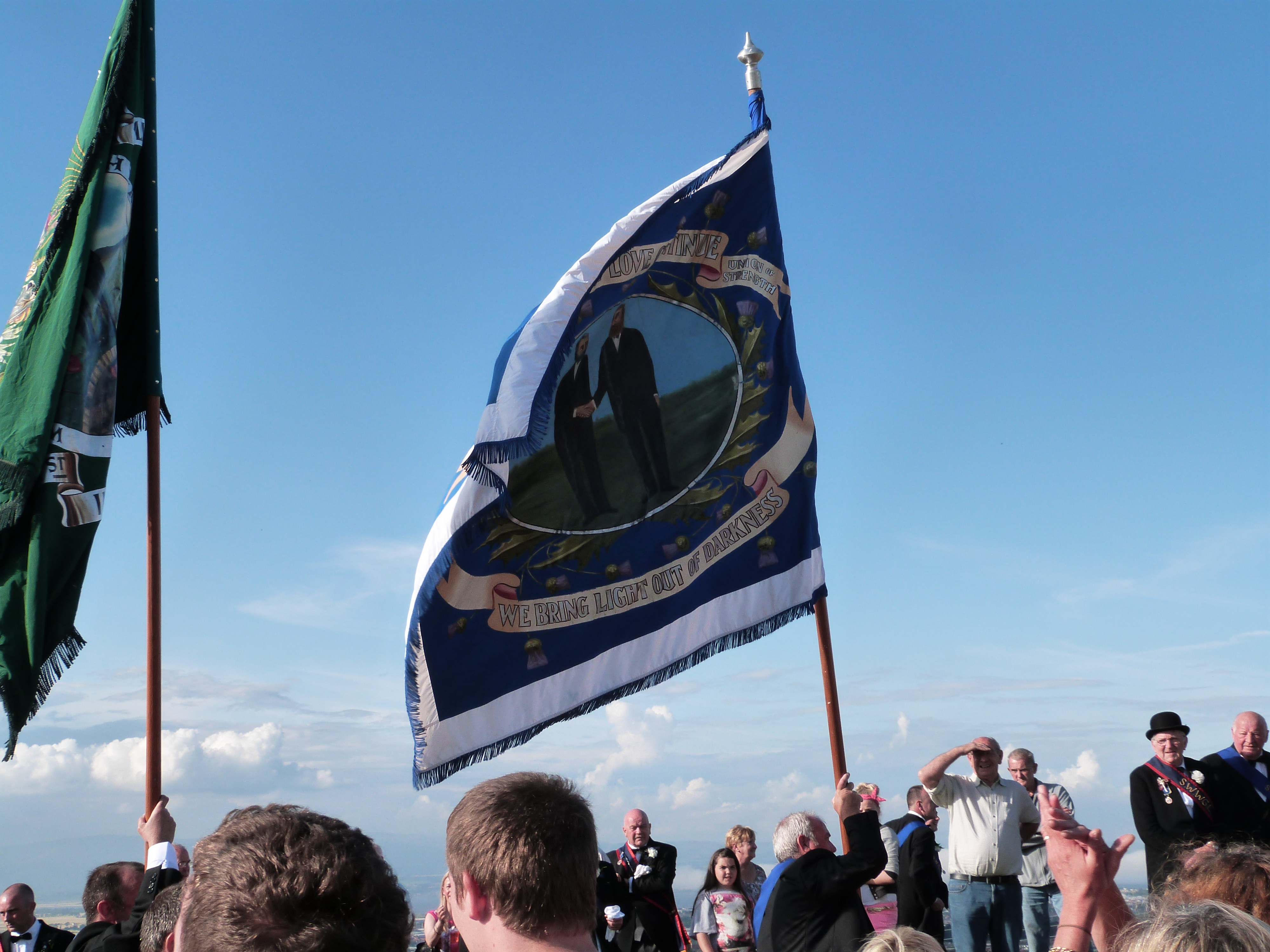
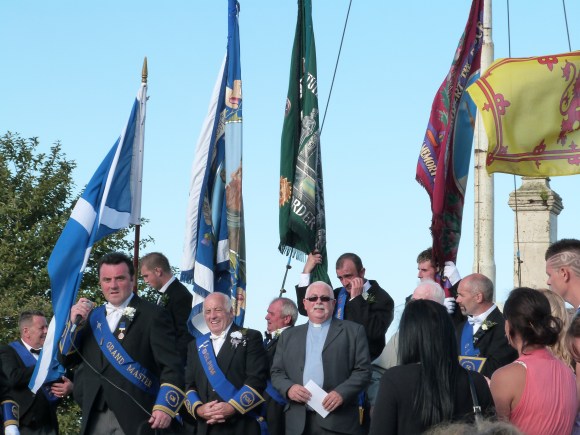
They bear that handsome flag of peace,
Two portraits stand thereon:
Sir William Wallace and the Bruce
In grandeur drawn upon.

O’er hill they march and then through glen,
And neighbouring country round;
A guard of honour leads them then
Back to that sacred ground

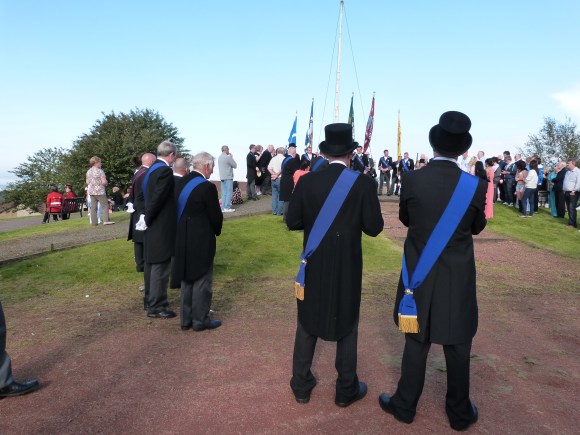
They march around that hallow’d ground
And then draw up in line,
And there a fresh guard leads them on
About that hill so fine.

They all fall in and march the heights
In warlike pomp arrayed;
The bands up old “Stirling’s rights,”
Which Wallace there once “said.”

They gather round that sacred spot,
With reverence bow the head;
The band then swells its music sweet
And plays there “Wallace bled.”

There stands a fag-staff on the heights, (3)
Two summer seats with ridge; (4)
Two relics here which bore those sights
That day at London Bridge… (5)
In full dress they appear,
With sword and spear and battle axe,
And other warlike gear.
And then draw up in line,
And there a fresh guard leads them on
About that hill so fine.
Thomson, D.
- A stone raised to the memory of Sir William Wallace in the year 1810, by the people of Wallacestone; his memory is celebrated every year by the Wallacestone fair.
- “Wallace Men” – members of the Grand Sir William Wallace Lodge of Free Colliers, instituted 21st July, 1863.
- A flagstaff raised by the inhabitants of Wallacestone.
- Two summer seats, the gift of ex-Bailie Mitchell, Falkirk.
- Two stones brought from London Bridge by a Falkirk mason.
NEWSPAPERS
- Caledonian Mercury, 25 August 1810, 4:
“On Friday the 3d current, a stone column, 13 feet high, containing a suitable inscription, was erected on the top of Redding-rig Moor, to the memory of that illustrious Scotch patriot, Sir William Wallace. The above-mentioned spot was selected for the site of the column, on account of a prevalent tradition, importing, that Wallace, in consequence of a misunderstanding with the other commanders, withdrew with his party to that place, from which, seated on a stone, which still exists, he viewed the unfortunate battle of Falkirk.- A great concourse of people, carrying Scots thistles in their hands, and accompanied by a drum and a pair of Highland bagpipes, proceeded to the place where the stone was to be erected. After its erection, the company, forming a circle around it, drank to the memory of the departed hero with the most enthusiastic rapture. The festivity of the day was concluded by dancing a variety of Caledonian reels.
- Morning Herald, 28 August 1810, 3:
On Friday 3d instant, a stone column, 13 feet high, containing a suitable inscription, was erected on the top of Redding-rig Moor, to the memory of that illustrious Scottish patriot, Sir William Wallace. The above-mentioned spot was selected for the site of the column, on account of a prevalent tradition, importing that Wallace, in consequence of a misunderstanding with the other commanders, withdrew his party to that place, from which, seated on a stone, which still exists, he viewed the unfortunate battle of Falkirk.” - British Press, 28 August 1810, 3:
On Friday the 3d current, a Stone column, 13 feet high, containing a suitable inscription, was erected on the top of Redding-rig Moor, to the memory of that illustrious Scotch patriot, Sir William Wallace. The above-mentioned spot was selected for the site of the column, on account of a prevalent tradition, importing, that Wallace, in consequence of a misunderstanding with the other commanders, withdrew with his party to that place, from which, seated on a stone, which still exists, he viewed the unfortunate battle of Falkirk.- A great concourse of people, carrying Scots thistles in their hands, and accompanied by a drum and a pair of Highland bagpipes, proceeded to the place where the stone was to be erected. After its erection, the company, forming a circle around it, drank to the memory of the departed hero with the most enthusiastic rapture. The festivity of the day was concluded by dancing a variety of Caledonian reels.
- When we consider the estimation in which the character and exploits of Sir William Wallace are held by the people of Scotland, we hope this small regard paid to his memory, by the inhabitants of Falkirk, will receive the approbation of the rest of their countrymen.
- Scotsman, 4 August 1824, 6:
“For many years past the anniversary of the battle of Falkirk, fought in 1298 – has been commemorated at Wallace’s Stone, the spot where Wallace is said to have drawn up his party, previous to the battle, and where a neat column has lately been erected to his memory. On Monday last, about 40 persons, who have this year become members of a Wallace Society at Redding, assembled at the above place, dressed in the Highland garb, and armed with Andrew Ferrara’s. After many loyal and patriotic toasts were given, the party left the hallowed ground, and did farther honour to the day in copious libations.” - Northern Star and Leeds General Advertiser, 16 September 1843, 8:
“Glen End. – A public meeting of the colliers of this place, Stone-rigg, and Reddington was held on Monday last 11th instant), at Wallace Stone, Mr John Patterson in the chair, for the purpose of hearing Mr Wm Daniells deliver a lecture on the laws, organization, and objects of the Miners; Association, which he did evidently with good effect; for the meeting immediately after he had finished his discourse passed a resolution in favour of the Association. The place of holding this meeting is one of the most remarkable in Scotland, being the ground where the battle of Falkirk was fought, between the English and Scotch, in the year 1298; and Wallace Stone is a square pillar erected to commemorate that event….” - Falkirk Herald, 20 February 1851, 3:
“No monuments of this unfortunate battle are now remaining on the ground whence it was fought; but one mile south-east of Callendar Wood, on the summit of a hill, there was erected a block three feet high, by one foot six inches thick. It is known as Wallace’s Stone, and his initials W.W., are said by Nimmo, to have been visible upon it. It has now entirely disappeared, and immediately adjoining there stands a square pillar…” - Caledonian Mercury, 16 August 1856, 3:
in the neighbourhood of Falkirk there is a wide moor, and on that moor there is a small village, the inhabitants of which are the most enthusiastic lovers of the memory of the Scottish hero [Wallace] with whom it has been our fortune to meet. The village to which we have referred is called Wallacestone, and is a regular picture of a Scottish inland hamlet. There are no trees about it of any consequence, if we except a small clump of scotch firs that grow upon the north side, nearly at the bottom of the elevated ridge upon which the village stands. The houses are few, and have no pretensions to beauty; a few of them are thatched, and the remainder roofed with red tiles; still, in spite of the bleak situation, the unproductive-looking moor that stretches away upon its south and west sides, the absence of trees, and the anti-poetical character of the majority of the buildings, there is a certain air of comfort and snugness about it which would render it a welcome sight to a traveller who had lost his way, and probably, as a consequence, his wits in the moor on which it is situated. The village, however, is by no means the most interesting object in that neighbourhood to the lover of Scottish tradition. On a slight elevation on the north side of, and immediately adjoining the village, there is a stone erected, commemorative of Wallace. Tradition asserts although history has asserted the contrary, much to the chagrin of the lover of the former – who is not unfrequently as veracious a personage as the latter – that upon the identical spot on which the memorial stone is erected stood Wallace upon the day of the disastrous battle of Falkirk – viz on the second day of August 1298. The north side of the pillar bears the following brief record:
Hic Statit
II die Auguste 1298.
And on the south side is the subjoined inscription:
ERECTED
to the
MEMORY
of that
celebrated
SCOTTISH HERO
SIR WILLIAM
WALLACE
2 August.
1810- Our readers are not to imagine from the above date that no stone marked out the position taken up by the Governor of Scotland during the battle of Falkirk previous to 1810. On the contrary, there has been a stone from time immemorial associated there with Wallace and the 2d of August 1298. The tooth of time and the hands of the admirers of the hero had, however, gradually removed the precious relic, until but a very small portion of it remained; and a gentleman, with an unbounded love for Wallace, and an equally boundless faith in the rectitude of his historian, Blind Harry, determined on substituting, at his own expense, a new stone to hand down the name of the preserver of his country’s independence to future generations. The name of this worthy man was James Menzies, and the pillar, which he erected without the aid of a committee, is square, from twelve to fourteen feet high, having an ornamental moulding at its top, and bearing the inscriptions given above. It was prepared in the Brightons quarry, the block having been supplied by the proprietor gratis; and on the anniversary of the battle of Falkirk, in the summer of 1810, it was placed on its present site with considerable pomp and ceremony. Since 1810, and for nobody knows how long before, the anniversary of the Battle of Falkirk has been observed as a holiday by the folks of Wallacestone and the surrounding neighbourhood. The pillar is annually painted and makes its appearance in its fresh coast always upon the second of the current month. Since the coal workings of his grace the Duke of Hamilton were commenced in the neighbourhood, the annual Wallacestone gatherings have been, in point of bulk, more important than they were formerly, and the demonstration of Monday week was the largest that had taken place for a great many years. Perhaps it was the beautiful day that drew so many people together; or it might have been the enthusiasm which has been awakened among all classes of people with reference to everything connected with Wallace, by the recent meeting at Stirling; or, probably, it was the rumour that there was to be a monster meeting of miners from various parts of the country to be held on the moor in the early part of the day; but from whatever cause, there were a great many people congregated upon the Wallacestone ridge; where at the same time there was a strong muster of sweetie stands, shooting galleries – nuts being the prizes – gooseberry baskets, itinerant fiddlers, and several sellers of potent liquids, to quench the thirst which the intense heat of the day naturally produced. We might descant at any length on the view from the site of Wallacestone. To the south and west, we have already said, there is little but moor. There are, to be sure, small cabins here and there, with patches of garden ground wonderfully productive around them; and there are tall chimney stalks ascending from the earth into the air, gaunt ghost-looking erections; but upon the whole, to the south and south-west the prospect is not inviting. To the north, the east, and the north-west, however, the prospect is one of the richest description, more especially at this season of the year when it is decked with its fairest and finest garniture…
- About six o’clock pm a meeting was held at the Wallace Pillar, presided over by James Simpson…
- Falkirk Herald, 3 January 1861, 3:
“…The place was once distinguished by a huge block bearing the patriots initials, but which gradually disappeared under the chipping propensities of visitors. Antiquaries and daws, it would seem, must always be picking.” - Falkirk Herald, 22 June 1889, 6:
“The appeal inserted in the Falkirk Herald a year ago, for funds to complete the railing in of the Wallace stone and flag-post, has resulted in the raising of a sum, which will justify the committee in proceeding with the work, and it is expected that the ornamental rail and wall will be finished by the annual demonstration on August 2nd. A movement is now on foot for placing two or three permanent seats around the base of the flagstaff for the convenience of visitors, several of whom have promised support.” - Falkirk Herald, 16 August 1890, 5:
There are also two of the balustrades from the old London Bridge, associated with the martyrdom of Wallace. It seems that the Scotch contractor, Mr Walker, who renewed the bridge, sent a number of the stones by Carron Company’s London sloops to his home at Laurieston. Besides the two that found their way to Wallacestone, there is still one left in the lobby of the hose now occupied by Mr Thomson. A substantial flagstaff, 60 ft high, with a Scottish flag waving in the breeze, completes the memorial, which, it may be added, is guarded by a neat iron railing… We may add that Messrs Mitchell and Johnstone were each recipients from Mr John Sneddon of a piece of the original Wallace stone, which has entirely disappeared. In its unprotected state if fell a prey to enthusiastic admirers of the national hero, who chipped it up and carried it off piecemeal, until unfortunately only a small portion fell to the share of local gentlemen interested in the matter. - Falkirk Herald, 8 August 1891, 3:
DEMONSTRATION WALLACESTONE. For upwards of 30 years the villagers of Wallace stone, assisted by the members of the Sir William Wallace Lodge of Free Colliers, have had annual procession, the purpose which has been to commemorate an incident connected with … - Falkirk Herald, 22 October 1898, 7:
SHIELDHILL AND DISTRICT. THE WALLACE STONE.-A movement has been set on foot to make a new road from the main highway to the historic stone, to provide new flags, and two new seats, and to repair the railing. etc. The scheme will entail a considerable expense, and the public are appealed to to give a helping hand….. - Falkirk Herald,9 August 1902:
”ANNUAL GALA DAY AT WALLACESTONE. SIR WILLIAM WALLACE ANNIVERSARY AND WALLACESTONE FAIR. The gala day of Wallacestone district- the Fair- was held on Monday of this week, owing to the second of the month falling on a Saturday, which was not considered a suitable day for such festivities. The accompanying sketch (taken specially for the ”Falkirk Herald”) is a view of the monument at Wallacestone to the memory of our great national hero. The monument was erected by the inhabitants on the 2nd of August, 1810, on the ground where Wallace viewed the battle of Falkirk in 1298, near the spot where he gave the command to his men to ”lie yet,” hence the name ”Lawyett” at Wallacestone. The monument bears the following inscription : – ”Erected to the memory of that celebrated Scottish hero, Sir William Wallace. 2nd August, 1810.” On the other side in Latin are the words;- ”Here he stood on the second day of August 1298.” Beside the monument are two balusters brought by a mason belonging to Redding from ”London Brig,” where Wallace’s headless body was quartered. For many years the stone stood unprotected, but by subscription…” - Falkirk Herald, 8 August 1925, 4:
One feature which gratified the large number of visitors was the attractive appearance of the Wallace Stone itself. In striking contrast to last year, the large flag staff. which had been painted and strengthened in the interval …
- Falkirk Herald, 6 August 1930, 12:
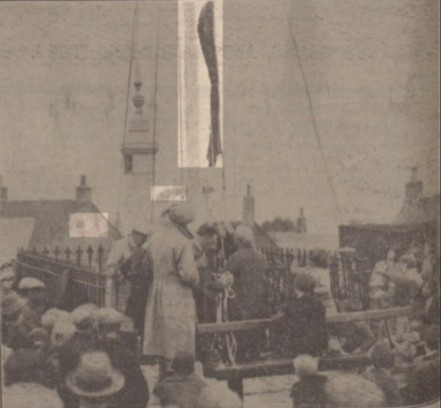
photograph. - Falkirk Herald, 8 July 1933, 7:
Attention was drawn in the columns of the Falkirk Herald some time ago to the shocking state which the Wallace Stone had been allowed to fall into. To-day, thanks to the voluntary labours of local men, the Stone and the adjoining ground bears an exceedingly well-kept appearance… levelling scheme now almost completed. All that remains to be done is the laying of the rubble with a coat of ashes…
- Falkirk Herald, 30 December 1939, 21:
Grahamston Iron Co supplies… … place where Robert Burns, the National Poet slept on one of his visits. They also supplied the old Falkirk coat-of-arms at Victoria Park and the iron work for Wallace’s Monument at Wallacestone, near Falkirk. Their manufactures have also been used in some…

